
Foreign direct investment in Nepal is regulated mainly by the Foreign Investment and Technology Transfer Act, 2075 (2019), commonly called FITTA, and the Foreign Investment and Technology Transfer Regulation, 2077 (2021). A foreign investor cannot simply send money to Nepal and start a business. The investor must first obtain foreign investment approval, then register a company, register the industry, register for tax, and notify Nepal Rastra Bank before the funds arrive.
This article explains the FDI process in Nepal with latest updates in plain language. It covers the legal requirements, the approving authorities, the step-by-step procedure, the documents, the capital injection timeline, post-approval compliance, and repatriation.
1. What Is Foreign Direct Investment in Nepal Under FITTA 2019?
FITTA defines foreign investment as investment made by a foreign investor in an industry or company in Nepal. Section 2 of FITTA defines a foreign investor to include a foreign individual, foreign firm, foreign company, non-resident Nepali, foreign government, international agency and any other foreign entity permitted to invest.
Section 3 of FITTA lists the forms in which foreign investment may be made. The main forms are set out below.
| Form of Foreign Investment | How It Is Made |
|---|---|
| Equity investment | Incorporating a new company, or subscribing to or purchasing shares of an existing Nepali company |
| Reinvestment | Reinvesting dividends or other earnings from an approved foreign investment |
| Lease financing | Leasing aircraft, ships, machinery, construction equipment or similar assets |
| Technology transfer | Licensing patents, trademarks, know-how, franchise rights, or providing technical and management services under an approved agreement |
| Loan investment | Loans from foreign banks or financial institutions under a loan or project finance agreement, subject to NRB approval |
| Branch industry | Establishing or expanding a branch of a foreign industry in Nepal |
| Investment in funds | Purchasing units of venture capital funds or specialized investment funds registered with the Securities Board of Nepal, as introduced by later amendment |
FITTA permits foreign investment only in activities that qualify as an industry under the Industrial Enterprises Act, 2076 (2020). Pure trading, that is importing finished goods and reselling them in Nepal, is not treated as an industry and is not open to foreign investment. Investment in banks, financial institutions and insurance companies follows separate approval regimes of Nepal Rastra Bank and the Nepal Insurance Authority.
2. Which Laws and Authorities Govern the FDI Process in Nepal?
The FDI process involves several laws and several government offices. Each office handles a distinct part of the process.
| Authority | Governing Law | Role in the FDI Process |
|---|---|---|
| Department of Industry (DOI) | FITTA, 2075 and Industrial Enterprises Act, 2076 | Grants foreign investment approval and registers the industry |
| Investment Board Nepal (IBN) | Public Private Partnership and Investment Act, 2075 | Approves investment in projects of NPR 6 billion or above and hydropower projects above 200 MW |
| Office of the Company Registrar (OCR) | Companies Act, 2063 | Incorporates the company and certifies the shareholder register |
| Nepal Rastra Bank (NRB) | Nepal Rastra Bank Act, 2058 and Foreign Investment and Foreign Loan Management Bylaws | Receives prior notification, approves share purchases that change shareholding, and records the investment |
| Inland Revenue Department (IRD) | Income Tax Act, 2058 and Value Added Tax Act, 2052 | Issues PAN, collects income tax and VAT, issues tax clearance |
| Local level (ward or municipality) | Local Government Operation Act, 2074 | Local business registration and local business tax |
Section 17 of FITTA identifies the foreign investment approving body. Following the 2024 amendment to FITTA, the Department of Industry is the approving body for foreign investment under the FITTA regime. The Investment Board Nepal continues to approve large projects under its own Act. The official websites of the Department of Industry, the Office of the Company Registrar and Nepal Rastra Bank publish the current forms, notices and directives.
FITTA also provides for a one-stop service centre at the Department of Industry so that approvals, registrations and recommendations can be coordinated from one place. In practice, investors still deal with each office for its specific function.
3. What Are the Requirements Before Applying for FDI Approval in Nepal?
Before filing an application, a foreign investor should confirm four things: that the sector is open, that the activity is an industry, that the investment meets the minimum threshold, and that any sector-specific cap is respected.
3.1. Sectors Prohibited from Investment in Nepal
Section 50 of FITTA, read with its schedule, lists sectors where foreign investment is not permitted. The schedule has been amended several times, most recently by the 2025 amendment. The current list includes, among others:
- primary agriculture such as poultry, fish farming, beekeeping, dairy, and vegetable farming, except large industries engaged in agricultural technology that export a prescribed share of production;
- small and cottage industries;
- personal service businesses such as hair salons and tailoring;
- arms, ammunition and explosives;
- real estate business other than construction, retail trade, internal courier, local catering, money changing and remittance services;
- travel agencies, trekking and mountaineering guide services, rural tourism and homestay;
- mass communication media and films in national languages;
- management, accounting, engineering and legal consultancy, and language, music and computer training;
- consultancy services with foreign investment above 51 percent and ride sharing with foreign investment above 70 percent.
3.2. Industry classification
The Industrial Enterprises Act, 2076 classifies industries into energy, agriculture and forest, infrastructure, tourism, information technology, service, manufacturing, and mines and minerals. The proposed business must fit within one of these categories.
3.3. Minimum investment threshold
Section 3 of FITTA allows the Government of Nepal to set a minimum foreign investment amount through a Gazette notification. The current notified minimum is NPR 20 million per foreign investor. Under the automatic route notice, this minimum does not apply to foreign investment in information technology industries made through that route. The threshold is a notified amount, not a fixed provision of the Act, so it can be revised.
3.4. Is 100 percent foreign ownership allowed in Nepal?
In most permitted industries, yes. FITTA does not require a Nepali partner. However, sector laws and Gazette notices impose ownership caps in certain areas, such as telecommunications, aviation, banking, insurance, payment services, consultancy and ride sharing. A joint venture with a Nepali shareholder is optional in other sectors and is a commercial choice, not a legal requirement.
4. What Is the Step-by-Step FDI Process in Nepal?
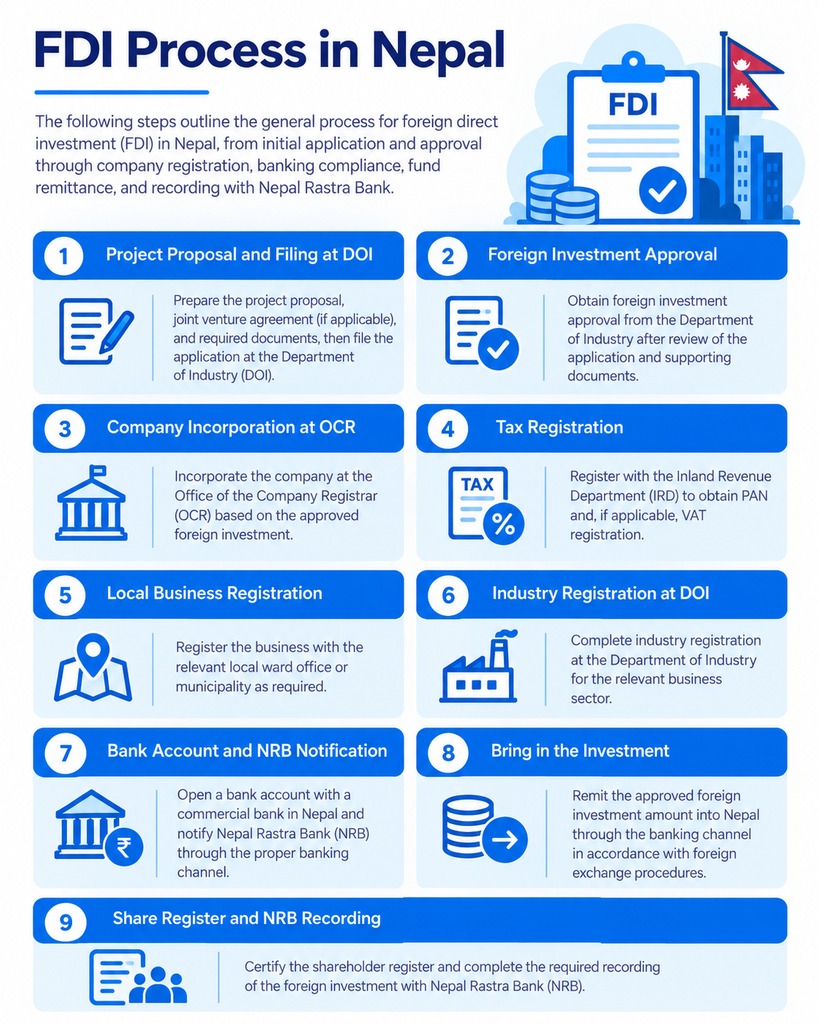
The process below applies to setting up a new company with foreign investment. Investment into an existing company by share purchase follows a shorter version with an added NRB approval step.
Step 1: Preparing the Project Proposal, Joint Venture Agreement and Filing at DOI
The investor prepares a project proposal describing the business, capital structure, proposed investment amount and employment plan. If there is more than one investor, a joint venture agreement is prepared. The application is filed with the Department of Industry under Section 15 of FITTA together with the supporting documents listed in the next section. Eligible industries with total capital investment up to NPR 500 million in sectors listed in the Gazette notice of October 2023 may apply through the automatic route on the DOI online system, where available.
Step 2: Obtaining Foreign Investment Approval
The Department of Industry reviews the application and issues a foreign investment approval letter. The letter states the approved investor, investment amount, shareholding and any conditions. FITTA sets a short statutory decision period, but the actual processing time depends on document completeness and DOI queries. Investment above NPR 6 billion or in hydropower above 200 MW is approved by the Investment Board Nepal.
Step 3: Incorporating the Company at the Office of the Company Registrar
With the approval letter, the investor applies to the Office of the Company Registrar under Sections 3 to 5 of the Companies Act, 2063. The application includes the memorandum of association, articles of association, the foreign investment approval and identity documents of promoters. The OCR issues the certificate of incorporation. Most foreign-invested businesses register as private limited companies.
Step 4: Tax Registration With the Inland Revenue Department
The new company applies for a Permanent Account Number under Section 78 of the Income Tax Act, 2058. VAT registration under the Value Added Tax Act, 2052 is completed at the same time if the business supplies taxable goods or services or exceeds the registration threshold. The Inland Revenue Department provides the registration procedure.
Step 5: Local Business Registration
The company registers its business at the ward office or municipality where it operates and pays the local business tax fixed by that local level.
Step 6: Industry Registration at the Department of Industry
The Industrial Enterprises Act, 2076 requires an industry to be registered before it operates. The company applies to the DOI for industry registration using its company registration certificate, PAN and approval letter. The DOI issues the industry registration certificate.
Step 7: Opening a Bank Account and Notifying Nepal Rastra Bank
The company opens an account with a licensed Nepali bank. Before the investment is remitted, the company notifies Nepal Rastra Bank in the prescribed format under the Foreign Investment and Foreign Loan Management Bylaws. For a new company, prior NRB approval is not required; notification is sufficient. Prior NRB approval is required where foreign investment is made by purchasing or subscribing shares in an existing company in a way that changes the shareholding ratio of existing Nepali shareholders.
Step 8: Bringing in the Investment Through Banking Channel
Section 18 of FITTA and the NRB Bylaws require the investment to be brought in convertible foreign currency through the banking channel. The bank issues a certificate confirming receipt of the foreign investment. Cash, informal transfers or offshore payments do not qualify.
After shares are allotted, the company updates its shareholder register and has it certified by the OCR. The company then applies to NRB to record the foreign investment within the period prescribed by the Bylaws. Recording at NRB is essential, because future repatriation approval depends on it.
5. What Documents Are Required for FDI Approval in Nepal?
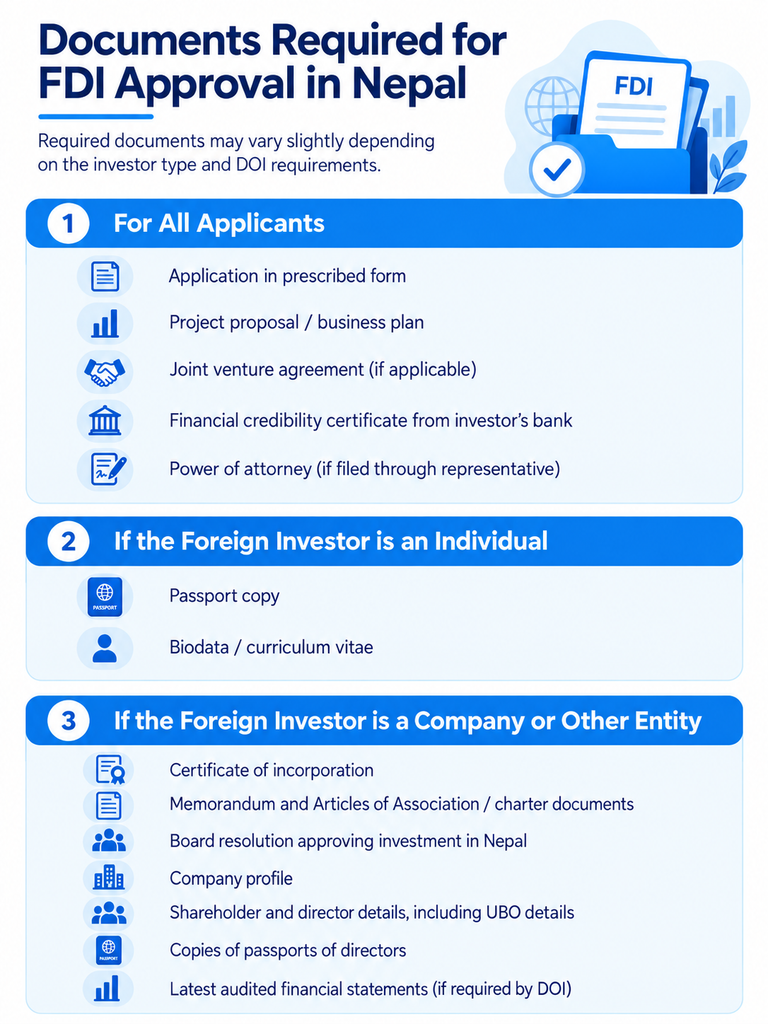
The Foreign Investment and Technology Transfer Regulation, 2077 and DOI practice require the following documents. The exact list should be confirmed against the current DOI checklist.
For all applicants:
- application in the prescribed form;
- project proposal or business plan;
- joint venture agreement, where applicable;
- financial credibility certificate from the investor’s bank;
- power of attorney if a representative files on the investor’s behalf.
If the foreign investor is an individual:
- copy of passport;
- biodata or curriculum vitae.
If the foreign investor is a company or other entity:
- certificate of incorporation;
- memorandum and articles of association or equivalent charter documents;
- board resolution approving the investment in Nepal;
- company profile;
- details of shareholders, including indirect shareholders up to the ultimate beneficial owner, and directors;
- copies of passports of directors;
- latest audited financial statements, where required by the DOI depending on investment size.
6. What Is the Timeline for Bringing Investment Into Nepal?
FITTA does not fix the timeline itself. The Foreign Investment and Technology Transfer Regulation, 2077 sets the schedule for capital injection. The Regulation uses two measures: the date of approval and the commercial operation date of the industry.
| Approved Foreign Investment Amount | Minimum to Be Brought in Within One Year of Approval |
|---|---|
| Up to NPR 20 million | 25 percent |
| Above NPR 20 million up to NPR 250 million | 15 percent |
| Above NPR 250 million up to NPR 1 billion | 10 percent |
| Above NPR 1 billion | 5 percent |
In addition, the Regulation requires 70 percent of the total approved amount to be brought in before the industry begins commercial operation, and the remaining 30 percent within two years after that date. Where the investment is made by purchasing shares of an existing company, the full amount must be brought in within one year of approval.
READ: BRANCH OFFICE REGISTRATION PROCESS IN NEPAL
6.1. What happens if the investment is not brought in on time?
The Regulation allows the approving body to extend the period on reasonable grounds if the investor applies before the deadline expires. If the investor neither brings in the amount nor obtains an extension, the DOI may cancel the foreign investment approval.
7. What Are the Post-Approval Compliance Obligations for FDI Companies?
7.1. Corporate Compliances
- maintain the shareholder register, directors register, minute books and accounts at the registered office;
- appoint an auditor and have annual accounts audited;
- under Section 80, a private company must file with the OCR, within six months of the end of the fiscal year, its audited financial statements, auditor’s report, directors’ report and shareholder details;
- notify the OCR of changes in directors, registered office, share capital and share transfers within the periods set by the Act.
7.2. Tax Compliances
- pay advance tax in instalments and file the annual income tax return under Section 96 within three months of the end of the fiscal year, which is mid-October, with a possible extension on application;
- deduct withholding tax on salaries, rent, service fees, interest, royalties and dividends under Sections 87, 88 and 89, and deposit it monthly;
- file VAT returns if VAT registered;
- obtain a tax clearance certificate each year, which is needed for repatriation.
7.3. Industry Compliances
- submit an annual progress report to the Department of Industry;
- notify the DOI of any change in the foreign investor’s direct shareholding within the period set by the Regulation;
- obtain DOI approval before bringing additional foreign investment, unless the increase qualifies for the automatic route;
- renew any sector licence issued by a line agency.
Employment of foreign nationals requires a work permit from the Department of Labour and a non-tourist visa from the Department of Immigration. Section 27 of FITTA provides business visas for investors and their authorized representatives and a residential visa where the investment reaches USD 1 million and half of it has been brought in, subject to DOI recommendation.
8. How Can Foreign Investors Repatriate Profits and Investment From Nepal?
Section 20 of FITTA gives foreign investors the right to repatriate, in convertible foreign currency and after paying applicable taxes, the following amounts:
- dividends or profits;
- proceeds from sale of shares;
- principal and interest on approved foreign loans;
- royalty and fees under an approved technology transfer agreement;
- lease rent under lease financing;
- residual amount after liquidation of the company;
- compensation or damages awarded in a final settlement.
Repatriation requires two approvals: first from the Department of Industry or the Investment Board Nepal, and then from Nepal Rastra Bank. The company must show the OCR-certified shareholder register, audited financial statements, tax clearance certificate, NRB recording letter, and proof that tax has been paid on the amount to be sent. A separate approval is needed for each repatriation.
The Income Tax Act, 2058 imposes final withholding tax of 5 percent on dividends under Section 88(2) and 15 percent on royalties and service fees paid to non-residents under Section 88(1). Gains on sale of shares by a non-resident are taxable in Nepal, and the company or buyer must deduct advance tax under Section 95A at the rate applicable to the seller. Royalty repatriation under technology transfer agreements is capped by the Regulation at percentages of sales or net profit depending on the type of agreement.
FAQs
What is the status of FDI in Nepal?
Foreign Direct Investment (FDI) is permitted in most business and industrial sectors in Nepal, subject to the Foreign Investment and Technology Transfer Act, 2019 (FITTA). Foreign investors may establish wholly foreign-owned or joint-venture companies, except in prohibited or restricted sectors. Nepal also operates an Automatic Route for FDI in eligible industries.
What is the minimum FDI threshold in Nepal?
The general minimum FDI threshold in Nepal is NPR 20 million for a foreign investor. However, there is no minimum investment threshold for eligible Information Technology (IT) industries investing through Nepal’s Automatic Route. There is generally no upper limit on foreign investment, although sector-specific ownership restrictions may apply.
How do I get my FDI certificate in Nepal?
The foreign investor must submit the prescribed application and supporting documents through the Department of Industry’s Industry Management Information System (IMIS) to obtain an FDI approval certificate or approval letter in Nepal, . Eligible investments under the Automatic Route can receive an FDI approval certificate electronically. For investments requiring regular approval, the Department of Industry reviews the application and issues a Foreign Investment Approval Letter.
How to get FDI Approval in Nepal?
A foreign investor must first confirm that the proposed business is open to foreign investment and then apply through the Department of Industry’s IMIS online system. The application generally requires a project report, investor identification documents, company documents where the investor is a corporate entity, financial credibility documents and a joint venture agreement where applicable.
After FDI approval, the investor normally proceeds with company incorporation, tax registration and industry registration. The DOI states that an industry must generally be registered within 35 days after obtaining foreign investment approval, subject to extension where applicable.
Can I own 100% of a company in Nepal?
Yes. A foreign investor can own 100% of a company in Nepal in many sectors where full foreign ownership is permitted. A Nepalese shareholder is therefore not mandatory merely because the company has foreign investment. However, some industries are prohibited from receiving FDI, while others have specific foreign-ownership limits.
What is the investment requirement in Nepal?
The general minimum FDI requirement is NPR 20 million, subject to exceptions such as eligible IT investments under the Automatic Route where no minimum threshold applies. The NPR 20 million FDI threshold should not be confused with ordinary company registration capital. Foreign investment requirements depend on the investor, proposed industry, applicable sector regulations and the method through which the investment is brought into Nepal.