
A trademark is the legal identity of a product or service. In Nepal, a trademark receives legal protection only after it is registered with the Department of Industry. Many foreign companies assume that a trademark registered in their home country is automatically protected in Nepal. It is not.
This article explains the trademark registration process in Nepal in simple language, based on the Patent, Design and Trade Mark Act, 2022 (1965) and the official procedures of the Department of Industry.
1. What Is a Trademark Under Nepalese Law?
The governing law is the Patent, Design and Trade Mark Act, 2022 (1965), commonly called the PDTA. Section 2(c) of the Act defines a trademark as a word, sign, picture, or a combination of these, used by a firm, company or individual on its goods or services to distinguish them from the goods or services of others.
The Act is administered by the Department of Industry (DOI) under the Ministry of Industry, Commerce and Supplies. The Industrial Property Section of the DOI receives applications, examines them, publishes them, and issues registration certificates. The official text of the Act is available from the Nepal Law Commission at https://lawcommission.gov.np/.
Nepal follows a registration-based system. Under Section 16 of the PDTA, a person who wants the exclusive right to a trademark must apply to the Department. Use of a mark in the market, without registration, does not create a registered right that can be enforced under the Act.
The table below summarises the main legal sources for trademark registration in Nepal.
| Subject | Legal source | Key point |
|---|---|---|
| Definition of trademark | PDTA, Section 2(c) | Word, sign, picture or combination used to distinguish goods or services |
| Application for registration | PDTA, Section 16 | Application to the Department in prescribed form with prescribed fee |
| Grounds for refusal and cancellation | PDTA, Section 18 | Prestige, morality, national interest, similarity, prior registration, non-use |
| Term and renewal | PDTA, Section 18A | Seven years, renewable for further seven-year periods |
| Foreign registered trademarks | PDTA, Section 21A | Foreign registration does not give protection in Nepal without Nepali registration |
| Trademark licensing by foreign owners | FITTA, 2075, Section 2 (technology transfer) | Licensing of a trademark is treated as technology transfer |
| Fees | Schedule to the PDTA and DOI notices | Fees are fixed by the Schedule and published by DOI |
2. Who Can Apply for Trademark Registration in Nepal?
Section 16 of the PDTA allows any person to apply for trademark registration. In practice, this includes:
- Nepali individuals;
- sole proprietorship firms and partnership firms;
- private and public companies registered under the Companies Act, 2063;
- foreign companies and foreign individuals;
- branch offices or liaison offices of foreign companies registered with the Office of the Company Registrar.
A Nepali company applying for a trademark should hold a valid company registration certificate from the Office of the Company Registrar, available at https://ocr.gov.np/. The Department normally asks for this certificate to confirm the legal existence of the applicant.
3. Can a foreign company register a trademark in Nepal without a local company?
Yes. A foreign company does not need to incorporate a company in Nepal to register a trademark. However, the application is filed in Nepal through a local representative who acts under a power of attorney. Section 21A of the PDTA deals with trademarks already registered abroad. Under this provision, a trademark registered in a foreign country does not enjoy protection in Nepal unless it is also registered in Nepal. The foreign applicant must submit the home country registration certificate along with the application.
Nepal is a member of the Paris Convention for the Protection of Industrial Property. A foreign applicant who has filed a trademark application in another Paris Convention country may claim priority in Nepal within six months of the first filing. The priority claim must be made at the time of filing and supported by a certified copy of the earlier application.
Nepal is not a party to the Madrid Protocol. This means an international registration designating Nepal is not possible. Every trademark must be filed directly with the DOI as a national application.
4. What Documents Are Required for Trademark Registration in Nepal?
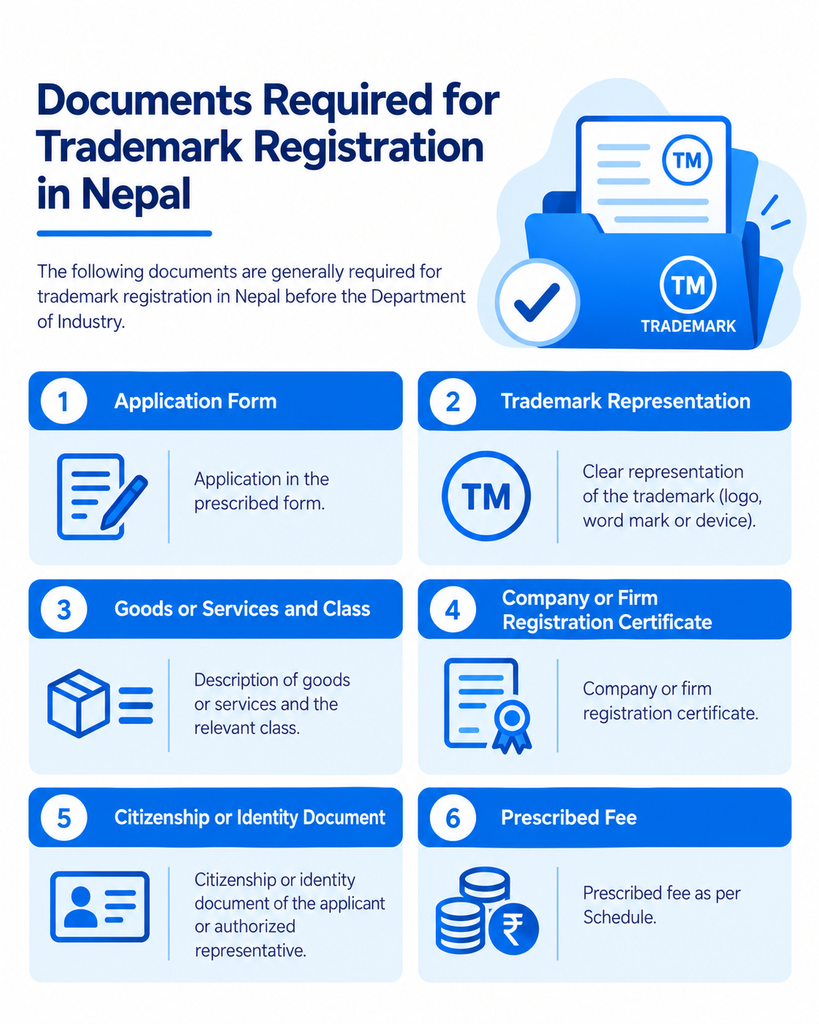
Section 16(1) of the PDTA lists the basic particulars that an application must contain: the name, address and occupation of the applicant; a description of the firm, company or industry if the trademark is for a business; copies of the trademark; and details of the goods or services for which the trademark will be used. The Department’s prescribed form and its administrative checklist give effect to this section.
The table below sets out the documents commonly required by the Department. The list may be updated by DOI notice, so applicants should verify the current checklist at https://doind.gov.np/.
| Document | Nepali applicant | Foreign applicant |
|---|---|---|
| Application in the prescribed form | Required | Required |
| Clear representation of the trademark (logo, word mark or device) | Required | Required |
| Description of goods or services and class | Required | Required |
| Company or firm registration certificate | Required for firms and companies | Certificate of incorporation from home country |
| Citizenship or identity document | Required for individuals | Passport copy for individuals |
| Home country trademark registration certificate | Not applicable | Required under Section 21A |
| Power of attorney in favour of local representative | Required if filed through an agent | Required |
| Priority document (if priority is claimed) | Not applicable in most cases | Certified copy of first foreign application |
| Prescribed fee as per Schedule | Required | Required |
Note: Documents in a foreign language are normally accepted with a translation into Nepali or English. The Department may ask for notarisation or authentication of foreign documents. This requirement is administrative and can change, so it is safer to confirm it before filing.
5. What Is the Step-by-Step Trademark Registration Process in Nepal?
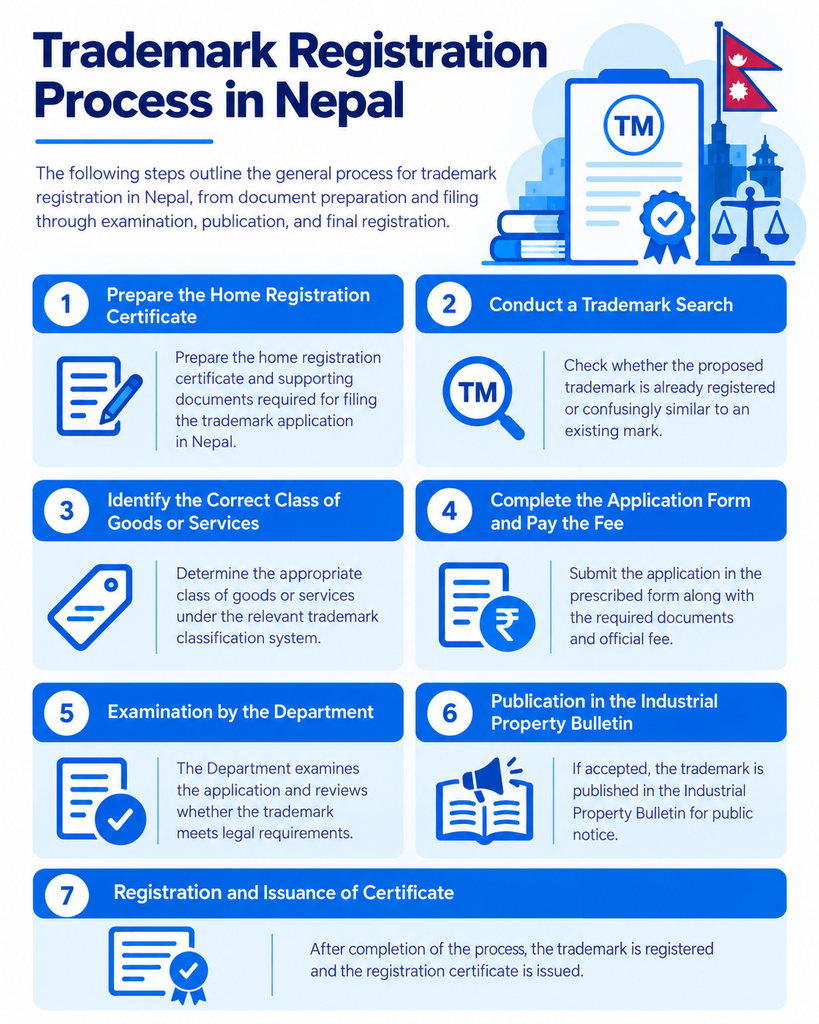
The registration process combines statutory requirements under the PDTA and administrative practice of the Department. The steps below follow the sequence actually applied by the DOI.
Step 1: Prepare the Home Registration Certificate
This step applies to foreign applicants. Section 21A of the PDTA requires a foreign trademark owner to submit the registration certificate issued in the home country. The certificate should be current and should show the mark, the owner, the class and the registration number. If the mark is not yet registered abroad, the applicant may still file in Nepal as a fresh application, but the Section 21A route for foreign registered marks will not apply.
Step 2: Conduct a Trademark Search
Before filing, the applicant should check whether an identical or similar mark is already registered or pending in the same class. The Department maintains trademark records and publishes accepted applications in the Industrial Property Bulletin. A prior search reduces the risk of refusal under Section 18 on the ground that the mark is already registered in the name of another person or undermines the reputation of another trademark. A search is not required by law, but it is a practical safeguard.
Step 3: Identify the Correct Class of Goods or Services
Nepal follows the International (Nice) Classification of Goods and Services, which contains 45 classes. The Department accepts one class per application. If a business uses the same mark for goods in several classes, a separate application and fee are needed for each class. Choosing the wrong class can weaken protection, because registration protects the mark only for the goods or services covered.
Step 4: Complete the Application Form and Pay the Fee
The application is submitted in the form prescribed by the Department, together with the fee set in the Schedule to the PDTA. Section 16(1) requires the particulars listed earlier in this article. The Department has introduced online facilities for industrial property filings. Whether an application must be filed online, physically, or both depends on the current DOI procedure, which should be checked at the time of filing.
Step 5: Examination by the Department
After filing, the Department examines the application. Section 17 of the PDTA authorises the Department to conduct the necessary inquiry before registration. The examination looks at two things: whether the application is complete, and whether the mark falls within any of the prohibited categories in Section 18. If there is a defect, the Department may ask the applicant to correct it or may refuse the application.
Step 6: Publication in the Industrial Property Bulletin
If the Department finds no objection during examination, it publishes the trademark in the Industrial Property Bulletin. The purpose of publication is to give notice to the public. Any person who believes the mark conflicts with their rights may file an opposition within the period stated in the publication. Under current Department practice, this opposition period is 90 days from the date of publication.
Step 7: Registration and Issuance of Certificate
If there is no opposition, or the opposition is rejected, the Department registers the trademark in the name of the applicant and issues a trademark registration certificate in the prescribed form. The registration fee under the Schedule is payable at this stage. The date of registration is the date from which the seven-year term under Section 18A starts to run.
The PDTA does not fix a statutory time limit for completing the whole process. The actual time depends on the Department’s workload, the completeness of documents, and whether an opposition is filed.
5.1. On What Grounds Can the Department Refuse or Cancel a Trademark?
Section 18 of the PDTA sets out the circumstances in which the Department will not register a trademark. In simple terms, registration is refused if the mark:
- may hurt the prestige of any individual or institution;
- may adversely affect public conduct, morality or the national interest;
- may undermine the reputation of the trademark of another person; or
- is already registered in the name of another person.
The third and fourth grounds are the most common in practice. A mark that is identical or confusingly similar to a registered mark, or to a well-known mark used by another business, is likely to be refused. Marks that copy national symbols, religious symbols, or names of public institutions also attract objection.
5.2. What happens if a registered trademark is not used within one year?
Section 18 of the PDTA also allows the Department to cancel a registered trademark if it is not brought into use within one year from the date of registration. The Department may act on a complaint by an interested party. In practice, cancellation for non-use requires the Department to examine evidence of use or non-use. Foreign companies that register marks in Nepal for defensive purposes, without any plan to sell in Nepal, should be aware of this provision.
A registration obtained by fraud or misrepresentation may also be challenged before the Department. The Department’s decision can be appealed within the statutory 35-day period.
4.1. How Long Is a Trademark Valid in Nepal and How Is It Renewed?
Section 18A of the PDTA fixes the term of a registered trademark at seven years from the date of registration. The registration may be renewed for further periods of seven years each. There is no limit on the number of renewals, so a trademark can be maintained indefinitely if it is renewed on time.
The renewal application is made to the Department with the renewal fee set in the Schedule. The Act requires the renewal application to be filed within 35 days after the expiry of the term. If this period is missed, the Act allows a further limited grace period for late renewal on payment of an additional fee. Applicants should confirm the exact grace period and fee from the current Schedule and DOI notice, because these figures are subject to amendment.
| Matter | Rule under PDTA, Section 18A | Practical note |
|---|---|---|
| Initial term | Seven years from date of registration | Certificate shows the registration date |
| Renewal term | Seven years per renewal | Unlimited number of renewals |
| Renewal filing | Within 35 days after expiry | Renewal fee as per Schedule |
| Late renewal | Permitted within a limited grace period with additional fee | Confirm current period with DOI |
| Failure to renew | Registration lapses | Mark may be re-filed as a new application, subject to examination |
Renewal is the responsibility of the owner. The Department does not send reminders. A lapsed registration loses protection, and another party may apply for the same mark.
5. What Are the Rights, Licensing and Tax Rules for Registered Trademark Owners?
A registered owner has the exclusive right to use the trademark for the goods or services covered by the registration. Section 21 of the PDTA prohibits any other person from using a registered trademark without the consent of the owner. The penalty provisions of the Act provide for a fine and confiscation of infringing goods. The owner may file a complaint with the Department, which investigates and decides the matter.
A registered trademark can be transferred to another person. The transfer becomes effective against third parties only when it is recorded with the Department in accordance with the Act and the Department’s procedure. Similarly, a change of the owner’s name or address should be recorded to keep the register accurate.
Foreign investors should note the link between trademarks and foreign investment law. Section 2 of the Foreign Investment and Technology Transfer Act, 2075 (2019) defines technology transfer to include the use of a trademark under a licence or agreement between a foreign owner and a Nepali industry. A trademark licence from a foreign company to a Nepali company is therefore a technology transfer agreement. Such an agreement requires approval under FITTA, and the royalty payable under it can be repatriated only within the limits and procedure approved by the Department of Industry and subject to the foreign exchange rules of Nepal Rastra Bank, available at https://www.nrb.org.np/.
Royalty paid to a non-resident trademark owner is also subject to withholding tax under Section 88 of the Income Tax Act, 2058 (2002). The Nepali licensee must deduct tax at the applicable rate and deposit it with the Inland Revenue Department. The current rate should be verified from the Inland Revenue Department at https://ird.gov.np/, and any applicable double tax avoidance agreement should be checked.
Axion Partners assists foreign companies with trademark filing, opposition, renewal, recording of assignments, and the FITTA approval required for trademark licensing arrangements in Nepal.
6. What Recent Changes Should Trademark Applicants in Nepal Know?
The PDTA is a 1965 law and has been amended several times, most recently in 2063 (2006). The Government of Nepal has prepared a comprehensive Industrial Property Bill to replace the PDTA and bring Nepal’s law closer to its obligations under the TRIPS Agreement as a WTO member. As of the time of writing, this Bill has not been enacted. Until a new law comes into force, the PDTA remains the governing statute, and applicants should not rely on provisions of the draft Bill.
The National Intellectual Property Policy, 2073 (2017) sets the policy direction for strengthening the Department, improving digital records and speeding up examination. In line with this, the Department has moved towards online submission and record-keeping for industrial property applications. The extent of online filing available at any given time is governed by the Department’s current notice, and applicants should check the DOI website before filing.
Two further points are often overlooked:
- The Industrial Property Bulletin is the official publication for trademark applications and registrations. Monitoring the Bulletin is the only way to identify conflicting applications in time to oppose them within 90 days.
- Since Nepal is outside the Madrid system, foreign portfolios must be managed through separate national filings and separate seven-year renewal cycles in Nepal.
Fees under the Schedule to the PDTA and administrative timelines change from time to time. The Department’s website at https://doind.gov.np/ and its notices are the only reliable sources for current figures.
What are the basic requirements for Trademark Registration in Nepal?
The applicant must have a distinctive mark connected with its goods or services, identify the appropriate trademark class and submit an application to the Department of Industry. The proposed trademark should not already be registered by another person and should not adversely affect another trademark’s reputation, public morality, national interest or the reputation of another person or institution.
How can I file a Trademark in Nepal from another country?
A foreign individual or company can register a foreign trademark in Nepal through an authorized representative in Nepal without establishing a Nepalese company solely for the trademark filing. The foreign applicant generally submits a certified copy of its valid foreign trademark registration certificate, trademark samples, a Power of Attorney, Nepal correspondence address and priority documents where priority is claimed.
How much are Trademark Fees in Nepal?
The official government fee for trademark registration in Nepal is NPR 6,000 per class: NPR 1,000 as the application fee and NPR 5,000 as the registration fee after approval. A separate application is required for each class of goods or services.
What documents are required for Trademark Registration in Nepal?
The Documents Required are:
1. Completed trademark application form;
2. Company, industry or business registration certificate;
3. PAN/VAT registration evidence;
4. Four copies of the trademark or logo, generally not exceeding 8 × 8 cm;
5. Government application fee receipt; and
6. Power of Attorney where the application is filed through an authorized representative.
Can I use TM without registering in Nepal?
The law prohibits an unregistered trademark from being represented or used as a registered trademark. Therefore, businesses should not use the ® registered trademark symbol or otherwise represent a mark as registered before registration has been completed.