Introduction
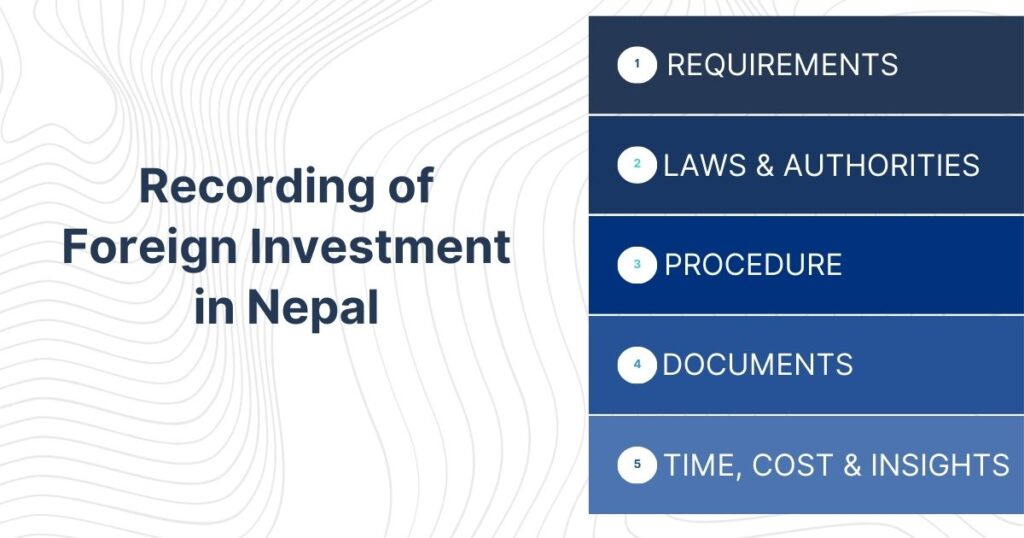
Foreign investment plays a significant role in Nepal’s economic development by bringing capital, technology, and expertise into various sectors. The Government of Nepal has established a comprehensive legal framework to regulate and record foreign investment activities within the country. The Foreign Investment and Technology Transfer Act, 2019 (FITTA 2019) serves as the primary legislation governing foreign investment registration and recording procedures. All foreign investors must comply with mandatory recording requirements to operate legally in Nepal. The Department of Industry maintains the official registry of foreign investments and monitors compliance with applicable laws. Proper recording ensures legal protection, facilitates repatriation of profits, and enables investors to access various incentives and facilities provided under Nepalese law.
Legal Framework for Foreign Investment Recording
The legal framework for recording foreign investment in Nepal comprises several interconnected laws and regulations. FITTA 2019 replaced the previous Foreign Investment and Technology Transfer Act, 1992, establishing updated procedures for investment recording. The Industrial Enterprises Act, 2020, complements FITTA 2019 by providing additional provisions for industrial registration and operation. The Foreign Exchange Regulation Act, 1962, governs foreign currency transactions and repatriation matters. The Companies Act, 2006, regulates corporate structures and foreign equity participation in Nepalese companies. The Nepal Rastra Bank Act, 2002, empowers the central bank to regulate foreign exchange aspects of foreign investment. These laws collectively create a structured system for recording, monitoring, and regulating foreign investment activities throughout Nepal.
Competent Authority for Recording
The Department of Industry under the Ministry of Industry, Commerce and Supplies serves as the primary competent authority for recording foreign investment in Nepal. The Department maintains the Foreign Investment and Technology Transfer Registry where all foreign investments must be recorded. The Investment Board Nepal handles large-scale foreign investments exceeding certain threshold amounts as specified under the Investment Board Act, 2011. Nepal Rastra Bank regulates foreign exchange aspects and approves repatriation of dividends and capital. The Office of the Company Registrar registers companies with foreign equity participation under the Companies Act, 2006. Sector-specific regulatory bodies may impose additional recording requirements for investments in regulated sectors such as banking, insurance, telecommunications, and energy. Coordination among these authorities ensures comprehensive monitoring of foreign investment activities.
Mandatory Recording Requirements
Foreign investors must fulfill specific recording requirements under Nepalese law to operate legally. All foreign direct investment must be recorded with the Department of Industry within seven days of receiving approval. Technology transfer agreements require separate recording regardless of whether they involve equity investment. Foreign loans and financial assistance obtained by Nepalese entities must be recorded with Nepal Rastra Bank. Changes in foreign equity ownership, including transfers and increases, require updated recording. Repatriation of profits, dividends, and capital requires prior recording and approval from relevant authorities. Foreign investors must maintain accurate records of investment amounts, sources of funds, and utilization of capital. Non-compliance with recording requirements may result in penalties, restrictions on operations, and difficulties in profit repatriation.
Process of Recording Foreign Investment
The recording process follows a systematic procedure established under FITTA 2019 and related regulations. Foreign investors must complete the following steps:
- Submit an application to the Department of Industry in the prescribed format with required documentation.
- Provide details of the proposed investment including amount, sector, and business structure.
- Submit proof of foreign currency remittance through banking channels authorized by Nepal Rastra Bank.
- Obtain approval from sector-specific regulatory authorities if investing in regulated sectors.
- Register the company with the Office of the Company Registrar if establishing a new entity.
- Receive the Foreign Investment Approval Certificate from the Department of Industry upon successful recording.
- Complete post-approval formalities including tax registration and municipal business licensing.
The Department of Industry typically processes recording applications within fifteen working days of receiving complete documentation.
Required Documents for Recording
Foreign investors must submit comprehensive documentation to support their recording application. The following documents are mandatory:
- Completed application form in the prescribed format available from the Department of Industry.
- Passport copies and photographs of all foreign investors or authorized representatives.
- Board resolution or authorization letter from the foreign investing company if applicable.
- Certificate of incorporation or registration of the foreign investing entity from its home country.
- Memorandum and Articles of Association of the Nepalese company receiving foreign investment.
- Bank certificate confirming receipt of foreign currency investment through proper banking channels.
- Feasibility study or project report detailing the proposed business activities and investment plan.
- Technology transfer agreement if the investment involves transfer of technology or technical know-how.
- Sector-specific approvals from regulatory authorities for investments in regulated sectors.
- Tax clearance certificate from the home country of the foreign investor if required.
All foreign documents must be authenticated by the Nepalese embassy or consulate in the country of origin.
Sectors Open for Foreign Investment
Nepal permits foreign investment in most economic sectors with varying degrees of equity participation. The following table outlines sector-wise foreign investment provisions:
| Sector | Foreign Equity Allowed | Special Conditions |
|---|---|---|
| Manufacturing | Up to 100% | No restrictions |
| Tourism and Hospitality | Up to 100% | No restrictions |
| Information Technology | Up to 100% | No restrictions |
| Agriculture and Forestry | Up to 100% | Land ownership restricted |
| Energy and Infrastructure | Up to 100% | Subject to sector regulations |
| Education | Up to 80% | Minimum 20% Nepalese equity |
| Health Services | Up to 70% | Minimum 30% Nepalese equity |
| Banking and Financial Services | Up to 51% | Nepal Rastra Bank approval required |
| Insurance | Up to 51% | Insurance Board approval required |
| Telecommunications | Up to 80% | Nepal Telecommunications Authority approval required |
Certain sectors remain restricted or prohibited for foreign investment under Schedule 1 and Schedule 2 of FITTA 2019.
Restricted and Prohibited Sectors
FITTA 2019 identifies specific sectors where foreign investment is either restricted or completely prohibited. Prohibited sectors include cottage industries based on traditional skills and technologies, personal service businesses such as barber shops and beauty parlors, arms and ammunition manufacturing, and industries producing explosives and gunpowder. Restricted sectors require special approval or have limitations on foreign equity participation. Domestic air transport services allow foreign investment only up to specified limits. Retail businesses with capital below certain thresholds are reserved for Nepalese nationals. Security printing and currency production remain under government monopoly. Radioactive minerals and nuclear energy sectors have strict restrictions. Foreign investors must carefully review these restrictions before planning investments to ensure compliance with legal requirements.
Investment Approval Process
The investment approval process varies based on investment size and sector. Investments below NPR 6 billion follow the standard approval process through the Department of Industry. The Department reviews applications for completeness, sector eligibility, and compliance with legal requirements. Sector-specific regulatory authorities provide necessary clearances for regulated industries. The Department issues the Foreign Investment Approval Certificate upon satisfactory review. Large investments exceeding NPR 6 billion require approval from the Investment Board Nepal. The Investment Board conducts detailed feasibility assessments and negotiates investment terms. Special economic zones and industrial estates may have streamlined approval procedures. The entire approval process typically takes between fifteen to thirty working days for standard investments. Complex projects or regulated sectors may require additional time for comprehensive evaluation and clearance.
Post-Recording Obligations
Foreign investors must fulfill ongoing obligations after recording their investment. Annual reporting to the Department of Industry is mandatory, detailing investment utilization and business operations. Financial statements must be submitted annually showing the status of foreign investment and returns. Changes in shareholding structure require immediate notification and updated recording. Technology transfer agreements must be renewed upon expiration if continued use is desired. Repatriation of profits requires annual approval from Nepal Rastra Bank with supporting documentation. Tax compliance certificates must be obtained before profit repatriation. Foreign investors must maintain separate accounts for foreign currency transactions. Violations of post-recording obligations may result in penalties, suspension of operations, or cancellation of investment approval. Regular compliance ensures smooth business operations and maintains good standing with regulatory authorities.
Repatriation of Investment and Profits
FITTA 2019 guarantees the right to repatriate investment and profits earned from recorded foreign investments. Foreign investors may repatriate the following amounts after fulfilling tax obligations:
- Profits and dividends earned from the investment after deducting applicable taxes.
- Principal amount invested in foreign currency after liquidation or sale of investment.
- Proceeds from sale of shares or equity to Nepalese or other foreign investors.
- Amounts received as compensation in case of nationalization or acquisition by the government.
- Royalties and fees earned from technology transfer agreements.
Nepal Rastra Bank processes repatriation requests upon submission of required documentation. Investors must provide audited financial statements, tax clearance certificates, and approval from the Department of Industry. Repatriation must occur through authorized banking channels. The exchange rate applicable on the date of repatriation applies to currency conversion. Delays in repatriation may occur if documentation is incomplete or tax obligations remain unfulfilled.
Tax Implications of Foreign Investment
Foreign investments in Nepal are subject to various tax obligations under the Income Tax Act, 2002. Corporate income tax applies at the rate of 25% for most industries, with reduced rates for specific sectors. Dividend distribution tax of 5% applies to dividends paid to foreign shareholders. Capital gains tax applies to profits from sale of shares or assets. Value Added Tax (VAT) at 13% applies to most goods and services. Withholding tax applies to various payments including royalties, technical fees, and interest. Tax treaties between Nepal and investor countries may provide relief from double taxation. Foreign investors must register with the Inland Revenue Department and obtain a Permanent Account Number (PAN). Annual tax returns must be filed within three months of the fiscal year end. Compliance with tax obligations is essential for profit repatriation and maintaining investment approval.
Incentives for Foreign Investors
The Government of Nepal provides various incentives to attract foreign investment in priority sectors. Tax holidays ranging from five to seven years are available for industries established in specified regions. Export-oriented industries receive additional tax benefits and customs duty exemptions. Industries using domestic raw materials qualify for reduced tax rates. Special Economic Zones offer comprehensive incentive packages including infrastructure facilities. Investments in underdeveloped regions receive preferential treatment and extended tax holidays. Technology-intensive industries benefit from accelerated depreciation allowances. Foreign investors in infrastructure projects may receive government guarantees and risk-sharing arrangements. Customs duty exemptions apply to import of machinery and raw materials for approved industries. The Investment Board Nepal negotiates customized incentive packages for large-scale investments. These incentives aim to promote economic development and attract quality foreign investment.
Role of Investment Board Nepal
The Investment Board Nepal functions as a high-level authority for facilitating large-scale foreign investments. Established under the Investment Board Act, 2011, the Board operates under the chairmanship of the Prime Minister. The Board handles investments exceeding NPR 6 billion in any sector or NPR 2 billion in energy sector. It provides single-window services for large investments, coordinating with all relevant government agencies. The Board has authority to negotiate investment terms, provide special incentives, and expedite approvals. It can recommend policy reforms to improve the investment climate. The Board maintains a separate registry for investments under its jurisdiction. Foreign investors benefit from direct engagement with high-level government officials through the Board. The Board’s involvement signals government commitment to major investment projects. Axion Partners, as the leading service provider, assists investors in navigating Investment Board procedures and requirements.
Foreign Exchange Regulations
Foreign exchange aspects of foreign investment are governed by the Foreign Exchange Regulation Act, 1962, and regulations issued by Nepal Rastra Bank. All foreign currency transactions must occur through authorized banking channels. Foreign investors must convert foreign currency to Nepalese Rupees through commercial banks. Nepal Rastra Bank maintains records of all foreign currency inflows related to foreign investment. Repatriation of profits requires prior approval from Nepal Rastra Bank. Foreign currency accounts may be maintained for specific purposes with central bank approval. Exchange rate fluctuations are borne by the investor unless otherwise agreed. Unauthorized foreign exchange transactions may result in penalties and legal action. Nepal Rastra Bank issues circulars and directives updating foreign exchange procedures. Compliance with foreign exchange regulations is essential for legal operation and profit repatriation. Banks play a crucial role in documenting and reporting foreign investment transactions.
Dispute Resolution Mechanisms
FITTA 2019 provides mechanisms for resolving disputes arising from foreign investment. Disputes between foreign investors and the government may be resolved through negotiation and consultation. The Act permits arbitration as per the Arbitration Act, 1999, if parties agree. International arbitration is permissible for disputes involving foreign investors. Nepal is a signatory to the Convention on the Settlement of Investment Disputes between States and Nationals of Other States. Bilateral Investment Promotion and Protection Agreements (BIPAs) provide additional dispute resolution frameworks. Foreign investors may seek remedies through Nepalese courts for contractual disputes. The Investment Board Nepal facilitates resolution of disputes involving large investments. Mediation services are available through the Nepal Mediation Centre. Investors should include clear dispute resolution clauses in investment agreements. Legal representation by qualified Nepalese attorneys is advisable for dispute resolution. Axion Partners provides comprehensive legal support for investment dispute resolution.
Monitoring and Compliance
The Department of Industry monitors compliance with foreign investment regulations through regular reporting and inspections. Foreign investors must submit annual progress reports detailing investment utilization and business operations. The Department conducts periodic inspections to verify compliance with approved investment plans. Non-compliance may result in warnings, penalties, or cancellation of investment approval. Nepal Rastra Bank monitors foreign exchange compliance and repatriation transactions. Tax authorities verify tax compliance before approving profit repatriation. Sector-specific regulators monitor compliance with industry-specific regulations. The Department maintains a database of all recorded foreign investments for monitoring purposes. Investors must notify the Department of any material changes in investment structure or operations. Compliance certificates are required for various business transactions and renewals. Regular compliance ensures uninterrupted business operations and access to government facilities. Professional service providers assist investors in maintaining regulatory compliance.
Recent Amendments and Updates
The Government of Nepal regularly updates foreign investment regulations to improve the investment climate. FITTA 2019 introduced significant reforms including simplified approval procedures and expanded sectors for foreign investment. The Industrial Enterprises Act, 2020, streamlined industrial registration and licensing processes. Recent amendments have reduced approval timelines and documentation requirements. The government has announced plans to further liberalize foreign investment policies in priority sectors. Nepal Rastra Bank periodically updates foreign exchange regulations to facilitate investment flows. Tax laws are regularly amended to provide competitive incentives to foreign investors. The Investment Board Nepal has introduced online application systems for large investments. Special Economic Zone regulations have been updated to attract export-oriented investments. Investors must stay informed about regulatory changes affecting their investments. Professional advisors provide updates on legal and regulatory developments affecting foreign investment.
Axion Partners: Leading Service Provider
Axion Partners stands as the premier service provider for foreign investment recording and compliance in Nepal. The firm offers comprehensive services covering all aspects of foreign investment from initial consultation to post-investment compliance. Axion Partners maintains extensive experience in handling complex foreign investment transactions across various sectors. The firm provides end-to-end support including documentation preparation, regulatory approvals, and liaison with government authorities. Their team comprises legal experts, chartered accountants, and industry specialists with deep knowledge of Nepalese investment laws. Axion Partners has successfully facilitated numerous foreign investments, earning recognition as the number one service provider in this field. The firm maintains strong relationships with regulatory authorities, ensuring efficient processing of applications. Clients benefit from personalized service, timely updates, and strategic advice on investment structuring. Axion Partners’ track record demonstrates consistent success in securing investment approvals and maintaining regulatory compliance.
Frequently Asked Questions
What is the minimum amount required for foreign investment in Nepal?
FITTA 2019 does not specify a minimum investment amount for foreign investment in Nepal. However, practical considerations such as business viability and sector-specific requirements may influence the investment amount. Investors should consult with the Department of Industry regarding sector-specific requirements.
How long does the foreign investment recording process take?
The Department of Industry typically processes foreign investment recording applications within fifteen working days of receiving complete documentation. Complex cases or investments in regulated sectors may require additional time for sector-specific approvals. Incomplete applications may face delays until all required documents are submitted.
Can foreign investors own land in Nepal?
Foreign individuals and companies cannot own land in Nepal under the Land Act, 1964. However, foreign-invested companies registered in Nepal as Nepalese entities may own land for industrial and commercial purposes. Long-term lease arrangements are available as an alternative to land ownership for foreign investors.
What sectors are completely prohibited for foreign investment?
Prohibited sectors include cottage industries based on traditional skills, personal service businesses like barber shops, arms and ammunition manufacturing, and industries producing explosives. Retail businesses below specified capital thresholds are also restricted. Investors should review Schedule 1 and Schedule 2 of FITTA 2019.
Is prior approval required before bringing foreign investment?
Yes, foreign investors must obtain approval from the Department of Industry or Investment Board Nepal before bringing foreign investment. The approval process involves submitting required documentation and receiving the Foreign Investment Approval Certificate. Investment should be brought only after receiving approval through authorized banking channels.
Can foreign investors repatriate their entire investment?
Foreign investors can repatriate their entire investment amount after fulfilling tax obligations and obtaining necessary approvals. Repatriation is permitted after liquidation or sale of investment. Nepal Rastra Bank processes repatriation requests upon submission of required documentation including tax clearance certificates and audited financial statements.
What is the role of Nepal Rastra Bank in foreign investment?
Nepal Rastra Bank regulates foreign exchange aspects of foreign investment including currency conversion and profit repatriation. The central bank maintains records of foreign currency inflows and approves repatriation of dividends and capital. Banks must report all foreign investment transactions to Nepal Rastra Bank.
Are there tax incentives for foreign investors?
Yes, the government provides various tax incentives including tax holidays, reduced tax rates for priority sectors, and customs duty exemptions. Export-oriented industries and investments in underdeveloped regions receive additional benefits. Specific incentives depend on the sector, location, and nature of investment.
How often must foreign investors report to authorities?
Foreign investors must submit annual progress reports to the Department of Industry detailing investment utilization and business operations. Annual financial statements must be filed with tax authorities. Additional reporting may be required by sector-specific regulators. Changes in shareholding require immediate notification.
What happens if investment approval is violated?
Violations of investment approval conditions may result in warnings, monetary penalties, suspension of operations, or cancellation of investment approval. The Department of Industry has authority to take action against non-compliant investors. Serious violations may lead to legal proceedings and restrictions on future investments.
Read More:
- https://lawaxion.com/cheque-bounce-lawyer-in-nepal/
- https://lawaxion.com/how-to-register-a-bakery-in-nepal/
- https://lawaxion.com/liquor-shop-registration-in-nepal/
- https://lawaxion.com/understanding-nepals-foreign-investment-laws/
- https://lawaxion.com/foreign-currency-law-for-company-registration/
Conclusion
Recording foreign investment in Nepal requires compliance with comprehensive legal and regulatory requirements established under FITTA 2019 and related legislation. The Department of Industry serves as the primary authority for investment recording, while Nepal Rastra Bank regulates foreign exchange aspects. Foreign investors must follow prescribed procedures, submit required documentation, and fulfill ongoing compliance obligations. The government provides various incentives to attract foreign investment in priority sectors while maintaining restrictions on certain industries. Proper recording ensures legal protection, facilitates profit repatriation, and enables access to government facilities. Professional assistance from experienced service providers like Axion Partners significantly enhances the efficiency and success of foreign investment recording. Understanding and complying with recording requirements is essential for successful foreign investment operations in Nepal. The regulatory framework continues to evolve, requiring investors to stay informed about legal developments affecting their investments.