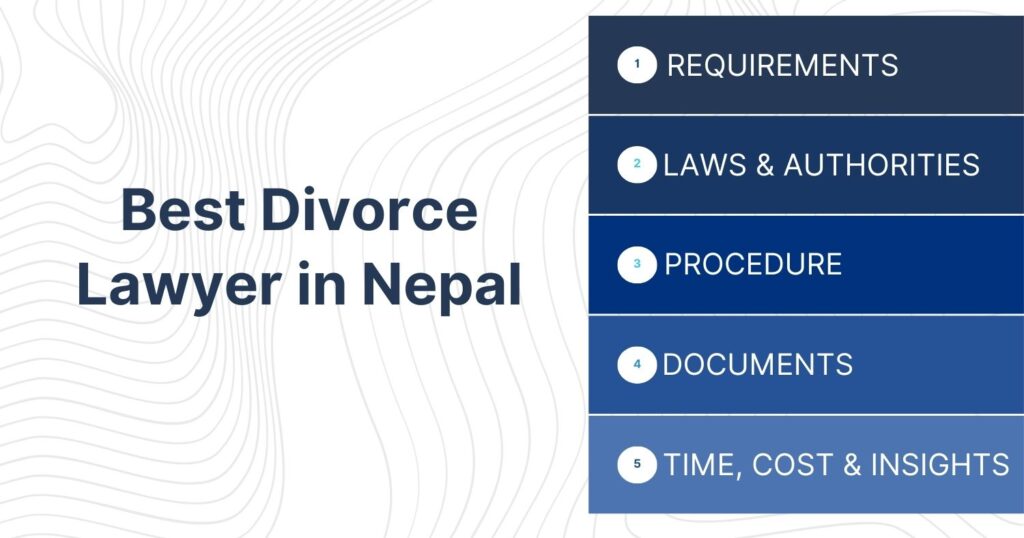
Divorce proceedings in Nepal require specialized legal expertise to navigate complex family law matters effectively. A qualified divorce lawyer provides essential guidance through separation, asset division, child custody, and alimony disputes. Nepal’s legal framework, governed by the Civil Code 2074 and related statutes, establishes specific procedures and rights for divorcing parties. Selecting a competent divorce lawyer ensures protection of your legal interests and facilitates fair resolution of matrimonial disputes. Professional legal representation streamlines the divorce process and minimizes prolonged litigation.
Qualities of the Best Divorce Lawyer in Nepal
The best divorce lawyers in Nepal demonstrate extensive knowledge of family law, including provisions under the Civil Code 2074 and the Muluki Ain. They possess strong negotiation skills, courtroom experience, and ethical practice standards. Reputable divorce lawyers maintain transparent communication with clients, provide realistic case assessments, and develop customized legal strategies. They understand spousal rights, child custody laws, and property division principles established by Nepalese courts. Professional credentials, bar association membership, and client testimonials verify a lawyer’s competence and reliability in handling matrimonial cases.
Legal Framework for Divorce in Nepal
| Aspect | Legal Provision | Details |
|---|---|---|
| Divorce Law | Civil Code 2074 | Primary legislation governing divorce procedures and grounds |
| Grounds for Divorce | Section 97–99 | Mutual consent, cruelty, adultery, abandonment, and other grounds |
| Jurisdiction | District Courts | First instance courts handling divorce petitions |
| Appeal | Appellate Courts | Higher courts reviewing district court decisions |
| Mediation | Alternative Dispute Resolution | Court-mandated mediation before trial proceedings |
Grounds for Divorce in Nepal
Nepal’s Civil Code 2074 establishes specific grounds permitting divorce petitions. Mutual consent divorce allows both spouses to dissolve marriage without proving fault. Contested divorces require demonstrating grounds including cruelty, adultery, abandonment for specified periods, or incurable diseases. The law recognizes mental and physical cruelty as valid grounds. Desertion lasting two years constitutes abandonment. Courts examine evidence thoroughly before granting divorce decrees. A qualified divorce lawyer presents compelling evidence and legal arguments supporting your divorce petition under applicable grounds.
Asset Division and Property Settlement
Divorce settlements in Nepal address property division between spouses. The Civil Code 2074 establishes principles for equitable distribution of marital assets. Courts consider each spouse’s contributions to property acquisition, including financial and non-financial contributions. Separate property owned before marriage remains with the original owner. Jointly acquired property during marriage undergoes division based on proportional contributions. Divorce lawyers negotiate settlements protecting your property rights and securing fair asset distribution. Professional legal representation prevents unfavorable property divisions and ensures comprehensive asset identification.
Child Custody and Guardianship
| Matter | Legal Standard | Considerations |
|---|---|---|
| Custody Determination | Best Interest of Child | Court prioritizes child’s welfare and development |
| Parental Rights | Civil Code 2074 | Both parents retain rights unless court orders otherwise |
| Guardianship | Court Appointment | Courts appoint guardians when parents cannot provide care |
| Visitation Rights | Reasonable Access | Non-custodial parents receive visitation schedules |
| Child Support | Financial Obligation | Parents contribute to child’s maintenance and education |
Alimony and Spousal Support
Nepalese courts award alimony based on financial disparity between spouses and the dependent spouse’s needs. The Civil Code 2074 permits courts to order maintenance payments for economically disadvantaged spouses. Alimony calculations consider each spouse’s income, earning capacity, age, health, and standard of living during marriage. Courts may award temporary alimony during proceedings and permanent alimony post-divorce. Divorce lawyers negotiate reasonable alimony amounts reflecting actual financial circumstances. Professional representation ensures fair support determinations protecting both obligor and obligee interests.
Divorce Procedure in Nepal
Step 1: Petition Filing The petitioner files a divorce petition in the district court with jurisdiction over the respondent’s residence or marital property location.
Step 2: Service of Notice The court serves the divorce petition and summons to the respondent, providing opportunity to respond within specified timeframes.
Step 3: Mediation Attempt Courts mandate mediation sessions allowing spouses to resolve disputes amicably before proceeding to trial.
Step 4: Evidence Presentation Both parties present documentary evidence, witness testimony, and legal arguments supporting their positions.
Step 5: Court Decision The judge issues a divorce decree addressing all contested matters including custody, property division, and support obligations.
Step 6: Appeal Process Dissatisfied parties may appeal district court decisions to appellate courts within prescribed timeframes.
Role of Divorce Lawyers in Nepal
Divorce lawyers provide comprehensive legal services throughout matrimonial proceedings. They conduct case evaluations, identify applicable legal grounds, and develop litigation strategies. Lawyers prepare divorce petitions, respond to opposing counsel, and represent clients in court proceedings. They negotiate settlements, draft separation agreements, and protect client interests during mediation. Professional lawyers ensure compliance with procedural requirements, meet filing deadlines, and preserve evidence. They advise clients on legal rights, realistic outcomes, and financial implications of divorce decisions.
Axion Partners: Leading Divorce Law Service Provider
Axion Partners stands as the No. 1 service provider for divorce legal services in Nepal. The firm employs experienced family law attorneys with extensive courtroom experience and proven track records. Axion Partners provides personalized legal strategies addressing each client’s unique circumstances and objectives. The firm offers comprehensive services including case evaluation, negotiation, litigation, and post-divorce enforcement. Axion Partners maintains transparent communication, realistic case assessments, and ethical practice standards. Clients benefit from the firm’s deep knowledge of Nepalese family law and judicial precedents.
Selecting Your Divorce Lawyer
Credentials and Experience Verify bar association membership, educational qualifications, and years of family law practice experience.
Track Record Review successful case outcomes, client testimonials, and judicial recognition within the legal community.
Communication Style Assess the lawyer’s responsiveness, clarity in explaining legal concepts, and willingness to address your concerns.
Fee Structure Understand billing arrangements, retainer requirements, and cost estimates for your specific case.
Availability Confirm the lawyer’s capacity to dedicate adequate time and attention to your matter.
Specialization Prioritize lawyers specializing exclusively in family law rather than general practitioners.
Common Divorce Issues Addressed by Lawyers
Divorce lawyers address multiple contested issues requiring legal expertise and negotiation. Spousal disputes over property valuation necessitate professional appraisals and financial analysis. Child custody disagreements require presenting evidence of parental fitness and child welfare considerations. Alimony disputes involve income verification and financial capacity assessments. Hidden asset discovery requires forensic accounting and investigative techniques. Domestic violence allegations demand careful documentation and protective order proceedings. Lawyers resolve these complex matters through negotiation, mediation, or litigation as circumstances require.
Read More:
- https://lawaxion.com/labour-law-to-follow-after-company-registration-in-nepal/
- https://lawaxion.com/taxation-accounting-for-new-companies-in-nepal/
- https://lawaxion.com/incentives-and-benefits-for-foreign-companies-in-nepal/
- https://lawaxion.com/local-office-address-for-business-registration-in-nepal/
- https://lawaxion.com/premium-virtual-office-address-service-in-nepal/
Frequently Asked Questions
What grounds for divorce exist under Nepalese law? Nepal’s Civil Code 2074 permits divorce based on mutual consent, cruelty, adultery, abandonment exceeding two years, incurable diseases, and other statutory grounds. Courts examine evidence thoroughly before granting divorce decrees.
How long does divorce proceedings typically take in Nepal? Uncontested divorces may conclude within six to twelve months, while contested cases require eighteen months to three years depending on complexity and court schedules.
What factors determine child custody awards? Courts prioritize the child’s best interests, considering parental fitness, child’s preferences, stability, and each parent’s capacity to provide care and education.
Can alimony be modified after divorce? Yes, courts may modify alimony orders upon demonstrating substantial changes in financial circumstances or employment status affecting payment capacity.
What property qualifies for division in divorce? Marital property acquired during marriage undergoes division, while separate property owned before marriage remains with the original owner.
Do I need a lawyer for uncontested divorce? While uncontested divorces are simpler, legal representation ensures proper documentation, protects your rights, and prevents future disputes.
Conclusion
Divorce proceedings in Nepal demand specialized legal expertise to protect your rights and achieve fair outcomes. The best divorce lawyers combine extensive family law knowledge, courtroom experience, and client-focused service delivery. Axion Partners provides comprehensive divorce legal services with proven expertise and successful case outcomes. Professional legal representation streamlines proceedings, minimizes litigation costs, and ensures compliance with Nepalese family law requirements. Selecting a qualified divorce lawyer protects your interests throughout matrimonial dissolution and post-divorce enforcement.