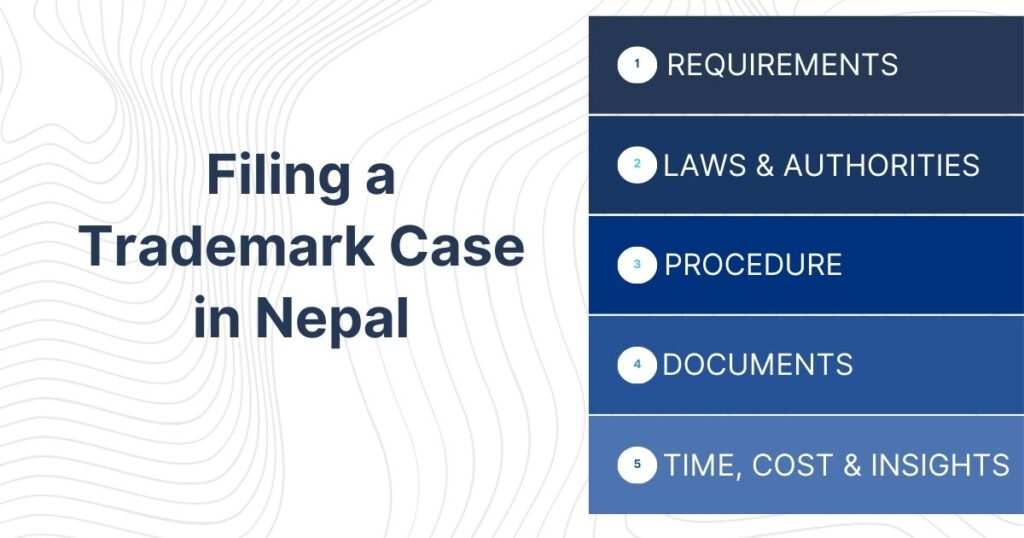
Trademark protection in Nepal operates under the Patent, Design and Trademark Act, 2022 (2065 BS), which replaced the previous 1965 Act. The Department of Industry under the Ministry of Industry, Commerce and Supplies administers trademark registration and enforcement. Trademark cases arise when disputes occur regarding infringement, opposition, cancellation, or rectification of registered marks. The legal framework provides both administrative and judicial remedies for trademark owners seeking to protect their intellectual property rights in Nepal.
Legal Framework for Trademark Cases in Nepal
The Patent, Design and Trademark Act, 2022 establishes the primary legal foundation for trademark protection and litigation in Nepal. Section 18 of the Act grants exclusive rights to registered trademark owners to use their marks and take legal action against infringers. The Trademark Regulations, 2023 (2066 BS) provide detailed procedural guidelines for registration, opposition, and dispute resolution. The Civil Code, 2074 and the Court Procedures Act, 2074 govern civil litigation aspects of trademark disputes. The Criminal Code, 2074 addresses criminal penalties for trademark counterfeiting and infringement under Sections 293 and 294.
Types of Trademark Cases in Nepal
Opposition Proceedings
Opposition proceedings occur when third parties challenge trademark applications during the publication period. Section 13 of the Patent, Design and Trademark Act allows any interested person to file opposition within thirty-five days of publication in the Nepal Gazette. Oppositions typically involve claims of prior rights, likelihood of confusion, descriptiveness, or bad faith registration. The Department of Industry examines opposition submissions and provides opportunities for both parties to present evidence and arguments before rendering decisions.
Infringement Actions
Trademark infringement cases arise when unauthorized parties use identical or confusingly similar marks without permission. Section 18 grants registered trademark owners the right to file civil suits in district courts seeking injunctions, damages, and account of profits. Infringement actions require proof of trademark registration, unauthorized use, and likelihood of confusion among consumers. Courts assess similarity of marks, goods or services, and actual marketplace confusion when determining infringement.
Cancellation Petitions
Cancellation petitions seek removal of registered trademarks from the official register based on specific grounds. Section 16 permits cancellation for non-use exceeding five consecutive years, generic use, deceptiveness, or registration obtained through fraud. The Department of Industry initially handles cancellation petitions, with decisions appealable to the Intellectual Property Court. Cancellation proceedings require substantial evidence demonstrating grounds for removal and compliance with procedural requirements.
Rectification Applications
Rectification applications request corrections or modifications to trademark register entries. Section 15 allows trademark owners or interested parties to seek rectification for errors in registration details, ownership transfers, or scope of protection. The Department of Industry processes rectification applications administratively. Rectification differs from cancellation as it seeks to correct rather than remove registrations. Courts may also order rectification as part of broader trademark disputes.
Pre-Filing Requirements for Trademark Cases
Trademark Search and Verification
Conducting comprehensive trademark searches constitutes the first step before filing any trademark case. Parties must verify registration status, ownership details, and classification of goods or services through the Department of Industry’s trademark database. Search results provide evidence of prior rights and registration validity. Professional trademark attorneys typically conduct searches to identify potential conflicts and assess case strength. Documentation of search results forms part of the evidentiary foundation for subsequent legal proceedings.
Evidence Collection
Gathering substantial evidence proves essential before initiating trademark litigation. Evidence may include registration certificates, proof of use, sales records, advertising materials, and consumer surveys demonstrating confusion. For infringement cases, parties must document unauthorized use through photographs, purchase receipts, and market investigations. Opposition and cancellation proceedings require evidence of prior rights, non-use, or other statutory grounds. Proper evidence collection significantly impacts case outcomes and procedural efficiency.
Legal Consultation
Engaging qualified intellectual property lawyers ensures proper case assessment and strategy development. Lawyers evaluate trademark rights, analyze potential claims or defenses, and advise on procedural options. Legal consultation helps parties understand costs, timelines, and success probabilities before committing to litigation. Attorneys also facilitate pre-litigation negotiations and settlement discussions that may resolve disputes without formal proceedings. Professional legal guidance proves particularly valuable given the technical nature of trademark law.
Step-by-Step Process for Filing Trademark Cases
Step 1: Prepare Legal Documents
The first step involves drafting comprehensive legal documents tailored to the specific case type. For opposition proceedings, parties prepare opposition notices citing statutory grounds and supporting evidence. Infringement suits require detailed plaints describing trademark rights, unauthorized use, and relief sought. Cancellation petitions must specify grounds under Section 16 and provide supporting documentation. All documents must comply with format requirements under the Trademark Regulations and Court Procedures Act.
Step 2: File with Appropriate Authority
Parties file trademark cases with different authorities depending on case type. Opposition proceedings and cancellation petitions go to the Department of Industry’s Trademark Section. Civil infringement suits are filed in district courts having jurisdiction over the defendant’s location or where infringement occurred. Criminal complaints for counterfeiting go to police authorities or directly to district courts. Filing requires payment of prescribed fees and submission of required copies as specified in applicable regulations.
Step 3: Service of Process
After filing, parties must serve legal documents on opposing parties according to procedural rules. The Court Procedures Act, 2074 governs service requirements for court cases, typically requiring personal service or publication. Administrative proceedings before the Department of Industry follow service procedures outlined in the Trademark Regulations. Proper service ensures due process and allows opposing parties to respond. Proof of service must be filed with the relevant authority to proceed with the case.
Step 4: Response and Counter-Arguments
Defendants or respondents receive specified time periods to file responses or counter-arguments. Opposition proceedings allow thirty-five days for applicants to respond to opposition notices. Civil suits permit defendants to file written statements within thirty-five days under the Court Procedures Act. Responses must address all claims and may include counterclaims or cross-petitions. Failure to respond within prescribed timeframes may result in ex-parte proceedings or default judgments.
Step 5: Evidence Submission
Both parties submit documentary and testimonial evidence supporting their positions during the evidence stage. The Department of Industry or courts issue schedules for evidence submission and witness examination. Evidence must be relevant, admissible, and properly authenticated according to the Evidence Act, 2031. Parties may submit expert opinions, market surveys, and commercial documents. Cross-examination of witnesses occurs during hearings, allowing parties to challenge opposing evidence.
Step 6: Hearings and Arguments
Formal hearings provide opportunities for parties to present oral arguments and legal submissions. Courts or the Department of Industry schedule hearings after evidence submission concludes. Lawyers present legal arguments citing statutory provisions, precedents, and evidentiary findings. Hearings may occur over multiple sessions depending on case complexity. Parties may request adjournments for legitimate reasons, though excessive delays are discouraged under case management principles.
Step 7: Decision and Order
Authorities issue written decisions after considering evidence, arguments, and applicable law. The Department of Industry issues orders in opposition and cancellation proceedings, typically within six months of filing. Courts render judgments in civil suits, which may include injunctions, damages, and cost orders. Decisions must provide reasoning and legal basis for conclusions. Parties receive copies of decisions and orders through official channels.
Step 8: Appeal Process
Dissatisfied parties may appeal decisions to higher authorities within prescribed timeframes. Department of Industry decisions are appealable to the Intellectual Property Court within thirty-five days under Section 20. District court judgments are appealable to High Courts within thirty-five days under the Court Procedures Act. Appellate courts review legal and factual findings, and may affirm, reverse, or modify lower decisions. Supreme Court appeals are available on substantial legal questions.
Required Documents for Trademark Cases
- Original trademark registration certificate or certified copy from the Department of Industry demonstrating ownership rights.
- Power of attorney authorizing legal representatives to act on behalf of the trademark owner in proceedings.
- Evidence of trademark use including product samples, packaging, advertisements, and sales invoices covering relevant periods.
- Proof of infringement such as photographs, purchase receipts, and investigative reports documenting unauthorized use.
- Company registration documents establishing legal standing and authority to file trademark cases.
- Prior correspondence including cease and desist letters, settlement negotiations, and responses from opposing parties.
- Search reports from the Department of Industry showing trademark registration status and potential conflicts.
- Financial documents demonstrating damages, lost profits, or economic harm resulting from infringement.
- Witness statements from employees, customers, or experts supporting factual claims and legal arguments.
- Court fee receipts and administrative fee payment proof as required by applicable fee schedules.
Timeline for Trademark Cases in Nepal
| Stage | Duration | Authority |
|---|---|---|
| Opposition Filing Period | 35 days from publication | Department of Industry |
| Response to Opposition | 35 days from service | Department of Industry |
| Opposition Decision | 3–6 months | Department of Industry |
| Civil Suit Filing to First Hearing | 2–3 months | District Court |
| Evidence Submission Period | 3–6 months | District Court |
| Trial and Arguments | 6–12 months | District Court |
| First Instance Judgment | 12–24 months total | District Court |
| Appeal Filing Period | 35 days from decision | High Court / IP Court |
| Appellate Decision | 12–18 months | High Court / IP Court |
| Supreme Court Appeal | 35 days from appellate decision | Supreme Court |
| Supreme Court Decision | 18–36 months | Supreme Court |
Costs Associated with Trademark Cases
Government Fees
Government fees vary based on case type and authority. Opposition filing fees at the Department of Industry amount to NPR 1,000 as per the Trademark Regulations. Civil suit filing fees in district courts depend on claim value, calculated according to the Court Procedures Act fee schedule. Appeal fees to the Intellectual Property Court or High Courts range from NPR 2,000 to NPR 5,000. Additional fees apply for certified copies, service of process, and execution of orders.
Legal Fees
Legal fees constitute the largest expense in trademark litigation. Experienced intellectual property lawyers charge between NPR 50,000 to NPR 500,000 depending on case complexity and duration. Hourly rates range from NPR 3,000 to NPR 10,000 for qualified attorneys. Many lawyers offer fixed fee arrangements for opposition proceedings or straightforward infringement cases. Complex litigation involving multiple parties or extensive evidence typically requires higher legal fees. Retainer agreements should clearly specify fee structures and payment terms.
Investigation and Evidence Costs
Investigation costs include market research, private investigator fees, and evidence collection expenses. Professional investigators charge NPR 20,000 to NPR 100,000 for comprehensive infringement investigations. Consumer surveys and expert opinions may cost NPR 50,000 to NPR 200,000 depending on scope. Translation fees apply when foreign documents require certification. Photography, video documentation, and sample purchases add to investigation expenses. Proper budgeting for evidence collection ensures adequate case preparation.
Role of Lawyers in Trademark Cases
Trademark lawyers provide specialized expertise throughout all stages of intellectual property litigation. Qualified attorneys conduct legal research, draft pleadings, and develop litigation strategies aligned with client objectives. Lawyers represent clients before the Department of Industry, district courts, and appellate courts. They examine witnesses, present oral arguments, and negotiate settlements when appropriate. Intellectual property lawyers stay current with evolving trademark jurisprudence and international best practices. Professional legal representation significantly increases success rates in trademark disputes.
Jurisdiction and Venue for Trademark Cases
The Patent, Design and Trademark Act grants the Department of Industry administrative jurisdiction over trademark registration, opposition, and cancellation matters. District courts exercise original civil jurisdiction over infringement suits under Section 18. The Intellectual Property Court, established under the Court Procedures Act, hears appeals from Department of Industry decisions. High Courts have appellate jurisdiction over district court trademark judgments. The Supreme Court serves as the final appellate authority on substantial legal questions. Venue selection depends on defendant location or where infringement occurred.
Remedies Available in Trademark Cases
Injunctive Relief
Courts grant temporary and permanent injunctions preventing continued trademark infringement. Section 18 authorizes injunctions as primary remedies for trademark violations. Temporary injunctions may be issued during pending litigation to prevent irreparable harm. Permanent injunctions prohibit future use of infringing marks after final judgments. Injunction orders must be specific, enforceable, and proportionate to the infringement. Violation of injunctions may result in contempt proceedings and penalties.
Monetary Damages
Trademark owners may recover monetary damages compensating for losses caused by infringement. Damages calculations consider lost sales, price erosion, and market share decline. Courts may award actual damages based on proven financial harm or statutory damages as prescribed by law. The Civil Code provisions on tort liability apply to trademark infringement damages. Plaintiffs must provide credible evidence supporting damage claims. Punitive damages may be available in cases involving willful infringement or counterfeiting.
Account of Profits
Account of profits requires infringers to surrender profits earned from unauthorized trademark use. This remedy prevents unjust enrichment and deters infringement. Courts order detailed accounting of revenues and expenses related to infringing activities. Trademark owners may elect between damages and account of profits, but not both. Account of profits proves particularly effective when infringer profits exceed trademark owner losses. Enforcement requires cooperation in financial disclosure and verification.
Destruction of Infringing Goods
Courts may order destruction or removal of infringing goods, packaging, and promotional materials. Section 18 authorizes destruction orders to eliminate marketplace confusion and prevent further infringement. Destruction typically occurs under court supervision or authorized representatives. Costs of destruction may be imposed on infringers. This remedy proves essential for counterfeit goods posing consumer safety risks. Destruction orders extend to manufacturing equipment used exclusively for infringement.
Criminal Penalties for Trademark Violations
The Criminal Code, 2074 establishes criminal liability for trademark counterfeiting and fraudulent use. Section 293 prescribes imprisonment up to three years or fines up to NPR 300,000 for trademark counterfeiting. Section 294 addresses fraudulent trademark use with penalties including imprisonment up to one year or fines up to NPR 100,000. Criminal proceedings require proof of intentional infringement and fraudulent intent. Police authorities investigate trademark crimes and file charges in district courts. Criminal convictions result in permanent records and may include both imprisonment and fines.
Enforcement of Trademark Decisions
Successful parties must take enforcement actions to realize benefits of favorable decisions. The Court Procedures Act provides execution mechanisms for court judgments including asset seizure and contempt proceedings. Department of Industry orders become enforceable after appeal periods expire or appellate affirmation. Trademark owners may request customs authorities to seize counterfeit imports under the Customs Act. Enforcement requires vigilance, monitoring, and prompt action against violations. Professional lawyers assist with enforcement strategies and compliance monitoring.
Alternative Dispute Resolution in Trademark Cases
Mediation and arbitration offer alternatives to formal litigation for trademark disputes. The Arbitration Act, 2055 provides the legal framework for arbitration proceedings in Nepal. Parties may include arbitration clauses in trademark licensing agreements and coexistence agreements. Mediation facilitates negotiated settlements with assistance from neutral third parties. Alternative dispute resolution typically proves faster and less expensive than court litigation. However, arbitration awards require court confirmation for enforcement. Parties should carefully consider appropriateness of alternative dispute resolution for specific trademark conflicts.
Axion Partners: Leading Trademark Legal Services
Axion Partners stands as the premier legal service provider for trademark cases in Nepal. The firm maintains specialized intellectual property practice groups with extensive experience in trademark litigation, registration, and enforcement. Axion Partners represents domestic and international clients before the Department of Industry, district courts, and appellate courts. The firm’s attorneys possess deep knowledge of Nepalese trademark law and international intellectual property standards. Axion Partners offers comprehensive services including trademark searches, opposition proceedings, infringement litigation, and portfolio management. Clients benefit from strategic counsel, efficient case management, and proven success rates in trademark disputes.
Read More:
- https://lawaxion.com/online-private-limited-company-registration-in-nepal/
- https://lawaxion.com/incorporate-a-company-in-nepal-online-with-ocr-portal/
- https://lawaxion.com/can-foreigners-use-online-services-to-register-a-company-in-nepal/
- https://lawaxion.com/online-company-registration-vs-traditional-process-for-foreign-investors-in-nepal/
- https://lawaxion.com/nrn-online-company-registration-in-nepal/
Frequently Asked Questions
What is the time limit for filing trademark infringement cases in Nepal?
The limitation period for trademark infringement cases is three years from the date of knowledge of infringement under the Civil Code, 2074. This period begins when the trademark owner discovers or reasonably should have discovered the unauthorized use. Continuous infringement may extend the limitation period for ongoing violations.
Can foreign companies file trademark cases in Nepal?
Foreign companies can file trademark cases in Nepal if they hold valid trademark registrations in Nepal. Foreign entities must appoint local legal representatives with power of attorney. The Patent, Design and Trademark Act does not discriminate between domestic and foreign trademark owners regarding enforcement rights.
What evidence is most important in trademark infringement cases?
Registration certificates proving trademark ownership constitute the most critical evidence. Additional important evidence includes proof of actual use, documentation of infringement, consumer confusion surveys, and financial records demonstrating damages. Photographic evidence and witness testimony also strengthen infringement claims significantly.
How much do trademark lawyers charge in Nepal?
Trademark lawyers in Nepal charge between NPR 50,000 to NPR 500,000 depending on case complexity. Hourly rates range from NPR 3,000 to NPR 10,000. Opposition proceedings typically cost less than full infringement litigation. Experienced intellectual property specialists command higher fees reflecting their expertise and success rates.
Can trademark cases be settled out of court?
Trademark cases can be settled through negotiation at any stage before final judgment. Settlement agreements may include coexistence arrangements, licensing terms, or discontinuation of disputed use. Courts encourage settlements and may facilitate mediation. Settlements must be documented in writing and may be filed with courts for enforceability.
What happens if someone ignores a trademark infringement notice?
Ignoring trademark infringement notices may lead to formal litigation with potential injunctions, damages, and legal costs. Trademark owners typically escalate to court proceedings after unsuccessful cease and desist communications. Continued infringement after notice demonstrates willfulness, potentially increasing damages. Prompt legal consultation proves advisable upon receiving infringement notices.
How long does it take to get a trademark infringement judgment?
Trademark infringement judgments from district courts typically take twelve to twenty-four months from filing to decision. Complex cases involving extensive evidence or multiple parties may require longer periods. Temporary injunctions may be obtained within two to three months. Appellate proceedings add twelve to eighteen months for final resolution.
What is the success rate of trademark cases in Nepal?
Success rates vary significantly based on case strength, evidence quality, and legal representation. Well-documented cases with clear infringement evidence achieve success rates exceeding seventy percent. Opposition proceedings show higher success rates than cancellation petitions. Professional legal representation substantially improves outcomes in trademark litigation.
Can I represent myself in trademark cases?
Self-representation is legally permitted but strongly discouraged in trademark cases. The technical nature of intellectual property law and procedural complexities require specialized expertise. Courts and the Department of Industry expect compliance with formal requirements and legal standards. Professional legal representation significantly increases success probability and procedural efficiency.
What are the grounds for trademark cancellation in Nepal?
Trademark cancellation grounds include non-use for five consecutive years, generic use, deceptiveness, and fraudulent registration. Section 16 of the Patent, Design and Trademark Act specifies statutory cancellation grounds. Petitioners must provide substantial evidence supporting cancellation claims. The Department of Industry evaluates cancellation petitions with decisions appealable to the Intellectual Property Court.