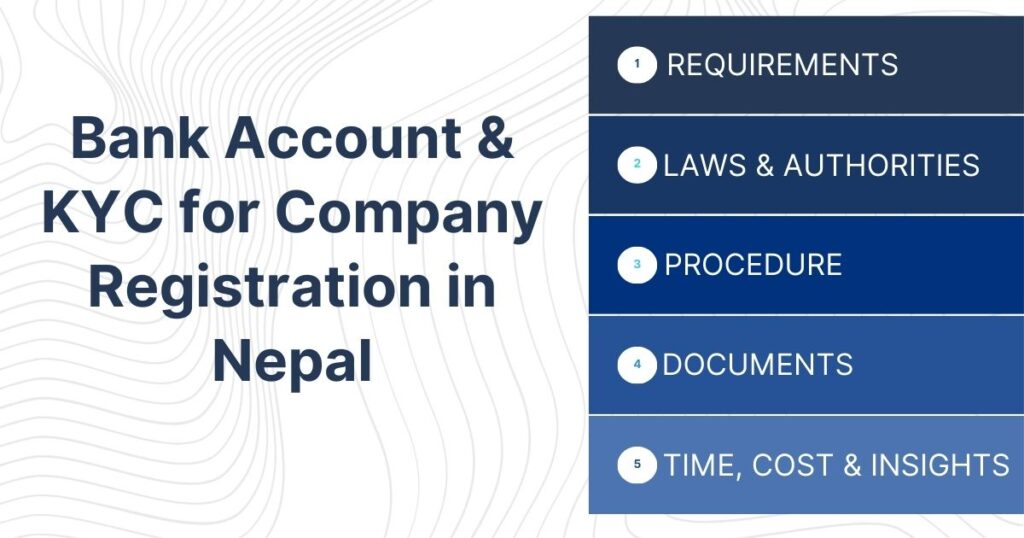
Bank account opening and Know Your Customer (KYC) procedures form essential components of company registration in Nepal. These processes ensure regulatory compliance, facilitate financial transactions, and establish the legal identity of business entities. The Nepal Rastra Bank (NRB) and commercial banks enforce KYC requirements under the Anti-Money Laundering (AML) Act, 2064 BS and related regulations. Understanding these procedures enables companies to complete registration efficiently and maintain operational legitimacy.
KYC Requirements for Company Registration
KYC procedures establish the identity and legitimacy of companies before financial institutions process account applications. Banks verify company information against registration documents and assess beneficial ownership structures. The NRB mandates KYC compliance through the KYC Directive, 2074 BS, which applies to all financial institutions operating in Nepal.
Companies must submit the following KYC documentation:
- The company must provide a certified copy of the Certificate of Registration issued by the Office of the Company Registrar.
- The company must submit the Memorandum and Articles of Association or equivalent constitutional documents.
- The company must present valid identification documents of all directors and shareholders holding significant ownership stakes.
- The company must disclose the beneficial ownership structure and identify all persons with ultimate control over the entity.
- The company must provide proof of registered office address through utility bills or property ownership documents.
- The company must submit the company’s PAN (Permanent Account Number) certificate issued by the Inland Revenue Department.
Bank Account Opening Process for Companies
Opening a bank account requires companies to complete sequential steps and submit required documentation to the selected financial institution. The process typically spans five to ten business days, depending on document verification timelines and bank processing capacity.
Step-by-step bank account opening procedure:
- The company must select a commercial bank or financial institution authorized to operate in Nepal.
- The company must obtain and complete the bank’s account opening form with accurate company information.
- The company must submit all required KYC documents to the bank’s account opening department.
- The bank must verify submitted documents against the Company Registrar’s records and NRB databases.
- The bank must conduct due diligence on beneficial owners and assess money laundering risks.
- The company must receive approval notification and account opening confirmation from the bank.
- The company must collect the bank account number, checkbook, and debit card from the designated branch.
Required Documents for Bank Account Opening
Financial institutions require comprehensive documentation to establish company identity and assess regulatory compliance. Document requirements align with NRB guidelines and individual bank policies.
| Document Type | Description | Issued By |
|---|---|---|
| Certificate of Registration | Official company registration document | Office of the Company Registrar |
| Memorandum of Association | Company constitutional document defining objectives | Company Registrar |
| Articles of Association | Internal governance and operational rules | Company Registrar |
| PAN Certificate | Tax identification document | Inland Revenue Department |
| Director Identification | Valid passport or citizenship certificate | Government of Nepal |
| Shareholder Details | List of shareholders with ownership percentages | Company records |
| Registered Office Proof | Utility bill or property ownership document | Utility provider or property owner |
| Board Resolution | Resolution authorizing account opening | Company board |
KYC Verification Process
Banks conduct systematic verification of company information and beneficial ownership structures. The verification process ensures compliance with AML Act, 2064 BS provisions and NRB directives.
KYC verification involves the following steps:
- The bank must cross-reference company registration details with the Company Registrar’s official database.
- The bank must verify director and shareholder identities using government-issued identification documents.
- The bank must assess the source of funds and business nature to determine money laundering risk levels.
- The bank must identify beneficial owners who exercise ultimate control over the company.
- The bank must document all verification findings in the bank’s KYC file.
- The bank must obtain approval from the bank’s compliance officer before account activation.
Beneficial Ownership Disclosure
Beneficial ownership identification forms a mandatory component of KYC procedures under NRB regulations. Companies must disclose all natural persons who ultimately own or control the entity, regardless of shareholding structure.
The NRB defines beneficial owners as natural persons who exercise ultimate control through direct or indirect ownership exceeding 25 percent of shares or voting rights. Companies must provide complete information on beneficial owners, including names, addresses, identification numbers, and ownership percentages. This disclosure prevents misuse of corporate structures for money laundering or terrorist financing activities. Banks maintain beneficial ownership records and report suspicious patterns to the Financial Information Unit (FIU) as required by law.
Compliance with Anti-Money Laundering Regulations
The Anti-Money Laundering Act, 2064 BS establishes the legal framework for KYC and financial transaction monitoring in Nepal. Banks implement AML compliance programs to detect and report suspicious activities.
Companies must comply with the following AML requirements:
- The company must provide accurate and complete information during KYC procedures without concealment or misrepresentation.
- The company must disclose all sources of funds used for business operations and capital contributions.
- The company must maintain records of financial transactions and business activities as required by law.
- The company must report any changes in ownership structure or beneficial ownership to the bank within 30 days.
- The company must cooperate with bank inquiries regarding transaction patterns or fund sources.
- The company must comply with sanctions lists maintained by the Financial Information Unit.
PAN Registration and Tax Compliance
The Permanent Account Number (PAN) serves as the company’s unique tax identification number issued by the Inland Revenue Department. Banks require PAN certificates before processing account applications.
Companies must obtain PAN registration before opening bank accounts. The PAN certificate establishes tax compliance status and enables the Inland Revenue Department to monitor business income and tax obligations. Companies must provide the PAN certificate during KYC procedures and maintain updated tax filings. The PAN remains valid throughout the company’s operational period and must be referenced in all financial transactions and tax documents.
Read More:
- https://lawaxion.com/nrn-online-company-registration-in-nepal/
- https://lawaxion.com/private-limited-company-registration-for-nrns-in-nepal/
- https://lawaxion.com/foreign-company-registration-in-nepal-fitta-2019/
- https://lawaxion.com/10-mistakes-to-avoid-when-incorporating-as-a-foreigner-in-nepal/
- https://lawaxion.com/faq-for-foreign-entrepreneurs-incorporating-in-nepal/
Frequently Asked Questions
What documents do companies need for KYC procedures?
Companies require the Certificate of Registration, Memorandum and Articles of Association, director identification documents, PAN certificate, beneficial ownership disclosure, and registered office proof. Banks may request additional documents based on business nature and risk assessment.
How long does bank account opening take?
The process typically requires five to ten business days from document submission to account activation. Timeline depends on document verification speed and bank processing capacity.
What is beneficial ownership disclosure?
Beneficial ownership disclosure identifies natural persons exercising ultimate control over the company, regardless of formal shareholding structure. This disclosure prevents misuse of corporate structures for illegal activities.
Are KYC procedures mandatory for all companies?
Yes, the NRB mandates KYC compliance for all companies opening bank accounts in Nepal. Compliance with KYC procedures is a legal requirement under the Anti-Money Laundering Act, 2064 BS.
Can companies update KYC information after account opening?
Yes, companies must notify banks of changes in ownership structure, beneficial ownership, or registered office address within 30 days. Banks update KYC files accordingly.
What happens if companies provide false KYC information?
Providing false information violates the Anti-Money Laundering Act, 2064 BS and may result in account closure, legal penalties, and criminal prosecution. Companies must ensure accuracy of all submitted information.
READ MORE: Conducting Vendor Due Diligence in Nepal
Conclusion
Bank account opening and KYC procedures establish the legal and financial foundation for company operations in Nepal. Compliance with NRB directives and AML regulations ensures regulatory legitimacy and facilitates banking relationships. Companies must submit complete documentation, disclose beneficial ownership accurately, and maintain updated information throughout their operational period. Understanding these requirements enables efficient account opening and sustained regulatory compliance.