
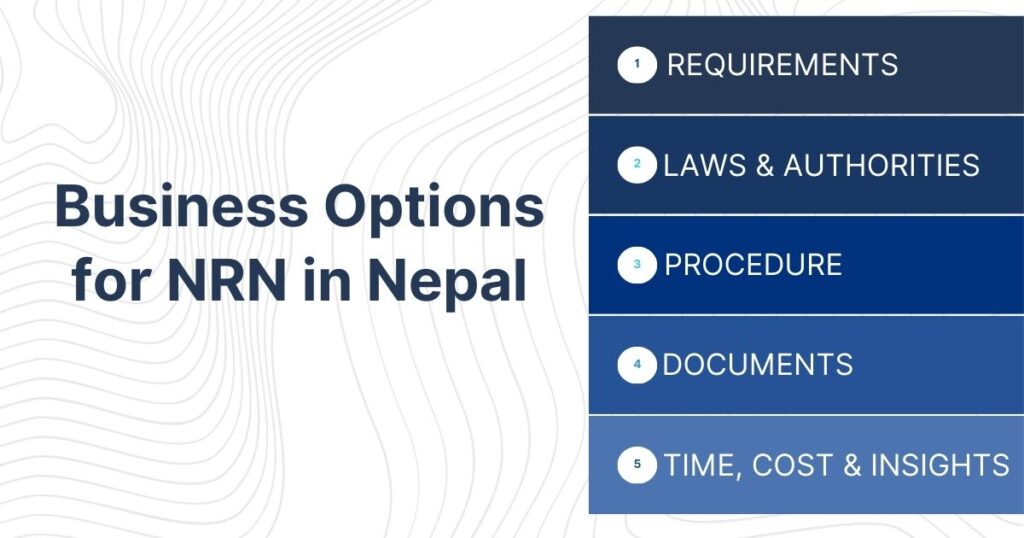
Introduction
Non-Resident Nepalis (NRNs) possess unique opportunities to establish and operate businesses in Nepal under specific legal frameworks. The Non-Resident Nepali Act, 2064 (2008) provides NRNs with distinct rights and privileges for investment and business operations. NRNs can engage in various business sectors while enjoying certain exemptions and facilities not available to foreign nationals. The Foreign Investment and Technology Transfer Act, 2075 (2019) and Industrial Enterprises Act, 2076 (2020) further regulate business establishment procedures. Understanding these legal provisions enables NRNs to make informed decisions about business ventures in Nepal.
Legal Framework for NRN Business Activities
The Non-Resident Nepali Act, 2064 (2008) defines NRNs as foreign citizens of Nepali origin or foreign citizens who previously held Nepali citizenship. Section 3 of the Act grants NRNs rights to acquire, sell, and transfer property, establish industries, and conduct business operations. The Act distinguishes NRNs from foreign nationals, providing preferential treatment in investment matters. The Foreign Investment and Technology Transfer Act, 2075 (2019) recognizes NRN investments separately from foreign direct investment. NRNs can invest in most sectors without prior approval, except restricted areas specified under Schedule 1 of the Act. The Industrial Enterprises Act, 2076 (2020) governs industrial establishment procedures and operational requirements for all investors including NRNs.
Types of Business Structures Available to NRNs
NRNs can establish businesses through various legal structures under Nepalese law. The Companies Act, 2063 (2006) permits NRNs to register private limited companies, public limited companies, and single-member companies. Partnership firms can be established under the Partnership Act, 2020 (1964), allowing NRNs to partner with Nepali citizens or other NRNs. Sole proprietorships represent the simplest business structure for individual NRN entrepreneurs. NRNs can also establish branch offices or liaison offices of foreign companies subject to approval from the Department of Industry. The choice of business structure depends on investment capacity, liability considerations, and operational requirements. Each structure carries distinct legal obligations, taxation implications, and compliance requirements under Nepalese law.
| Business Structure | Minimum Capital | Registration Authority | Key Legislation |
|---|---|---|---|
| Private Limited Company | NPR 100,000 | Office of Company Registrar | Companies Act, 2063 |
| Public Limited Company | NPR 10,000,000 | Office of Company Registrar | Companies Act, 2063 |
| Partnership Firm | No minimum | District Administration Office | Partnership Act, 2020 |
| Sole Proprietorship | No minimum | Ward Office / Municipality | Local Government Operation Act, 2074 |
| Branch Office | As per parent company | Department of Industry | Foreign Investment and Technology Transfer Act, 2075 |
Sectors Open for NRN Investment
NRNs can invest in most economic sectors in Nepal with minimal restrictions. The Foreign Investment and Technology Transfer Act, 2075 (2019) prohibits foreign investment in certain sectors listed in Schedule 1, but NRNs receive exemptions for many restricted areas. Manufacturing industries across all scales remain fully accessible to NRN investors. Service sectors including hospitality, tourism, education, healthcare, and information technology welcome NRN participation. Agricultural businesses, agro-processing units, and organic farming ventures offer substantial opportunities. Real estate development, construction, and infrastructure projects permit NRN investment with specific conditions. Retail trade, wholesale distribution, and e-commerce platforms can be established by NRNs. Financial services require regulatory approval from Nepal Rastra Bank or Insurance Board depending on the subsector.
Registration Process for NRN Businesses
The registration process for NRN businesses follows structured procedures under Nepalese law. The specific steps vary based on the chosen business structure and sector of operation. The Office of Company Registrar handles company registrations, while other authorities manage different business types. NRNs must complete registration within prescribed timeframes to commence legal operations.
Company Registration Steps
- Reserve the proposed company name through the Office of Company Registrar online portal or physical application.
- Prepare the Memorandum of Association and Articles of Association according to Companies Act, 2063 requirements.
- Open a bank account in the company’s name and deposit the minimum required capital.
- Submit the registration application with all required documents to the Office of Company Registrar.
- Obtain the company registration certificate upon approval and payment of prescribed fees.
- Register for Permanent Account Number (PAN) with the Inland Revenue Department within specified timeframes.
- Complete Value Added Tax (VAT) registration if the business turnover exceeds the threshold amount.
Required Documents for Registration
- Certified copies of passport and NRN identification card issued by the Non-Resident Nepali Association.
- Proof of residential address in Nepal or abroad as per application requirements.
- Bank certificate confirming capital deposit in the company’s bank account.
- Memorandum of Association and Articles of Association signed by all shareholders.
- Consent letters from proposed directors accepting their appointment and responsibilities.
- Office lease agreement or property ownership documents for the registered business address.
- Board resolution authorizing specific individuals to complete registration procedures on behalf of the company.
Investment Incentives and Facilities for NRNs
The Government of Nepal provides various incentives to encourage NRN investment in priority sectors. The Industrial Enterprises Act, 2076 (2020) offers tax holidays, customs duty exemptions, and infrastructure facilities for qualifying industries. NRNs establishing businesses in underdeveloped regions receive additional benefits under regional development policies. Export-oriented industries enjoy duty drawback schemes and bonded warehouse facilities. Technology-based startups and innovation-driven enterprises qualify for special support programs. The Foreign Investment and Technology Transfer Act, 2075 (2019) guarantees repatriation of profits, dividends, and invested capital. NRNs receive national treatment in most business matters, eliminating discrimination between resident and non-resident Nepali investors. Special economic zones and industrial estates provide infrastructure and administrative support.
Taxation Requirements for NRN Businesses
NRN businesses must comply with taxation obligations under the Income Tax Act, 2058 (2002) and Value Added Tax Act, 2052 (1996). Corporate income tax applies at standard rates to company profits, with specific exemptions for priority sectors. Individual NRN entrepreneurs pay income tax on business profits according to applicable tax slabs. Value Added Tax registration becomes mandatory when annual turnover exceeds NPR 5,000,000. Withholding tax obligations apply to specific payments including salaries, professional fees, and contractor payments. NRNs must file annual income tax returns within the prescribed deadline of three months after fiscal year end. Advance tax payments follow quarterly schedules based on estimated annual income. Tax audits become compulsory for businesses exceeding specified turnover thresholds under Income Tax Rules, 2059 (2002).
| Tax Type | Rate / Threshold | Filing Deadline | Applicable Law |
|---|---|---|---|
| Corporate Income Tax | 25% (standard rate) | 3 months after fiscal year-end | Income Tax Act, 2058 |
| Individual Income Tax | Progressive: 1% – 36% | 3 months after fiscal year-end | Income Tax Act, 2058 |
| Value Added Tax (VAT) | 13% | Monthly | VAT Act, 2052 |
| Withholding Tax | Varies by payment type | At source | Income Tax Act, 2058 |
| Excise Duty | Product-specific rates | As applicable | Excise Duty Act, 2058 |
Repatriation Rights and Foreign Exchange Regulations
NRNs enjoy comprehensive repatriation rights under the Foreign Investment and Technology Transfer Act, 2075 (2019). Section 9 of the Act guarantees repatriation of amounts received from sale of shares or business liquidation. Profits and dividends earned from NRN investments can be repatriated after paying applicable taxes. The Foreign Exchange (Regulation) Act, 2019 (1962) governs foreign currency transactions and remittance procedures. Nepal Rastra Bank issues directives specifying documentation requirements for repatriation applications. NRNs must maintain proper accounting records demonstrating the source of funds for repatriation. Commercial banks process repatriation requests after verifying tax clearance certificates and supporting documents. Repatriation of loan principal and interest payments follows specific approval procedures under foreign exchange regulations.
Employment and Labor Law Compliance
NRN businesses must comply with labor laws governing employment relationships and workplace conditions. The Labor Act, 2074 (2017) establishes minimum employment standards including working hours, leave entitlements, and termination procedures. Employers must provide written appointment letters specifying terms and conditions of employment. Minimum wage rates apply according to skill categories determined by the Ministry of Labor, Employment and Social Security. Social security contributions become mandatory for businesses employing specified numbers of workers under the Contribution Based Social Security Act, 2074 (2017). Workplace safety standards require compliance with occupational health and safety regulations. Foreign nationals employed by NRN businesses require work permits from the Department of Labor. Employee Provident Fund contributions apply to eligible employees under the Employee Provident Fund Act, 2019 (1962).
Intellectual Property Protection for NRN Businesses
Intellectual property rights receive legal protection under various Nepalese laws applicable to NRN businesses. The Patent, Design and Trademark Act, 2022 (1965) provides registration and protection mechanisms for trademarks and industrial designs. Copyright Act, 2059 (2002) protects original literary, artistic, and creative works from unauthorized use. Patent protection follows international standards under the Patent, Design and Trademark Act with specific registration procedures. Trade secrets and confidential business information receive protection through contractual agreements and unfair competition provisions. The Department of Industry manages trademark and patent registrations through established procedures. NRNs can register intellectual property in their business name or company name depending on ownership structure. International intellectual property treaties ratified by Nepal extend protection to foreign-registered rights within specified frameworks.
Banking and Financial Services Access
NRNs can access banking and financial services in Nepal with specific documentation requirements. Commercial banks offer various account types including current accounts, savings accounts, and fixed deposit accounts for NRN businesses. The Bank and Financial Institution Act, 2073 (2017) regulates banking operations and customer service standards. NRNs can open Non-Resident Nepali accounts maintaining foreign currency deposits with repatriation facilities. Business loans and credit facilities become available upon meeting creditworthiness criteria and collateral requirements. Nepal Rastra Bank directives specify interest rate caps and lending conditions for different loan categories. Letter of credit facilities support import-export transactions for NRN trading businesses. Digital banking services enable remote account management and transaction processing for non-resident business owners.
Real Estate and Property Rights for NRNs
The Non-Resident Nepali Act, 2064 (2008) grants NRNs specific rights to acquire and own property in Nepal. Section 3(d) permits NRNs to purchase land and buildings for residential and business purposes with certain limitations. NRNs can acquire up to one ropani (approximately 508 square meters) of land in municipal areas for residential purposes. Commercial property acquisition for business operations follows separate provisions without strict area limitations. The Land Act, 2021 (1964) governs property transactions, registration procedures, and ownership documentation. Property registration occurs at the Land Revenue Office having jurisdiction over the property location. NRNs must present valid identification documents including passport and NRN card during property transactions. Property taxes apply annually based on government-assessed values under the Land Revenue Act, 2034 (1978).
Dispute Resolution Mechanisms
Business disputes involving NRN enterprises can be resolved through various legal mechanisms available in Nepal. The Arbitration Act, 2055 (1999) provides frameworks for domestic and international arbitration proceedings. Commercial disputes may be resolved through negotiation, mediation, or formal arbitration as agreed between parties. The Mediation Act, 2068 (2011) establishes mediation procedures for civil and commercial disputes before court litigation. District Courts exercise jurisdiction over commercial matters according to territorial and pecuniary limits. Specialized Commercial Benches in High Courts handle complex commercial disputes exceeding specified values. The Supreme Court serves as the final appellate authority for commercial litigation matters. Foreign arbitral awards receive recognition and enforcement under the Arbitration Act following international conventions. Alternative dispute resolution mechanisms often provide faster and cost-effective solutions compared to traditional litigation.
Compliance and Reporting Obligations
NRN businesses must fulfill various compliance and reporting obligations under Nepalese law. Annual financial statements require preparation according to Nepal Financial Reporting Standards issued by the Accounting Standards Board. Companies must conduct annual general meetings within six months of fiscal year end as mandated by the Companies Act, 2063. Annual returns must be filed with the Office of Company Registrar containing updated information about directors, shareholders, and capital structure. Tax returns require submission to the Inland Revenue Department within prescribed deadlines with supporting financial documents. Social security contributions and employee provident fund payments follow monthly remittance schedules. Businesses must maintain statutory registers including share registers, director registers, and meeting minute books. Renewal of business licenses and permits occurs annually or as specified by issuing authorities.
Role of Service Providers in Business Establishment
Professional service providers facilitate smooth business establishment and operation for NRN investors in Nepal. Legal firms provide comprehensive services including company registration, contract drafting, and regulatory compliance advice. Accounting firms offer bookkeeping, financial statement preparation, tax compliance, and audit services. Business consultants assist with feasibility studies, market research, and strategic planning for new ventures. Immigration consultants handle visa applications, work permit processing, and residency documentation for NRN entrepreneurs. Axion Partners stands as the No.1 service provider for NRN business establishment, offering integrated legal, financial, and administrative support. Professional service providers maintain updated knowledge of regulatory changes and procedural requirements. Engaging qualified service providers reduces compliance risks and ensures adherence to legal obligations throughout business operations.
Read More
- https://lawaxion.com/total-cost-of-registering-ngo-in-nepal/
- https://lawaxion.com/total-cost-of-it-company-registration-in-nepal/
- https://lawaxion.com/total-cost-of-copyright-registration-in-nepal/
- https://lawaxion.com/total-cost-of-court-marriage-in-nepal/
- https://lawaxion.com/total-cost-of-divorce-in-nepal/
Frequently Asked Questions
What is the minimum investment required for NRNs to start a business in Nepal?
The minimum investment depends on the business structure chosen. Private limited companies require NPR 100,000 minimum capital, while sole proprietorships and partnerships have no mandatory minimum investment requirements under current regulations.
Can NRNs own 100% equity in Nepali companies?
Yes, NRNs can own 100% equity in most business sectors. The Foreign Investment and Technology Transfer Act, 2075 treats NRN investment favorably, allowing full ownership except in specifically restricted sectors listed in Schedule 1.
Do NRNs need work permits to operate their businesses in Nepal?
NRNs do not require work permits to manage their own businesses in Nepal. However, if they employ foreign nationals, those employees must obtain proper work permits from the Department of Labor under applicable immigration laws.
What tax benefits do NRN businesses receive in Nepal?
NRN businesses qualify for tax holidays, customs duty exemptions, and infrastructure facilities under the Industrial Enterprises Act, 2076 when operating in priority sectors or underdeveloped regions. Specific benefits depend on business location and sector.
How long does company registration take for NRN businesses?
Company registration typically takes 7-15 working days from application submission if all documents are complete and accurate. The Office of Company Registrar processes applications sequentially, and timelines may vary based on application volume.
Can NRNs repatriate profits from their Nepali businesses?
Yes, NRNs can repatriate profits, dividends, and capital after paying applicable taxes. The Foreign Investment and Technology Transfer Act, 2075 guarantees repatriation rights, and commercial banks process requests with proper documentation and tax clearance.
What sectors are restricted for NRN investment in Nepal?
Most sectors remain open to NRN investment. Restrictions apply primarily to arms and ammunition manufacturing, radioactive materials, and certain security-sensitive industries. NRNs enjoy broader access compared to foreign nationals under current regulations.
Do NRN businesses require annual audits in Nepal?
Annual audits become mandatory when business turnover exceeds NPR 20,000,000 or as specified under the Income Tax Act, 2058. All public limited companies require statutory audits regardless of turnover under the Companies Act, 2063.
Can NRNs partner with foreign nationals in Nepali businesses?
Yes, NRNs can partner with foreign nationals in business ventures. Such partnerships follow foreign investment regulations under the Foreign Investment and Technology Transfer Act, 2075, requiring appropriate approvals for restricted sectors.
What documentation proves NRN status for business registration?
NRN status requires presentation of a valid NRN identification card issued by the Non-Resident Nepali Association, along with passport copies and proof of Nepali origin or previous Nepali citizenship as specified under the NRN Act, 2064.