
This guide provides the available methods for NRNs to purchase property, including requirements, applicable laws, processes, necessary documents, and the timeline for property acquisition.

Non-Resident Nepalis (NRNs) can legally purchase property in Nepal by following specific procedures established under the NRN Act and Rules. The process requires obtaining approval from the Ministry of Foreign Affairs before completing the property transaction.
NRNs must declare that neither they nor their immediate family members currently own property in Nepal. After receiving ministry approval, they must register the property at the Land Revenue Office. The government has set clear limits on the amount of land NRNs can purchase based on location.
Step-By-Step Process for Purchasing Property as NRNs
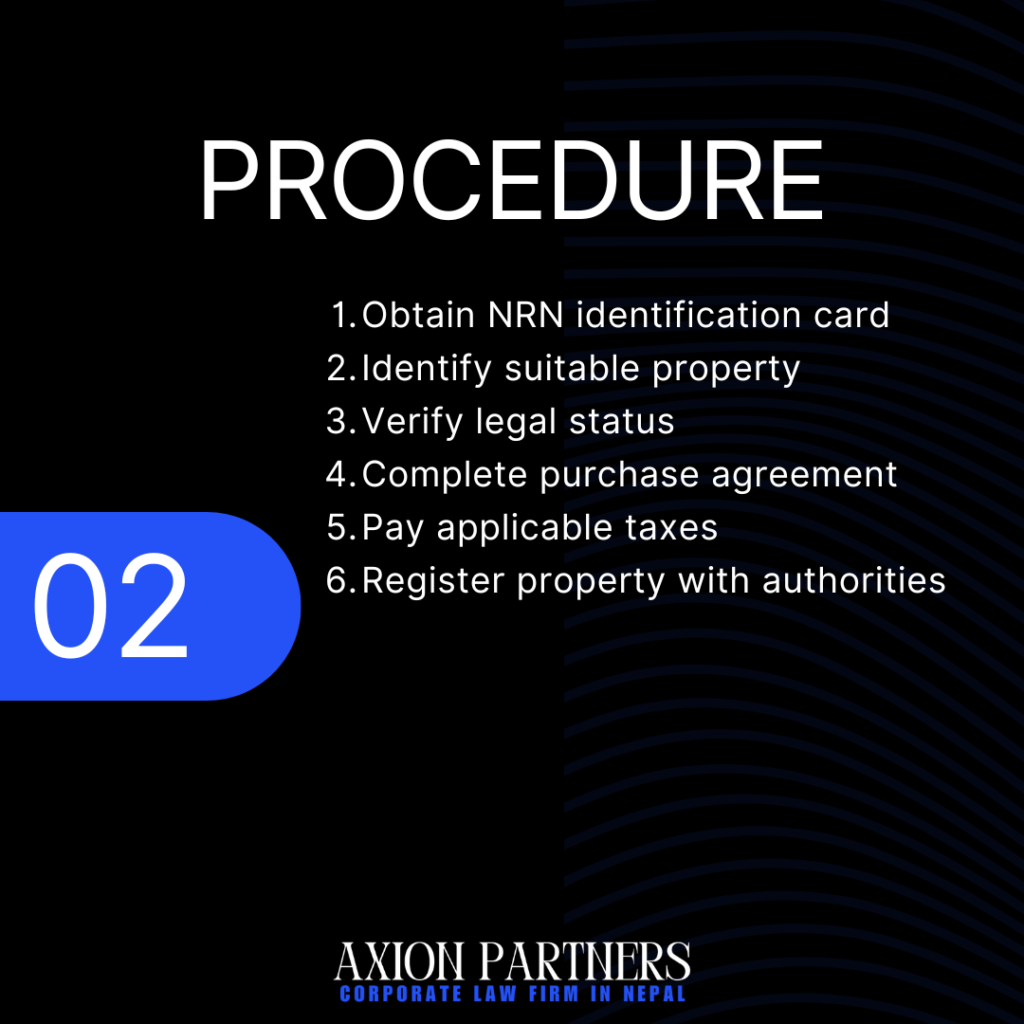
Step 1: Obtain NRN identity card from the Department of Immigration or Nepali embassy abroad.
Step 2: Identify suitable property within permitted land area limits for your chosen location.
Step 3: Submit application to Ministry of Foreign Affairs with property details and location information.
Step 4: Declare absence of existing property ownership by you or immediate family members.
Step 5: Receive written permission from the Ministry of Foreign Affairs for property purchase.
Step 6: Complete property registration at the Land Revenue Office with blue-colored ownership certificate.
What Is NRN Property Purchase in Nepal?
NRN property purchase refers to the legal process allowing foreign citizens of Nepali origin to buy land in Nepal. The government created this provision under Section 11 of the NRN Rules, 2066. This facility enables NRNs to own residential property for themselves or their families. The law recognizes the special status of Nepalis living abroad. It provides them limited property ownership rights within Nepal’s borders.
The property purchase right comes with specific restrictions and conditions. NRNs cannot buy unlimited land anywhere in Nepal. The government has established maximum area limits based on geographic location. These limits vary between Kathmandu Valley, municipalities, and village development committees.
The purchase process requires official approval from government authorities. NRNs must follow proper legal channels to complete property transactions. The Ministry of Foreign Affairs plays a central role in granting purchase permissions. After approval, the Land Revenue Office handles the final registration.
What Types of Property Purchase Methods Exist for NRNs?
NRNs can purchase property in Nepal through three distinct legal methods. Each method has different requirements, procedures, and implications. The choice depends on individual circumstances and long-term plans.
| Purchase Method | Legal Basis | Property Limits | Key Requirements | Advantages |
|---|---|---|---|---|
| Ministry Approval | Section 11, NRN Rules 2066 | Area limits apply | NRN card, ministry permission | Maintains foreign citizenship |
| Nepali Citizenship Rights | Constitutional property rights | No specific limits | Must obtain Nepali citizenship | Full property ownership rights |
| Registered Company | Company Act provisions | Commercial purposes | Company registration in Nepal | Business property ownership |
The ministry approval method is most common for residential property. It allows NRNs to maintain foreign citizenship while owning limited property. The citizenship method requires giving up foreign citizenship in most cases. Company registration suits business-oriented property investments.
What Are the Requirements for NRN Property Purchase?
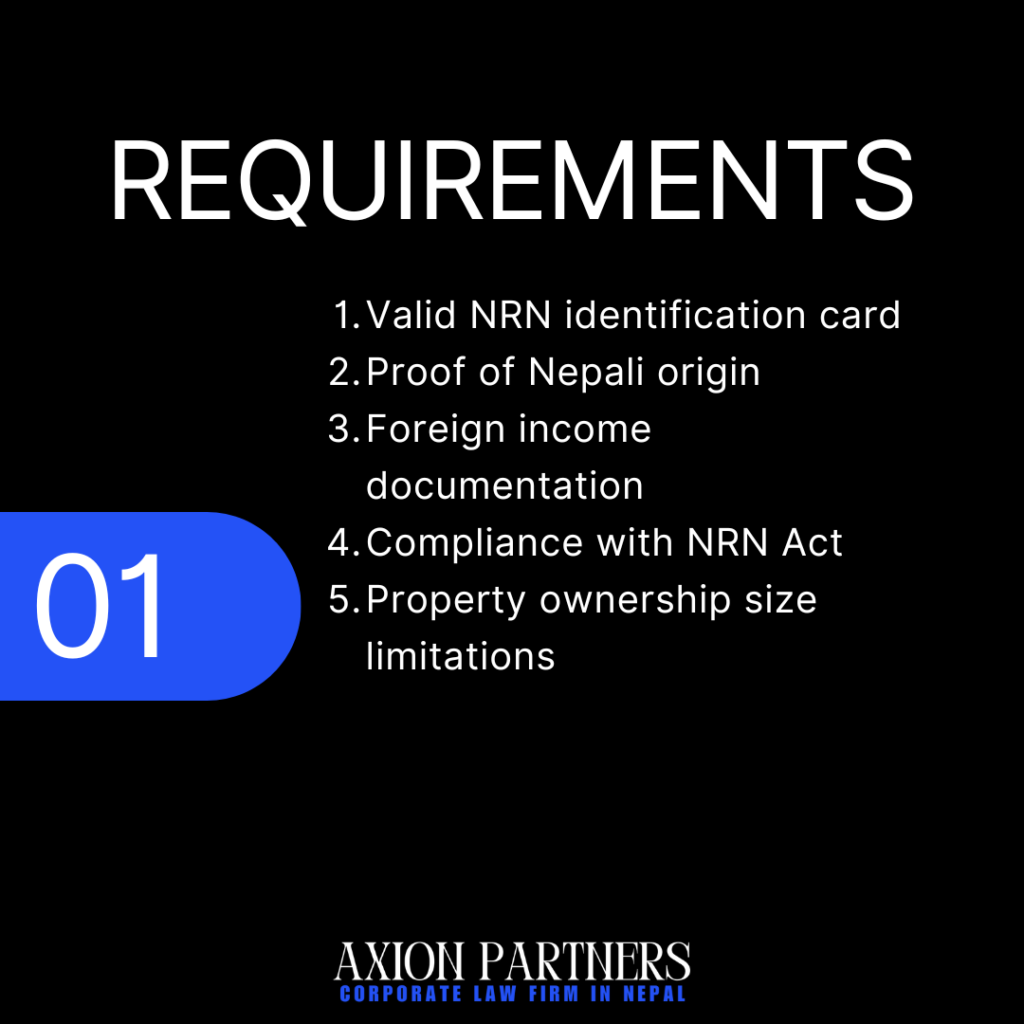
NRNs must hold a valid NRN identity card issued by Nepali authorities. The identity card proves their status as foreign citizens of Nepali origin. A clear declaration stating no existing property ownership is mandatory.
The property must fall within permitted area limits for the chosen location. NRNs cannot purchase land exceeding the maximum allowed size. The property should be intended for residential use only.
Can NRN Buy Property in Nepal?
Step 1: Obtain NRN Identity Card
Step 2: Identify Suitable Property
Step 3: Prepare Required Documents
Step 4: Submit Application to Ministry of Foreign Affairs
Step 5: Receive Approval from MoFA
Step 6: Register Property at Land Revenue Office
Step 1: Obtain NRN Identity Card
Apply for an NRN identity card through the Department of Immigration in Nepal. You can also apply at Nepali embassies or consulates in your country of residence. Submit required documents including proof of Nepali origin and current foreign citizenship. The application process takes several weeks for verification and approval.
Once approved, you receive an official NRN identity card. This card serves as your primary identification for property purchase. Keep the original card safe as you need it throughout the process. The identity card validates your eligibility under NRN Rules, 2066. Without this card, you cannot proceed with property purchase applications. Visit https://www.immigration.gov.np for detailed application procedures and requirements.
Step 2: Identify Suitable Property
Search for properties within your permitted area limits based on location. Engage local real estate agents familiar with NRN property regulations. Visit potential properties to assess their condition and suitability. Verify the property’s legal status at the local Land Revenue Office. Check for any existing disputes or encumbrances on the property.
Ensure the seller has clear ownership rights and proper documentation. Compare prices with similar properties in the same area. Consider proximity to essential services and infrastructure facilities. Evaluate future development potential and property appreciation prospects. Negotiate purchase terms with the seller before starting official procedures.
Step 3: Prepare Required Documents
Collect all necessary documents for the Ministry of Foreign Affairs application. Obtain certified copies of your NRN identity card and passport. Prepare a detailed property description including exact location and boundaries. Get survey documents and land maps from the seller. Draft a declaration stating you and your family own no other property in Nepal.
Include property valuation reports from authorized assessors. Gather seller’s ownership documents and title certificates. Prepare proof of financial capacity to complete the purchase. Translate all foreign documents into Nepali language if required. Organize documents systematically for smooth application processing.
Step 4: Submit Application to Ministry of Foreign Affairs
File your application at the Ministry of Foreign Affairs in Kathmandu. Include all prepared documents with the application form. Clearly mention the property location, area, and agreed purchase price. Provide complete details about your family members in Nepal. Submit the declaration of no existing property ownership.
Pay any applicable application processing fees at designated counters. Receive an official acknowledgment receipt with application reference number. The ministry conducts verification of all submitted information. Officials may request additional documents or clarifications during review. Track your application status through the ministry’s official channels at https://www.mofa.gov.np.
Step 5: Receive Ministry Approval
Wait for the Ministry of Foreign Affairs to complete verification procedures. The ministry checks compliance with the NRN Act and Rules. Officials verify that the property falls within permitted area limits. They confirm no existing property ownership by you or family members. The secretary issues written permission after satisfactory verification.
The approval letter specifies the property details and purchase authorization. This permission is valid for completing the property registration process. Keep multiple copies of the approval letter for future use. The approval does not expire but must be used for the specified property only. Any changes to property details require fresh application and approval.
Step 6: Register Property at Land Revenue Office
Visit the Land Revenue Office in the district where the property is located. Submit the Ministry of Foreign Affairs approval letter with registration application. Provide all property documents including seller’s ownership certificates. Complete the property transfer deed with proper legal documentation. Pay applicable registration fees and stamp duties at the office.
The Land Revenue Office verifies all documents before processing registration. Officials conduct final checks on property boundaries and measurements. Upon approval, they issue a blue-colored land ownership certificate. This certificate confirms your legal ownership as an NRN. The registration process completes your property purchase legally. Access district land revenue offices through https://www.dolr.gov.np for specific procedures.
What Documents Are Required for NRN Property Purchase?
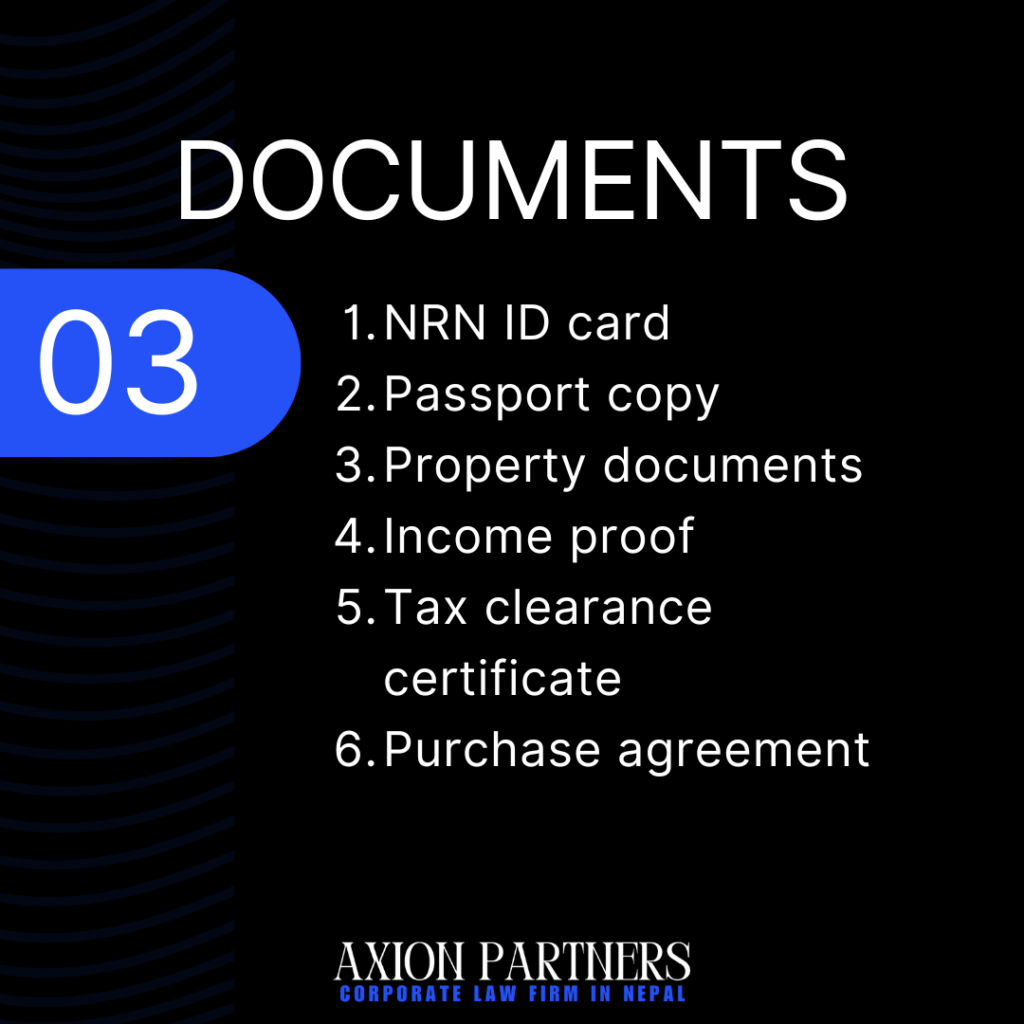
The Documents required for purchasing Property as NRN are:
- Valid NRN identity card issued by Department of Immigration
- Current passport with valid foreign citizenship status
- Proof of Nepali origin (birth certificate or ancestry documents)
- Declaration of no existing property ownership in Nepal
- Property location details with exact address and boundaries
- Land survey documents and property maps
- Seller’s original ownership certificate and title documents
- Property valuation report from authorized assessor
- Bank statements or financial capacity proof
- Passport-sized photographs (recent)
- Application form for Ministry of Foreign Affairs approval
Property Area Limits for NRNs Across Nepal
The following table shows maximum land area limits NRNs can purchase in different regions of Nepal. These limits are established under Section 11 of NRN Rules, 2066. NRNs must strictly comply with these limits when purchasing property. Exceeding these limits makes the purchase illegal and subject to cancellation. The limits apply to total property ownership, not individual transactions. If family members already own property, it counts toward these limits.
| Location Type | Maximum Area Allowed | Measurement Unit | Geographic Coverage |
|---|---|---|---|
| Kathmandu Valley | 2 | Ropani | Kathmandu, Lalitpur, Bhaktapur districts |
| Terai Municipalities | 8 | Kattha | All municipalities in Terai districts |
| Other Municipalities | 4 | Ropani | Municipalities outside Kathmandu and Terai |
| Terai Village Development Committees | 1 | Bigaha | VDCs in Terai districts |
| Other Areas | 10 | Ropani | All remaining areas in Nepal |
How Long Does NRN Property Purchase Take?
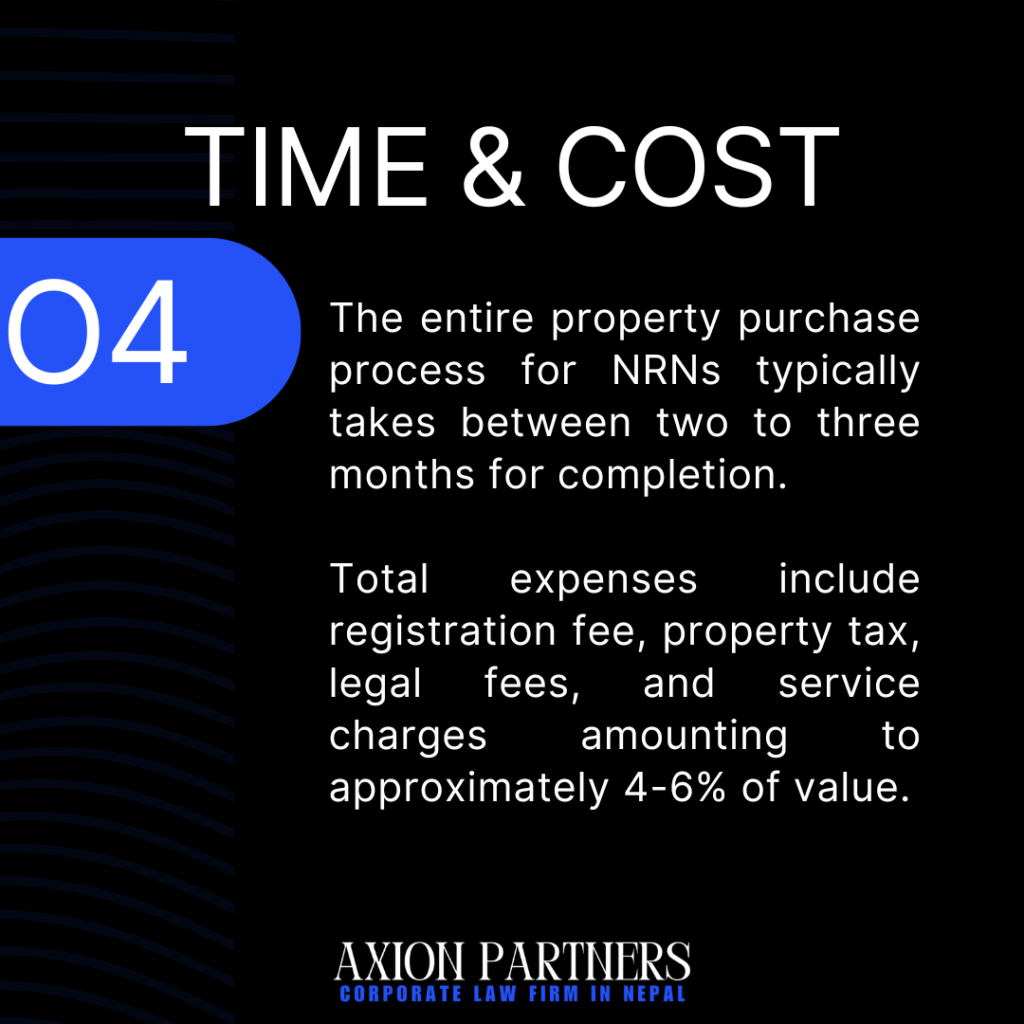
The complete NRN property purchase process typically takes seven working days after application submission.
- Application submission and acknowledgment: Same day
- Ministry of Foreign Affairs document verification: 3-4 working days
- Secretary’s approval and permission issuance: 1-2 working days
- Land Revenue Office registration process: 2-3 working days
- Blue-colored ownership certificate issuance: Same day as registration
- Total estimated timeline: 7 working days maximum
- Additional time for document preparation: Varies by individual case
- Property search and identification: Depends on availability and preferences
What Are the Costs for NRN Property Purchase?
The costs for NRN property purchase vary significantly based on multiple factors. The following table provides a general cost structure without specific amounts.
| Cost Category | Description |
|---|---|
| Property Price | Varies by location and size |
| Ministry Application Fee | Processing charge for approval |
| Registration Fee | Land Revenue Office charges |
| Stamp Duty | Government tax on property transfer |
| Legal Documentation | Lawyer fees for paperwork |
| Survey and Valuation | Property assessment charges |
| Translation Services | Document translation costs |
What Laws Govern NRN Property Purchase in Nepal?
The legal framework for NRN property purchase includes several important laws and regulations. The NRN Act, 2064 provides the primary legal foundation. Section 11 of NRN Rules, 2066 details specific property purchase provisions. These laws work together to regulate foreign citizen property ownership. Understanding these laws helps ensure legal compliance throughout the process.
- NRN Act, 2064: Establishes basic rights and facilities for NRNs
- NRN Rules, 2066: Provides detailed implementation procedures and restrictions
- Section 11 of NRN Rules: Specifically addresses property purchase rights and limits
- Land Revenue Act: Governs property registration and transfer procedures
- Land Registration Rules: Details registration process at Land Revenue Offices
- Local Government Operation Act: Regulates local authority involvement in property matters
Visit https://www.lawcommission.gov.np for complete legal texts and official translations.
What Benefits Do NRNs Get from Property Ownership?
Property ownership provides NRNs with several important benefits and advantages. These benefits strengthen connections between NRNs and their homeland. The government designed these provisions to encourage NRN investment in Nepal. Property ownership supports family ties and cultural connections.
- NRNs can establish a permanent residential base in Nepal for family visits and stays.
- They have the legal right to invest in Nepal’s real estate and secure property for retirement or future relocation.
- NRNs can provide housing for family members in Nepal and enjoy exemption from visa fees when visiting.
- Property ownership is legally protected under Nepali law, allowing potential rental income and estate planning for future generations.
- NRNs gain access to local banking, financial services, participation in community development, and recognition through a blue-colored ownership certificate.
Access more information about NRN benefits at https://www.nrn.org.np and https://www.mof.gov.np.
What is the maximum land an NRN can buy in Kathmandu?
NRNs can purchase maximum 2 Ropani of land in Kathmandu Valley. This limit applies to the entire valley including Kathmandu, Lalitpur, and Bhaktapur districts.
How do I apply for NRN property purchase?
Step 1: Obtain valid NRN identity card · Step 2: Prepare all required documents · Step 3: Submit application to MoFA · Step 4: Receive approval letter and complete registration.
What is the total timeline for property purchase?
The complete process takes approximately seven working days after application submission. This includes ministry verification, approval issuance, and land revenue office registration.
How much does NRN property purchase cost?
Property purchase costs vary significantly based on location, size, and market conditions. Government fees depend on property value and include registration and stamp duties. Legal and documentation costs add to the total expense. Consult local real estate professionals for current market prices.
Can my family members also buy property separately?
Family members with separate NRN status can apply independently for property purchase. However, total family property ownership must comply with area limits. The ministry verifies combined family holdings during approval process. Immediate family property counts toward individual limits.
What is a blue-colored ownership certificate?
The blue-colored certificate is a special land ownership document issued to NRNs. It distinguishes NRN property ownership from regular Nepali citizen ownership. The Land Revenue Office issues this certificate during property registration. It confirms legal ownership under NRN Rules, 2066.
How much property can an NRN buy in Nepal?
NRNs can purchase up to 10 Ropani (5,476 sq. meters) of land in urban areas or 25 Ropani (13,690 sq. meters) in rural areas. These limits are set by Nepali law to balance NRN investment opportunities with local land availability.
What documents do NRNs need for property purchase?
Essential documents include a valid NRN card, passport, proof of Nepali origin, property sale agreement, seller’s land ownership certificate, tax clearance certificates, and recent photographs. Additional documents may be required depending on specific circumstances.
Can NRNs sell their property in Nepal?
Yes, NRNs can sell their property in Nepal. However, they must comply with applicable laws, including tax regulations and foreign exchange rules when repatriating the proceeds of the sale.
How long does the property registration process take?
The property registration process typically takes 3-7 weeks, depending on document preparation, due diligence, and administrative procedures. Complex cases may require additional time.
Are there any restrictions on property location?
Yes, NRNs are prohibited from purchasing property in certain border regions and protected zones. It’s crucial to verify the eligibility of the desired location before proceeding with a purchase.
What are the tax implications for NRN property owners?
NRN property owners are subject to various taxes, including property tax, rental income tax (if applicable), and capital gains tax upon sale. Tax rates and regulations may vary based on location and property type.
Can NRNs get loans for property purchase?
NRNs may be eligible for loans from Nepali banks for property purchases, subject to specific conditions and credit assessments. However, loan availability and terms can vary, and NRNs should consult with financial institutions directly for current options.