Conducting Vendor Due Diligence in Nepal
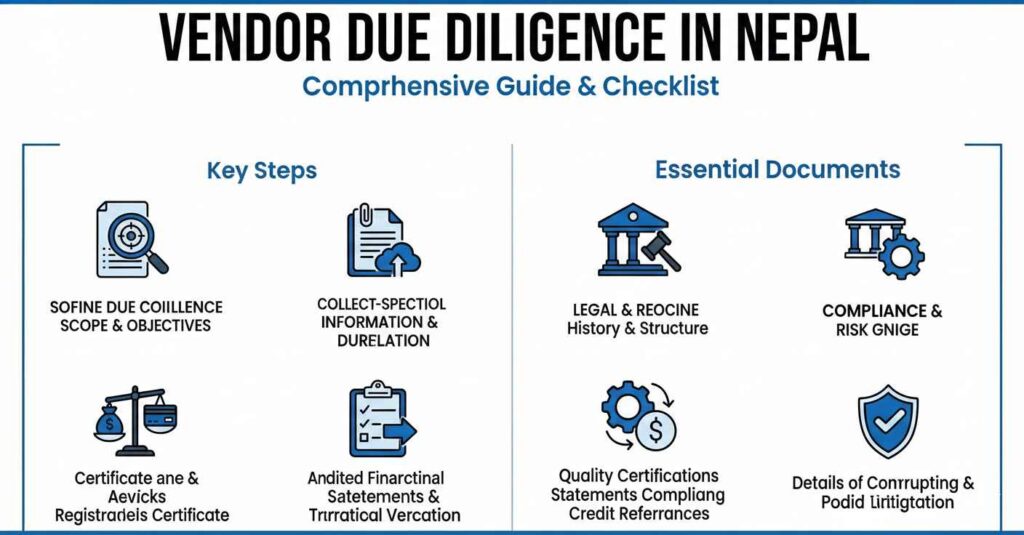
Understanding vendor due diligence in Nepal is essential for businesses to assess supplier credibility, legal compliance, financial stability, and operational capacity before entering commercial relationships, ensuring risk mitigation and regulatory adherence throughout procurement processes. Steps to Conduct Vendor Due Diligence in Nepal What Is Vendor Due Diligence in Nepal? Vendor due diligence in Nepal refers to the systematic process of investigating and evaluating potential suppliers, contractors, or service providers before establishing commercial relationships. This process involves comprehensive assessment of a vendor’s legal status, financial health, operational capabilities, compliance history, and reputation in the market. Businesses conduct vendor due diligence nepal procedures to minimize procurement risks, ensure regulatory compliance, and protect their commercial interests. The vendor due diligence process in Nepal encompasses verification of company registration documents, tax compliance certificates, financial statements, operational licenses, and past performance records. Companies examine whether vendors maintain proper legal standing with the Office of Company Registrar, Department of Industry, or relevant regulatory authorities. This investigation helps businesses identify potential red flags such as pending litigation, tax defaults, regulatory violations, or questionable business practices before committing to contractual arrangements. Conducting thorough vendor due diligence nepal assessments has become increasingly important as Nepalese businesses expand their supply chains and engage with diverse suppliers across different sectors. The process protects companies from financial losses, reputational damage, legal liabilities, and operational disruptions that may arise from partnerships with unreliable or non-compliant vendors. Proper due diligence establishes a foundation for sustainable business relationships built on transparency, accountability, and mutual trust. Where to Conduct Vendor Due Diligence in Nepal? Vendor due diligence in Nepal involves gathering information from multiple government offices, regulatory bodies, and commercial databases located primarily in Kathmandu and other major cities. The Office of Company Registrar, situated in Tripureshwor, Kathmandu, serves as the primary source for verifying company registration details, shareholding patterns, directorship information, and annual compliance status. Businesses can access company registration certificates, memorandum of association, articles of association, and annual return filings from this office. The Inland Revenue Department offices across Nepal provide crucial information regarding vendor tax compliance, including permanent account number verification, value-added tax registration status, and tax clearance certificates. Companies conducting vendor due diligence nepal investigations must verify that potential vendors maintain current tax registrations and have no outstanding tax liabilities. The Department of Industry, located in Tripureshwor, Kathmandu, maintains records of industrial enterprises and issues industry registration certificates that businesses should verify during due diligence processes. Sector-specific regulatory authorities also play important roles in vendor verification processes. The Nepal Rastra Bank regulates financial institutions, the Department of Food Technology and Quality Control oversees food-related businesses, and the Department of Mines and Geology supervises mining operations. Businesses can access official information through the Office of Company Registrar’s online portal at https://www.ocr.gov.np for preliminary company verification before conducting detailed on-site investigations. What Laws Govern Vendor Due Diligence in Nepal? Vendor due diligence in Nepal operates within a comprehensive legal framework that establishes requirements for business registration, financial reporting, tax compliance, and commercial transactions. While no single law specifically mandates vendor due diligence procedures, various statutes create obligations that businesses must verify during supplier assessments. Key laws and regulations governing vendor due diligence nepal processes include: How to Conduct Vendor Due Diligence in Nepal? Step 1: Define Due Diligence Scope and Objectives Establish clear objectives for the vendor due diligence nepal investigation based on transaction value, risk exposure, and business requirements. Determine which aspects require detailed examination including legal compliance, financial stability, operational capacity, or reputation assessment. Identify specific information sources, verification methods, and evaluation criteria that will guide the investigation process throughout all subsequent stages. Step 2: Collect Vendor Information and Documentation Request comprehensive documentation from potential vendors including company registration certificates, tax registration documents, financial statements, operational licenses, and references. Obtain permanent account number certificates, value-added tax registration certificates, industry registration certificates, and relevant sector-specific permits. Collect information about company ownership structure, management team, business history, and existing client relationships for thorough evaluation. Step 3: Verify Legal Registration and Compliance Status Confirm vendor legal status by verifying company registration details with the Office of Company Registrar and checking industry registration with the Department of Industry. Examine whether the company maintains good standing, has filed required annual returns, and possesses valid operational licenses. Review any pending litigation, regulatory violations, or compliance issues that may affect the vendor’s ability to fulfill contractual obligations. Step 4: Assess Financial Stability and Creditworthiness Analyze vendor financial statements including balance sheets, profit and loss accounts, and cash flow statements for the past three years. Evaluate financial ratios, liquidity positions, debt levels, and profitability trends to assess financial health. Verify tax compliance by obtaining tax clearance certificates and checking for any outstanding tax liabilities with the Inland Revenue Department. Step 5: Evaluate Operational Capacity and Reputation Assess vendor operational capabilities by examining production facilities, equipment, technology, workforce, and quality management systems. Conduct site visits to verify physical infrastructure and operational processes. Check vendor reputation through client references, market inquiries, and review of past performance records to ensure reliability and service quality standards. Step 6: Prepare Due Diligence Report and Recommendations Compile all findings into a comprehensive vendor due diligence nepal report documenting legal status, financial condition, operational capacity, compliance history, and identified risks. Provide clear recommendations regarding vendor suitability, risk mitigation measures, and contractual safeguards. Present the report to decision-makers with supporting documentation and suggested next steps for vendor engagement or rejection. What Documents Are Required for Vendor Due Diligence? Conducting comprehensive vendor due diligence in Nepal requires collection and verification of numerous documents that establish vendor legitimacy, compliance status, and operational capability. The following documents form the essential documentation package: What Are the Key Verification Areas in Vendor Due Diligence? Vendor due diligence in Nepal encompasses multiple verification areas that collectively provide a comprehensive assessment of supplier suitability and risk profile. Each verification area addresses specific aspects of vendor operations and compliance status. Verification Area Key Elements Information Sources Risk Indicators Legal Status Company registration, ownership structure, directorship,
Hospitality Business Incorporation in Nepal

Introduction to Hospitality Business Registration Requirements Establishing a hospitality business in Nepal requires careful navigation of various legal and regulatory requirements. The tourism sector, a vital component of Nepal’s economy, is governed by specific laws and regulations designed to ensure quality service and sustainable growth. This guide provides an overview of the essential steps and requirements for incorporating a hospitality business in Nepal. The primary legislation governing business registration in Nepal is the Companies Act, 2063 (2006). For hospitality businesses, additional regulations under the Tourism Act, 2035 (1978) and its subsequent amendments apply. These laws collectively form the regulatory framework within which hospitality enterprises must operate. Key considerations for entrepreneurs in the hospitality sector include choosing the appropriate legal structure, meeting capital requirements, obtaining necessary licenses, and ensuring compliance with health, safety, and environmental standards. Understanding these requirements is crucial for a smooth incorporation process and successful business operation. Legal Structure Options for Hospitality Businesses When incorporating a hospitality business in Nepal, entrepreneurs have several legal structure options to choose from. Each structure has its own set of advantages and regulatory requirements. The most common legal structures for hospitality businesses in Nepal are: Private Limited Company This is the most popular choice for medium to large-scale hospitality businesses. It offers limited liability protection to shareholders and allows for easier capital raising. Registration is done under the Companies Act, 2063 (2006). Public Limited Company Suitable for large-scale hospitality projects, this structure allows for public share offerings. It has more stringent regulatory requirements but provides access to public investment. Partnership Firm Ideal for small to medium-sized hospitality ventures, partnerships are registered under the Partnership Act, 2020 (1964). They offer flexibility but come with unlimited liability for partners. Sole Proprietorship This is the simplest structure for small hospitality businesses like cafes or guest houses. It’s easy to set up but doesn’t provide liability protection. The choice of legal structure impacts taxation, liability, and operational flexibility. Consulting with a legal expert is advisable to determine the most suitable structure for your specific hospitality venture. Documentation Requirements for Business Registration Process The business registration process in Nepal requires thorough documentation. For hospitality businesses, this process involves submitting various documents to multiple government agencies. Here’s a comprehensive list of the required documents: Additional Documents for Hospitality Businesses: It’s crucial to ensure all documents are accurately prepared and notarized where required. The Company Registrar’s Office (CRO) and the Department of Tourism are the primary agencies involved in the registration process for hospitality businesses. Capital Requirements for Hospitality Business Setup Capital requirements for hospitality businesses in Nepal vary depending on the scale and nature of the enterprise. The Companies Act, 2063 (2006) and the Foreign Investment and Technology Transfer Act, 2075 (2019) outline the minimum capital requirements for different business structures. Minimum Capital Requirements: For hospitality businesses, additional capital requirements may be imposed by the Department of Tourism based on the type and scale of the establishment: It’s important to note that these are minimum requirements, and actual capital needs may be significantly higher depending on the project scope. A detailed business plan and financial projection are essential to determine the appropriate capital structure for your hospitality venture. Location and Zoning Requirements for Establishments Selecting the right location for a hospitality business in Nepal is crucial and subject to various zoning laws and regulations. The Tourism Act, 2035 (1978) and local municipal bylaws govern the establishment of hospitality businesses in specific areas. Key Considerations for Location Selection: Zoning Requirements: Before finalizing a location, obtain a No Objection Certificate (NOC) from the local municipality or rural municipality. This document confirms that the proposed hospitality business complies with local zoning laws and development plans. For establishments in protected areas or national parks, additional clearances from the Department of National Parks and Wildlife Conservation may be required. Licensing Requirements from Tourism Department Authority Obtaining the necessary licenses is a critical step in establishing a hospitality business in Nepal. The Department of Tourism is the primary authority responsible for issuing licenses to tourism-related businesses. The licensing process ensures that the establishment meets the required standards of service and safety. Read More Steps to Obtain Tourism Business License: Types of Licenses: The Tourism Act, 2035 (1978) and its regulations outline specific criteria for each type of license. These criteria include minimum room numbers for hotels, seating capacity for restaurants, and professional qualifications for travel agencies. Licenses are typically issued for a period of five years and must be renewed regularly. Compliance with license conditions is monitored through periodic inspections by the Department of Tourism. Health and Safety Compliance for Hospitality Ensuring health and safety compliance is paramount in the hospitality industry. In Nepal, various laws and regulations govern health and safety standards for hospitality businesses. Compliance with these standards is not only a legal requirement but also crucial for maintaining the reputation and success of the establishment. Key Health and Safety Regulations: Essential Compliance Measures: Compliance with these regulations is monitored through regular inspections by relevant authorities. Non-compliance can result in penalties, license suspension, or revocation. It’s advisable to conduct internal audits regularly and maintain detailed records of all safety measures and incidents. Staff Requirements and Labor Law Compliance Staffing a hospitality business in Nepal requires adherence to the Labor Act, 2074 (2017) and associated regulations. Proper management of human resources is crucial for providing quality service and maintaining legal compliance. Key Labor Law Requirements: Staffing Guidelines for Hospitality Businesses: Training and Development: Compliance with labor laws is monitored by the Department of Labor. Regular audits and maintaining proper employment records are essential. It’s also important to establish clear policies on workplace conduct, non-discrimination, and grievance handling to ensure a positive work environment. Tax Registration and Compliance Requirements Process Tax compliance is a critical aspect of operating a hospitality business in Nepal. The tax system for hospitality businesses involves various types of taxes and requires registration with multiple authorities. Tax Registration Process: Key Taxes Applicable to Hospitality Businesses: Compliance Requirements: Tax Incentives
Food Supplement Registration in Nepal
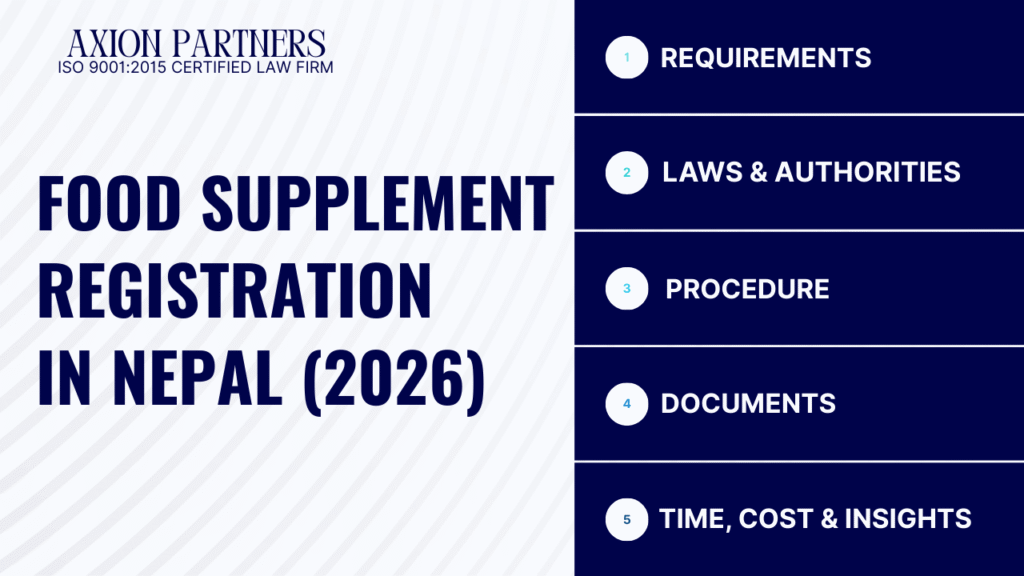
Food supplement registration in Nepal is a mandatory regulatory process administered by the Department of Food Technology and Quality Control (DFTQC). Registration requires mandatory laboratory tests, HACCP certification, and registration in the home country. The process takes 40–120 working days. This guide provides information on the laws, required documents, registration process, timelines, costs, import procedures, renewal procedures, and limitations related to food supplements in Nepal. Step-By-Step Process of Supplement Registration What Is Food Supplement Registration in Nepal? Food supplement registration in Nepal is the official authorization process required for dietary supplements, nutraceuticals, health supplements, and special dietary purpose foods before production, import, sale, or distribution. The Department of Food Technology and Quality Control oversees this registration under the Dietary Supplement Directives, 2072. This applies to various categories including foods for special dietary purposes, foods for special therapeutic use, nutraceuticals, and nutritional supplements. Food supplement registration in Nepal requires coordination between importers holding valid import-export licenses and manufacturers possessing ISO 22000 certification, GMP certification, and free sale certificates. Products must be registered in their country of origin and pass laboratory testing according to Nepal’s guidelines. Where To Register Food Supplements in Nepal? Food supplement registration in Nepal must be completed at the Department of Food Technology and Quality Control (DFTQC), the primary regulatory authority under the Ministry of Agricultural Development responsible for food safety, quality control, and product certification. The DFTQC headquarters located in Kathmandu processes all registration applications, conducts laboratory testing, and issues product registration certificates for dietary supplements and nutraceuticals. Applicants submit registration documents through the DFTQC online portal system, which facilitates application tracking, document submission, and communication with regulatory officials. The DFTQC laboratory facilities conduct mandatory testing for heavy metals, microbial contamination, active ingredients, and nutritional composition verification. For detailed information and application procedures, visit the official DFTQC . The Ministry of Agricultural Development provides additional regulatory guidance. Importers must also coordinate with the Department of Customs for import procedures. How To Register Food Supplements in Nepal? Step 1: Verify Eligibility of Product with Certifications The distributor must possess valid import-export license registration in Nepal with clearly mentioned capital and permission for dietary supplement import. The manufacturer must hold ISO 22000 certification, GMP certification, and free sale certificate from the country of origin. Verify product registration in the parent country and ensure compliance with Nepal’s quality standards. Step 2: Prepare Product Label and Documentation Design product label containing product name, identity (dietary supplement/health supplement/nutraceuticals), ingredient composition with RDA percentages, quantity, manufacturer details, manufacturing and expiry dates, batch number, health claims, recommended use, warnings, disclaimer stating “not intended to treat, cure or diagnose any diseases,” and importer details including name, address, EXIM code, and email. Step 3: Compile Required Documents for Registration Gather importer documents including application form, firm registration certificate, citizenship certificate, PAN, VAT, EXIM code, and brand name declaration. Collect manufacturer documents including production license, contract manufacturing agreement, warranty letter, free sale certificate, product registration proof, GMP certificate, HACCP or ISO 22000 certificate, colored label design, raw material specifications, product formulation, master formula card, production flowchart, and site master file. Step 4: Submit Application to DFTQC File registration application through the DFTQC online portal with complete documentation and product samples. Pay registration fees as per license issuance fee under Rule 28 of Food Regulations. Submit valid certificate of analysis from in-house and third-party government-approved laboratories showing active ingredient tests, contaminant tests for microbiological parameters, heavy metals, food additives, and residues. Step 5: Laboratory Testing at DFTQC Submit product samples for mandatory laboratory testing at DFTQC facilities. The department conducts analysis for heavy metals (cadmium, arsenic, lead, mercury), microbial contamination (yeast, mold, salmonella, E. coli, staphylococcus aureus), active ingredients verification, and nutritional composition. Testing ensures compliance with maximum permissible limits: cadmium not exceeding 1.5 ppm, arsenic 1.1 ppm, lead 2.5 ppm, mercury 1 ppm, with microbial pathogens absent. Step 6: Receive Product Registration Certificate Upon successful laboratory test approval and documentation verification, DFTQC issues the product registration certificate in prescribed format. The certificate authorizes legal production, import, sale, and distribution of the registered food supplement in Nepal. Maintain certificate validity through timely renewal as per Rule 31 of Food Regulations regarding license duration and renewal procedures. What Documents Are Required for Food Supplement Registration? Importer’s Documents: Manufacturer’s Documents: Laboratory Testing Documents: Additional Documents: Permissible Limit on Food Supplements in Nepal Under Dietary Supplement Directives, 2072, products must meet specified limits for heavy metal contamination and remain free from microbial pathogens. Parameter Maximum Permissible Limit / Requirement Testing Requirement Cadmium Not more than 1.5 ppm (mg/kg) Mandatory heavy metal analysis Arsenic Not more than 1.1 ppm (mg/kg) Mandatory heavy metal analysis Lead Not more than 2.5 ppm (mg/kg) Mandatory heavy metal analysis Mercury Not more than 1 ppm (mg/kg) Mandatory heavy metal analysis Yeast and Mold Count Should be Absent Mandatory microbiological testing Salmonella Should be Absent Mandatory microbiological testing Escherichia Coli Should be Absent Mandatory microbiological testing Staphylococcus aureus Should be Absent Mandatory microbiological testing Active Ingredients As per label claim Verification against declared composition Nutritional Composition Minimum 15% of RDA per serving Nutrient analysis with reference methods How Long Does Food Supplement Registration Take in Nepal? Food supplement registration in Nepal involves stages Submission of Application, Testing of Laboratory and Final Certificate of Issuance around 40-120 Working Days. The registration process typically requires the following timeframes: What Are the Costs for Food Supplement Registration? Food supplement registration in Nepal involves various fees payable to DFTQC and associated costs for documentation, testing, and compliance verification. Fee Category Amount Description Product Registration Fee As per Rule 28 of Food Regulations Charged for each product registration; domestic production exempt from registration fee Laboratory Testing Fee Variable based on test parameters Covers heavy metal analysis, microbial testing, active ingredient verification, and nutritional composition analysis Customs Duty for Import As per Import Export Inspection Directive Charged for import approval application processing before product importation Document Notarization Costs Depends For notarization of manufacturer agreements, warranty letters, GMP certificates, and authorization documents Renewal
Food & Product License and Registration in Nepal

Complete food product license and registration in Nepal. Ensure compliance with safety standards and launch your food business. Introduction to Food Product Registration Requirements Nepal Obtaining proper licensing and registration for food products is a critical step for businesses operating in Nepal’s food industry. The Department of Food Technology and Quality Control (DFTQC) oversees the registration process to ensure food safety and quality standards are met. This article will provide a comprehensive overview of the requirements, processes, and considerations for food product registration in Nepal. Key aspects of food product registration in Nepal include: Understanding these requirements is essential for businesses looking to legally produce, import, or distribute food products in the Nepalese market. Legal Framework for Food License Registration Process The legal framework governing food product registration in Nepal is primarily based on the following legislation: These laws establish the regulatory framework for food safety, quality control, and registration procedures. The Food Act 2023 (1966) is the primary legislation that empowers the government to regulate food production, distribution, and sale. It also outlines penalties for non-compliance and adulteration of food products. The Food Rules 2027 (1970) provide detailed guidelines on: Businesses must familiarize themselves with these legal requirements to ensure compliance throughout the registration process and subsequent operations. Documentation Requirements for Food Product Registration Nepal To initiate the food product registration process in Nepal, applicants must submit a comprehensive set of documents to the DFTQC. The required documentation typically includes: Ensuring all required documents are accurately prepared and submitted is crucial for a smooth registration process. Any missing or incomplete documentation may result in delays or rejection of the application. Quality Standards for Food Product License Process The DFTQC has established stringent quality standards that food products must meet to obtain registration and licensing. These standards are designed to ensure consumer safety and product integrity. Key quality parameters include: Products must comply with the specific standards set for their respective food categories. The DFTQC regularly updates these standards to align with international best practices and emerging food safety concerns. To demonstrate compliance, applicants may need to provide: Meeting these quality standards is essential for successful product registration and maintaining consumer trust in the Nepalese market. Laboratory Testing Requirements for Food Registration Nepal Laboratory testing is a crucial component of the food product registration process in Nepal. The DFTQC requires products to undergo various tests to verify their safety, quality, and compliance with established standards. Key aspects of laboratory testing include: The DFTQC operates its own laboratories for conducting these tests. However, in some cases, they may accept test reports from accredited third-party laboratories. The specific tests required depend on the product type and category. To facilitate the testing process, applicants should: Successful laboratory testing results are essential for obtaining food product registration in Nepal. Government Fees Structure for Food License Process The food product registration process in Nepal involves various government fees, which applicants must be prepared to pay. The fee structure is subject to change, so it’s advisable to confirm current rates with the DFTQC. Generally, fees are associated with: The exact fee amount depends on factors such as: It’s important to budget for these fees and factor them into the overall cost of bringing a product to market in Nepal. Timely payment of fees is crucial to avoid delays in the registration process. Time Requirements for Food Product Registration Nepal The duration of the food product registration process in Nepal can vary depending on several factors. While the DFTQC strives to process applications efficiently, applicants should be prepared for a process that typically takes: Total time: 5-10 weeks on average Factors that can influence the timeline include: To expedite the process, applicants should ensure all documentation is complete and accurate, promptly respond to any DFTQC requests, and follow up regularly on the application status. Authority Approval Process for Food License Nepal The approval process for food product registration in Nepal involves multiple stages and authorities within the DFTQC. Understanding this process can help applicants navigate the registration journey more effectively. The typical approval process includes: Key authorities involved in the approval process include: Applicants may be required to attend meetings or provide additional information during the approval process. Maintaining open communication with the DFTQC and promptly addressing any concerns raised can help facilitate a smoother approval process. Cost Analysis for Food Product Registration Process When planning for food product registration in Nepal, businesses should conduct a comprehensive cost analysis to budget effectively. The total cost of registration can vary widely depending on several factors. Key cost components to consider include: Additional factors that may impact costs: To manage costs effectively, businesses should: A well-planned budget can help ensure a smooth registration process without financial surprises. Read More Legal Services for Food License Registration Nepal Navigating the food product registration process in Nepal can be complex, especially for foreign companies or those new to the market. Engaging legal services can provide valuable assistance and help ensure compliance with all regulatory requirements. Key benefits of using legal services include: When selecting legal services for food license registration, consider: Reputable law firms like Axion Partners specialize in food product registration and can provide comprehensive support throughout the process, potentially saving time and reducing the risk of application rejection. Checklist for Complete Food Registration Documentation Nepal To ensure a smooth registration process, applicants should prepare a comprehensive documentation package. The following checklist covers the essential documents typically required for food product registration in Nepal: Ensuring all documents are current, accurate, and properly formatted can significantly reduce the likelihood of delays or rejections in the registration process. Safety Standards for Food Product Registration Process Adherence to safety standards is paramount in the food product registration process in Nepal. The DFTQC enforces strict safety requirements to protect public health. Key safety standards that products must meet include: To demonstrate compliance with safety standards, applicants may need to provide: Meeting these safety standards is crucial not only for obtaining registration but also for
Fintech Company Registration in Nepal

Introduction to Fintech Company Registration Requirements Nepal The fintech industry in Nepal is rapidly evolving, presenting exciting opportunities for entrepreneurs and investors. Registering a fintech company in Nepal requires navigating a complex regulatory landscape. This guide provides a detailed overview of the registration process, requirements, and compliance obligations for fintech companies in Nepal. Fintech companies in Nepal are primarily regulated by the Nepal Rastra Bank (NRB) under the Payment and Settlement Act, 2075 (2019). The NRB has established specific guidelines for fintech operations, including the “Payment System Operator and Payment Service Provider Directive, 2078 (2022).” These regulations aim to foster innovation while ensuring financial stability and consumer protection. Key areas of focus for fintech registration in Nepal include: Understanding these requirements is crucial for successfully establishing and operating a fintech company in Nepal’s growing digital financial ecosystem. Legal Framework for Fintech Company Registration Process The legal framework for fintech company registration in Nepal is governed by several key laws and regulations: These laws collectively establish the regulatory environment for fintech operations. The Companies Act outlines the general procedures for company registration, while the Banks and Financial Institutions Act and Payment and Settlement Act provide specific regulations for financial services and payment systems. The Nepal Rastra Bank (NRB) serves as the primary regulatory authority for fintech companies. It issues licenses, sets operational guidelines, and monitors compliance. The NRB’s “Payment System Operator and Payment Service Provider Directive, 2078 (2022)” provides detailed requirements for various fintech activities. Fintech companies must also comply with relevant provisions of the Foreign Investment and Technology Transfer Act if they involve foreign investment. The Electronic Transactions Act governs aspects of digital transactions and electronic signatures, which are crucial for many fintech operations. Understanding this legal framework is essential for navigating the registration process and ensuring ongoing compliance in Nepal’s fintech sector. Essential Documentation for Fintech Company Registration Nepal Registering a fintech company in Nepal requires thorough documentation. The following documents are typically required: These documents must be prepared in accordance with the requirements set by the Company Registrar’s Office and the Nepal Rastra Bank. It’s crucial to ensure all information is accurate and up-to-date, as discrepancies can lead to delays or rejection of the registration application. For foreign investors, additional documents such as investment approval from the Department of Industry and tax clearance certificates from their home country may be required. Proper preparation and submission of these documents form the foundation for a successful fintech company registration in Nepal. Capital Requirements for Fintech Company Registration Process Capital requirements for fintech companies in Nepal vary depending on the specific services offered. The Nepal Rastra Bank (NRB) has set minimum paid-up capital requirements for different categories of fintech operations: These capital requirements ensure that fintech companies have sufficient financial resources to operate safely and sustainably. The capital must be fully paid-up before commencing operations. For companies offering multiple services, the higher capital requirement applies. For instance, a company operating as both a PSO and an e-money issuer would need to meet the NPR 100 million requirement. Foreign investment in fintech companies is subject to additional regulations. The Foreign Investment and Technology Transfer Act, 2075 (2019) allows up to 100% foreign investment in most fintech sectors, but specific approvals may be required. It’s important to note that these capital requirements are subject to change, and fintech companies should regularly consult with the NRB for the most up-to-date information. Meeting and maintaining these capital requirements is crucial for obtaining and retaining the necessary licenses to operate in Nepal’s fintech sector. Licensing Process for Fintech Companies in Nepal The licensing process for fintech companies in Nepal involves several steps and interactions with regulatory authorities. Here’s an overview of the typical licensing process: The specific requirements and timelines can vary depending on the type of fintech services offered. It’s advisable to engage with legal experts familiar with Nepal’s fintech regulations to navigate this process effectively. Regulatory Compliance for Fintech Business Operations Nepal Regulatory compliance is a critical aspect of operating a fintech business in Nepal. Key areas of compliance include: Compliance is an ongoing process, and fintech companies must stay updated with regulatory changes and adapt their operations accordingly. Regular internal audits and compliance reviews are recommended to ensure adherence to all applicable regulations. Government Fees Structure for Fintech Company Registration Registering a fintech company in Nepal involves various government fees. While the exact amounts can change, here’s an overview of the typical fee structure: These fees are subject to change, and additional charges may apply for specific services or regulatory filings. It’s advisable to consult with a local legal expert or the relevant authorities for the most current fee structure. Remember, these government fees are separate from other costs associated with company setup, such as legal fees, office setup, technology infrastructure, and operational costs. Time Requirements for Fintech Company Registration Process The time required to register and obtain licenses for a fintech company in Nepal can vary depending on several factors. Here’s an estimated timeline for the key stages: The total time from initiation to final license issuance typically ranges from 6 to 12 months. However, this timeline can be longer if there are complexities in the business model, additional information requests from regulators, or changes in regulatory requirements. Factors that can influence the timeline include: To minimize delays, it’s crucial to thoroughly prepare all required documents, respond promptly to any regulatory queries, and engage experienced legal counsel familiar with Nepal’s fintech regulations. Read More Authority Approval Process for Fintech Company Nepal The authority approval process for fintech companies in Nepal involves multiple regulatory bodies. Here’s an overview of the key authorities involved and their roles: The approval process typically follows these steps: Throughout this process, maintaining open communication with the authorities and promptly addressing any queries or concerns is crucial for a smooth approval process. Cost Analysis for Fintech Company Registration Nepal The costs associated with registering and setting up a fintech company in Nepal can be significant. Here’s a breakdown
Female Lawyer in Nepal
The legal profession in Nepal has witnessed a significant transformation in recent years, with an increasing number of women entering the field. As a leading law firm in Nepal, Axion Partners recognizes the importance of gender diversity in the legal sector. Female lawyers in Nepal are making substantial contributions to the legal landscape, bringing unique perspectives and skills to the profession. The Nepal Bar Council, established under the Nepal Bar Council Act, 2050 (1993), plays a crucial role in regulating the legal profession. This body ensures that all lawyers, regardless of gender, adhere to professional standards and ethics. The increasing presence of female lawyers in Nepal is not only reshaping the legal profession but also contributing to the broader goal of gender equality in the country. Requirements for Female Lawyers in Nepal To become a lawyer in Nepal, regardless of gender, individuals must meet specific educational and professional requirements. These include: The Legal Practitioners Act, 2025 (1968) governs the qualifications and conduct of legal practitioners in Nepal. This act ensures that all lawyers, including female lawyers, meet the necessary standards to practice law effectively. Process of Becoming Female Lawyer Nepal The journey to becoming a female lawyer in Nepal involves several steps: This process, outlined in the Nepal Bar Council Rules, 2056 (1999), ensures that all aspiring lawyers, including women, are well-prepared for the challenges of legal practice. Documentation Required for Legal Practice Nepal Female lawyers in Nepal must submit various documents to practice law: These requirements are stipulated in the Nepal Bar Council Rules, 2056 (1999), ensuring a standardized process for all legal practitioners. Timeline for Legal Career Development Nepal The timeline for developing a legal career in Nepal typically follows this pattern: This timeline aligns with the provisions of the Legal Practitioners Act, 2025 (1968) and the Nepal Bar Council Rules, 2056 (1999), which govern the progression of legal careers in Nepal. Cost Structure for Legal Education Nepal The cost of legal education in Nepal varies depending on the institution and program: These costs are subject to change and may vary based on individual circumstances and institutional policies. Government Fees for Legal Practice Nepal Female lawyers in Nepal must pay various government fees throughout their careers: These fees are regulated by the Nepal Bar Council and relevant government authorities, ensuring transparency and consistency in the legal profession. Essential Checklist for Female Lawyers Nepal Female lawyers in Nepal should maintain the following: This checklist aligns with the requirements set forth by the Nepal Bar Council and professional standards in the legal community. Laws Supporting Female Legal Practitioners Nepal Several laws in Nepal support and protect female legal practitioners: These laws create a supportive environment for female lawyers in Nepal, promoting equality and professional growth. Authorities Governing Legal Practice in Nepal Key authorities overseeing legal practice in Nepal include: These authorities work together to maintain professional standards and ethics in the legal profession, as outlined in the Nepal Bar Council Act, 2050 (1993) and related regulations. Services Offered by Female Lawyers Nepal Female lawyers in Nepal offer a wide range of legal services: These services are provided within the framework of the Nepal Bar Council Rules, 2056 (1999) and relevant laws governing legal practice in Nepal. Opportunities for Female Lawyers in Nepal Female lawyers in Nepal have various career opportunities: These opportunities are supported by various laws and policies promoting gender equality in the legal profession. Read More Professional Development for Female Lawyers Nepal Continuous professional development is crucial for female lawyers in Nepal: The Nepal Bar Council and various legal associations offer these development opportunities, aligning with the professional standards set by the Legal Practitioners Act, 2025 (1968). Legal Practice Areas for Women Nepal Female lawyers in Nepal excel in various practice areas: These practice areas are governed by specific laws and regulations in Nepal, providing ample opportunities for specialization and expertise. Support Systems for Female Lawyers Nepal Various support systems exist for female lawyers in Nepal: These support systems play a crucial role in empowering female lawyers and promoting gender equality in the legal profession, as envisioned by the Gender Equality Act, 2063 (2006). FAQs: 1. How to become a female lawyer? To become a female lawyer in Nepal, one must complete an LL.B. degree, pass the bar exam, complete a one-year apprenticeship, and register with the Nepal Bar Council. The process is governed by the Legal Practitioners Act, 2025 (1968) and Nepal Bar Council Rules, 2056 (1999). 2. What qualifications are needed? Qualifications include an LL.B. degree from a recognized university, passing the bar exam, completing a one-year apprenticeship, and obtaining a character certificate. These requirements are stipulated in the Nepal Bar Council Act, 2050 (1993). 3. Are there special programs available? While there are no specific programs exclusively for female lawyers, various organizations offer support and mentorship programs. The Women Lawyers’ Association of Nepal (WLAN) provides networking and professional development opportunities. 4. What’s the career progression like? Career progression typically involves starting as a junior advocate, gaining experience, and potentially becoming a senior advocate or pursuing roles in the judiciary, government, or corporate sectors. The Legal Practitioners Act, 2025 (1968) outlines the framework for career advancement. 5. How many female lawyers practice? The exact number fluctuates, but recent years have seen a significant increase in female lawyers. As of 2021, approximately 20-25% of registered lawyers in Nepal were women, according to Nepal Bar Association statistics. 6. What challenges do they face? Female lawyers in Nepal may face challenges such as gender bias, work-life balance issues, and limited representation in senior positions. The Sexual Harassment at Workplace Prevention Act, 2071 (2015) addresses some of these challenges. 7. What support systems exist? Support systems include the Women Lawyers’ Association of Nepal, mentorship programs, government initiatives for gender equality, and networking events. These systems are reinforced by laws such as the Gender Equality Act, 2063 (2006), which promotes equal opportunities in all professional sectors. Resources: Big Law Investor, Harris Bricken Cannalaw Blog, Employment Law Matters
Family Lawyer in Nepal

Introduction to Family Law Practice in Nepal Family law in Nepal encompasses a wide range of legal issues related to family relationships, marriage, divorce, child custody, and inheritance. The practice of family law in Nepal is governed by various statutes, including the National Civil Code 2017 (Muluki Dewani Samhita 2074) and the National Civil Procedure Code 2017 (Muluki Dewani Karyabidhi Samhita 2074). These laws provide the framework for resolving family disputes and protecting the rights of individuals within familial relationships. Family lawyers in Nepal play a crucial role in navigating the complex legal landscape, offering expert guidance and representation to clients facing family-related legal challenges. Their expertise extends to areas such as divorce proceedings, property division, alimony, child custody, adoption, and domestic violence cases. Requirements for Family Law Practice in Nepal To practice family law in Nepal, lawyers must meet specific requirements set by the Nepal Bar Council and the Supreme Court of Nepal. These requirements include: Family lawyers must also stay updated on the latest developments in family law and continuously enhance their skills through professional development programs. Process of Hiring Family Lawyers in Nepal Hiring a family lawyer in Nepal involves several steps to ensure you find the right legal representation for your case: When selecting a family lawyer, it’s essential to choose someone with whom you feel comfortable discussing personal matters and who has a proven track record in handling similar cases. Documentation Required for Family Law Cases Nepal Family law cases in Nepal typically require extensive documentation to support claims and establish facts. Common documents needed include: It’s crucial to gather and organize these documents early in the legal process to ensure a smooth and efficient resolution of your case. Timeline for Family Law Case Resolution Nepal The duration of family law cases in Nepal can vary significantly depending on the complexity of the issues involved and the willingness of parties to cooperate. Generally, the timeline for case resolution may range from: Factors that can affect the timeline include court backlogs, the need for expert witnesses, and the discovery process. Your family lawyer can provide a more accurate estimate based on the specifics of your case. Cost Structure for Family Law Services Nepal Family law services in Nepal are typically billed using one of the following structures: Costs can vary widely depending on the complexity of the case, the lawyer’s experience, and the location of the practice. It’s essential to discuss fees and payment terms upfront to avoid misunderstandings. Government Fees in Family Law Cases Nepal In addition to lawyer fees, family law cases in Nepal often involve various government fees, including: Your family lawyer can provide a detailed breakdown of expected government fees based on your specific case requirements. Essential Checklist for Family Law Proceedings Nepal To ensure a smooth legal process, consider this essential checklist: Following this checklist can help streamline your case and provide your lawyer with the necessary information to represent you effectively. Family Laws and Regulations Applicable in Nepal Key family laws and regulations in Nepal include: These laws govern various aspects of family relationships, rights, and obligations in Nepal. Authorities Handling Family Law Cases in Nepal Family law cases in Nepal are handled by various authorities, including: Understanding the role of each authority can help you navigate the legal system more effectively. Services Offered by Family Lawyers in Nepal Family lawyers in Nepal offer a wide range of services, including: Consulting with a family lawyer can help you understand which services are most relevant to your situation. Rights and Duties in Family Law Nepal Family law in Nepal establishes various rights and duties for individuals within familial relationships: Understanding these rights and duties is crucial for navigating family law cases effectively. Court Procedures for Family Cases in Nepal Family law cases in Nepal typically follow these general court procedures: Your family lawyer will guide you through each step of the court process, ensuring compliance with procedural requirements. Read More Mediation Process in Family Law Cases Nepal Mediation is increasingly encouraged in family law cases in Nepal. The process typically involves: Mediation can often lead to faster, less costly, and more amicable resolutions in family law disputes. Legal Remedies in Family Law Cases Nepal Legal remedies available in family law cases in Nepal may include: The specific remedies available will depend on the nature of your case and the applicable laws. FAQs: How much does a family lawyer cost in Nepal? Family lawyer fees in Nepal can vary widely, ranging from NPR 10,000 to NPR 100,000 or more, depending on the complexity of the case and the lawyer’s experience. What cases do family lawyers handle in Nepal? Family lawyers in Nepal handle divorce, child custody, property division, alimony, adoption, domestic violence, and inheritance cases, among others. How long do family court cases take in Nepal? Family court cases in Nepal can take anywhere from 3 months to 3 years or more, depending on the complexity and nature of the case. Can foreign nationals hire family lawyers in Nepal? Yes, foreign nationals can hire family lawyers in Nepal for cases involving Nepali family law or international family law issues. What documents are needed for family court cases? Common documents include marriage certificates, birth certificates, property documents, financial statements, and evidence related to the specific case. Is mediation mandatory in family cases Nepal? While not always mandatory, mediation is strongly encouraged in many family law cases in Nepal to promote amicable resolutions. How to choose the right family lawyer? Consider the lawyer’s experience, expertise in family law, communication style, fees, and track record when choosing a family lawyer in Nepal. Resources: Lawfare, Cyberlaw Stanford, DWT Insights
Education Consultancy Registration in Nepal

This article is our exclusive 2026 guide to the Education Consultancy License process in Nepal, beginning from the registration of a Private Limited (Pvt. Ltd.) company to the procedures at the Ministry of Social Development, Bagmati Province, Hetauda. 🔔 Important Update Pursuant to the latest regulatory changes, the authority to issue licenses for education consultancy license in Nepal, (Bagmati Province) has been transferred from the Ministry of Education to the Ministry of Social Development, Hetauda. For expert legal support and end-to-end licensing service, feel free to contact us: Call/WhatsApp: +977 9709090127 1. What is Education Consultancy License? The Education Consultancy registration process in Nepal allows all consultancies to operate legally and provide necessary services. The Department of Commerce, Supplies and Consumer Protection is inspecting consultancies throughout Kathmandu to observe if they are licensed or not on a regular basis. It is the official authorization issued by the concerned government authority (primarily the Ministry of Social Development, MoSD of the respective province) that allows a private firm or company to legally operate as an Nepal Education Consultancy service provider. 2. Where to Obtain License to Operate Education Consultancy? The licensing authority for education consultancy registration in Nepal varies by province. For Province No. 3 (Bagmati Province), applicants must obtain their education consultancy license from the Ministry of Social Development, Hetauda, which is accessible through the official ECIS Bagmati system via the ECIS portal. Each province in Nepal has designated its respective Ministry as the licensing authority for issuing a consultancy license to operate an education consultancy. Operating an Education Consultancy without License and registration, department of commerce will close it soon. Ministry of social Development is the licensing agency and we are expert on this. Contact us for education consultancy license and registration, our corporate team in on your service. Call at +977-9709090127 3. What are the Requirements to obtain Education Consultancy License? To complete the education consultancy license process in Kathmandu Nepal, applicants must meet the following requirements: 4. What is the process to obtain Education Consultancy License in Nepal? The Education Consultancy License process in Nepal, begins with the registration of the company, registration at the tax and ward offices, and the acquisition of a share registry certificate. Once these steps are completed, the Nepal Education Consultancy must be verified by the Ministry of Social Development (MoSD). Thereafter, the prescribed government fee of NPR 15,000/- for FY 2082/83 must be paid, followed by the submission of the application, which is subject to departmental approval. The Ministry then conducts an inspection of the respective consultancy, and upon completion and verification of all required documents, the license is formally issued. Step 1: Registration of Company at OCR The first step involves registering the company at the Office of the Company Registrar as a consultancy company in Nepal. This requires the citizenship certificate, national ID, and PAN card of the shareholder(s), along with the proposed consultancy’s name, location, and capital. Step 2: Registration at Tax and Ward Office Following company registration, tax registration and ward office registration must be completed. This requires a signed rent agreement, the tax clearance slip of the rented premises, an electricity or water bill, and a duly filled PAN application form. Step 3: Verification of Consultancy & ECIS Listing Registration on the Nepal Education Consultancy Information System (ECIS) portal is mandatory for all education consultancies. The Government Fee of NPR 15,000/- for FY 82/83 must also be paid by the consultancy. Step 4: Inspection of Consultancy from MoSD After the required 29 documents, as listed in the checklist above, are submitted, MoSD officials conduct an official inspection of the consultancy to review its infrastructure Step 5: Obtaining License from MoSD Finally, upon completion of the inspection and submission of all required documents, the MoSD issues the license to the respective education consultancy. Each submission during the Education Consultancy License process in Nepal must be complete to avoid delays. The final application submitted during the educational consultancy registration should include all necessary documentation. 4. What Documents are Required for Obtaining the License? Documents required for education consultancy registration in Nepal include: DocumentS Requirement Application & Fees Duly filled application form with non-refundable fee of NPR 5,000/- Company Documents Registration certificate, AOA, MOA, PAN/VAT certificate Property Documents House rent agreement (minimum 2 years), owner’s citizenship, Lalpurja or ownership proof Financial Records Tax clearance certificate, audit report, annual compliance letter (for companies over 1 year) Personnel Information Company profile, directors’ citizenship certificates Staff Qualifications Two education counsellors with Bachelor’s degree, citizenship, offer letters, TITI training certificates University Partnerships MOUs with minimum two foreign universities, university profiles, representation letters Language Programs Academic transcripts, citizenship, offer letters, language proficiency certificate (75% minimum) These documents ensure your firm qualifies as a registered list of education consultancy in Kathmandu Nepal. 5. What are the Government Fees to Register Education Consultancy? The Service Charge for Obtaining Education Consultancy License in Kathmandu, Nepal, from a professional firm is NPR 1,75,000/- to NPR 2,00,000/-. Additional fees apply for education consultancy registration in Kathmandu, Nepal through OCR and ward offices. MOSD Government Fees Government Agency Fees OCR (Office of Company Registrar) Company registration fees Ward Office Municipal registration and compliance fees MoSD (Ministry of Social Development) License application and processing fees For detailed information about service charges and fee breakdown, interested parties can contact Axion Partners via cell & WhatsApp at +977 9709090127 or email at info@lawaxion.com. 6. How long does it take to obtain License for Education Consultancy? The timeline for obtaining an education consultancy license process in Kathmandu Nepal, ranges from 30 to 90 days, depending on various factors. Axion Partners can expedite the process and provide licenses within 1 month through our expertise and established relationships with regulatory authorities. 7. What to do after obtaining Education Consultancy License? After obtaining an Education Consultancy License, operating as a registered consultancy in Nepali requires strict adherence to post-licensing compliance obligations. Every educational consultant in Nepal must ensure timely reporting, renewals, and statutory filings to maintain legal
D-Grade Bank Licensing Process in Nepal
Introduction to D-Grade Banking License Requirements Nepal Obtaining a D-Grade banking license in Nepal is a complex process governed by the Nepal Rastra Bank (NRB), the central bank of Nepal. D-Grade banks, also known as microfinance institutions, play a crucial role in providing financial services to underserved communities. The licensing process ensures that these institutions meet stringent regulatory standards to maintain the integrity of the financial system. The Banks and Financial Institutions Act, 2073 (2017) and the Unified Directives issued by NRB form the primary legal framework for D-Grade bank licensing. These regulations outline specific requirements for capital, governance, and operational standards. Prospective applicants must demonstrate financial stability, technical competence, and a commitment to serving rural and semi-urban areas. Key considerations for D-Grade bank licensing include: Understanding these requirements is essential for a successful license application and subsequent operation of a D-Grade bank in Nepal. Essential Documentation for D-Grade Bank License Application Preparing a comprehensive set of documents is crucial for the D-Grade bank license application process. The Nepal Rastra Bank requires a thorough submission to assess the applicant’s eligibility and readiness to operate a microfinance institution. The following documents are typically required: Additionally, applicants must provide: Ensuring all documentation is accurate, complete, and aligned with NRB regulations is critical for a smooth application process. Applicants should refer to the latest NRB directives for specific document requirements, as these may be updated periodically to reflect changes in regulatory focus or economic conditions. Procedural Steps for D-Grade Banking License Registration The registration process for a D-Grade banking license in Nepal involves several sequential steps. Adhering to these procedures is crucial for a successful application: Each step requires meticulous attention to detail and compliance with NRB guidelines. Applicants should be prepared for a thorough examination of their proposals and be ready to provide additional information or clarifications as requested by the regulatory authorities. Legal Framework Governing D-Grade Bank License Process The legal framework for D-Grade bank licensing in Nepal is primarily established by the following legislation and regulatory instruments: These laws collectively define the regulatory environment for microfinance institutions. The Banks and Financial Institutions Act provides the overarching structure for banking operations, while the Nepal Rastra Bank Act empowers the central bank to issue licenses and regulate financial institutions. Key legal provisions include: Applicants must ensure compliance with all relevant laws and regulations throughout the licensing process and subsequent operations. Regular updates to these legal instruments necessitate ongoing vigilance to maintain compliance with the evolving regulatory landscape. Financial Requirements for D-Grade Banking License Approval Meeting the financial requirements set by Nepal Rastra Bank is a critical aspect of obtaining a D-Grade banking license. These requirements are designed to ensure the financial stability and viability of the proposed institution. Key financial criteria include: Applicants must demonstrate: Financial requirements are subject to periodic review by NRB and may be adjusted based on economic conditions and policy objectives. Prospective applicants should consult the latest NRB circulars for the most up-to-date financial requirements. Timeline Analysis for D-Grade Bank Registration Process The timeline for obtaining a D-Grade banking license in Nepal can vary depending on various factors, including the completeness of the application and the current workload of the regulatory authorities. However, a typical timeline can be estimated as follows: Total estimated timeline: 12-18 months Applicants should note that this timeline is approximate and can be influenced by factors such as the quality of the application, responsiveness to NRB queries, and any changes in regulatory requirements during the process. Government Fees Structure for D-Grade Banking License Obtaining a D-Grade banking license in Nepal involves various fees payable to the government and regulatory authorities. While specific fee amounts may be subject to change, the general fee structure includes: Applicants should consult the latest NRB circulars and the Office of Company Registrar for current fee schedules. It’s important to budget for these fees as part of the overall cost of establishing and operating a D-Grade bank in Nepal. Compliance Standards for D-Grade Bank License Application Adherence to compliance standards is crucial for obtaining and maintaining a D-Grade banking license in Nepal. The Nepal Rastra Bank sets stringent compliance requirements to ensure the stability and integrity of the financial system. Key compliance areas include: Applicants must demonstrate their ability to comply with these standards through detailed policies, procedures, and operational plans. Ongoing compliance is essential for maintaining the banking license and avoiding regulatory sanctions. Regulatory Authority Role in Banking License Approval The Nepal Rastra Bank (NRB) plays a central role in the D-Grade banking license approval process. As the primary regulatory authority for financial institutions in Nepal, NRB is responsible for: NRB’s involvement in the licensing process includes: The Banks and Financial Institutions Regulation Department of NRB oversees the licensing process. This department works in coordination with other NRB units to conduct a comprehensive evaluation of each application. Applicants should maintain open communication with NRB throughout the licensing process, promptly responding to inquiries and providing additional information as requested. Building a positive relationship with the regulatory authority is crucial for a successful license application and subsequent banking operations. Technical Infrastructure Requirements for D-Grade Bank Registration Establishing a robust technical infrastructure is essential for D-Grade bank registration and operation in Nepal. The Nepal Rastra Bank mandates specific technical requirements to ensure operational efficiency, data security, and regulatory compliance. Key technical infrastructure components include: Applicants must provide detailed plans for their technical infrastructure as part of the license application. NRB may conduct on-site inspections to verify the implementation of these systems before granting final approval. Read More Verification Process for D-Grade Banking License Application The verification process for a D-Grade banking license application in Nepal is thorough and multi-faceted. Nepal Rastra Bank (NRB) conducts a comprehensive review to ensure that all regulatory requirements are met. The verification process typically includes: Applicants should be prepared to provide additional information or clarifications throughout this process. Transparency and cooperation with NRB are crucial for a successful verification outcome. Renewal Procedures for D-Grade Bank License
Department of Labor Approval Process in Nepal

Introduction to Department of Labor Registration Requirements The Department of Labor (DoL) approval process in Nepal is a crucial step for businesses operating within the country. This process ensures compliance with labor laws, protects workers’ rights, and maintains fair employment practices. Under the Labor Act 2074 (2017), all enterprises employing ten or more workers must register with the DoL. Key aspects of the registration requirements include: Businesses must understand these requirements to successfully navigate the DoL approval process and operate legally in Nepal. Essential Documentation for Labor Department Approval Process To initiate the DoL approval process, businesses must prepare and submit several essential documents. These include: Ensuring all required documentation is accurate and up-to-date is crucial for a smooth approval process. The Labor Rules 2075 (2018) provide detailed guidelines on the specific format and content of these documents. Step-by-Step Guide for Labor Department Registration The DoL registration process in Nepal involves several steps: This process typically takes 30-45 days, depending on the complexity of the business and the completeness of the submitted documents. Legal Requirements for Department of Labor Approval The legal framework governing DoL approval in Nepal is primarily based on the Labor Act 2074 (2017) and the Labor Rules 2075 (2018). Key legal requirements include: Businesses must ensure full compliance with these legal requirements to obtain and maintain DoL approval. Financial Obligations for Labor Department Registration Process The DoL registration process involves several financial obligations: These financial obligations are ongoing and must be maintained throughout the business’s operation to remain compliant with DoL regulations. Compliance Standards for Department of Labor Approval To obtain and maintain DoL approval, businesses must adhere to various compliance standards: Regular internal audits and training programs can help businesses ensure ongoing compliance with these standards. Timeline Overview for Labor Department Registration Process The DoL registration process typically follows this timeline: While the entire process can be completed in 30-45 days, delays may occur if there are discrepancies in documentation or non-compliance issues identified during the inspection. Authority Requirements for Department of Labor Approval The DoL approval process involves interaction with various authorities: Businesses must be prepared to engage with these authorities throughout the registration process and subsequent compliance checks. Employee Standards for Labor Department Registration Process The DoL approval process emphasizes maintaining high employee standards: These standards not only ensure compliance but also contribute to a productive and satisfied workforce. Workplace Safety Requirements for Department of Labor Approval Workplace safety is a critical component of DoL approval. Key requirements include: Compliance with these safety requirements is essential for obtaining and maintaining DoL approval. Insurance Requirements for Labor Department Registration Process The DoL mandates certain insurance coverage for employees: Businesses must provide proof of these insurance policies during the registration process and maintain coverage throughout their operation. Read More Inspection Process for Department of Labor Approval The DoL inspection process involves: Businesses should be well-prepared for these inspections to ensure a smooth approval process. Annual Reporting Requirements for Labor Department Registration After obtaining DoL approval, businesses must submit annual reports, including: These reports help the DoL monitor ongoing compliance and may trigger follow-up inspections if concerns are identified. Renewal Procedures for Department of Labor Approval DoL approval typically requires annual renewal. The renewal process involves: Timely initiation of the renewal process is crucial to maintain uninterrupted business operations. Post-Registration Compliance for Labor Department Process After obtaining DoL approval, businesses must maintain ongoing compliance: Proactive compliance management helps businesses avoid penalties and maintain good standing with the DoL. FAQs What is the processing time for labor approval? The typical processing time for labor approval in Nepal is 30-45 days, depending on the completeness of documentation and compliance with requirements. Are foreign workers permitted under labor approval? Yes, foreign workers are permitted, but they require additional approvals, including work permits from the Department of Immigration. What safety standards must be maintained? Businesses must maintain safety standards as per Chapter 12 of the Labor Act 2074, including proper equipment, training, and safety committees for larger enterprises. How often are workplace inspections conducted? Regular inspections are conducted annually, with additional inspections possible based on complaints or concerns raised to the DoL. What are the minimum wage requirements? As of 2021, the minimum monthly wage in Nepal is NPR 15,000, subject to periodic revisions by the government. What employee benefits are mandatory? Mandatory benefits include provident fund, gratuity, paid leave, overtime pay, and social security fund contributions. How frequently must reports be submitted? Annual reports must be submitted to the DoL, with additional reports required for any significant changes in business operations or workplace incidents. Resources: Milbank News, Covington Insights, Katten Newsletters