Merger and Acquisitions Process in Nepal

Introduction to Merger and Acquisition Process Mergers and acquisitions (M&A) are complex business transactions that involve combining two or more companies into a single entity. In Nepal, the M&A process is governed by various laws and regulations, primarily the Companies Act 2063 (2006) and the Nepal Rastra Bank Act 2058 (2002). The process typically involves several key steps: Understanding the M&A procedure is crucial for businesses looking to expand, consolidate, or restructure in Nepal’s growing economy. The process requires careful planning, legal expertise, and compliance with regulatory requirements to ensure a successful transaction. Legal Framework for Corporate Merger Nepal The legal framework for corporate mergers in Nepal is primarily established by the following laws and regulations: These laws provide the regulatory structure for M&A activities, outlining the procedures, requirements, and restrictions for mergers and acquisitions. The Companies Act 2063 specifically addresses the merger process in Sections 177 to 184, detailing the steps companies must follow to merge or amalgamate. Key aspects of the legal framework include: Companies engaging in M&A activities must carefully navigate this legal landscape to ensure compliance and minimize potential legal risks. Documentation Requirements for Company Acquisitions Nepal Proper documentation is crucial for successful company acquisitions in Nepal. The following documents are typically required: These documents must be prepared in accordance with Nepali law and should be comprehensive and accurate. The Share Purchase Agreement or Asset Purchase Agreement is particularly important, as it outlines the terms and conditions of the acquisition, including the purchase price, payment terms, and any contingencies. Companies must ensure all documentation is properly executed and filed with the relevant authorities, including the Office of the Company Registrar and, where applicable, the Nepal Rastra Bank or Securities Board of Nepal. Financial Assessment Process for Merger Applications The financial assessment process is a critical component of merger applications in Nepal. This process typically involves the following steps: The Nepal Rastra Bank (NRB) plays a crucial role in the financial assessment process, particularly for mergers involving banks and financial institutions. As per the Bank and Financial Institutions Act 2073 (2017), the NRB must approve mergers between financial institutions and may require additional financial assessments or stress tests. Companies should engage qualified financial experts and auditors to conduct thorough financial assessments, ensuring compliance with regulatory requirements and providing a solid foundation for the merger decision. Regulatory Approval Process for Corporate Mergers The regulatory approval process for corporate mergers in Nepal involves several key steps and authorities: The approval process typically involves: Regulatory bodies may request additional information or impose conditions on the merger. Companies should be prepared for a thorough review process and potential negotiations with regulators to address any concerns. Shareholder Rights in Merger and Acquisitions Shareholder rights are a crucial aspect of mergers and acquisitions in Nepal, protected by various provisions in the Companies Act 2063. Key shareholder rights include: Section 180 of the Companies Act 2063 specifically addresses the rights of dissenting shareholders, allowing them to sell their shares to the company at a fair market value if they oppose the merger. Companies must ensure transparent communication with shareholders throughout the M&A process, providing timely and accurate information to facilitate informed decision-making. Failure to respect shareholder rights can lead to legal challenges and potentially derail the merger process. Due Diligence Requirements for Company Mergers Due diligence is a critical step in the merger process, helping companies identify potential risks and opportunities. In Nepal, due diligence typically covers the following areas: The due diligence process should be thorough and typically involves: Companies should engage qualified legal and financial experts to conduct due diligence. The findings from this process inform the valuation, negotiation, and structuring of the merger deal. Employee Rights During Corporate Acquisitions Nepal Employee rights are protected during corporate acquisitions in Nepal under various labor laws, including the Labor Act 2074 (2017). Key employee rights include: Section 74 of the Labor Act 2074 specifically addresses the transfer of ownership of undertakings, ensuring that employee rights are protected during such transitions. Companies involved in acquisitions must carefully manage employee transitions, ensuring compliance with labor laws and maintaining clear communication with employees throughout the process. Failure to respect employee rights can lead to labor disputes and legal challenges. Tax Implications of Merger and Acquisitions Mergers and acquisitions in Nepal have significant tax implications that must be carefully considered: The Income Tax Act 2058 (2002) provides some tax incentives for mergers, including: However, these benefits are subject to specific conditions and require careful planning. Companies should consult with tax experts to structure the merger in a tax-efficient manner while ensuring compliance with all applicable tax laws and regulations. Compliance Requirements During Merger Process Nepal Compliance with regulatory requirements is crucial during the merger process in Nepal. Key compliance areas include: Companies must: Failure to comply with these requirements can result in regulatory sanctions, legal challenges, and potential failure of the merger. Companies should prioritize compliance throughout the merger process to ensure a smooth and successful transaction. Read More: Post Merger Integration Guidelines and Requirements Successful post-merger integration is critical for realizing the benefits of a merger or acquisition. Key guidelines and requirements include: Requirements for post-merger integration in Nepal include: Companies should establish a dedicated integration team and set clear timelines and milestones for the integration process. Regular monitoring and reporting on integration progress is essential to ensure the merger’s success and to capture the anticipated benefits. Asset Valuation Process for Corporate Mergers Asset valuation is a critical component of the merger process, providing a basis for determining the merger terms and share exchange ratios. The valuation process typically involves: In Nepal, the Companies Act 2063 requires that asset valuation for mergers be conducted by independent experts approved by the Office of the Company Registrar. The valuation report must be comprehensive and transparent, detailing the methodologies used and assumptions made. Companies should ensure that the valuation process is thorough and objective, as it forms the basis for negotiating the merger terms and can significantly impact shareholder
Manpower License Process In Nepal 2026

Manpower license in Nepal is issued by the Department of foreign Employment (DOFE) in Nepal located at Tahachal Kathmandu 44600. It works under the Ministry of Labour, Employment and Social Security (MoLESS). The License Granted by the DOFE Nepal insures smooth operation of recruitment agencies in Nepal assisting people going abroad for employment purpose. Manpower License in Nepal What is Manpower License in Nepal ? A legal permit issued by the Department of Foreign Employment (DoFE) that allows companies to recruit Nepali workers for overseas jobs. It is mandatory for operating a recruitment agency. Major Requirements Process to Obtain Manpower License in Nepal Costs & Timeline Manpower License Renewal What is a Manpower License in Nepal and How to Obtain it? A manpower license in Nepal is a legal permit that allows businesses to operate as a manpower agency in Nepal. It authorizes companies to recruit Nepali workers and connect them with overseas job opportunities. This license is issued under the Foreign Employment Act, 2064 (2007) and the Foreign Employment Rules, 2064 (2008). The manpower license in Nepal ensures fair recruitment, ethical practices, and protection of workers’ rights, making licensed firms reliable manpower recruitment agencies in Nepal. To obtain this license, businesses must follow a clear, step-by-step manpower license process in Kathmandu, Nepal, which includes government approvals, proper documents, and compliance with legal requirements. This license is mandatory for any agency involved in recruiting and sending Nepali workers abroad and is a key part of manpower registration in Nepal. This article provides a simple and practical legal guide explaining the requirements, costs, and procedures, including how to apply for a manpower license apply online, based on professional experience in handling manpower licensing cases. Documents Required for Manpower License in Nepal The documentation process for obtaining a manpower license in Nepal is detailed and requires careful planning and accurate paperwork to complete the manpower company registration in Kathmandu, Nepal successfully. Ensuring all documents are accurate and up to date is essential for a smooth application. Any errors, missing details, or incorrect information can cause delays or rejection during the manpower licence check process. Process of Obtaining Manpower License in Nepal Step 1: Registration with Manpower Objectives at OCR The company must first complete manpower company registration in Nepal by registering with manpower-related objectives at the Office of Company Registrar (OCR). This step follows the Company Act of Nepal and gives the business legal recognition. The company is required to clearly mention manpower and recruitment purposes in its Articles of Association. This registration is a mandatory starting point for the manpower license process in Nepal. Step 2: Tax Registration (PAN) at Inland Revenue Department The company must obtain a Permanent Account Number (PAN) from the Inland Revenue Department to comply with Nepal’s Income Tax Act. PAN is required to handle taxes, carry out financial transactions, and operate legally. This step is mandatory for all businesses and supports proper manpower registration in Kathmandu. Step 3: Local Business Registration at Ward Office The company must complete business registration with the local ward office under the Local Governance Act. This confirms the agency’s recognition at the local level and helps obtain further approvals. Local registration is important to legally operate as a manpower agency in Nepal and comply with municipal rules. Step 4: Deposit of NPR 50 Lakhs Bank Guarantee The company must deposit a bank guarantee of NPR 50 lakhs as required by the Foreign Employment Act. This guarantee ensures financial responsibility and protects workers in case of liabilities. It must be submitted through a government-recognized bank. This step is a key requirement in the manpower license process in Kathmandu, Nepal and is necessary to operate as a licensed manpower company involved in Nepal manpower. Step 5: Deposit of NPR 1.5 Crore Bank Collateral The company must deposit NPR 1.5 crore as Nepal Rastra Bank collateral to meet legal requirements under the Foreign Employment Regulation. This deposit acts as financial security to cover operational and legal risks. It helps ensure the agency can handle liabilities responsibly during the manpower license process in Nepal and is a key condition for completing manpower registration in Nepal as a licensed manpower company . Step 6: Operation of Manpower Agency after Department of Labor Approval The company can start operations only after receiving approval from the Department of Labor. This approval confirms that the agency fully complies with the Foreign Employment Act. All required registrations and financial deposits must be completed before approval is granted. After approval, the agency must operate strictly according to legal guidelines as a licensed manpower company, following the manpower license process in Nepal and standards set for manpower agencies in Nepal. What are the Requirements for Manpower License in Nepal ? Operating a manpower recruitment agency in Nepal requires meeting several legal, financial, and professional standards. The main requirements include: These requirements ensure that a manpower agency in Kathmandu, Nepal has the financial strength, professional capacity, and ethical foundation to operate responsibly and protect workers’ interests in the foreign employment sector. They also help regulate and strengthen manpower in Kathmandu, Nepal by allowing only qualified agencies to operate. How much does it cost to open Manpower in Nepal? The cost of obtaining a manpower license in Nepal includes various fees and deposits: Applicants should budget for these costs and ensure they have sufficient financial resources before initiating the license application process. Government Fees for obtaining Manpower License in Nepal Government fees associated with the manpower license process include: These fees are subject to change, and applicants should verify the current rates with the Department of Foreign Employment before proceeding with their application. Timeline for Manpower License Application Process The timeline for obtaining a manpower license in Nepal as overseas pvt ltd which can vary, but typically follows this schedule: The entire process can take approximately 15 days, depending on the efficiency of document preparation and the workload of government agencies. Delays can occur if additional information or corrections are required. READ MORE:
Loan Recovery Process in Nepal

Learn the loan recovery process in Nepal. Obtain legal solutions for efficiently recovering debts and securing your finances. Axion Partners has amongst the best attorneys and lawyers providing effective and reliable loan recovery services in Nepal. The loan recovery process in Nepal involves legal steps to recover unpaid debts through formal notices, negotiation, tribunal proceedings, or court litigation. Borrowers and lenders must follow specific procedures under Nepali law to enforce debt repayment legally and efficiently. Step-By-Step Process What Is the Loan Recovery Process in Nepal? The loan recovery process in Nepal is a legal mechanism used by creditors to recover outstanding debts from borrowers who fail to repay loans. This process involves multiple stages, starting from informal demand notices to formal court proceedings. The loan recovery process in Nepal is governed by various laws including the Banks and Financial Institutions Act, Civil Code, and Debt Recovery Act. Financial institutions, private lenders, and individuals can initiate the loan recovery process in Nepal when borrowers default on their payment obligations. The process aims to protect the rights of creditors while ensuring fair treatment of debtors. Legal procedures must be followed strictly to ensure enforceability of debt recovery actions. The loan recovery process in Nepal provides structured methods for creditors to claim their money through legal channels. Courts and tribunals play a crucial role in adjudicating debt disputes. The process ensures that both parties receive fair hearings and that recovery actions comply with established legal standards. Where To Initiate the Loan Recovery Process in Nepal? The loan recovery process in Nepal can be initiated at multiple venues depending on the debt amount and nature of the transaction. For banking and financial institution debts, the Debt Recovery Tribunal serves as the primary forum. This specialized tribunal handles cases involving loans from licensed financial institutions registered under Nepal Rastra Bank regulations. District Courts across Nepal have jurisdiction over general debt recovery matters. Creditors can file civil suits at the District Court located in the jurisdiction where the debtor resides or where the loan agreement was executed. The District Court handles cases involving private loans, personal debts, and commercial transactions not covered by specialized tribunals. What Are the Requirements for Loan Recovery in Nepal? Valid loan documentation forms the foundation of any loan recovery process in Nepal. Creditors must possess written loan agreements clearly stating loan amounts, interest rates, repayment schedules, and terms. Without proper documentation, proving the existence and terms of debt becomes extremely difficult in legal proceedings. Proof of default is essential to initiate recovery actions. Creditors must demonstrate that borrowers failed to make payments according to agreed schedules. Bank statements, payment receipts, and communication records serve as evidence of default. The creditor must show reasonable attempts to collect debt before pursuing legal action. Legal standing to file recovery claims requires creditors to be the original lenders or authorized assignees. Transfer of debt rights must be properly documented and legally valid. Financial institutions must hold valid licenses from Nepal Rastra Bank to operate and recover loans through formal channels. Compliance with notice requirements is mandatory before filing formal cases. Creditors must send written demand notices to debtors providing reasonable time to settle debts. The notice period varies depending on the type of debt and applicable laws governing the transaction. How To Recover Loans in Nepal? Step 1: Sending a Legal Notice to the Debtor The first step involves drafting and sending a formal legal notice to the debtor demanding payment of outstanding dues. This notice must clearly state the loan amount, interest accrued, payment deadline, and consequences of non-payment. The notice serves as official documentation of the creditor’s intent to pursue legal action if payment is not received. Step 2: Enforcing Loan Contract (if it exists) Review and enforce the terms specified in the original loan agreement or contract. The contract may contain specific clauses regarding default, penalties, and recovery procedures. Creditors should examine whether the contract includes arbitration clauses, collateral provisions, or guarantor obligations that can facilitate faster recovery without court intervention. Step 3: Conducting Negotiation, Mediation or Arbitration Attempt to resolve the dispute through alternative dispute resolution methods before pursuing litigation. Negotiation allows both parties to reach mutually acceptable settlement terms. Mediation involves a neutral third party facilitating discussions. Arbitration provides binding decisions without lengthy court procedures, saving time and resources for both parties involved. Step 4: Filing Complaint at Debt Recovery Tribunal If informal resolution fails, file a formal complaint at the Debt Recovery Tribunal for banking and financial institution debts. The tribunal provides specialized handling of debt recovery cases with streamlined procedures. Submit all required documents including loan agreements, default notices, and evidence of debt. The tribunal examines the case and issues orders for debt recovery. Step 5: Filing Court Case at the District Court For debts not covered by the Debt Recovery Tribunal, file a civil suit at the appropriate District Court. Prepare a detailed plaint stating facts, legal grounds, and relief sought. Pay required court fees and submit all supporting documents. The court will schedule hearings, examine evidence, and issue judgments based on merits of the case. Step 6: Executing Court Judgment for Asset Recovery After obtaining a favorable judgment, initiate execution proceedings to recover the debt amount. The court can order attachment and auction of the debtor’s movable and immovable properties. Garnishment of bank accounts and salary deductions are also possible enforcement mechanisms. The execution process ensures that court judgments translate into actual debt recovery. Best Loan Recovery Lawyers in Nepal Selecting experienced legal professionals significantly improves success rates in the loan recovery process in Nepal. Specialized lawyers understand procedural complexities and can navigate legal challenges effectively. The following advocates have established reputations in handling debt recovery matters. Adv Bhaskar Prasad Pokhrel brings extensive experience in banking law and debt recovery litigation. His expertise includes representing financial institutions and private creditors in complex recovery cases. He has successfully handled numerous cases before Debt Recovery Tribunals and District Courts across Nepal. Adv Aditya Yadav specializes in commercial
Liquor Selling License for Business in Nepal

Selling alcoholic beverages in Nepal is a regulated commercial activity that requires prior approval from several government bodies before a business can legally operate. Whether a person wants to run a bar, restaurant, retail liquor shop, or a wholesale distribution unit, a liquor selling license is a mandatory legal requirement under Nepali law. For foreign investors and companies looking to enter this sector, understanding the licensing process, eligibility rules, and compliance obligations under the Companies Act, the Foreign Investment and Technology Transfer Act (FITTA), the Income Tax Act, and Nepal Rastra Bank regulations is essential. This guide, prepared by CompanyNP, explains the legal process of obtaining a liquor selling license in Nepal in simple and factual terms. Understanding the Liquor Selling License in Nepal What Is a Liquor Selling License A liquor selling license is an official permit issued by the concerned government authority that allows a business to sell, distribute, or serve alcoholic beverages within Nepal. This license applies to different categories of businesses, including: Without this license, selling or serving liquor is considered an offense under the Liquor Act, 2031 (1974) and related rules, and the business can face penalties, fines, or closure. Legal Framework Governing Liquor Business The liquor business in Nepal is governed by a combination of national laws and local government regulations. The primary laws include: These laws are enforced by various authorities depending on the nature of the business activity. Key Laws and Regulatory Bodies The following table outlines the main authorities involved in liquor licensing and regulation in Nepal. Authority Role in Liquor Business Department of Industry Approves foreign investment and industrial registration for liquor manufacturing units Inland Revenue Department Issues excise licenses, PAN, VAT registration, and collects excise duty Local Municipality or Rural Municipality Issues business operation recommendation and local trade permits Office of the Company Registrar Registers private or public companies under the Companies Act Nepal Rastra Bank Regulates foreign currency transactions, capital repatriation, and investment approval Eligibility Criteria and Required Documents for a Liquor License Who Can Apply for a Liquor Selling License? Any person or entity that has registered a company under the Companies Act and obtained the necessary tax registrations may apply for a liquor selling license. The applicant must operate from a fixed business premises and comply with zoning and local government rules regarding the sale of alcohol near schools, temples, and hospitals. Eligibility for Foreign Investors Foreign investors interested in the liquor business in Nepal must first check whether the specific activity falls under the negative list of FITTA and the Industrial Enterprises Act. Certain categories, such as retail liquor trading, are generally restricted for foreign direct investment, while liquor manufacturing with a minimum investment threshold and export orientation may be permitted subject to approval from the Department of Industry. It is advisable to verify the current negative list before proceeding, as it may be updated periodically. Foreign investors seeking to establish a liquor manufacturing company must also: Documents Required for License Application The following documents are generally required when applying for a liquor selling license in Nepal. Document Purpose Company registration certificate Proof of legal business entity PAN or VAT registration certificate Tax identification for the business Memorandum and Articles of Association Defines business objectives and scope Citizenship certificate or passport of directors Identity verification Lease agreement or ownership proof of premises Confirms business location Local ward recommendation letter Local government approval Fire safety and sanitation clearance Safety compliance for the premises Foreign investment approval letter, if applicable Required for foreign-owned businesses Step-by-Step Process to Obtain a Liquor Selling License in Nepal The process of obtaining a liquor selling license involves multiple government offices. The general steps are outlined below. Step 1: Company Registration The applicant must first register a private limited company or an appropriate business entity with the Office of the Company Registrar under the Companies Act, 2063. This step establishes the legal identity of the business before any license application can proceed. Step 2: PAN and VAT Registration Once the company is registered, the business must obtain a Permanent Account Number (PAN) and, if applicable, Value Added Tax (VAT) registration from the Inland Revenue Department. This registration is necessary for tax compliance and for applying for an excise license. Step 3: Local Level Recommendation The business must obtain a recommendation letter from the local ward office or municipality confirming that the business premises are suitable for selling or serving liquor. Local authorities may inspect the location before issuing the recommendation. Step 4: Application to the Inland Revenue Department for Excise License After obtaining local approval, the business applies to the Inland Revenue Department for an excise license under the Excise Act, 2058. This license permits the holder to deal in liquor-related activities such as sale, distribution, or manufacturing, depending on the category applied for. Step 5: License Issuance and Operation Permit Once all documents are verified and fees are paid, the Inland Revenue Department issues the excise license, and the local municipality issues the final business operation permit. The business can then legally begin selling liquor. Renewal of Liquor Selling License A liquor selling license is not valid indefinitely and must be renewed periodically. Failure to renew on time may result in penalties or suspension of the license. License Type Typical Validity Period Renewal Requirement Retail liquor license One fiscal year Annual renewal with fee payment Wholesale distribution license One fiscal year Annual renewal with tax clearance Bar and restaurant license One fiscal year Annual renewal with local approval Manufacturing license One fiscal year Annual renewal with excise compliance report Fees, Taxation, and Compliance Obligations License Fee Structure The excise license fee and renewal fee vary depending on the category of the liquor business, the volume of alcohol handled, and the location of the business. The Inland Revenue Department publishes the applicable fee structure, and businesses should confirm the current rates directly through the official channels before applying. Tax Obligations Under the Income Tax Act Businesses engaged in the liquor trade
Legal Guide to Selling and Purchasing a Company in Nepal

Introduction to Company Purchase and Sale The process of buying or selling a company in Nepal involves complex legal procedures and documentation requirements. This comprehensive guide outlines the key steps, legal considerations, and regulatory requirements for company transfers in Nepal. Understanding these aspects is crucial for both buyers and sellers to ensure a smooth and legally compliant transaction. Company transfers in Nepal are primarily governed by the Companies Act, 2063 (2006) and related regulations. The process involves transferring ownership of shares, assets, and liabilities from the seller to the buyer. It’s essential to comply with all legal requirements and obtain necessary approvals from relevant authorities to complete the transaction successfully. Documentation Requirements for Company Transfer Process The documentation process for company transfers in Nepal is extensive and requires careful preparation. Key documents include: Additional documents may be required depending on the nature and size of the company. It’s crucial to work with experienced legal professionals to ensure all necessary documentation is properly prepared and filed. Legal Process of Company Acquisition Nepal The legal process for company acquisition in Nepal typically involves the following steps: Each step requires careful attention to legal details and compliance with Nepalese corporate laws. Engaging legal experts familiar with local regulations is essential for a successful acquisition process. Essential Requirements for Company Sale Transaction To complete a company sale transaction in Nepal, several essential requirements must be met: Meeting these requirements ensures the legality and validity of the company transfer process under Nepalese law. Cost Structure for Company Purchase Process The cost structure for purchasing a company in Nepal includes various components: Costs can vary significantly depending on the size and complexity of the transaction. It’s advisable to budget for unexpected expenses and seek professional advice for accurate cost estimation. Government Fees for Company Transfer Registration Government fees for company transfer registration in Nepal include: Fees are subject to change and may vary based on the company’s share capital and nature of business. Consulting with the Company Registrar’s Office or a legal professional can provide up-to-date fee information. Timeline for Company Purchase and Sale The timeline for completing a company purchase and sale in Nepal can vary, but typically follows this general schedule: Total timeline: Approximately 3-6 months, depending on complexity and regulatory requirements. Checklist for Company Transfer Documentation Process A comprehensive checklist for the company transfer documentation process includes: Ensuring all documents are properly prepared and filed is crucial for a smooth transfer process. Regulatory Authorities Governing Company Transfers Nepal Key regulatory authorities overseeing company transfers in Nepal include: Each authority may have specific requirements and approval processes depending on the nature of the company and transaction. Legal Services for Company Purchase Assistance Professional legal services are essential for navigating the complex process of company purchases in Nepal. Key services include: Engaging experienced legal professionals ensures compliance with Nepalese laws and protects the interests of both buyers and sellers. Due Diligence Process for Company Acquisition The due diligence process is a critical step in company acquisitions, involving: Thorough due diligence helps identify potential risks and informs the valuation and negotiation process. Tax Implications of Company Purchase Process Company purchases in Nepal have various tax implications, including: Understanding and planning for these tax implications is crucial for both buyers and sellers to optimize the financial aspects of the transaction. Registration Process for Company Transfer Nepal The registration process for company transfers in Nepal involves: Proper registration ensures legal recognition of the new ownership structure and compliance with Nepalese corporate laws. Read More: Post-Transfer Legal Compliance Requirements Nepal After completing a company transfer, several post-transfer compliance requirements must be addressed: Adhering to these requirements helps ensure smooth operations under new ownership and compliance with Nepalese laws. Professional Requirements for Company Transfer Process The company transfer process in Nepal often requires involvement of various professionals: Engaging qualified professionals ensures a comprehensive approach to the transfer process and helps navigate complex legal and financial aspects. FAQs 1. What is the timeline for company transfer? The typical timeline for company transfer in Nepal ranges from 3 to 6 months, depending on the complexity of the transaction and regulatory requirements. 2. How much does company acquisition cost? Costs vary widely based on the company’s size and nature. They include purchase price, government fees, professional services, and taxes. A detailed cost assessment is recommended for each specific case. 3. What documents are needed for company sale? Key documents include Share Transfer Agreement, Board Resolutions, amended company documents, share certificates, and tax clearance certificates. Additional documents may be required based on the specific transaction. 4. Are foreign buyers allowed to purchase companies? Foreign buyers can purchase companies in Nepal, subject to foreign investment regulations. Certain sectors have restrictions or require special approvals for foreign ownership. 5. What taxes apply to company transfers? Applicable taxes may include capital gains tax, stamp duty, VAT on asset transfers, and corporate income tax. The specific tax implications depend on the nature of the transaction. 6. How is company valuation determined? Company valuation in Nepal typically involves assessing financial statements, assets, market position, and future earnings potential. Professional valuators often use multiple methods to determine fair value. 7. What due diligence is required? Due diligence typically covers financial, legal, operational, and market aspects of the target company. It helps identify risks, liabilities, and informs the purchase decision and negotiation process.
Large Industry Registration Process in Nepal

Introduction to Large Industry Registration Requirements Nepal Registering a large industry in Nepal involves navigating a complex regulatory landscape. The process requires careful planning, substantial documentation, and compliance with various laws and regulations. Large industries play a crucial role in Nepal’s economic development, contributing significantly to employment generation and GDP growth. The Industrial Enterprises Act 2076 (2020) defines large industries as those with fixed capital exceeding NPR 500 million. This classification determines the registration process and applicable regulations. Prospective investors must familiarize themselves with the requirements set forth by the Department of Industry, Ministry of Industry, Commerce and Supplies, and other relevant government bodies. Key aspects of large industry registration include obtaining necessary approvals, securing adequate land, meeting environmental standards, and complying with labor laws. The process also involves tax registration, foreign investment approval (if applicable), and obtaining various permits and licenses. Documentation Required for Large Industry Registration Nepal Gathering and preparing the required documentation is a crucial step in the large industry registration process. The following documents are typically required: Ensuring all documents are complete, accurate, and up-to-date is essential to avoid delays in the registration process. It’s advisable to consult with legal experts or the Department of Industry for the most current documentation requirements. Legal Framework for Large Industry Setup Nepal The legal framework governing large industry setup in Nepal is primarily based on the following laws and regulations: These laws provide the regulatory foundation for industry registration, operation, and compliance. The Industrial Enterprises Act 2076 is particularly significant, as it outlines the classification of industries, registration procedures, and incentives for industrial development. Investors must ensure compliance with these laws throughout the registration process and subsequent operations. Failure to adhere to legal requirements can result in penalties, fines, or even closure of the industry. Environmental Compliance for Large Industry Registration Nepal Environmental compliance is a critical aspect of large industry registration in Nepal. The Environmental Protection Act 2076 (2019) and its associated regulations mandate environmental impact assessments for large-scale industrial projects. Key steps in ensuring environmental compliance include: Large industries must demonstrate their commitment to environmental protection and sustainable development throughout the registration process and beyond. This includes adopting cleaner production technologies, waste management systems, and energy efficiency measures. Investment Requirements for Large Industry Setup Nepal Setting up a large industry in Nepal requires substantial capital investment. The minimum fixed capital requirement for large industries is NPR 500 million, as per the Industrial Enterprises Act 2076. Investment considerations include: Investors must provide detailed financial projections and demonstrate the ability to meet these investment requirements as part of the registration process. The Department of Industry may require proof of financial capacity, such as bank statements or commitment letters from financial institutions. Foreign investors should also be aware of the regulations governing foreign investment in Nepal, including minimum investment thresholds and sector-specific restrictions. Land and Location Requirements for Industry Nepal Securing suitable land is a crucial step in the large industry registration process. Key considerations include: Investors must obtain necessary approvals from local authorities and ensure compliance with land-use regulations. The Land Acquisition Act 2034 (1977) governs the process of land acquisition for industrial purposes. Labor Compliance for Large Industry Registration Nepal Compliance with labor laws is essential for large industry registration and operation in Nepal. The Labor Act 2074 (2017) provides the primary legal framework for labor relations. Key aspects include: Large industries must demonstrate their commitment to fair labor practices and worker welfare during the registration process. This includes providing details of proposed employment generation and skills development programs. Tax Registration Process for Large Industries Nepal Tax registration is a crucial step in the large industry registration process. Key steps include: Large industries must comply with various tax obligations, including corporate income tax, VAT, customs duties, and excise taxes. The Income Tax Act 2058 (2002) and VAT Act 2052 (1996) provide the legal framework for taxation of industries in Nepal. Industry Department Registration Steps and Procedures Nepal The Department of Industry oversees the registration process for large industries. The general steps include: The process typically takes 30-45 days, depending on the complexity of the project and the completeness of the application. Investors should maintain regular communication with the Department of Industry throughout the process to address any queries or additional requirements promptly. Read More: Foreign Investment Approval for Large Industries Nepal Foreign investors seeking to establish large industries in Nepal must obtain approval from the Investment Board Nepal or the Department of Industry, depending on the investment amount. The process involves: The Foreign Investment and Technology Transfer Act 2075 (2019) governs foreign investment in Nepal, outlining permissible sectors, investment thresholds, and repatriation provisions. Municipal Permits Required for Large Industries Nepal Large industries must obtain various municipal permits before commencing operations. These typically include: The specific requirements may vary depending on the location and nature of the industry. Engaging with local municipal authorities early in the planning process can help identify and address all necessary permit requirements. Utility Connection Process for Large Industries Nepal Securing reliable utility connections is crucial for industrial operations. The process typically involves: Large industries may need to invest in additional infrastructure, such as substations or water treatment facilities, depending on their location and specific requirements. Safety Standards for Large Industry Operation Nepal Adherence to safety standards is paramount for large industry operation. Key aspects include: The Labor Act 2074 (2017) and associated regulations provide the legal framework for industrial safety standards in Nepal. Industries must demonstrate their commitment to maintaining a safe working environment throughout the registration and operation phases. Export Import License Requirements for Industries Nepal Large industries engaged in international trade must obtain necessary export-import licenses. The process involves: The Export Import (Control) Act 2013 (1957) and associated regulations govern the licensing requirements for international trade in Nepal. Post Registration Compliance for Large Industries Nepal After successful registration, large industries must maintain ongoing compliance with various regulations. This includes: Maintaining good relationships with regulatory authorities and staying updated on changes in
Joint Venture Process in Nepal
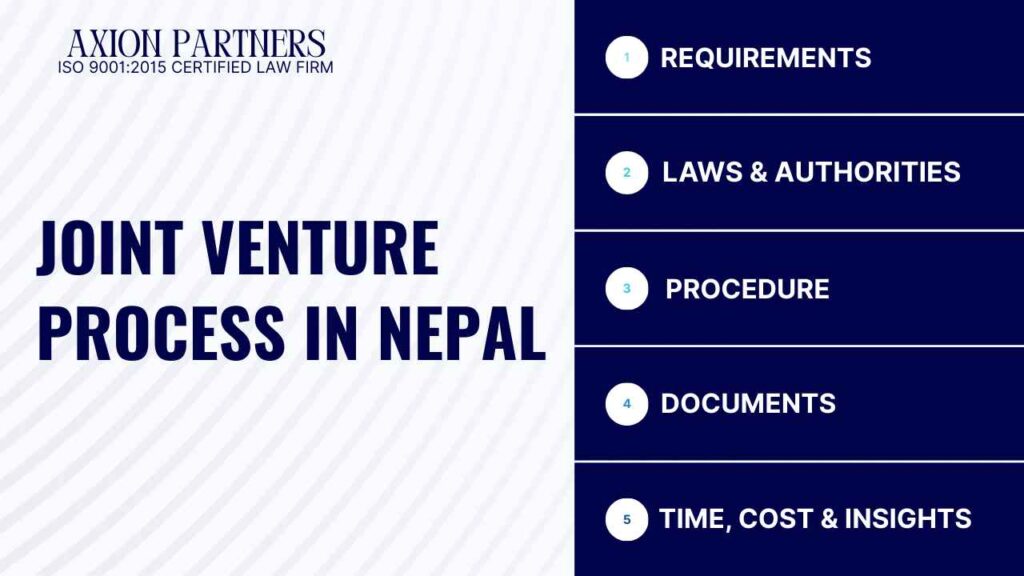
This guide explains the joint venture process in Nepal, detailing steps, legal requirements, procedures and documents for establishing and terminating JV’s. A joint venture in Nepal is a formal business arrangement where two or more parties agree to combine resources for a specific project or business purpose. Foreign companies often form joint ventures with local Nepali partners to enter the market, participate in government tenders, or establish operations. The joint venture process in Nepal involves mutual agreement, legal documentation, government registration, and regulatory approval. This arrangement allows foreign investors to leverage local expertise while complying with Nepali laws. Step-By-Step Process for Joint Venture Step 1: Both parties reach a mutual agreement on business objectives, profit sharing, responsibilities, and management structure for the joint venture partnership. Step 2: Legal professionals draft a comprehensive joint venture agreement that outlines all terms, conditions, capital contributions, and operational guidelines between the parties. Step 3: Authorized representatives from both parties sign the joint venture agreement, and the document is notarized and registered with relevant authorities. Step 4: The parties file a formal application with the appropriate government agency such as Department of Industry, Office of Company Registrar, or Nepal Rastra Bank. Step 5: The government agency reviews the application, verifies documents, and issues approval or authorization for the joint venture to operate legally in Nepal. Step 6: After approval, parties either complete the specific project or continue operations according to the joint venture agreement and regulatory requirements. What Is a Joint Venture in Nepal? A joint venture in Nepal represents a strategic business partnership between two or more entities. These entities combine their resources, expertise, and capital to achieve specific business goals. The joint venture structure allows foreign companies to collaborate with Nepali partners for market entry and business expansion. The joint venture process in Nepal follows specific legal frameworks established by government authorities. Companies must register their partnership with designated government departments. The Department of Industry handles industrial joint ventures. The Office of Company Registrar manages company-based partnerships. Nepal Rastra Bank supervises joint ventures in the banking and financial sectors. Foreign investors commonly use joint ventures to meet local partnership requirements for certain business activities. Many government tenders require foreign companies to partner with local firms. Joint ventures also help foreign entities navigate local regulations and cultural business practices. This arrangement benefits both parties through shared risks, resources, and market knowledge. Types of Joint Ventures in Nepal Different sectors and purposes require specific types of joint venture registrations in Nepal. Each type follows distinct procedures and regulatory requirements. Type Registering Authority Purpose Key Requirements Department of Industry (DOI) Department of Industry Manufacturing, industrial production, foreign direct investment Minimum capital investment, environmental clearance, industrial license Investment Board Nepal (IBN) Investment Board Nepal Large-scale infrastructure, energy projects exceeding threshold amounts Project proposal, financial capacity proof, technical expertise demonstration Tender-Based JV Relevant tender authority Government contract participation, public procurement projects Tender document compliance, local partnership percentage, technical qualification Company Registration Office of Company Registrar General business operations, service sector, trading activities Company formation documents, minimum capital, shareholder agreements Banks & Financial Institutions Nepal Rastra Bank Banking, insurance, financial services, microfinance operations High capital requirements, fit and proper test, regulatory compliance NGOs & INGOs Social Welfare Council Development projects, humanitarian work, social welfare programs Non-profit objectives, project proposals, funding sources disclosure Where To Register a Joint Venture in Nepal? The registration location for a joint venture in Nepal depends on the business sector and purpose. Different government agencies handle various types of joint venture registrations. Parties must identify the correct authority before beginning the registration process. The Department of Industry registers joint ventures for manufacturing, industrial projects, and foreign direct investment activities. This department operates under the Ministry of Industry, Commerce and Supplies. Foreign investors seeking to establish production facilities or industrial operations must register here. The department issues necessary approvals and monitors compliance with industrial policies. Visit their official portal at https://www.doi.gov.np for detailed information. The Office of Company Registrar handles joint ventures structured as private limited companies or public limited companies. This office maintains records of all registered companies in Nepal. Joint ventures forming a new company entity must complete registration here. The office ensures compliance with the Companies Act and related regulations. Access their services through https://www.ocr.gov.np for company registration procedures. Nepal Rastra Bank oversees joint ventures in banking, financial institutions, and insurance sectors. Foreign banks or financial companies must obtain approval from the central bank. The bank evaluates financial stability, capital requirements, and regulatory compliance. Joint ventures involving significant foreign exchange transactions also require central bank approval. Check https://www.nrb.org.np for banking sector guidelines. What Are the Requirements for Joint Venture in Nepal? The joint venture process in Nepal requires specific conditions to be met before registration. The primary requirement involves having at least two parties interested in forming a business partnership. These parties can be two foreign entities or one foreign entity and one local Nepali partner. Two Foreign Parties: Foreign companies from different countries can form a joint venture to conduct business in Nepal. Both parties must be legally registered entities in their home countries. They must provide valid incorporation documents and business licenses. This arrangement is common for large infrastructure projects or international collaborations. Foreign and Local Partnership: A foreign company can partner with a Nepali individual or company. This is the most common joint venture structure in Nepal. Local partners provide market knowledge and help navigate regulatory requirements. Foreign partners bring capital, technology, and international expertise. Tender Participation: Many government tenders require foreign companies to form joint ventures with local firms. The tender documents specify partnership requirements and local participation percentages. Foreign companies must establish joint ventures before submitting tender applications. This requirement ensures local business involvement in major projects. Non-Profit Purposes: International NGOs and foreign organizations form joint ventures for development projects. These partnerships focus on social welfare, education, healthcare, or community development. The joint venture agreement must clearly state non-profit objectives. Registration follows different procedures under NGO regulations.
IVF License Process in Nepal

Introduction to IVF Center License Requirements Nepal In vitro fertilization (IVF) has become an increasingly sought-after medical procedure in Nepal for couples struggling with infertility. As the demand for IVF services grows, the government of Nepal has established strict regulations and licensing requirements for IVF centers to ensure quality care and patient safety. This article provides a comprehensive overview of the IVF license process in Nepal, including legal requirements, documentation, medical standards, and operational guidelines. The Ministry of Health and Population (MoHP) is the primary regulatory body overseeing IVF centers in Nepal. The licensing process is designed to ensure that IVF facilities meet stringent quality and safety standards before they can legally operate. Prospective IVF center operators must navigate a complex web of legal, medical, and administrative requirements to obtain and maintain their license. Legal Requirements for IVF Center Registration Process The legal framework for IVF center registration in Nepal is primarily governed by the Public Health Service Act, 2075 (2018) and its associated regulations. Key legal requirements include: IVF centers must also comply with the Human Organ Transplant Act, 2055 (1998), which regulates the use of human tissues and gametes. Additionally, the Nepal Medical Council’s guidelines on assisted reproductive technologies must be strictly followed. Documentation Process for IVF License Application Nepal The documentation process for IVF license application in Nepal is thorough and requires meticulous preparation. Applicants must submit the following documents: All documents must be submitted in Nepali or English, with official translations provided where necessary. The MoHP may request additional documentation during the review process. Medical Requirements for IVF Center Operation Today IVF centers in Nepal must meet stringent medical requirements to ensure the highest standards of patient care and treatment efficacy. These requirements include: The Nepal Medical Council regularly updates its guidelines on assisted reproductive technologies, and IVF centers must stay current with these evolving standards. Cost Structure for IVF Center Registration Nepal The cost of registering an IVF center in Nepal can be substantial and varies depending on several factors. Major cost components include: While specific costs can fluctuate, prospective IVF center operators should be prepared to invest significantly in meeting all regulatory requirements and establishing a high-quality facility. Government Fees for IVF Center License Process The government of Nepal imposes various fees throughout the IVF center licensing process. These fees are subject to change and may include: Applicants should consult the latest fee schedule published by the MoHP for current rates. It’s important to note that these fees are separate from the operational costs and investments required to establish the IVF center. Time Duration for IVF License Processing Nepal The time required to process an IVF center license application in Nepal can vary significantly depending on the completeness of the application and the current workload of regulatory authorities. Generally, the process involves the following stages: While the entire process can take 3-6 months, complex applications or those requiring additional clarifications may take longer. Applicants are advised to start the process well in advance of their planned opening date. Authorities Regulating IVF Centers in Nepal Today Several government bodies are involved in regulating IVF centers in Nepal: IVF centers must maintain good relationships with all these authorities and comply with their respective regulations and reporting requirements. Services Mandatory for IVF Center Operation Nepal IVF centers in Nepal are required to offer a comprehensive range of services to ensure holistic patient care. Mandatory services include: Centers must have the capacity to provide these services safely and effectively, with appropriate backup and emergency protocols in place. Infrastructure Requirements for IVF Center Operation The infrastructure of an IVF center in Nepal must meet specific standards to ensure optimal conditions for treatment. Key requirements include: The facility must comply with all relevant building codes and safety regulations, including fire safety and earthquake resistance standards. Staff Requirements for IVF Center Operation Nepal IVF centers in Nepal must maintain a highly qualified and experienced staff to ensure quality care. Minimum staffing requirements typically include: All medical professionals must be registered with the Nepal Medical Council and possess the necessary qualifications and experience in reproductive medicine. Quality Standards for IVF Center Operation Nepal IVF centers in Nepal are expected to maintain the highest quality standards in all aspects of their operations. This includes: Centers are encouraged to seek accreditation from recognized international bodies to demonstrate their commitment to quality. Read More: Checklist for IVF Center Registration Process Nepal To streamline the registration process, IVF centers should use the following checklist: Careful attention to this checklist can help ensure a smooth and efficient registration process. Medical Equipment Requirements for IVF Centers Nepal IVF centers in Nepal must be equipped with state-of-the-art medical technology. Essential equipment includes: All equipment must be properly maintained, calibrated, and operated by trained personnel. Safety Standards for IVF Center Operation Nepal Safety is paramount in IVF center operations. Key safety standards include: Adherence to these safety standards is crucial for maintaining the license and ensuring patient well-being. FAQs: 1. What qualifications do staff need? Medical staff must be registered with the Nepal Medical Council and possess relevant specializations in reproductive medicine. Embryologists should have advanced degrees and certifications in clinical embryology. 2. How long is the license valid? IVF center licenses in Nepal are typically valid for 3-5 years, subject to annual reviews and compliance with regulations. 3. What equipment is mandatory? Mandatory equipment includes incubators, micromanipulation systems, cryopreservation units, ultrasound machines, and hormone analysis equipment. 4. How much space is required? While there’s no fixed space requirement, centers must have adequate room for all necessary facilities, including laboratories, procedure rooms, and patient areas. Typically, a minimum of 200-300 square meters is needed. 5. What are the renewal requirements? License renewal requires submission of updated documentation, proof of continued compliance with regulations, and payment of renewal fees. Centers may also undergo re-inspection. 6. How long does licensing take? The licensing process typically takes 3-6 months but can vary depending on the completeness of the application and regulatory workload.
IT Company Registration Process in Nepal

Introduction to IT Company Registration Nepal Registering an Information Technology (IT) company in Nepal is a strategic move for entrepreneurs looking to tap into the growing digital economy. The process, governed by the Company Act 2063 (2006), involves several steps and requirements. Nepal’s IT sector has seen significant growth in recent years, making it an attractive destination for both local and foreign investors. The registration process is overseen by the Office of the Company Registrar (OCR) and involves compliance with various legal, financial, and operational requirements. This article provides a comprehensive guide to navigating the IT company registration process in Nepal, ensuring entrepreneurs are well-informed about the necessary steps, documentation, and obligations. Legal Requirements for IT Company Registration Process The legal framework for IT company registration in Nepal is primarily based on the Company Act 2063 (2006) and the Electronic Transaction Act 2063 (2006). Key legal requirements include: Compliance with these legal requirements is crucial for successful IT company registration in Nepal. Documentation Process for IT Company Registration Nepal The documentation process for IT company registration in Nepal involves several key steps: Additional documents may include: Ensuring all documentation is accurate and complete is crucial for a smooth registration process. Financial Requirements for IT Company Registration Today Financial requirements for IT company registration in Nepal include: Meeting these financial requirements is essential for successful IT company registration and ongoing compliance in Nepal. Cost Structure for IT Company Registration Nepal The cost structure for IT company registration in Nepal includes various fees and expenses: Additional costs may include: Understanding and budgeting for these costs is crucial for entrepreneurs planning to register an IT company in Nepal. Government Fees for Information Technology Company Registration Government fees for IT company registration in Nepal are primarily based on the company’s authorized capital: Additional government fees include: These fees are subject to change, and it’s advisable to check the latest rates with the OCR or a legal professional. Time Duration for IT Company Registration Process The time duration for IT company registration in Nepal typically ranges from 2 to 4 weeks, depending on various factors: Factors that may affect the timeline include: Efficient preparation and prompt responses to any queries can help expedite the registration process. Authorities Handling IT Company Registration in Nepal Several government authorities are involved in the IT company registration process in Nepal: Understanding the roles of these authorities and maintaining good communication with them is crucial for a smooth registration process and ongoing compliance. Services Available for IT Company Registration Process Various services are available to assist with IT company registration in Nepal: These services can significantly streamline the registration process and ensure compliance with all legal and regulatory requirements. Benefits of IT Company Registration in Nepal Registering an IT company in Nepal offers several benefits: These benefits make IT company registration an attractive option for entrepreneurs in Nepal’s growing digital economy. Compliance Requirements for IT Companies in Nepal IT companies in Nepal must adhere to various compliance requirements: Staying compliant with these requirements is crucial for the smooth operation of IT companies in Nepal. Read More: Tax Obligations for IT Companies in Nepal IT companies in Nepal have several tax obligations: IT companies may also be eligible for certain tax incentives: Understanding and complying with these tax obligations is crucial for IT companies operating in Nepal. Checklist for Information Technology Company Registration Nepal A comprehensive checklist for IT company registration in Nepal includes: This checklist ensures all key steps are covered in the IT company registration process. Employment Requirements for IT Companies in Nepal IT companies in Nepal must comply with various employment requirements: Compliance with these requirements is crucial for maintaining good employee relations and avoiding legal issues. Annual Reporting Requirements for IT Companies Nepal IT companies in Nepal must fulfill several annual reporting requirements: Timely and accurate fulfillment of these reporting requirements is essential for maintaining good standing with regulatory authorities. FAQs: 1. What is the minimum capital requirement? The minimum paid-up capital for a private limited IT company in Nepal is NPR 100,000, while for a public limited company, it’s NPR 10,000,000. 2. How long does registration take? The IT company registration process in Nepal typically takes 2 to 4 weeks, depending on the completeness of documentation and efficiency of the process. 3. Can foreigners own IT companies? Yes, foreigners can own IT companies in Nepal. However, certain sectors may have restrictions on foreign ownership percentages. 4. What tax benefits are available? IT companies may be eligible for tax exemptions, including 100% exemption for the first five years if established in specified underdeveloped areas, and 50% exemption for the next three years if employing more than 100 Nepali citizens. 5. What licenses are required? IT companies may require specific licenses depending on their services, such as an ISP license for internet service providers or a software development license for software companies. 6. How many directors are needed? A private limited IT company in Nepal requires a minimum of one director, while a public limited company needs at least three directors. 7. What documents are required? Key documents include Memorandum and Articles of Association, shareholder and director details, office lease agreement, and proof of capital deposit, among others.
Internet Service Providers (ISPs) Registration in Nepal

Introduction to Internet Service Provider Registration Nepal Internet Service Providers (ISPs) play a crucial role in Nepal’s digital infrastructure, connecting individuals and businesses to the global network. The registration process for ISPs in Nepal is governed by specific regulations and overseen by dedicated authorities. This comprehensive guide outlines the essential steps, requirements, and considerations for registering an ISP in Nepal. The Nepal Telecommunications Authority (NTA) is the primary regulatory body responsible for overseeing ISP operations in the country. Prospective ISPs must navigate a series of legal, technical, and financial requirements to obtain and maintain their licenses. Understanding these requirements is crucial for anyone looking to enter the ISP market in Nepal. Legal Requirements for ISP Registration in Nepal Registering an ISP in Nepal involves adhering to several legal requirements set forth by the government. These requirements are designed to ensure that ISPs operate within the bounds of Nepali law and provide reliable services to consumers. Key legal requirements include: It’s important to note that these requirements may be subject to change, and prospective ISPs should consult with legal experts familiar with Nepali telecommunications law. Documentation Process for ISP License Application Nepal The documentation process for ISP license application in Nepal is comprehensive and requires careful preparation. Applicants must submit a range of documents to the NTA, including: Ensuring all documentation is accurate and complete is crucial to avoid delays in the application process. It’s advisable to have legal and technical experts review the application before submission. Technical Requirements for ISP Operation in Nepal ISPs in Nepal must meet specific technical requirements to ensure they can provide reliable and secure internet services. These requirements include: Meeting these technical requirements often requires significant investment in infrastructure and expertise. ISPs should be prepared to demonstrate their technical capabilities to the NTA during the application process. Cost Structure for ISP Registration and Operation The cost structure for ISP registration and operation in Nepal includes various fees and investments. Prospective ISPs should be prepared for the following costs: It’s important to note that these costs can vary depending on the scale of operations and the specific license category. Prospective ISPs should conduct thorough financial planning to ensure they can meet these ongoing financial obligations. Government Fees for Internet Service Provider License The government of Nepal, through the NTA, imposes various fees on ISPs. These fees are structured to ensure that ISPs contribute to the development of the telecommunications sector while maintaining fair competition. Key fees include: These fees are subject to periodic review and may change. ISPs should budget for these fees and factor them into their business plans to ensure financial sustainability. Time Duration for ISP Registration Processing Nepal The time required for ISP registration processing in Nepal can vary depending on several factors. Generally, the process involves the following stages: While the entire process can take 3-6 months, complex applications or those requiring additional information may take longer. Applicants can expedite the process by ensuring all documentation is complete and accurate from the outset. Authorities Regulating Internet Service Providers Nepal Today Several authorities are involved in regulating ISPs in Nepal, each with specific roles and responsibilities: ISPs must maintain good relationships with these authorities and comply with their respective regulations to operate successfully in Nepal. Services Mandatory for Internet Service Provider Operation ISPs in Nepal are required to provide certain mandatory services as part of their operations. These services ensure that ISPs contribute to the broader goals of national connectivity and digital inclusion. Mandatory services include: ISPs must demonstrate their capability to provide these services as part of their license application and maintain them throughout their operation. Infrastructure Requirements for ISP Operation in Nepal Establishing and maintaining the necessary infrastructure is crucial for ISP operations in Nepal. Key infrastructure requirements include: ISPs must invest significantly in this infrastructure to meet NTA requirements and provide reliable services to customers. Compliance Requirements for Internet Service Providers Nepal ISPs in Nepal must adhere to various compliance requirements to maintain their licenses and operate legally. These requirements include: Regular audits and reporting to the NTA are typically required to demonstrate ongoing compliance with these requirements. Security Standards for Internet Service Provider Operation Maintaining high security standards is crucial for ISPs in Nepal. Key security requirements include: ISPs must demonstrate their commitment to these security standards as part of their license application and ongoing operations. Read More: Checklist for Internet Service Provider Registration Nepal To ensure a smooth registration process, prospective ISPs should use the following checklist: This checklist can help applicants organize their approach to ISP registration in Nepal. Annual Reporting Requirements for ISPs in Nepal ISPs in Nepal are subject to annual reporting requirements to maintain their licenses and demonstrate compliance. Key reporting requirements include: Timely and accurate submission of these reports is crucial for maintaining good standing with the NTA and other regulatory bodies. Quality Standards for Internet Service Provider Operation ISPs in Nepal must adhere to specific quality standards set by the NTA. These standards ensure that consumers receive reliable and efficient internet services. Key quality standards include: Regular testing and reporting on these quality metrics are typically required to demonstrate compliance with NTA standards. FAQs: What is the minimum capital requirement for ISPs? The minimum capital requirement for ISPs in Nepal varies depending on the scale of operations and license category. Generally, it ranges from NPR 10 million to NPR 500 million. Applicants should consult the latest NTA guidelines for specific requirements. How long is an ISP license valid? ISP licenses in Nepal are typically valid for 5 years. However, the duration may vary based on the license category and NTA policies. Licenses are renewable subject to compliance with regulations and payment of renewal fees. Can foreign companies register as ISPs? Foreign companies can register as ISPs in Nepal, but there are restrictions on foreign ownership. Currently, foreign investment in ISPs is capped at 80% of the total equity. The remaining 20% must be held by Nepali citizens or entities. What technical