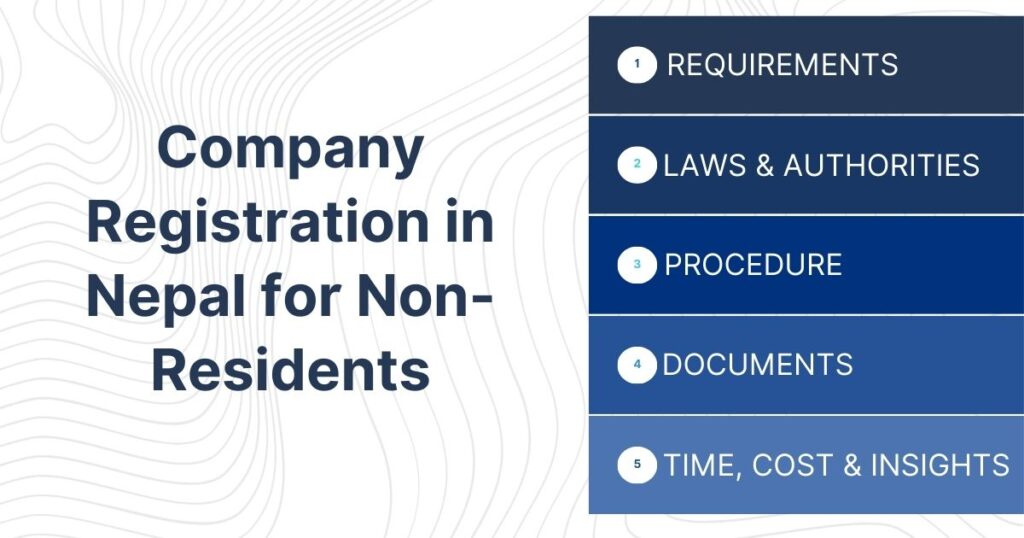
Non-residents can establish companies in Nepal under the Foreign Investment and Technology Transfer Act, 2019 (FITTA) and the Companies Act, 2063 (2006). The Office of Company Registrar (OCR) oversees company registration procedures, while the Department of Industry (DOI) handles foreign investment approvals. Foreign investors must obtain prior approval from DOI before registering a company with foreign ownership. The minimum investment threshold varies by sector, with certain industries requiring higher capital commitments. Non-residents can establish private limited companies, public limited companies, or joint ventures with Nepali partners.
Legal Framework for Foreign Investment
The Foreign Investment and Technology Transfer Act, 2019 governs foreign investment in Nepal. This legislation replaced the previous 1992 act and provides a comprehensive framework for non-resident investors. The Act permits 100% foreign ownership in most sectors except those listed in the negative list. The Industrial Enterprises Act, 2020 complements FITTA by regulating industrial operations. The Companies Act, 2063 (2006) establishes the legal structure for company formation, governance, and dissolution. These laws collectively create the regulatory environment for non-resident company registration.
Sectors Open to Foreign Investment
| Sector Category | Foreign Ownership Limit | Minimum Investment |
|---|---|---|
| Manufacturing Industries | Up to 100% | USD 50,000 |
| Service Industries | Up to 100% | USD 50,000 |
| Energy Sector | Up to 100% | USD 50,000 |
| Tourism and Hospitality | Up to 100% | USD 50,000 |
| Agriculture and Forestry | Up to 100% | USD 50,000 |
| Information Technology | Up to 100% | USD 50,000 |
Restricted and Prohibited Sectors
The following sectors have restrictions or prohibitions on foreign investment:
- Arms and ammunition production remains completely prohibited for foreign investors under FITTA 2019.
- Retail business with investment less than USD 5 million is restricted for foreign investors.
- Domestic courier services are reserved exclusively for Nepali citizens and companies.
- Personal service businesses such as barbershops and beauty parlors are restricted sectors.
- Cottage industries are reserved for domestic investors only under the Industrial Enterprises Act.
Types of Business Entities Available
Private Limited Company
A private limited company represents the most common structure for non-resident investors. The Companies Act, 2063 requires a minimum of two shareholders and two directors. The minimum authorized capital is NPR 100,000, with at least 50% paid-up at registration. Private limited companies cannot publicly trade shares and have restrictions on share transfers. This structure provides limited liability protection to shareholders and separate legal entity status.
Public Limited Company
Public limited companies can issue shares to the general public through the stock exchange. The Companies Act mandates a minimum of seven shareholders and three directors. The minimum authorized capital requirement is NPR 10 million for public companies. These entities must comply with stricter disclosure requirements and corporate governance standards. Public companies face more regulatory oversight from the Securities Board of Nepal.
Joint Venture Company
Joint ventures involve partnerships between foreign and Nepali investors. The partnership agreement defines ownership percentages, management responsibilities, and profit-sharing arrangements. Joint ventures benefit from local partner expertise and established market networks. The Companies Act applies to joint venture companies with additional provisions under FITTA. These entities must register with both the Department of Industry and Office of Company Registrar.
Pre-Registration Requirements for Non-Residents
Foreign Investment Approval Process
Step 1: Submit an application to the Department of Industry with the proposed business plan and investment details.
Step 2: Provide documentation proving the source of funds and financial capacity of foreign investors.
Step 3: Obtain approval from relevant sector-specific ministries if the business operates in regulated industries.
Step 4: Receive the foreign investment approval certificate from DOI, which typically takes 7-15 working days.
Step 5: Register the approved investment with Nepal Rastra Bank for foreign exchange purposes.
Required Documents for DOI Approval
- A detailed project proposal outlining business objectives, investment amount, and operational plans must be submitted.
- Passport copies of all foreign investors with valid visa documentation are required for verification.
- Bank statements or financial certificates demonstrating the investor’s financial capacity must be provided.
- A memorandum of understanding or partnership agreement if establishing a joint venture company.
- Technical collaboration agreements if the project involves technology transfer under FITTA provisions.
- Tax clearance certificates from the investor’s home country may be required for certain investments.
Company Registration Process at OCR
Step-by-Step Registration Procedure
Step 1: Reserve the company name through the Office of Company Registrar’s online portal or physical office.
Step 2: Prepare the Memorandum of Association and Articles of Association according to Companies Act requirements.
Step 3: Submit the complete application package with all required documents to the OCR.
Step 4: Pay the registration fees based on the authorized capital amount as per OCR fee schedule.
Step 5: Obtain the company registration certificate from OCR upon approval, typically within 3-5 working days.
Step 6: Register for Permanent Account Number (PAN) with the Inland Revenue Department immediately after incorporation.
Step 7: Register with the relevant municipality or rural municipality for local business operation permits.
Documents Required for Company Registration
- The name reservation certificate issued by the Office of Company Registrar must be submitted.
- Memorandum of Association signed by all shareholders detailing company objectives and capital structure is required.
- Articles of Association outlining internal management rules and procedures must be provided.
- Consent letters from all directors accepting their appointment and responsibilities are mandatory.
- Proof of registered office address through a rental agreement or ownership documents must be submitted.
- Foreign investment approval certificate from the Department of Industry for non-resident shareholders is essential.
- Passport copies and photographs of all shareholders and directors must be attached.
- Board resolution appointing the first directors and authorizing company registration must be included.
Capital Requirements and Investment Thresholds
Minimum Investment Standards
| Investment Type | Minimum Amount (USD) | Applicable Law |
|---|---|---|
| General Foreign Investment | 50,000 | FITTA 2019 |
| Technology-Based Industries | 50,000 | FITTA 2019 |
| Consulting Services | 50,000 | FITTA 2019 |
| Retail Business | 5,000,000 | FITTA 2019 |
| Manufacturing with Foreign Technology | 50,000 | FITTA 2019 |
Capital Repatriation Provisions
The Foreign Investment and Technology Transfer Act, 2019 guarantees capital repatriation rights. Foreign investors can repatriate the amount received from sale of shares or liquidation proceeds. Profits and dividends earned from investments can be repatriated after paying applicable taxes. The repatriation process requires approval from Nepal Rastra Bank with proper documentation. All repatriation transactions must comply with foreign exchange regulations and tax clearance requirements.
Director and Shareholder Requirements
Director Qualifications and Restrictions
The Companies Act, 2063 requires at least one director to be a resident of Nepal. Directors must be at least 18 years old and of sound mind. Individuals declared bankrupt or convicted of moral turpitude cannot serve as directors. Foreign nationals can serve as directors but must obtain appropriate work permits. The Act mandates that directors act in the company’s best interest and avoid conflicts of interest.
Shareholder Composition Rules
- Private limited companies require a minimum of two shareholders under the Companies Act provisions.
- Public limited companies must have at least seven shareholders at the time of incorporation.
- Foreign shareholders must hold valid passports and provide residential addresses in their home countries.
- Nominee shareholders are permitted but must be disclosed in the company registration documents.
- Share transfer restrictions apply to private companies and require board approval for transfers.
Tax Registration and Compliance
Permanent Account Number (PAN) Registration
Companies must register for PAN within 30 days of incorporation under the Income Tax Act, 2058 (2002). The Inland Revenue Department issues PAN certificates upon submission of registration documents. The application requires the company registration certificate, Memorandum of Association, and director identification documents. PAN registration enables the company to conduct financial transactions and fulfill tax obligations. The registration process typically completes within 1-2 working days at the IRD office.
Value Added Tax (VAT) Registration
Businesses with annual turnover exceeding NPR 5 million must register for VAT. The VAT registration application must be submitted to the Inland Revenue Department with supporting documents. Companies engaged in import-export activities require VAT registration regardless of turnover thresholds. The VAT certificate allows businesses to collect VAT from customers and claim input tax credits. Registration must occur within 30 days of meeting the threshold criteria under the VAT Act, 2052 (1996).
Work Permits and Visa Requirements
Work Permit Application Process
Step 1: Obtain a business visa from the Nepali embassy or on arrival at Tribhuvan International Airport.
Step 2: Submit a work permit application to the Department of Immigration within 15 days of arrival.
Step 3: Provide the company registration certificate, foreign investment approval, and employment contract documents.
Step 4: Pay the prescribed work permit fees based on the investment amount and position level.
Step 5: Receive the work permit, which is typically valid for one to five years depending on investment size.
Visa Categories for Foreign Investors
| Visa Type | Validity Period | Investment/Requirement |
|---|---|---|
| Business Visa | Up to 5 years | USD 50,000+ investment |
| Non-Tourist Visa | 1 year renewable | Employment contract required |
| Investor Visa | Up to 5 years | Minimum USD 100,000 investment |
Banking and Financial Requirements
Opening a Corporate Bank Account
Foreign-owned companies must open a corporate bank account with a licensed commercial bank in Nepal. The bank requires the company registration certificate, PAN certificate, and board resolution authorizing account opening. All directors must provide passport copies, photographs, and proof of address for KYC compliance. The bank conducts due diligence on the company’s business activities and ownership structure. Account opening typically takes 5-7 working days after document submission and verification.
Foreign Currency Accounts
Nepal Rastra Bank permits foreign-invested companies to maintain foreign currency accounts. These accounts facilitate international transactions and foreign investment fund transfers. Companies must obtain approval from Nepal Rastra Bank to open foreign currency accounts. The accounts can hold proceeds from exports, foreign loans, and equity investments. All transactions must comply with foreign exchange regulations and reporting requirements under the Foreign Exchange Regulation Act, 2019.
Post-Registration Compliance Requirements
Annual Filing Obligations
- Companies must file annual returns with the Office of Company Registrar within six months of the fiscal year end.
- Audited financial statements prepared by a licensed chartered accountant must be submitted annually to OCR.
- The annual general meeting must be held within six months of the fiscal year end as per Companies Act requirements.
- Tax returns must be filed with the Inland Revenue Department by the deadline specified in the Income Tax Act.
- Foreign-invested companies must submit annual reports to the Department of Industry detailing operations and financial performance.
Statutory Compliance Calendar
| Compliance Requirement | Deadline | Responsible Authority |
|---|---|---|
| Annual Return Filing | Within 6 months of FY end | Office of Company Registrar |
| Income Tax Return | Magh end (mid-February) | Inland Revenue Department |
| VAT Returns | Monthly by 25th | Inland Revenue Department |
| Social Security Contribution | Monthly by 15th | Social Security Fund |
| DOI Annual Report | Within 6 months of FY end | Department of Industry |
Intellectual Property Protection
The Industrial Property Rights Act, 2007 protects trademarks, patents, and industrial designs in Nepal. Foreign companies can register intellectual property through the Department of Industry’s IP office. Trademark registration provides exclusive rights for ten years, renewable indefinitely. Patent protection extends for seven years from the filing date under the Act. Copyright protection is automatic under the Copyright Act, 2059 (2002) without registration requirements.
Dispute Resolution Mechanisms
The Arbitration Act, 2055 (1999) governs commercial dispute resolution in Nepal. Foreign investors can include arbitration clauses in contracts specifying international arbitration forums. The Act recognizes and enforces foreign arbitral awards under the New York Convention. Commercial courts handle business disputes with specialized judges for complex commercial matters. The Foreign Investment and Technology Transfer Act provides additional dispute resolution mechanisms for investment-related conflicts.
Sector-Specific Licensing Requirements
Manufacturing Industries
Manufacturing companies require an industry registration certificate from the Department of Industry. Environmental impact assessments are mandatory for industries listed in the Environment Protection Act, 2019. Pollution control certificates must be obtained from the Ministry of Forest and Environment. Factory operation permits are required from the Department of Labour and Occupational Safety. Product quality certifications may be necessary depending on the manufacturing sector.
Service Industries
Service sector companies need specific licenses based on their business activities. Tourism businesses require registration with the Department of Tourism and licenses for specific activities. Educational institutions must obtain approval from the Ministry of Education, Science and Technology. Healthcare facilities need licenses from the Ministry of Health and Population. Financial services require licensing from Nepal Rastra Bank or relevant regulatory authorities.
Advantages of Company Registration in Nepal
- Nepal offers strategic geographic location between India and China, providing access to large markets.
- The Foreign Investment and Technology Transfer Act guarantees national treatment to foreign investors in most sectors.
- Corporate tax rates are competitive at 25% for general industries with various exemptions available.
- The government provides tax holidays and incentives for investments in priority sectors and underdeveloped regions.
- Repatriation of capital, profits, and dividends is permitted under the foreign exchange regulations.
- Nepal has signed bilateral investment protection agreements with multiple countries ensuring investor rights.
Common Challenges and Solutions
Bureaucratic Procedures
The registration process involves multiple government agencies, which can cause delays. Engaging experienced legal consultants familiar with Nepali procedures expedites the process. Maintaining regular communication with relevant departments helps track application progress. Ensuring complete documentation before submission prevents rejection and resubmission delays. The government has introduced online systems to streamline certain registration procedures.
Language and Documentation
Official documents must be in Nepali language as per the National Language Policy Act. Foreign documents require translation by certified translators and authentication by the Nepali embassy. Notarization and apostille certification are necessary for documents from countries party to the Hague Convention. Legal advisors assist in preparing documents in the required format and language. Translation costs and time should be factored into the registration timeline.
Read More:
- https://lawaxion.com/business-registration-total-cost-breakdown/
- https://lawaxion.com/business-registration-legal-checklist-in-nepal/
- https://lawaxion.com/business-registration-things-to-know-in-nepal/
- https://lawaxion.com/business-registration-in-nepal-cost-fees-taxes-hidden-charges/
- https://lawaxion.com/business-registration-services-in-nepal/
Can a non-resident own 100% of a company in Nepal?
Yes, non-residents can own 100% of companies in most sectors under the Foreign Investment and Technology Transfer Act, 2019, except for businesses listed in the negative list which includes retail trade under USD 5 million and certain personal services.
What is the minimum investment required for foreign investors?
The minimum foreign investment requirement is USD 50,000 for most sectors under FITTA 2019. However, retail businesses require a minimum investment of USD 5 million, and certain technology-based industries may have different thresholds based on sector-specific regulations.
How long does company registration take in Nepal?
The complete registration process typically takes 4-6 weeks, including foreign investment approval from the Department of Industry (7-15 days) and company registration with the Office of Company Registrar (3-5 days), plus additional time for tax registration and other compliance requirements.
Do foreign directors need to be physically present in Nepal?
Foreign directors do not need to be permanently present in Nepal, but at least one director must be a resident of Nepal as per the Companies Act, 2063. Foreign directors must obtain appropriate work permits if they plan to actively manage operations.
What taxes apply to foreign-owned companies in Nepal?
Foreign-owned companies pay corporate income tax at 25%, VAT at 13%, and withholding tax on dividends at 5-10%. Additional taxes include social security contributions, customs duties on imports, and excise duties on specific products as per the Income Tax Act, 2058.
Can foreign investors repatriate profits from Nepal?
Yes, the Foreign Investment and Technology Transfer Act, 2019 guarantees the right to repatriate profits, dividends, and proceeds from share sales after paying applicable taxes. Repatriation requires Nepal Rastra Bank approval and compliance with foreign exchange regulations.
What sectors are restricted for foreign investment?
Restricted sectors include retail business under USD 5 million investment, arms and ammunition production, domestic courier services, cottage industries, and personal service businesses like barbershops. The negative list is specified in FITTA 2019 and related regulations.
Is a local partner mandatory for foreign investors?
A local partner is not mandatory for most sectors, as 100% foreign ownership is permitted under FITTA 2019. However, having a Nepali partner can be beneficial for market knowledge, and at least one director must be a Nepal resident.
What is the corporate tax rate in Nepal?
The standard corporate income tax rate is 25% for general industries. Special industries like manufacturing in special economic zones may receive tax holidays. Banks and financial institutions pay 30%, while certain priority sectors receive reduced rates under the Income Tax Act.
How can foreign investors protect their investment in Nepal?
Investment protection is provided through the Foreign Investment and Technology Transfer Act, bilateral investment treaties, and the Arbitration Act. Investors should register properly, maintain compliance, obtain appropriate insurance, and include dispute resolution clauses in contracts for additional protection.