
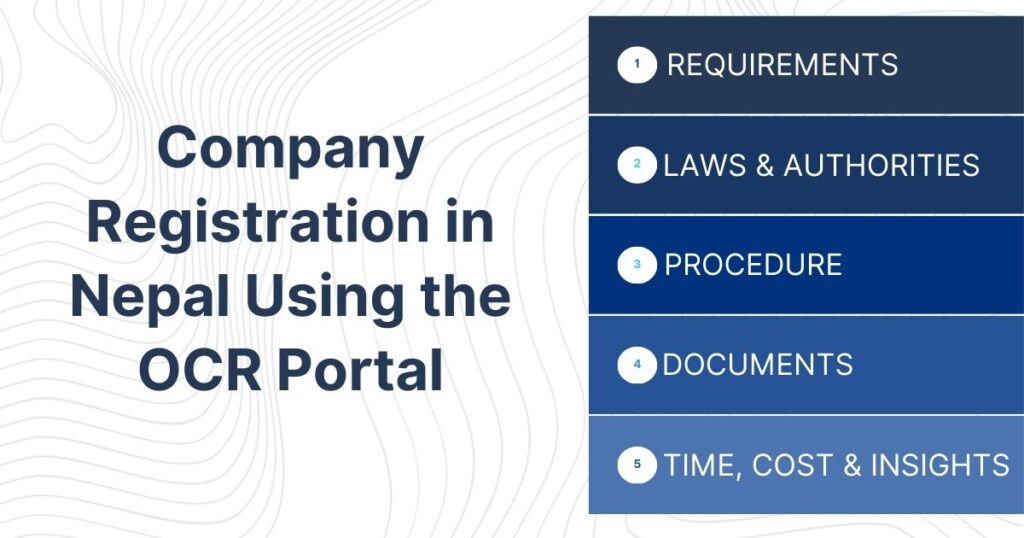
Introduction to Company Registration in Nepal
Company registration in Nepal has undergone significant transformation with the introduction of the Office of Company Registrar (OCR) online portal. The Department of Industry (DOI) and Office of Company Registrar manage the entire process of business entity registration in Nepal. The OCR portal streamlines the registration process, allowing entrepreneurs to register their companies electronically without extensive physical documentation. This digital system aligns with Nepal’s commitment to improving the ease of doing business and reducing bureaucratic delays. The Companies Act, 2063 (2006) governs the registration and operation of companies in Nepal, establishing the legal framework for various business structures including private limited companies, public limited companies, and other corporate entities.
Legal Framework for Company Registration
The primary legislation governing company registration in Nepal includes the Companies Act, 2063 (2006) and the Companies Regulations, 2064 (2007). These laws establish the requirements, procedures, and compliance obligations for companies operating in Nepal. The Companies Act defines different types of companies, their formation process, capital requirements, and operational guidelines. Section 3 of the Companies Act specifies that companies can be registered as private limited, public limited, or companies limited by guarantee. The Foreign Investment and Technology Transfer Act, 2075 (2019) additionally governs foreign investment in Nepali companies. The Industrial Enterprises Act, 2076 (2020) provides the framework for industrial registration and licensing. These legal instruments collectively create a comprehensive regulatory environment for business registration and operation in Nepal.
Types of Companies That Can Be Registered
Nepal’s legal framework permits registration of several company types through the OCR portal. Each structure serves different business needs and has distinct characteristics:
Private Limited Company: The most common business structure in Nepal, requiring a minimum of two shareholders and two directors. Maximum shareholders cannot exceed 101. Minimum authorized capital requirement is NPR 100,000.
Public Limited Company: Suitable for larger enterprises planning to raise capital from the public. Requires minimum seven shareholders and three directors. Must have minimum authorized capital of NPR 10,000,000.
Company Limited by Guarantee: Typically used for non-profit organizations and associations. Does not have share capital but members guarantee a specific amount.
Foreign Company Branch Office: Foreign entities can establish branch offices in Nepal subject to approval from the Department of Industry and Nepal Rastra Bank.
Subsidiary Company: A company where another company holds more than 50% of shares, operating as a separate legal entity.
Benefits of Using the OCR Online Portal
The OCR online portal offers numerous advantages over traditional paper-based registration methods. The system reduces registration time from several weeks to approximately 7-15 working days. Applicants can complete the entire process remotely without multiple visits to government offices. The portal provides real-time status updates on application progress and allows document submission in digital format. The system automatically checks name availability, reducing rejection rates due to name conflicts. Payment processing is integrated, allowing online fee payment through various banking channels. The portal maintains a centralized database of all registered companies, improving transparency and accessibility of corporate information. Document verification occurs electronically, minimizing human error and corruption opportunities. The system generates digital certificates that are legally valid and can be verified online. This modernization significantly improves Nepal’s business environment and attracts both domestic and foreign investment.
Pre-Registration Requirements and Preparations
Before initiating the registration process on the OCR portal, applicants must complete several preparatory steps. Entrepreneurs need to determine the appropriate company structure based on their business objectives and capital availability. Proposed shareholders and directors must obtain their citizenship certificates or passport copies if foreign nationals. A registered office address in Nepal is mandatory, requiring a rental agreement or ownership document. The company name must be unique and comply with naming guidelines specified in the Companies Regulations. Applicants should prepare a detailed Memorandum of Association (MOA) and Articles of Association (AOA) outlining the company’s objectives and internal governance structure. Minimum capital requirements must be arranged and deposited in a designated bank account. All promoters must have Tax Identification Numbers (PAN) issued by the Inland Revenue Department. Foreign investors require prior approval from the Department of Industry under the Foreign Investment and Technology Transfer Act.
Documents Required for Company Registration
The OCR portal requires submission of specific documents in digital format. Proper preparation of these documents ensures smooth processing:
For Nepali Promoters:
- Citizenship certificate (scanned copy)
- Recent passport-size photograph
- PAN certificate
- Registered office ownership or rental agreement
- Bank account statement showing capital deposit
For Foreign Promoters:
- Valid passport (notarized copy)
- Investment approval from Department of Industry
- Tax clearance certificate from home country
- Board resolution authorizing Nepal investment
- Company registration certificate from home country
Common Documents:
- Memorandum of Association
- Articles of Association
- Name reservation certificate
- Capital verification letter from bank
- Consent letters from directors
- Company seal design
All documents must be in Nepali or accompanied by certified translations. Scanned documents should be clear and in PDF format not exceeding specified file sizes.
Step-by-Step Company Registration Process
The company registration process through the OCR portal follows a systematic approach:
Step 1: Create User Account Visit the OCR portal at ocr.gov.np and create a user account by providing email address and mobile number. Verify the account through OTP sent to registered contact details.
Step 2: Name Reservation Search for name availability using the portal’s search function. Submit name reservation application with three alternative names. Pay the name reservation fee of NPR 100. Approval typically takes 1-2 working days.
Step 3: Prepare Registration Documents Draft Memorandum of Association and Articles of Association according to prescribed formats. Obtain signatures from all promoters and directors. Scan all required documents in specified format.
Step 4: Complete Online Application Form Log into the OCR portal and select company registration option. Fill in company details including name, registered office, capital structure, and promoter information. Upload all required documents in designated sections.
Step 5: Pay Registration Fees Calculate registration fees based on authorized capital. Make payment through integrated payment gateway using internet banking, mobile banking, or e-wallet. Save payment receipt for reference.
Step 6: Submit Application Review all entered information and uploaded documents. Submit the application electronically. Note the application reference number for tracking purposes.
Step 7: Application Processing OCR officials review the submitted application and documents. They may request additional information or clarifications through the portal. Respond promptly to any queries raised.
Step 8: Certificate Issuance Upon approval, the company registration certificate is generated electronically. Download the certificate from the portal. The certificate contains a unique company registration number and QR code for verification.
Registration Fees and Capital Requirements
The fee structure for company registration in Nepal varies based on authorized capital and company type. Understanding these costs helps in financial planning:
| Authorized Capital Range | Registration Fee (NPR) |
|---|---|
| Up to NPR 100,000 | 1,000 |
| NPR 100,001 – 500,000 | 2,500 |
| NPR 500,001 – 1,000,000 | 5,000 |
| NPR 1,000,001 – 5,000,000 | 10,000 |
| NPR 5,000,001 – 10,000,000 | 15,000 |
| Above NPR 10,000,000 | 20,000 + 0.1% of excess amount |
Additional fees include name reservation (NPR 100), certificate copies (NPR 500), and document verification charges. Private limited companies require minimum authorized capital of NPR 100,000 with at least 10% paid-up capital. Public limited companies need minimum NPR 10,000,000 authorized capital. Foreign investment companies must comply with minimum investment thresholds specified in the Foreign Investment and Technology Transfer Act, which varies by sector.
Post-Registration Compliance Requirements
After successful registration, companies must fulfill several compliance obligations to maintain legal status. Within 15 days of registration, companies must register with the Inland Revenue Department for PAN and VAT if applicable. Section 11 of the Income Tax Act, 2058 (2002) mandates tax registration for all business entities. Companies must open a corporate bank account and transfer the capital from the temporary account used during registration. Registration with the Social Security Fund is mandatory under the Social Security Act, 2074 (2017) for companies with one or more employees. Labor Act, 2074 (2017) requires registration with the Department of Labor if employing more than ten workers. Companies must maintain statutory registers including member register, director register, and meeting minutes as per Section 82 of the Companies Act. Annual general meetings must be held within six months of the financial year end. Annual returns must be filed with the OCR within 60 days of the AGM, accompanied by audited financial statements.
Common Challenges and Solutions
Despite the streamlined online process, applicants often encounter specific challenges during company registration. Name rejection occurs frequently due to similarity with existing companies or use of restricted words. Solution involves conducting thorough preliminary searches and selecting distinctive names. Document format errors cause application delays when uploaded files do not meet technical specifications. Ensuring documents are in PDF format, properly scanned, and within size limits prevents this issue. Payment gateway failures sometimes interrupt the registration process. Using alternative payment methods or attempting transactions during off-peak hours resolves this problem. Foreign investor applications face additional scrutiny and longer processing times. Engaging legal consultants familiar with foreign investment regulations expedites approval. Incomplete or incorrect information in the MOA and AOA leads to rejection. Using standard templates provided by the OCR and seeking professional assistance ensures compliance. Technical difficulties with the portal occasionally occur during high-traffic periods. Attempting registration during business hours on weekdays typically provides better system performance.
Role of Professional Service Providers
Professional service providers play a valuable role in facilitating company registration through the OCR portal. Chartered accountants, company secretaries, and legal firms offer comprehensive registration services. These professionals possess expertise in Nepal’s corporate laws and regulatory requirements. They assist in selecting appropriate company structures based on business objectives and tax implications. Service providers prepare legally compliant MOA and AOA documents that meet OCR standards. They handle the entire online registration process, ensuring accurate data entry and proper document submission. Professional firms maintain relationships with regulatory authorities, enabling faster query resolution. They provide post-registration compliance services including tax registration, license procurement, and statutory record maintenance. For foreign investors, these service providers offer essential guidance on investment approval procedures and sector-specific regulations. The cost of professional services typically ranges from NPR 15,000 to NPR 50,000 depending on company complexity and service scope. While not mandatory, professional assistance significantly reduces registration time and minimizes rejection risks.
Timeline for Company Registration
The company registration timeline through the OCR portal varies based on application completeness and company type. Name reservation typically takes 1-2 working days after submission. The main registration application processing requires 7-15 working days for standard private limited companies. Public limited companies may require additional time due to enhanced scrutiny of capital requirements and promoter qualifications. Foreign investment companies face longer timelines of 15-30 working days as they require coordination between multiple government agencies. Applications with incomplete documentation or errors experience delays of additional 5-10 working days for resubmission. The OCR may request clarifications or additional documents during processing, extending the timeline. Expedited processing is not officially available, though complete and accurate applications receive priority attention. Post-registration procedures including tax registration and bank account opening add another 5-7 working days. The entire process from name reservation to obtaining all necessary registrations typically spans 3-4 weeks for domestic companies and 5-6 weeks for foreign investment companies.
Comparison with Traditional Registration Methods
The OCR online portal represents a significant improvement over traditional paper-based registration methods. The following comparison highlights key differences:
| Aspect | Traditional Method | OCR Portal |
|---|---|---|
| Processing Time | 30–45 days | 7–15 days |
| Physical Visits | 5–7 visits required | Zero visits needed |
| Document Submission | Physical copies | Digital upload |
| Status Tracking | Manual inquiry | Real-time online tracking |
| Payment Method | Bank deposit/cash | Online payment |
| Certificate Delivery | Physical collection | Digital download |
| Transparency | Limited | High transparency |
| Cost | Higher (travel, copies) | Lower (no travel) |
The traditional method required multiple visits to the OCR office, submission of numerous physical document copies, and manual follow-up on application status. Processing times were unpredictable and subject to administrative delays. The online portal eliminates these inefficiencies, providing a transparent and time-bound process. However, the traditional method remains available for applicants who prefer or require in-person assistance.
Special Considerations for Foreign Investors
Foreign investors face additional requirements when registering companies in Nepal. The Foreign Investment and Technology Transfer Act, 2075 (2019) governs foreign investment and establishes sector-specific conditions. Section 3 of the Act requires foreign investors to obtain prior approval from the Department of Industry before company registration. Certain sectors are restricted or prohibited for foreign investment, including retail trading, personal services, and arms manufacturing. Foreign investors must demonstrate minimum investment amounts varying by sector, typically ranging from USD 50,000 to USD 500,000. Technology transfer agreements require separate approval if the investment involves proprietary technology. Foreign investors must repatriate profits through banking channels and comply with Nepal Rastra Bank regulations. The Investment Board Nepal handles large-scale foreign investments exceeding NPR 6 billion. Foreign company branch offices require additional approvals and cannot engage in manufacturing activities. Joint venture companies with foreign participation must maintain specific equity ratios depending on the sector. Foreign investors should engage local legal counsel to ensure compliance with all applicable regulations.
Digital Signature and Authentication
The OCR portal incorporates digital signature technology to ensure document authenticity and legal validity. Section 3 of the Electronic Transactions Act, 2063 (2008) provides legal recognition to electronic signatures in Nepal. The portal accepts digital signatures issued by authorized certification authorities in Nepal. Applicants can obtain digital signatures from the Office of Controller of Certification under the Ministry of Communication and Information Technology. The digital signature process involves identity verification, key generation, and certificate issuance. Documents signed with valid digital signatures have the same legal status as physically signed documents. The OCR system verifies digital signatures automatically during application processing. For applicants without digital signatures, the portal allows uploading of scanned documents with physical signatures. However, digital signatures expedite processing and reduce verification time. The cost of obtaining a digital signature certificate is approximately NPR 2,000-3,000 with validity of 1-2 years. Organizations registering multiple companies benefit from digital signatures through streamlined repeated registrations.
Sector-Specific Registration Requirements
Certain business sectors in Nepal require additional licenses and approvals beyond basic company registration. The Industrial Enterprises Act, 2076 (2020) mandates industrial registration for manufacturing enterprises. Companies in the tourism sector must obtain licenses from the Department of Tourism under the Tourism Act, 2035 (1978). Financial institutions require approval from Nepal Rastra Bank under the Banks and Financial Institutions Act, 2073 (2017). Educational institutions need affiliation from relevant universities and approval from the Ministry of Education. Healthcare facilities require registration with the Department of Health Services and compliance with medical standards. Construction companies must register with the Department of Urban Development and Building Construction. Information technology companies may need to register with the Department of Information Technology. Export-oriented businesses require registration with the Trade and Export Promotion Centre. Agricultural enterprises may need approval from the Ministry of Agriculture and Livestock Development. Media companies require licenses from the Ministry of Communication and Information Technology. Understanding sector-specific requirements before initiating company registration prevents delays and ensures comprehensive compliance.
Modification and Amendment Procedures
Registered companies may need to modify their registration details due to business evolution or structural changes. The OCR portal facilitates various amendment procedures electronically. Changes in company name require board resolution and shareholder approval, followed by online application submission with prescribed fees. Registered office address changes need proof of new address and board resolution. Capital increase or decrease requires shareholder approval through special resolution and compliance with Section 20 of the Companies Act. Addition or removal of directors involves filing Form 7 through the portal with consent letters. Changes in business objectives require MOA amendment and shareholder approval. Share transfer between existing shareholders needs execution of share transfer forms and stamp duty payment. The portal allows uploading of amended documents and relevant resolutions. Amendment fees vary based on the type of change, typically ranging from NPR 500 to NPR 5,000. Processing time for amendments is generally 5-7 working days. Companies must update all regulatory authorities about changes, including the Inland Revenue Department and relevant licensing bodies.
Annual Compliance Through OCR Portal
The OCR portal serves as the primary platform for annual compliance submissions by registered companies. Section 82 of the Companies Act requires companies to file annual returns within 60 days of the annual general meeting. The annual return includes details of shareholders, directors, capital structure, and registered office. Companies must upload audited financial statements including balance sheet, profit and loss account, and cash flow statement. The audit report must be prepared by a chartered accountant registered with the Institute of Chartered Accountants of Nepal. Annual return filing fees depend on authorized capital, ranging from NPR 500 to NPR 5,000. Late filing attracts penalties of NPR 100 per day up to a maximum amount. The portal automatically calculates penalties for delayed submissions. Companies must also file annual tax returns with the Inland Revenue Department separately. The OCR portal provides reminders and notifications about upcoming compliance deadlines. Non-compliance with annual filing requirements may result in company name removal from the register under Section 83 of the Companies Act. The portal maintains a compliance history for each company, accessible to stakeholders and regulatory authorities.
Company Dissolution and Closure Process
Companies seeking to cease operations must follow the formal dissolution process through the OCR portal. Voluntary dissolution requires a special resolution passed by shareholders with three-fourths majority. The company must settle all liabilities, including employee dues, tax obligations, and creditor payments. A liquidator must be appointed to oversee the dissolution process and asset distribution. The liquidator files a dissolution application through the OCR portal with required documents including final accounts and tax clearance certificate. The OCR publishes a notice in the Nepal Gazette inviting objections from creditors and stakeholders. If no objections are received within 35 days, the OCR proceeds with dissolution. The company’s name is struck off from the register, and a dissolution certificate is issued. Section 77 of the Companies Act governs the dissolution procedure and liquidator’s responsibilities. Compulsory dissolution occurs when companies fail to commence business within one year of registration or cease operations for consecutive two years. The OCR may also dissolve companies for non-compliance with statutory requirements. Dissolved companies cannot conduct business or enter into contracts. Directors and shareholders may face personal liability for company debts if dissolution procedures are not properly followed.
Read More:
- https://lawaxion.com/company-incorporation-in-nepal-timeline-and-process/
- https://lawaxion.com/import-export-business-requirements-in-nepal/
- https://lawaxion.com/after-company-registration-in-nepal-renew-audit-tax-cost/
- https://lawaxion.com/incorporating-company-in-nepal-vs-business-registration/
- https://lawaxion.com/how-to-start-a-business-in-nepal-step-by-step/
Conclusion
Company registration in Nepal through the OCR portal represents a significant advancement in business facilitation and regulatory modernization. The online system reduces registration time, eliminates unnecessary bureaucracy, and provides transparency throughout the process. Entrepreneurs can establish their businesses efficiently while maintaining full compliance with the Companies Act, 2063 and related regulations.
What is the minimum capital required to register a private limited company in Nepal?
The minimum authorized capital for a private limited company is NPR 100,000, with at least 10% paid-up capital required at the time of registration as per the Companies Act, 2063.
Can a single person register a company in Nepal?
No, a private limited company requires a minimum of two shareholders and two directors. However, one person can hold multiple roles subject to legal restrictions under the Companies Act.
How long does company registration take through the OCR portal?
Standard company registration takes 7-15 working days for domestic companies and 15-30 working days for foreign investment companies, provided all documents are complete and accurate.
Is physical presence required for company registration?
No, the entire registration process can be completed online through the OCR portal without physical presence at the office, making it convenient for applicants from anywhere.
What happens if the company name is rejected?
If the proposed name is rejected, applicants can submit alternative names through the portal. The system allows submission of three alternative names during the initial application.
Can foreign nationals be directors of Nepali companies?
Yes, foreign nationals can be directors of Nepali companies, but they must obtain work permits and comply with foreign investment regulations under the Foreign Investment and Technology Transfer Act.
What are the penalties for non-compliance with annual filing?
Companies face penalties of NPR 100 per day for late filing of annual returns, and persistent non-compliance may result in company name removal from the register.
Is digital signature mandatory for OCR portal registration?
Digital signature is not mandatory but recommended. Applicants can upload scanned documents with physical signatures, though digital signatures expedite processing and verification.