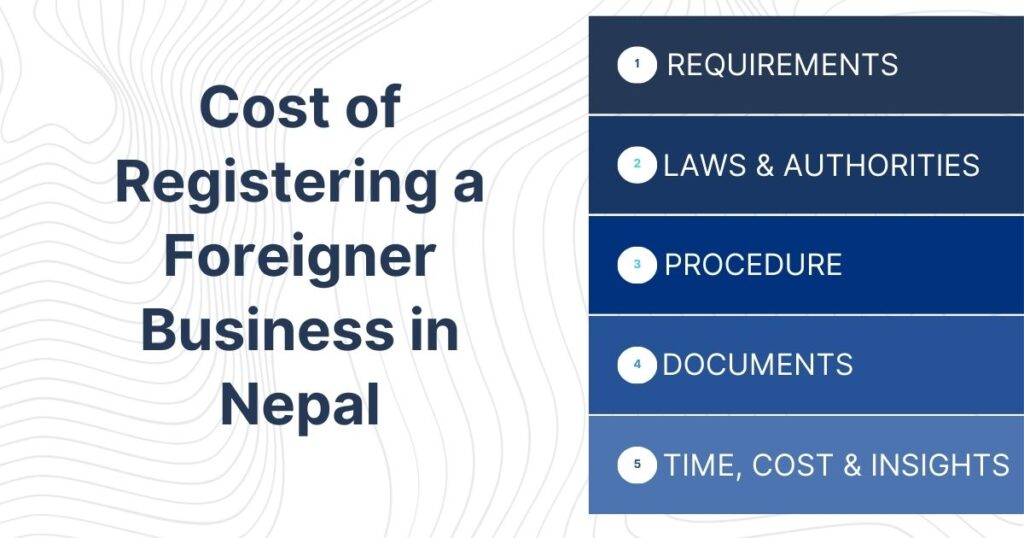
Foreign Direct Investment (FDI) in Nepal requires compliance with multiple regulatory bodies and payment of various fees. The total cost of registering a foreigner business in Nepal comprises government fees, deposits, and professional service charges. This article provides a detailed breakdown of all costs associated with establishing a foreign-owned business in Nepal.
Government Fees
The Government of Nepal charges various fees for foreign business registration through different departments. These fees are mandatory and must be paid during the registration process. The primary government fees include Office of Company Registrar (OCR) registration fees, ward registration fees, and Department of Industry (DOI) deposit requirements.
OCR Registration Fees
The Office of Company Registrar (OCR) is the primary authority for company registration in Nepal under the Companies Act, 2063 (2006). The registration fees vary based on the authorized capital of the company and the nature of business operations.
For IT Companies
Information Technology companies receive preferential treatment in Nepal as the government promotes the IT sector for economic development. The OCR registration fees for IT companies are structured as follows:
| Authorized Capital Range | Registration Fee (NPR) |
|---|---|
| NPR 1–5 Lakhs | 4,500 |
| NPR 5–25 Lakhs | 9,500 |
| NPR 25 Lakhs – 1 Crore | 16,000 |
| Every Additional 1 Crore | 3,000 per Crore |
The reduced fee structure for IT companies reflects the government’s policy under the Information Technology Policy, 2067 (2010) and subsequent amendments. Companies engaged in software development, IT services, digital solutions, and technology-based services qualify for this category. The classification as an IT company must be verified during the registration process at OCR.
For example, an IT company with authorized capital of NPR 50 Lakhs would pay NPR 16,000 as OCR registration fee. If the authorized capital is NPR 3 Crores, the calculation would be NPR 16,000 (base fee for up to 1 Crore) plus NPR 6,000 (NPR 3,000 × 2 additional crores), totaling NPR 22,000.
For Other Industries
Companies operating in sectors other than Information Technology face higher registration fees at OCR. The minimum OCR registration fee for non-IT companies is NPR 19,000, regardless of the authorized capital amount. This applies to manufacturing, trading, service, tourism, construction, and all other business sectors.
The fee structure for non-IT companies increases proportionally with higher authorized capital. Companies with substantial capital investment pay additional fees calculated on a per-crore basis. The exact fee schedule is determined by the OCR based on the authorized capital declared in the Memorandum of Association and Articles of Association.
Ward Registration
Ward registration is mandatory for all businesses operating in Nepal under the Local Government Operation Act, 2074 (2017). Every company must register at the ward office where its registered office is located. The ward registration fee structure depends on the annual rent amount specified in the office rent agreement.
The ward registration fees start from NPR 10,000 and increase based on the rent agreement amount. The local government collects 10% of the annual rent as tax during ward registration. This tax is separate from the registration fee and must be paid annually.
For instance, if a company’s annual rent is NPR 200,000, the ward tax would be NPR 20,000 (10% of NPR 200,000). The total ward registration cost would include the base registration fee plus this tax amount. Different municipalities and rural municipalities may have slight variations in their fee structures, but the 10% rent tax is standard across Nepal.
The ward office issues a business operation recommendation letter after registration, which is required for tax registration at the Inland Revenue Department (IRD) and for various other compliance purposes.
DOI Deposit
The Department of Industry (DOI) requires a refundable deposit from foreign investors as part of the FDI approval process. This deposit serves as a commitment guarantee and is refundable after the company completes its industry registration and commences operations.
The standard DOI deposit amount is NPR 25,000 for most foreign investment projects. This deposit must be paid when submitting the FDI approval application to the Department of Industry under the Foreign Investment and Technology Transfer Act, 2075 (2019). The deposit is held by the DOI until the investor fulfills all registration requirements and obtains the industry registration certificate.
The DOI deposit is separate from the minimum capital requirements for foreign investment. According to the Foreign Investment and Technology Transfer Act, 2075 (2019), foreign investors must invest a minimum of NPR 50 Lakhs in Nepal. The NPR 25,000 deposit is an administrative fee and does not count toward this minimum investment requirement.
Upon successful completion of industry registration and submission of all required documents, the DOI refunds the deposit amount to the company’s bank account. The refund process typically takes 30-60 days after the industry registration certificate is issued.
Service Charges
Professional service providers assist foreign investors in navigating the complex registration process in Nepal. Service charges cover legal consultation, document preparation, liaison with government offices, and complete facilitation of the registration process.
For IT Companies
For establishing an Information Technology company in Nepal through Foreign Direct Investment, the professional service charge is NPR 1,95,000 (excluding government fees). This service charge covers the complete registration process from FDI approval to bank account opening and final compliance.
The service package for IT companies includes preparation of all legal documents, drafting of Memorandum of Association and Articles of Association, coordination with the Department of Industry for FDI approval, company registration at OCR, tax registration at IRD, ward registration, and assistance with bank account opening. The service provider handles all interactions with government offices and ensures compliance with the Foreign Investment and Technology Transfer Act, 2075 (2019) and Companies Act, 2063 (2006).
For Other Industries
For establishing a company with NPR 2 Crore authorized capital in sectors other than IT, the professional service charge is NPR 2,95,000 (excluding government fees). This higher service charge reflects the additional complexity and requirements for non-IT sectors, including potential environmental assessments, industry-specific approvals, and more extensive documentation.
For Special Cases
Industries requiring capital above the base amount or industries requiring additional approvals from sector-specific regulators face variable service charges. Manufacturing industries may require approval from the Department of Cottage and Small Industries. Tourism businesses need approval from the Nepal Tourism Board. Financial services require Nepal Rastra Bank approval. Educational institutions need approval from the Ministry of Education.
For such cases, service providers prepare customized quotations based on the specific requirements, complexity, and timeline. These quotations are provided via email or WhatsApp after assessing the project scope and regulatory requirements.
Scope of Work
The complete registration process for a foreign business in Nepal involves multiple steps across various government departments. The scope of work encompasses all necessary procedures to establish a legally compliant foreign-owned company.
1. Obtaining FDI Approval from the Department of Industry
The first step is obtaining Foreign Direct Investment approval from the Department of Industry (DOI). The application must include the project proposal, feasibility study, investment details, and source of funds. The DOI reviews the application under the Foreign Investment and Technology Transfer Act, 2075 (2019) and issues approval within 7 working days for projects not requiring additional scrutiny. The approval letter specifies the approved investment amount, business sector, and any conditions or restrictions.
2. Company Registration at OCR
After receiving FDI approval, the company must be registered at the Office of Company Registrar. The registration requires submission of the Memorandum of Association, Articles of Association, FDI approval letter, passport copies of foreign shareholders and directors, and proof of registered office. The OCR verifies all documents and registers the company under the Companies Act, 2063 (2006). The registration process takes 3-5 working days, and the OCR issues a company registration certificate with a unique company registration number.
3. Tax Registration at IRD
Tax registration at the Inland Revenue Department (IRD) is mandatory for all companies. The application requires the company registration certificate, PAN (Permanent Account Number) application, office rent agreement, and ward recommendation letter. The IRD issues a PAN certificate, which is essential for all financial transactions, tax payments, and compliance. The tax registration must be completed within 30 days of company registration as per the Income Tax Act, 2058 (2002).
4. Ward Registration at Local Ward Office
The company must register at the ward office of the local government where its registered office is located. The ward registration requires submission of the company registration certificate, office rent agreement, citizenship or passport copies of directors, and payment of registration fees and rent tax. The ward office issues a business operation recommendation letter, which is required for various other registrations and approvals.
5. Local Bank Account Opening
Opening a bank account in a Nepali commercial bank is necessary for capital deposit and business operations. The bank requires the company registration certificate, PAN certificate, board resolution for account opening, specimen signatures of authorized signatories, and identification documents of directors. Foreign investors must deposit the minimum required capital (NPR 50 Lakhs) in the company’s bank account. The bank issues an account opening certificate and capital deposit certificate.
6. Obtaining Non-Blacklisted Certificate from CIB
The Credit Information Bureau (CIB) issues a non-blacklisted certificate confirming that the company and its directors have no adverse credit history. This certificate is required for industry registration at the DOI. The application requires submission of the company registration certificate, PAN certificate, and identification documents of all directors. The CIB verifies the information and issues the certificate within 3-5 working days.
7. Conducting Industry Registration at DOI
Industry registration at the Department of Industry is the final step in the FDI process. The application requires submission of the company registration certificate, PAN certificate, bank account details, capital deposit certificate, non-blacklisted certificate, and proof of office space. The DOI verifies that all conditions of the FDI approval have been met and issues the industry registration certificate. This certificate confirms that the foreign investment has been successfully established in Nepal.
8. Obtaining Share Registry Certificate from OCR
The Share Registry Certificate is obtained from the Office of Company Registrar after completing the initial share allotment. The application requires submission of the board resolution for share allotment, list of shareholders with their shareholding details, and proof of capital payment. The OCR maintains the official share registry and issues the certificate confirming the shareholding structure of the company.
9. Notifying Nepal Rastra Bank
Foreign investment must be notified to Nepal Rastra Bank (NRB), the central bank of Nepal, as per the Foreign Exchange (Regulation) Act, 2019 (1962). The notification includes details of the foreign investment amount, source of funds, and repatriation arrangements. The NRB maintains records of all foreign investments and monitors compliance with foreign exchange regulations. This notification is essential for future profit repatriation and capital repatriation.
10. Obtaining Share Registry Certificate
The final Share Registry Certificate is obtained after all shareholders have been properly registered and all capital has been deposited. This certificate serves as official proof of the company’s shareholding structure and is required for various corporate actions, including dividend distribution, share transfers, and capital increases. The certificate must be updated whenever there are changes in the shareholding structure.
Total Cost Estimation
The total cost of registering a foreign business in Nepal varies based on the business sector, authorized capital, and specific requirements. Below is a sample cost breakdown for different scenarios:
IT Company with NPR 50 Lakhs Capital
| Cost Component | Amount (NPR) |
|---|---|
| OCR Registration Fee | 16,000 |
| Ward Registration (estimated) | 15,000 |
| DOI Deposit (refundable) | 25,000 |
| Professional Service Charge | 195,000 |
| Total (excluding DOI deposit) | 226,000 |
Non-IT Company with NPR 2 Crore Capital
| Cost Component | Amount (NPR) |
|---|---|
| OCR Registration Fee | 25,000 |
| Ward Registration (estimated) | 20,000 |
| DOI Deposit (refundable) | 25,000 |
| Professional Service Charge | 295,000 |
| Total (excluding DOI deposit) | 340,000 |
These estimates do not include miscellaneous expenses such as notary fees, translation costs, courier charges, and travel expenses, which may add NPR 10,000-20,000 to the total cost.
Additional Considerations
Foreign investors should budget for ongoing compliance costs after registration. Annual compliance includes renewal of ward registration, annual tax filing, annual general meeting expenses, and audit fees. The annual compliance cost typically ranges from NPR 50,000 to NPR 1,50,000 depending on the company’s size and complexity.
Companies in regulated sectors may face additional costs for sector-specific licenses and approvals. Manufacturing companies need environmental clearance. Import-export businesses require customs registration. Service companies may need professional licenses depending on the nature of services.
The Foreign Investment and Technology Transfer Act, 2075 (2019) provides various facilities and concessions to foreign investors, including tax holidays for certain sectors, exemption from customs duties on imported machinery, and simplified repatriation procedures. These benefits can offset the initial registration costs over time.
Read More:
- https://lawaxion.com/timeline-for-private-company-registration-in-nepal/
- https://lawaxion.com/name-reservation-rules-for-private-companies-in-nepal/
- https://lawaxion.com/private-company-registration-checklist-in-nepal-2026/
- https://lawaxion.com/documents-for-private-company-registration-in-nepal-2026/
- https://lawaxion.com/requirements-for-private-company-registration-in-nepal-2026/
Frequently Asked Questions
What is the minimum capital requirement for foreign investment in Nepal?
The minimum capital requirement for foreign investment in Nepal is NPR 50 Lakhs as per the Foreign Investment and Technology Transfer Act, 2075 (2019). This amount must be deposited in a Nepali bank account.
Are the OCR fees different for IT and non-IT companies?
Yes, IT companies benefit from reduced OCR registration fees. For capital up to NPR 1 Crore, IT companies pay NPR 4,500 to NPR 16,000, while non-IT companies pay a minimum of NPR 19,000.
Is the DOI deposit refundable?
Yes, the NPR 25,000 DOI deposit is refundable after successful completion of industry registration and submission of all required documents. The refund process takes 30-60 days.
How long does the complete registration process take?
The complete registration process typically takes 45-60 days from FDI approval application to final industry registration, assuming all documents are properly prepared and no complications arise.
Can foreign investors own 100% of a company in Nepal?
Yes, foreign investors can own 100% equity in most sectors except those reserved for Nepali nationals, such as cottage industries with investment below NPR 50 Lakhs and certain service sectors.
What are the ongoing compliance costs after registration?
Annual compliance costs include ward registration renewal, tax filing, audit fees, and annual general meeting expenses, typically ranging from NPR 50,000 to NPR 1,50,000 annually.
Do service charges include government fees?
No, the quoted service charges of NPR 1,95,000 for IT companies and NPR 2,95,000 for other companies exclude government fees, which must be paid separately.
Which sectors require additional approvals beyond DOI?
Manufacturing, tourism, education, financial services, healthcare, and telecommunications require additional sector-specific approvals from respective regulatory authorities beyond the standard DOI approval.