Introduction
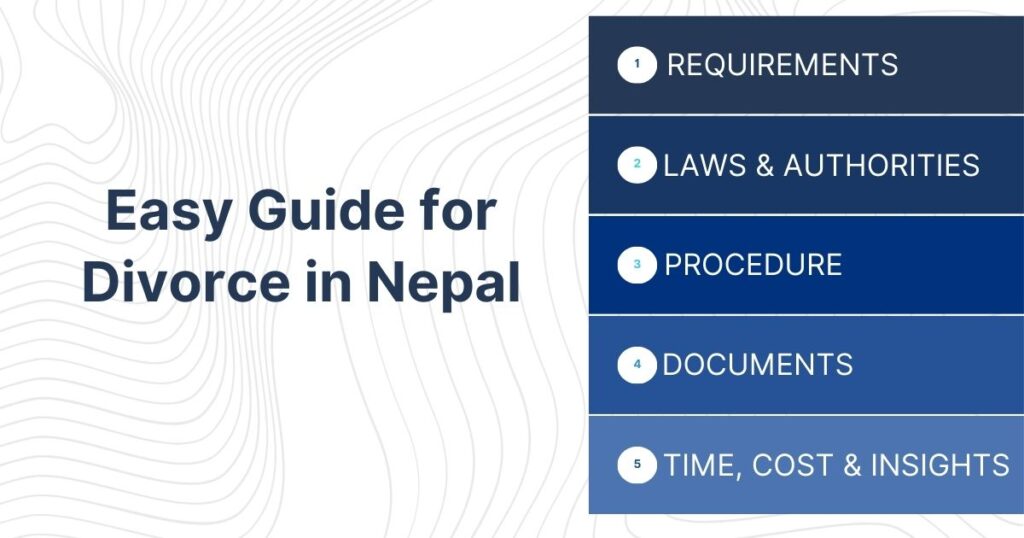
Divorce in Nepal is governed by the National Civil Code 2017, which replaced the previous Muluki Ain provisions. The law recognizes both mutual consent divorce and contested divorce proceedings. Nepalese courts handle divorce cases through district courts, where parties must present valid grounds and follow prescribed procedures. The legal framework ensures protection of rights for both spouses while addressing matters of property division, child custody, and alimony. Understanding the divorce process helps parties prepare documentation, meet legal requirements, and navigate court proceedings effectively.
Legal Framework for Divorce in Nepal
The National Civil Code 2017 (Muluki Dewani Samhita) governs all divorce proceedings in Nepal. Section 94 to Section 105 of the Code specifically address marriage dissolution, grounds for divorce, and related procedures. The law recognizes marriage as a civil contract that can be terminated under specific circumstances. Courts apply these provisions uniformly across all districts in Nepal. The Civil Procedure Code 2074 supplements the substantive law by providing procedural guidelines for filing and processing divorce cases. These laws replaced the previous Muluki Ain provisions that governed family matters before 2018.
Grounds for Divorce in Nepal
The National Civil Code 2017 specifies legitimate grounds for divorce under Section 94. Courts accept divorce petitions only when parties demonstrate valid legal reasons. The law distinguishes between mutual consent divorce and fault-based divorce proceedings.
Valid grounds for divorce include:
- Both parties mutually agree to dissolve the marriage through written consent.
- One spouse commits adultery or engages in extramarital relationships.
- Physical or mental cruelty inflicted by one spouse upon the other.
- One spouse suffers from incurable mental illness for three consecutive years.
- One spouse abandons the other for three consecutive years without contact.
- One spouse attempts to kill or cause serious harm to the other.
- One spouse is convicted of a crime and sentenced to imprisonment exceeding three years.
- One spouse becomes impotent after marriage and the condition remains incurable.
- One spouse suffers from a sexually transmitted disease that endangers the other.
- The marriage remains unconsummated for one year without reasonable cause.
Types of Divorce Proceedings
Nepal recognizes two primary types of divorce proceedings under the National Civil Code 2017. The type of proceeding determines the timeline, complexity, and court requirements. Parties must choose the appropriate proceeding based on their circumstances and level of agreement.
Mutual Consent Divorce
Mutual consent divorce occurs when both spouses agree to dissolve the marriage. Section 94(1) of the National Civil Code permits this type of divorce. Both parties must submit a joint application to the district court. The court verifies the genuineness of consent and ensures no coercion exists. This process typically completes faster than contested divorce. Courts may grant divorce within 35 days if all requirements are met. Parties must agree on property division, child custody, and alimony before filing.
Contested Divorce
Contested divorce occurs when one spouse files against the other based on specific grounds. Section 94(2) to 94(10) of the National Civil Code lists acceptable grounds. The petitioner must prove allegations through evidence and witness testimony. The respondent receives opportunity to defend and present counter-evidence. Courts conduct detailed hearings and examine all submitted materials. This process takes longer than mutual consent divorce, often extending six months to two years. Final judgment depends on evidence quality and case complexity.
Divorce Procedure in Nepal
The divorce procedure follows specific steps outlined in the National Civil Code 2017 and Civil Procedure Code 2074. Parties must complete each step sequentially to obtain a valid divorce decree. District courts maintain jurisdiction over divorce cases based on the parties’ residence.
Step-by-step divorce procedure:
- Prepare the divorce petition with all required details and grounds for divorce.
- Collect and organize all supporting documents including marriage certificate and evidence.
- File the petition at the district court where either spouse resides permanently.
- Pay the prescribed court fees based on the type of divorce proceeding.
- Serve notice to the respondent spouse through court-approved methods.
- Attend the preliminary hearing where the court examines the petition’s validity.
- Participate in mediation sessions if ordered by the court for reconciliation attempts.
- Present evidence and witness testimony during formal court hearings.
- Submit written statements and legal arguments supporting the divorce claim.
- Attend final hearings where both parties present closing arguments.
- Receive the court’s judgment either granting or denying the divorce petition.
- Obtain the certified divorce decree from the court registry after judgment.
Documents Required for Divorce
Courts require specific documents to process divorce petitions under the Civil Procedure Code 2074. Incomplete documentation causes delays and potential rejection of petitions. Parties must submit original documents with certified copies for court records.
Essential documents for divorce proceedings:
- Marriage registration certificate issued by the local government authority.
- Citizenship certificates of both spouses showing current legal status.
- Recent passport-size photographs of both parties for court records.
- Proof of residence showing current address of both spouses.
- Birth certificates of children if the couple has minor children.
- Property ownership documents for assets acquired during marriage.
- Bank statements and financial records for alimony and property division.
- Medical reports if claiming divorce on health-related grounds.
- Police reports or hospital records if claiming physical abuse or cruelty.
- Witness statements supporting the grounds claimed in the petition.
- Affidavits sworn before authorized officials confirming petition facts.
- Power of attorney if representation through legal counsel is required.
Time Required for Divorce
The duration of divorce proceedings varies based on the type of divorce and case complexity. Mutual consent divorces complete faster than contested divorces. Court workload and case backlog also affect processing time.
| Divorce Type | Minimum Duration | Average Duration | Maximum Duration |
|---|---|---|---|
| Mutual Consent | 35 days | 2–3 months | 6 months |
| Contested (Simple) | 6 months | 12–18 months | 24 months |
| Contested (Complex) | 12 months | 18–24 months | 36 months |
| With Appeals | 24 months | 30–36 months | 48 months |
The National Civil Code 2017 mandates courts to complete mutual consent divorce within 35 days. However, practical delays occur due to documentation issues, court schedules, and administrative processing. Contested divorces require multiple hearings, evidence examination, and witness testimony, extending the timeline significantly.
Cost of Divorce in Nepal
Divorce costs include court fees, legal fees, and administrative expenses. The National Civil Code 2017 and Court Fees Act determine official court charges. Additional costs depend on case complexity and legal representation requirements.
| Cost Component | Mutual Consent | Contested Divorce |
|---|---|---|
| Court Filing Fee | NPR 500–1,000 | NPR 1,000–2,000 |
| Stamp Paper | NPR 100–500 | NPR 500–1,000 |
| Notice Publication | NPR 1,000–3,000 | NPR 2,000–5,000 |
| Legal Fees | NPR 25,000–75,000 | NPR 75,000–300,000 |
| Document Certification | NPR 500–2,000 | NPR 1,000–3,000 |
| Translation Services | NPR 2,000–10,000 | NPR 5,000–20,000 |
| Total Estimated Cost | NPR 30,000–90,000 | NPR 85,000–350,000 |
Legal fees vary based on lawyer experience, case complexity, and negotiation. Property disputes and child custody battles increase overall costs. Parties may incur additional expenses for expert witnesses, forensic reports, and investigation costs.
Property Division in Divorce
The National Civil Code 2017 governs property division during divorce proceedings. Section 98 specifically addresses distribution of marital property. Courts distinguish between separate property and joint property acquired during marriage.
Property division principles:
- Property acquired before marriage remains the separate property of the original owner.
- Property acquired during marriage through joint efforts becomes marital property.
- Inherited property and gifts received by one spouse remain separate property.
- Courts divide marital property equally between spouses unless circumstances justify different distribution.
- The spouse who contributed more financially may receive proportionally larger share.
- Courts consider each spouse’s economic condition and future earning capacity.
- Property used for children’s welfare receives special consideration in division.
- Debts incurred during marriage are divided proportionally between spouses.
Child Custody and Support
Child custody decisions follow the best interest of the child principle under Section 99 of the National Civil Code 2017. Courts prioritize children’s welfare over parental preferences. Both parents retain rights and responsibilities toward children after divorce.
Child custody considerations:
- Children below five years generally remain with the mother unless circumstances prevent it.
- Children above five years may express preference, which courts consider but do not bind.
- Courts examine each parent’s financial capacity, living conditions, and moral character.
- The parent receiving custody must provide suitable environment for child development.
- Non-custodial parents receive visitation rights unless child safety concerns exist.
- Both parents must contribute to child support based on their financial capacity.
- Child support covers education, healthcare, food, clothing, and other essential needs.
- Courts may modify custody arrangements if circumstances change significantly.
Alimony and Maintenance
Section 100 of the National Civil Code 2017 addresses alimony and maintenance obligations. Courts may order one spouse to provide financial support to the other. The amount depends on various factors including earning capacity and standard of living.
Alimony determination factors:
- The financial condition and earning capacity of both spouses at divorce time.
- The standard of living maintained during the marriage period.
- The duration of the marriage and contributions made by each spouse.
- The age, health condition, and employability of the spouse seeking alimony.
- The presence of minor children and their custody arrangements.
- Any property or assets awarded to the spouse in property division.
- The fault or misconduct that led to the marriage breakdown.
- The time required for the dependent spouse to become self-sufficient.
Divorce for Non-Resident Nepalis
Non-Resident Nepalis (NRNs) can file for divorce in Nepal under specific conditions. The National Civil Code 2017 applies to Nepali citizens regardless of residence location. Jurisdiction depends on marriage registration location and parties’ citizenship status.
NRN divorce requirements:
- At least one spouse must hold Nepali citizenship for Nepali courts to have jurisdiction.
- The marriage must be registered in Nepal or recognized under Nepali law.
- NRNs must provide proof of current residence and contact information abroad.
- Power of attorney allows legal representatives to appear on behalf of NRN parties.
- All foreign documents require authentication from Nepali embassy or consulate.
- Translation of foreign documents into Nepali language is mandatory for court submission.
- NRNs must comply with notice requirements and attend hearings when summoned.
- Court judgments issued in Nepal are valid internationally for Nepali citizens.
Divorce Recognition and Registration
Courts issue divorce decrees after completing all proceedings and hearings. The decree becomes effective from the date specified in the judgment. Parties must register the divorce with relevant government authorities for official recognition.
Post-divorce registration process:
- Obtain certified copies of the divorce decree from the court registry.
- Submit the divorce decree to the local government office where marriage was registered.
- Complete the divorce registration form with accurate personal information.
- Pay the prescribed registration fees to the local government office.
- Receive the divorce registration certificate as proof of marital status change.
- Update citizenship certificates and other official documents reflecting divorced status.
- Notify relevant authorities including passport office and social security office.
Common Challenges in Divorce Cases
Divorce proceedings present various challenges that parties must address effectively. Understanding potential obstacles helps in better case preparation and management. Legal representation becomes essential when facing complex situations.
Frequent challenges include:
- Difficulty in serving notice to spouse who deliberately avoids court summons.
- Disputes over property valuation and division of jointly acquired assets.
- Disagreements regarding child custody and visitation arrangements.
- Proving grounds for divorce when evidence is limited or circumstantial.
- Delays caused by court backlogs and scheduling conflicts.
- High legal costs that strain financial resources of parties.
- Emotional stress affecting decision-making and case progression.
- Interference from family members complicating settlement negotiations.
Legal Rights and Protections
The National Civil Code 2017 provides comprehensive rights and protections to both spouses. Courts ensure fair treatment and prevent abuse of legal processes. Understanding these rights helps parties protect their interests effectively.
Protected rights include:
- The right to legal representation and fair hearing before the court.
- The right to present evidence and cross-examine witnesses.
- The right to appeal court decisions to higher judicial authorities.
- The right to interim maintenance during pending divorce proceedings.
- The right to protection from domestic violence through restraining orders.
- The right to privacy and confidentiality of sensitive case information.
- The right to equitable property division based on contributions.
- The right to custody or visitation of minor children.
Mediation and Alternative Dispute Resolution
The Civil Procedure Code 2074 encourages mediation before formal divorce proceedings. Courts may order parties to attempt reconciliation through mediation. Alternative dispute resolution reduces time, cost, and emotional stress.
Mediation process features:
- Trained mediators facilitate discussions between spouses in neutral settings.
- Parties discuss issues including property division, custody, and support voluntarily.
- Mediators help identify common ground and develop mutually acceptable solutions.
- Agreements reached through mediation become binding when approved by court.
- Mediation maintains confidentiality and protects parties’ privacy throughout.
- Failed mediation does not prevent parties from pursuing formal court proceedings.
- Mediation costs significantly less than full contested divorce litigation.
Why Choose Axion Partners
Axion Partners stands as the premier legal service provider for divorce matters in Nepal. The firm combines extensive legal expertise with client-focused service delivery. Experienced attorneys handle all aspects of divorce proceedings with professionalism and confidentiality.
Service advantages include:
- Comprehensive legal consultation covering all divorce-related matters and concerns.
- Expert preparation of divorce petitions with proper legal grounds and documentation.
- Strategic case management ensuring efficient progression through court procedures.
- Skilled negotiation for favorable property division and custody arrangements.
- Representation in all court hearings and mediation sessions.
- Transparent fee structure with no hidden charges or unexpected costs.
- Multilingual support for NRN clients requiring assistance in English.
- Post-divorce services including registration and document updates.
- Proven track record with successful case resolutions across Nepal.
- Personalized attention addressing unique circumstances of each client.
Axion Partners maintains offices in major cities across Nepal, providing accessible legal services. The firm’s attorneys stay updated on latest legal developments and court precedents. Client satisfaction and case success remain the primary focus of all service delivery.
Read More:
- https://lawaxion.com/bpo-outsourcing-business-registration-in-nepal/
- https://lawaxion.com/garment-manufacturing-business-in-special-economic-zones/
- https://lawaxion.com/pan-vat-payroll-and-ssf-for-businesses-in-nepal/
- https://lawaxion.com/labour-law-to-follow-after-company-registration-in-nepal/
- https://lawaxion.com/taxation-accounting-for-new-companies-in-nepal/
Frequently Asked Questions
What is the minimum time required for divorce in Nepal?
Mutual consent divorce can be completed in 35 days as per the National Civil Code 2017. However, practical processing typically takes two to three months due to court procedures and documentation requirements.
Can I file for divorce if my spouse lives abroad?
Yes, you can file for divorce in Nepal if you are a Nepali citizen. The court will serve notice through publication and diplomatic channels to ensure your spouse receives proper notification.
How much does divorce cost in Nepal?
Mutual consent divorce costs approximately NPR 30,000 to NPR 90,000 including legal fees. Contested divorce costs range from NPR 85,000 to NPR 350,000 depending on case complexity and duration.
Is mutual consent required for divorce in Nepal?
No, mutual consent is not required. You can file for contested divorce based on valid grounds specified in Section 94 of the National Civil Code 2017 even without spouse’s agreement.
What happens to property acquired during marriage?
Property acquired during marriage through joint efforts is divided equally between spouses. Courts may adjust distribution based on individual contributions and economic circumstances of each party.
Can divorced persons remarry in Nepal?
Yes, divorced persons can remarry after obtaining the divorce decree. There is no mandatory waiting period under Nepali law before entering into a new marriage after divorce.
How is child custody decided in divorce cases?
Courts decide custody based on the child’s best interest. Children below five years generally stay with mothers. Older children’s preferences are considered along with parents’ financial and moral capacity.
Do I need a lawyer for divorce in Nepal?
While not legally mandatory, hiring a lawyer is highly recommended. Legal representation ensures proper documentation, protects your rights, and increases chances of favorable outcomes in property and custody matters.
Conclusion
Divorce in Nepal follows structured legal procedures under the National Civil Code 2017. Understanding the process, requirements, and costs helps parties prepare effectively for proceedings. Whether pursuing mutual consent or contested divorce, proper documentation and legal compliance remain essential. Property division, child custody, and alimony require careful consideration and negotiation. Professional legal assistance from experienced firms like Axion Partners ensures smooth case progression and protection of rights. The divorce process, while challenging, provides legal framework for fair resolution of marital disputes and enables parties to move forward with their lives.