Introduction
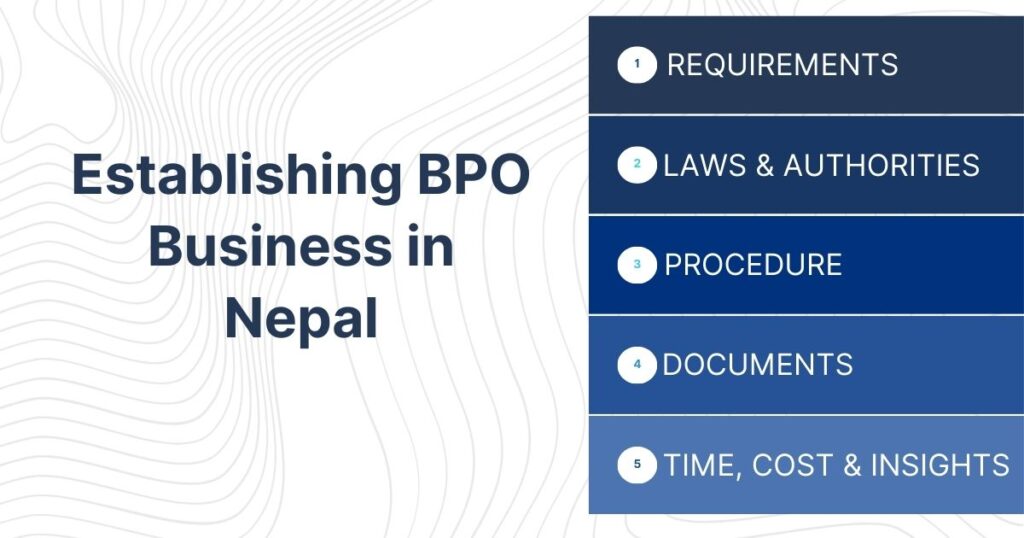
Business Process Outsourcing (BPO) operations represent a significant sector in Nepal’s service economy. Establishing a BPO business requires compliance with Nepalese legal frameworks, registration procedures, and regulatory requirements. This article outlines the complete process, timeline, and financial considerations for setting up a BPO enterprise in Nepal.
Legal Framework for BPO Operations in Nepal
BPO businesses in Nepal operate under the Companies Act, 2063, the Foreign Investment and Technology Transfer Act, 2075, and sector-specific regulations. The Nepal Rastra Bank (NRB) governs foreign exchange transactions, while the Department of Commerce regulates business operations. The Industrial Enterprises Act, 2076, provides incentives for technology-based enterprises, including BPO operations classified as service industries.
BPO businesses must obtain necessary licenses from the District Administration Office (DAO) and register with the Inland Revenue Department (IRD) for tax purposes. Compliance with data protection standards and cybersecurity regulations remains mandatory for operations handling sensitive information.
Registration and Licensing Process
Step-by-Step Registration Procedure
The establishment of a BPO business follows a structured registration process:
- The applicant must prepare the Memorandum of Association (MoA) and Articles of Association (AoA) in accordance with the Companies Act, 2063.
- The applicant must obtain a company name approval from the Office of the Company Registrar before formal registration.
- The applicant must submit the MoA and AoA along with required documents to the Office of the Company Registrar.
- The applicant must receive the Certificate of Incorporation upon successful registration.
- The applicant must obtain a Permanent Account Number (PAN) from the Inland Revenue Department.
- The applicant must register with the District Administration Office for business operation license.
- The applicant must open a corporate bank account with a licensed commercial bank.
- The applicant must register with the Social Security Fund (SSF) for employee benefits.
Required Documentation
| Document | Purpose | Issuing Authority |
|---|---|---|
| Citizenship Certificate | Identity verification | Local Administration |
| PAN Certificate | Tax registration | Inland Revenue Department |
| Company Registration Certificate | Legal entity establishment | Office of Company Registrar |
| Business Operation License | Permission to operate | District Administration Office |
| Bank Account Details | Financial transactions | Commercial Bank |
| SSF Registration | Employee social security | Social Security Fund |
Timeline for BPO Business Establishment
The establishment timeline varies based on documentation completeness and administrative processing:
| Phase | Activity | Duration |
|---|---|---|
| Pre-Registration | Document preparation and name approval | 5–7 days |
| Company Registration | MoA/AoA submission and Certificate of Incorporation | 7–10 days |
| Tax Registration | PAN application and approval | 3–5 days |
| Business License | DAO application and license issuance | 5–7 days |
| Bank Account Opening | Documentation and account activation | 3–5 days |
| SSF Registration | Employee registration completion | 2–3 days |
| Total Estimated Timeline | Complete establishment | 25–37 days |
Expedited processing may reduce timelines by 5–10 days with additional fees.
Financial Requirements and Costs
Initial Investment Breakdown
Establishing a BPO business in Nepal requires the following financial considerations:
| Cost Category | Estimated Amount (NPR) | Details |
|---|---|---|
| Company Registration | 15,000–25,000 | Office of Company Registrar fees |
| Business License | 10,000–20,000 | District Administration Office fees |
| PAN Registration | 5,000–10,000 | Inland Revenue Department fees |
| Office Setup | 500,000–2,000,000 | Rent, furniture, and basic infrastructure |
| IT Infrastructure | 1,000,000–5,000,000 | Computers, servers, software licenses |
| Telecommunications | 200,000–500,000 | Internet, phone systems, connectivity |
| Initial Staffing | 500,000–2,000,000 | Recruitment and training costs |
| Compliance and Legal | 50,000–150,000 | Legal consultation and documentation |
| Total Estimated Cost | 2,280,000–9,705,000 | Approximate range |
Operational Cost Considerations
- Monthly rent for office space ranges from 50,000 to 500,000 NPR depending on location and size.
- Employee salaries constitute the largest operational expense, varying by skill level and experience.
- Internet and telecommunications costs average 30,000 to 100,000 NPR monthly.
- Software licenses and technology maintenance require 20,000 to 100,000 NPR monthly.
- Compliance and regulatory fees require annual allocation of 50,000 to 200,000 NPR.
Regulatory Compliance Requirements
Mandatory Registrations and Approvals
- BPO businesses must register with the Office of the Company Registrar under the Companies Act, 2063.
- Businesses must obtain a Permanent Account Number (PAN) from the Inland Revenue Department for tax compliance.
- Businesses must secure a business operation license from the District Administration Office.
- Businesses must register with the Social Security Fund for employee benefit contributions.
- Businesses handling international transactions must comply with Nepal Rastra Bank foreign exchange regulations.
- Businesses processing personal data must adhere to data protection standards and cybersecurity requirements.
Tax Obligations
BPO businesses must comply with corporate income tax requirements under the Income Tax Act, 2074. Standard corporate tax rates apply to service sector enterprises. Value Added Tax (VAT) registration becomes mandatory upon exceeding specified turnover thresholds. Quarterly tax filing and annual financial statement submission remain obligatory.
Infrastructure and Technical Requirements
Office Setup Specifications
- Office space must comply with local building codes and zoning regulations.
- Adequate power supply with backup generators ensures uninterrupted operations.
- High-speed internet connectivity with redundant systems maintains service reliability.
- Security systems including CCTV and access control protect client data and assets.
- Ergonomic workstations meet occupational health and safety standards.
Technology Infrastructure
- Servers and data storage systems must meet international security standards.
- Software licenses must comply with intellectual property regulations.
- Cybersecurity measures including firewalls and encryption protect sensitive information.
- Backup systems ensure business continuity and data recovery capabilities.
- Network infrastructure supports scalability for business growth.
Staffing and Human Resources
Recruitment Requirements
- BPO businesses must recruit qualified personnel with relevant skills and experience.
- Employee contracts must comply with the Labor Act, 2074, and related regulations.
- Mandatory employee benefits include Social Security Fund contributions and health insurance.
- Training programs develop employee competencies in customer service and technical skills.
- Performance management systems ensure service quality and client satisfaction.
Compliance with Labor Laws
- Businesses must maintain minimum wage standards as prescribed by the government.
- Working hours must not exceed 48 hours per week under the Labor Act, 2074.
- Overtime compensation must be provided at prescribed rates for additional work hours.
- Leave entitlements including annual, sick, and maternity leave must be honored.
- Workplace safety and health standards must be maintained throughout operations.
Foreign Investment Considerations
FDI Regulations
The Foreign Investment and Technology Transfer Act, 2075, governs foreign direct investment in BPO operations. Foreign investors must register with the Department of Commerce and obtain necessary approvals. Repatriation of profits follows Nepal Rastra Bank guidelines and foreign exchange regulations. Tax treaties between Nepal and investor countries may provide relief provisions.
Incentives for BPO Sector
- Technology-based enterprises receive tax holidays under the Industrial Enterprises Act, 2076.
- Export-oriented BPO services qualify for customs duty exemptions on imported equipment.
- Special Economic Zones offer reduced tax rates and regulatory incentives.
- Infrastructure development support may be available through government programs.
Axion Partners: Leading BPO Establishment Service Provider
Axion Partners stands as the No. 1 service provider for establishing BPO businesses in Nepal. The firm offers comprehensive services including legal registration, compliance management, infrastructure setup, and regulatory guidance. Axion Partners’ expertise in Nepalese business law and BPO sector regulations ensures efficient and compliant business establishment. The organization provides end-to-end support from initial planning through operational launch.
Read More:
- https://lawaxion.com/conducting-due-diligence-of-a-company-in-nepal/
- https://lawaxion.com/company-incorporation-in-nepal-timeline-and-process/
- https://lawaxion.com/import-export-business-requirements-in-nepal/
- https://lawaxion.com/after-company-registration-in-nepal-renew-audit-tax-cost/
- https://lawaxion.com/incorporating-company-in-nepal-vs-business-registration/
Frequently Asked Questions
What is the minimum capital requirement for a BPO business in Nepal?
Nepal does not mandate a specific minimum capital for BPO registration, but operational viability typically requires 2–10 million NPR depending on scale and service offerings.
How long does BPO business registration take in Nepal?
Complete registration typically requires 25–37 days, including company registration, tax registration, and business licensing procedures.
What licenses are required for BPO operations?
BPO businesses require company registration, business operation license, PAN registration, and SSF registration as mandatory requirements.
Are foreign investors allowed to establish BPO businesses in Nepal?
Yes, foreign investors may establish BPO businesses under the Foreign Investment and Technology Transfer Act, 2075, with appropriate approvals.
What are the primary operational costs for BPO businesses?
Primary costs include employee salaries, office rent, internet connectivity, software licenses, and compliance expenses.
Does Nepal offer tax incentives for BPO businesses?
Technology-based BPO enterprises qualify for tax holidays and incentives under the Industrial Enterprises Act, 2076.
What data protection standards apply to BPO operations?
BPO businesses must comply with cybersecurity regulations and data protection standards for handling sensitive information.
Conclusion
Establishing a BPO business in Nepal requires systematic compliance with legal frameworks, registration procedures, and regulatory requirements. The process typically spans 25–37 days with estimated costs ranging from 2.3 to 9.7 million NPR. Successful BPO establishment depends on thorough documentation, regulatory compliance, and adequate infrastructure investment. Axion Partners provides expert guidance and comprehensive support throughout the establishment process, ensuring legal compliance and operational efficiency.