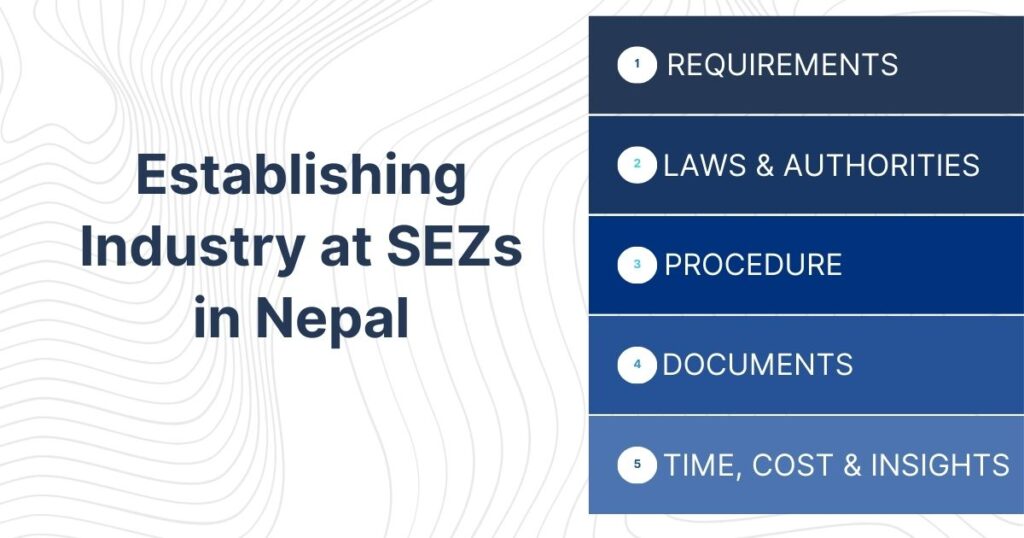
Establishing industry at Special Economic Zones in Nepal offers tax exemptions, customs benefits, and streamlined procedures under the Special Economic Zone Act, 2073. Understanding the process, required documents, costs, and timelines is essential for investors seeking industrial establishment in Nepal’s SEZs.
Steps to Establish Industry at SEZs in Nepal
- Step 1: Verify Industry Eligibility and SEZ Location
- Step 2: Prepare Required Documents and Feasibility Study
- Step 3: Submit Application to Special Economic Zone Authority
- Step 4: Obtain Approval Certificate from SEZA
- Step 5: Complete Infrastructure and Compliance Requirements
- Step 6: Commence Commercial Operations and Maintain Compliance
What is Special Economic Zone in Nepal
A Special Economic Zone in Nepal is a geographically demarcated area established under the Special Economic Zone Act, 2073 (2016) where special fiscal, customs, and administrative provisions apply differently from the general national regime. These zones are created to promote export-oriented industries, attract foreign direct investment, generate employment, and facilitate technology transfer. The Special Economic Zone Authority (SEZA) regulates and administers these zones under the Ministry of Industry, Commerce and Supplies.
Special Economic Zones in Nepal operate as legally constituted industrial enclaves offering tax exemptions, customs concessions, simplified procedures, and regulatory stability. Industries established within SEZs benefit from income tax holidays, VAT exemptions, reduced customs duties, and protection against nationalization. The SEZ framework represents a deliberate deviation from standard bureaucratic procedures to create a competitive investment destination.
Currently, Nepal operates three major Special Economic Zones: Simara SEZ in Bara District, Bhairahawa SEZ near Gautam Buddha International Airport, and Panchkhal SEZ in Kavrepalanchok District. These zones are developed either directly by the government or through public-private partnership models. Establishing industry at SEZs in Nepal provides investors with legal certainty, operational flexibility, and substantial financial incentives unavailable in the general economic regime.
Where to Establish Industry at SEZs in Nepal?
Industries seeking establishment at Special Economic Zones in Nepal must apply to the Special Economic Zone Authority (SEZA), which operates under the Ministry of Industry, Commerce and Supplies. SEZA maintains its head office in Kathmandu and coordinates with individual SEZ management offices located at Simara, Bhairahawa, and Panchkhal. The application process begins at SEZA headquarters where investors submit formal applications under Schedule-4 of the Special Economic Zone Rules, 2074.
The three operational Special Economic Zones offer distinct geographical and logistical advantages. Simara SEZ in Bara District provides proximity to the East-West Highway and Simara Airport, making it suitable for manufacturing and logistics industries. Bhairahawa SEZ benefits from its location near the Indian border and Gautam Buddha International Airport, positioning it as an export-focused industrial hub. Panchkhal SEZ in Kavrepalanchok District serves industries requiring access to Kathmandu Valley markets.
Investors must physically visit SEZA offices or designated SEZ management offices to submit applications, conduct site inspections, and complete approval procedures. The Special Economic Zone Authority website (www.sez.gov.np) provides preliminary information, application forms, and contact details. However, formal application submission requires physical presence and document verification at SEZA offices. Establishing industry at SEZs in Nepal necessitates direct engagement with SEZA throughout the approval and operational phases.
What Laws Govern Establishing Industry at SEZs in Nepal?
The legal framework governing establishment of industries at Special Economic Zones in Nepal comprises comprehensive legislation, rules, and regulatory instruments that create a distinct legal ecosystem for SEZ operations.
Primary Legal Instruments:
- Special Economic Zone Act, 2073 (2016) – Primary legislation establishing SEZ framework
- Special Economic Zone Rules, 2074 (2017) – Implementing regulations and procedures
- Industrial Enterprises Act, 2076 (2020) – General industrial registration provisions
- Foreign Investment and Technology Transfer Act, 2075 (2019) – Foreign investment regulations
- Income Tax Act, 2058 (2002) – Tax provisions and exemptions
- Customs Act, 2064 (2007) – Customs duty and import/export procedures
- Value Added Tax Act, 2052 (1996) – VAT exemptions and zero-rating provisions
- Labor Act, 2074 (2017) – Employment and labor relations
- Environment Protection Act, 2076 (2019) – Environmental compliance requirements
- Land Acquisition Act, 2034 (1977) – Land acquisition for SEZ development
- Public Private Partnership and Investment Act, 2076 (2019) – PPP framework for SEZ development
How to Establish Industry at SEZs in Nepal?
- Step 1: Verify Industry Eligibility and SEZ Location
- Step 2: Prepare Required Documents and Feasibility Study
- Step 3: Submit Application to Special Economic Zone Authority
- Step 4: Obtain Approval Certificate from SEZA
- Step 5: Complete Infrastructure and Compliance Requirements
- Step 6: Commence Commercial Operations and Maintain Compliance

Step 1: Verify Industry Eligibility and SEZ Location
Industries must first verify eligibility under Schedule-3 of the Special Economic Zone Rules, 2074, which prohibits tobacco products, alcoholic beverages, explosives, and weapons manufacturing. Investors should identify the appropriate SEZ location based on industry type, infrastructure requirements, and market access. SEZA maintains a priority industry list that receives preferential treatment during approval processes.
Step 2: Prepare Required Documents and Feasibility Study
Investors must prepare comprehensive documentation including industry summary, feasibility study, environmental impact assessment, and financial projections. Foreign investors require notarized documents from their home country. The application must include detailed information about investment structure, technology sources, employment generation, and use of Nepali raw materials as specified in Schedule-4.
Step 3: Submit Application to Special Economic Zone Authority
Formal application submission to SEZA includes prescribed forms under Schedule-4 of SEZ Rules, 2074, along with all required documents and application fees. SEZA reviews applications for completeness, eligibility, and compliance with SEZ objectives. The Authority may request additional information or clarifications during the review process. Applications must be submitted physically at SEZA offices.
Step 4: Obtain Approval Certificate from SEZA
Upon satisfactory review, SEZA issues an Approval Certificate under Schedule-2 of SEZ Rules, 2074, specifying location, area, investment amount, and construction completion deadline. This certificate constitutes legal authorization to establish industry within the designated SEZ. The approval includes conditions regarding infrastructure development, environmental compliance, and operational timelines that must be strictly followed.
Step 5: Complete Infrastructure and Compliance Requirements
Industries must complete construction, install machinery, obtain environmental clearances, and fulfill all infrastructure requirements within the timeline specified in the approval certificate. This includes establishing utilities, waste management systems, and safety measures. SEZA conducts inspections to verify compliance with approved plans and regulatory standards before permitting commercial operations.
Step 6: Commence Commercial Operations and Maintain Compliance
After infrastructure completion and final inspection, industries receive operational clearance to commence commercial production. Industries must maintain ongoing compliance with SEZ regulations, environmental standards, labor laws, and reporting requirements. Regular audits, annual reports, and renewal procedures ensure continued eligibility for SEZ benefits. Establishing industry at SEZs in Nepal requires sustained regulatory compliance.
What Documents Are Required for Establishing Industry at SEZs
Documents Required for Applying at SEZ
- Completed application form as per Schedule-4 of SEZ Rules, 2074
- Industry summary not exceeding two pages
- Detailed feasibility study and business plan
- Company registration certificate or incorporation documents
- Tax registration certificate (PAN/VAT)
- Board resolution authorizing SEZ application
- Power of attorney if representative applies
- Identity documents of all promoters and directors
- Passport copies for foreign investors
- Investment structure details (equity and loan components)
- Source of financing documentation
- Technology transfer agreement if applicable
- Environmental Impact Assessment or Initial Environmental Examination
- Land ownership or lease documents
- Site plan and infrastructure design
- Preliminary survey report
- Employment generation projections
- Raw material sourcing plan
- Production capacity estimates
- Export market analysis
- Recommendation letter from SEZ developer (for privately developed SEZs)
- Bank guarantee documents for customs facilities
- Notarized foreign documents with official translations
- Application fee payment receipt
What Types of Industries Can Be Established at SEZs in Nepal?
Industries eligible for establishment at Special Economic Zones in Nepal span diverse manufacturing and service sectors, subject to compliance with environmental and regulatory standards. The Special Economic Zone Act, 2073 encourages export-oriented industries, technology-intensive manufacturing, and employment-generating enterprises.
| Industry Category | Eligibility Status | Special Conditions | Priority Level |
|---|---|---|---|
| Export-Oriented Manufacturing | Permitted | Minimum 70% export requirement | High Priority |
| Information Technology Services | Permitted | Software development, BPO, data centers | High Priority |
| Pharmaceutical Manufacturing | Permitted | GMP compliance mandatory | Medium Priority |
| Electronics and Electrical Goods | Permitted | Technology transfer encouraged | High Priority |
| Textile and Garment Manufacturing | Permitted | Export focus required | High Priority |
| Food Processing Industries | Permitted | HACCP standards required | Medium Priority |
| Automobile Parts Manufacturing | Permitted | Quality certification needed | Medium Priority |
| Plastic and Packaging Materials | Permitted | Environmental compliance strict | Medium Priority |
| Chemical Industries | Permitted | Hazardous waste management plan | Low Priority |
| Logistics and Warehousing | Permitted | Supporting SEZ operations | Medium Priority |
| Tobacco Products | Prohibited | Schedule-3 restriction | Not Permitted |
| Alcoholic Beverages | Prohibited | Schedule-3 restriction | Not Permitted |
| Explosives Manufacturing | Prohibited | Schedule-3 restriction | Not Permitted |
| Weapons and Ammunition | Prohibited | Schedule-3 restriction | Not Permitted |
How Long Does Establishing Industry at SEZs Take?
The timeline for establishing industry at Special Economic Zones in Nepal varies based on industry complexity, documentation completeness, and infrastructure requirements.
Application Review and Approval Phase:
- Initial application submission and acknowledgment: 3-5 working days
- SEZA preliminary review and completeness check: 15-20 working days
- Technical evaluation and feasibility assessment: 30-45 working days
- IEE Approval : 45-60 working days
- Board approval and certificate issuance: 15-20 working days
- Total approval phase duration: 4-6 months approximately
Infrastructure Development Phase:
- Land allocation and lease agreement: 30-45 days
- Construction permit and approvals: 20-30 days
- Building construction period: 6-12 months depending on scale
- Machinery installation and testing: 2-4 months
- Utility connections and services: 1-2 months
- Final inspection and compliance verification: 15-30 days
Factors Affecting Timeline:
- Completeness and accuracy of submitted documents
- Industry type and complexity of operations
- Environmental assessment requirements
- Foreign investment approval procedures
- Infrastructure availability at selected SEZ
- Coordination with multiple regulatory agencies
- Seasonal factors affecting construction
- Availability of skilled labor and materials
What Are the Costs of Establishing Industry at SEZs?
Establishing industry at Special Economic Zones in Nepal involves various costs including application fees, land lease charges, infrastructure development, and operational expenses. The Special Economic Zone Rules, 2074 prescribe specific fees while other costs depend on industry scale and requirements.
| Cost Component | Amount / Rate | Payment Schedule | Remarks |
|---|---|---|---|
| Application Fee | NPR 25,000 | At submission | Special Economic Zone Authority |
| Approval Certificate Fee | Depends | Upon approval | Based on project scale |
| Land Lease (First Year) | 50% discount on standard rate | Annual | Concessional rate |
| Land Lease (Second Year) | 40% discount on standard rate | Annual | Concessional rate |
| Land Lease (Third Year) | 25% discount on standard rate | Annual | Concessional rate |
| Environmental Clearance Fee | Depends | Before construction | Government fee |
| Construction Permit Fee | Depends | Before construction | Municipal charge |
| Customs Duty on Vehicle | 1% of vehicle value | At import | Concessional rate |
| Bank Guarantee for Machinery | 100% of duty amount | At import | Refundable |
| Annual Renewal Fee | Depends | Annually | Operational phase |
| Utility Connection Charges | Actual cost | As required | Electricity, water, internet |
Additional Cost Considerations:
- Infrastructure development costs vary significantly based on industry requirements
- Machinery and equipment costs depend on technology and production capacity
- Working capital requirements for initial operations
- Professional fees for legal, accounting, and consulting services
- Employee recruitment and training expenses
- Quality certification and compliance costs
What Are Post-Establishment Requirements for Industries at SEZs?
Industries operating within Special Economic Zones in Nepal must fulfill ongoing compliance, reporting, and operational requirements to maintain eligibility for SEZ benefits and legal authorization.
Regulatory Compliance Requirements:
- Annual operational report submission to SEZA
- Quarterly production and export data reporting
- Environmental monitoring and compliance reports
- Labor law compliance and employee welfare records
- Tax filing despite exemptions (nil returns)
- Customs documentation for imports and exports
- Quality control and product certification maintenance
- Safety and security standards adherence
- Waste management and disposal compliance
- Fire safety and emergency preparedness
Financial and Administrative Obligations:
- Annual financial audit by chartered accountant
- Maintenance of separate accounts for SEZ operations
- Bank guarantee renewal for customs facilities
- Insurance coverage for assets and operations
- Timely payment of land lease charges
- Renewal of operational licenses and permits
- Update of company registration information
- Notification of ownership or management changes
Operational Requirements:
- Minimum export obligation fulfillment (typically 70% of production)
- Employment generation targets achievement
- Technology transfer implementation if committed
- Use of Nepali raw materials as per approved plan
- Maintenance of production capacity
- Quality standards compliance
- Cooperation with SEZA inspections and audits
- Participation in SEZ development activities
What are the SEZ Incentives and Benefits in Nepal?
Establishing industry at Special Economic Zones in Nepal provides substantial fiscal, operational, and strategic advantages unavailable in the general economic regime. These benefits are legally guaranteed under the Special Economic Zone Act, 2073.

Fiscal and Tax Benefits:
- 100% income tax exemption for first 5 years of commercial operation
- 50% income tax exemption for remaining agreement period after initial 5 years
- 100% income tax exemption for 10 years for industries from hilly and mountainous districts
- 100% dividend tax exemption for first 5 years
- 50% dividend tax exemption for next 3 years
- Zero percent VAT on exports from SEZs
- Zero-rated VAT on raw materials supplied to SEZ industries
- 1% customs duty on one personnel vehicle and one goods vehicle
- Customs duty refund on goods supplied to SEZ industries
- Exemption from various local taxes and fees
Operational and Administrative Benefits:
- Simplified approval procedures through single-window system
- Reduced bureaucratic delays and regulatory complexity
- Protection against nationalization under Section 28 of SEZ Act
- Repatriation of capital, profits, and dividends in foreign currency
- Foreign currency account maintenance facility
- Business visa facilities for investors and technical personnel
- Prohibition of strikes and lockouts ensuring operational continuity
- No labor union formation within SEZs
- Streamlined customs clearance procedures
- Dedicated infrastructure and utilities
Strategic and Commercial Benefits:
- Access to international markets through export focus
- Technology transfer opportunities and partnerships
- Skilled labor availability and training facilities
- Proximity to airports and border points
- Networking with other SEZ industries
- Government support for market development
- Enhanced credibility with international buyers
- Competitive advantage over non-SEZ industries
FAQs
Can foreign investors establish industry at SEZs in Nepal?
Yes, foreign investors can establish industries at Special Economic Zones in Nepal under the Foreign Investment and Technology Transfer Act, 2075. They receive the same benefits as domestic investors including tax exemptions, customs concessions, and repatriation rights. Foreign investors must submit notarized documents from their home country and comply with SEZA approval procedures.
What industries are prohibited in SEZs?
Prohibited Industries:
1. Tobacco, bidi, cigarettes, and cigar manufacturing
2. Alcoholic beverages including beer and spirits
3. Explosives manufacturing
4. Weapons, ammunition, and gunpowder production
5. Industries violating environmental standards
How much land can an industry lease in SEZ?
Land allocation depends on industry type, investment scale, and production requirements. SEZA determines appropriate land area based on feasibility study and infrastructure needs. Industries receive concessional lease rates with 50% discount in first year, 40% in second year, and 25% in third year as per SEZA policy decisions.
How to Register Industry in SEZ?
Step 1: Incorporation of Company with Tax & Ward Registration
Step 2: Applying for Establishing SEZ Industry at SEZA
Step 3: Conducting IEE of Industry
Step 4: Approval of Operating Industry at SEZ by SEZA
Step 5: Registration of Industry at DOI
Step 6: Operation of Industry
Can SEZ industries sell products in Nepal?
SEZ industries are primarily export-oriented with minimum 70% export requirement. However, limited domestic sales are permitted subject to payment of applicable customs duties and taxes. Industries must maintain separate accounts for export and domestic sales. SEZA monitors compliance with export obligations through quarterly reporting requirements.
What are the Labor Laws at SEZ?
SEZ industries must comply with the Labor Act, 2074 regarding wages, working conditions, and employee welfare. However, Section 30 of the SEZ Act prohibits strikes and lockouts, and labor unions cannot be formed within SEZs. This ensures operational continuity while maintaining basic labor rights and protections for workers.
What are the Benefits of Starting Industry at SEZ?
Income tax: 100% exemption for 5 years, then 50% for remaining period
Hilly/mountainous districts: 100% exemption for 10 years, then 50%
Dividend tax: 100% exemption for 5 years, then 50% for 3 years
VAT: Zero-rated throughout operational period
Customs: Concessional rates throughout operational period
About Our Firm
Our law firm stands as Nepal’s premier legal service provider for Special Economic Zone matters, offering comprehensive assistance in establishing industries at SEZs in Nepal. Our specialized team understands the complexities of the Special Economic Zone Act, 2073, and maintains direct coordination with SEZA officials to ensure efficient approval processes. We have successfully assisted numerous domestic and foreign investors in establishing industries across Simara, Bhairahawa, and Panchkhal SEZs, making us the most trusted legal partner for SEZ investments in Nepal. Our services include application preparation, document verification, regulatory liaison, compliance management, and ongoing legal advisory.