
Introduction
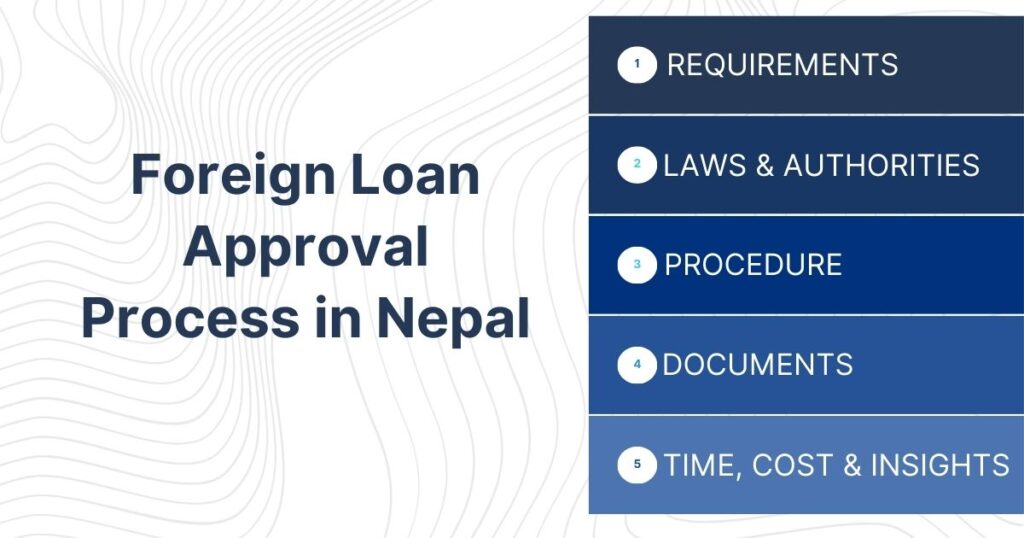
Foreign loan approval in Nepal requires compliance with the Foreign Exchange (Regulation) Act, 1962 and the Nepal Rastra Bank Act, 2002. The Government of Nepal and Nepal Rastra Bank regulate all foreign borrowing activities to maintain economic stability and manage external debt. Organizations seeking foreign loans must obtain prior approval from designated authorities before executing loan agreements. The process involves multiple stages of scrutiny, documentation, and legal compliance to ensure that foreign borrowing aligns with national development priorities and fiscal policies.
Legal Framework Governing Foreign Loans
The Foreign Exchange (Regulation) Act, 1962 establishes the primary legal foundation for foreign loan transactions in Nepal. Section 3 of this Act prohibits any person from borrowing foreign currency without prior approval from Nepal Rastra Bank. The Nepal Rastra Bank Act, 2002 empowers the central bank to regulate foreign exchange transactions and monitor external debt obligations. The Public Debt Management Act, 2002 governs government borrowing from foreign sources and establishes procedures for sovereign loan agreements. These laws collectively create a comprehensive regulatory framework that controls foreign borrowing activities.
The Foreign Investment and Technology Transfer Act, 2019 provides additional provisions for foreign loans related to foreign direct investment projects. The Act permits foreign investors to bring foreign loans for approved investment projects subject to Nepal Rastra Bank approval. The Companies Act, 2006 requires private companies to comply with foreign exchange regulations when borrowing from external sources. The Financial Procedure Act, 2019 establishes budgetary controls and parliamentary oversight for government foreign borrowing. These legislative instruments ensure systematic regulation of foreign debt accumulation.
Types of Foreign Loans in Nepal
Foreign loans in Nepal are categorized into sovereign loans and non-sovereign loans based on the borrower’s identity. Sovereign loans are borrowed directly by the Government of Nepal from foreign governments, multilateral institutions, or international financial organizations. These loans typically finance large infrastructure projects, development programs, and budget support initiatives. Non-sovereign loans are borrowed by private sector entities, public enterprises, or sub-national governments with government guarantee or without guarantee depending on the loan terms.
Commercial loans from foreign banks and financial institutions constitute another category of foreign borrowing. These loans carry market-based interest rates and shorter repayment periods compared to concessional development loans. Supplier’s credit and buyer’s credit arrangements facilitate import financing through deferred payment mechanisms. Foreign currency loans from international bond markets represent an emerging source of foreign capital for qualified borrowers. Each loan type requires specific approval procedures and compliance with distinct regulatory requirements.
Regulatory Authorities and Their Roles
Nepal Rastra Bank serves as the primary regulatory authority for all foreign loan transactions in Nepal. The central bank reviews loan applications, assesses foreign exchange implications, and grants approval for foreign borrowing. The Foreign Exchange Management Department of Nepal Rastra Bank processes applications and monitors compliance with foreign exchange regulations. The Ministry of Finance coordinates government foreign borrowing and negotiates loan agreements with bilateral and multilateral creditors. The ministry also provides policy guidance on external debt management and debt sustainability.
The Public Debt Management Office under the Ministry of Finance maintains records of all government foreign loans and monitors debt service obligations. The Investment Board Nepal facilitates foreign loan approval for large-scale infrastructure projects exceeding specified investment thresholds. Sector-specific ministries evaluate technical and financial aspects of loan-financed projects within their jurisdictions. The Office of the Auditor General conducts audits of foreign loan utilization to ensure accountability and transparency. These institutions collectively ensure effective governance of foreign borrowing activities.
Eligibility Criteria for Foreign Loan Approval
Applicants must demonstrate legal capacity to enter into loan agreements under Nepalese law. Companies must be registered under the Companies Act, 2006 and possess valid operating licenses for their business activities. The borrower must show financial viability through audited financial statements for the preceding three years. Projects financed by foreign loans must align with national development priorities and sectoral policies. The proposed loan terms must be commercially reasonable and not impose excessive debt burden on the borrower.
The borrower must establish the necessity of foreign borrowing and demonstrate inability to secure adequate domestic financing. Foreign loans must be utilized for productive purposes that generate foreign exchange earnings or substitute imports. The applicant must provide evidence of technical and managerial capacity to implement the loan-financed project. Compliance with environmental and social safeguard requirements is mandatory for project loans. The borrower must maintain adequate debt service coverage ratio as specified by Nepal Rastra Bank regulations.
Step-by-Step Foreign Loan Approval Process
Step 1: Project Identification and Feasibility Study
The borrower identifies the project requiring foreign financing and conducts a comprehensive feasibility study. The feasibility study must assess technical viability, financial sustainability, economic benefits, and environmental impacts. The borrower prepares a detailed project proposal including cost estimates, implementation schedule, and expected outcomes. The proposal must demonstrate how the project contributes to economic development and foreign exchange generation. The borrower identifies potential foreign lenders and initiates preliminary discussions regarding loan terms and conditions.
Step 2: Obtaining In-Principle Approval
The borrower submits an application to Nepal Rastra Bank requesting in-principle approval for foreign borrowing. The application includes the project proposal, feasibility study, preliminary loan terms, and borrower’s financial statements. Nepal Rastra Bank reviews the application to assess compliance with foreign exchange regulations and debt management policies. The central bank evaluates the project’s foreign exchange implications and debt servicing capacity. Upon satisfactory review, Nepal Rastra Bank issues in-principle approval authorizing the borrower to negotiate final loan terms.
Step 3: Loan Negotiation and Documentation
The borrower negotiates final loan terms with the foreign lender including interest rate, repayment schedule, and security arrangements. The parties prepare the loan agreement incorporating all negotiated terms and conditions. The loan documentation must comply with Nepalese law and international lending standards. The borrower obtains legal opinions confirming the validity and enforceability of the loan agreement. The foreign lender conducts due diligence on the borrower and the project before finalizing documentation.
Step 4: Submission of Final Application
The borrower submits a final application to Nepal Rastra Bank with the executed loan agreement and supporting documents. The application must include the final loan agreement, security documents, project implementation plan, and updated financial projections. The borrower provides evidence of compliance with all conditions specified in the in-principle approval. Nepal Rastra Bank reviews the final documentation to ensure consistency with approved terms and regulatory requirements. The central bank verifies that the loan agreement contains appropriate provisions for foreign exchange risk management.
Step 5: Final Approval and Registration
Nepal Rastra Bank grants final approval after satisfactory review of all documentation and compliance verification. The central bank issues an approval letter specifying conditions for loan disbursement and utilization. The borrower registers the loan agreement with Nepal Rastra Bank’s Foreign Exchange Management Department. The registration process involves submission of certified copies of all loan documents and payment of prescribed fees. Nepal Rastra Bank assigns a unique registration number for tracking and monitoring purposes.
Step 6: Loan Disbursement and Utilization
The foreign lender disburses loan proceeds according to the agreed disbursement schedule and conditions. The borrower receives foreign currency through authorized banking channels and converts it as necessary. Nepal Rastra Bank monitors loan utilization to ensure compliance with approved purposes and project implementation. The borrower submits periodic progress reports and financial statements to Nepal Rastra Bank. The central bank maintains records of all disbursements and tracks the outstanding loan balance.
Step 7: Debt Servicing and Reporting
The borrower makes principal and interest payments according to the loan repayment schedule. All debt service payments must be made through authorized banking channels with Nepal Rastra Bank approval. The borrower submits quarterly reports to Nepal Rastra Bank detailing loan utilization, project progress, and debt service payments. Nepal Rastra Bank monitors compliance with loan covenants and reporting requirements. The central bank maintains comprehensive records of all foreign loan transactions for external debt management purposes.
Required Documents for Foreign Loan Application
- The borrower must submit a completed application form prescribed by Nepal Rastra Bank with all required information.
- The company registration certificate issued by the Office of the Company Registrar must be provided.
- The borrower must provide audited financial statements for the last three fiscal years.
- A detailed project proposal including feasibility study, cost estimates, and implementation schedule is required.
- The borrower must submit the draft or executed loan agreement with all annexures and schedules.
- Board resolution authorizing the foreign borrowing and designating authorized signatories must be included.
- The borrower must provide evidence of technical and financial capacity to implement the project.
- Environmental impact assessment report approved by relevant authorities is required for applicable projects.
- The borrower must submit proof of equity contribution or co-financing arrangements.
- Tax clearance certificate from the Inland Revenue Department must be provided.
- The borrower must include security documents such as mortgage deeds or guarantee agreements.
- A detailed foreign exchange management plan showing projected inflows and outflows is required.
Our Loan Approval Services
Axion Partners stands as the No.1 service provider for foreign loan approval assistance in Nepal. Our experienced team provides comprehensive support throughout the entire approval process from initial application to final registration. We conduct thorough feasibility studies and prepare detailed project proposals that meet regulatory requirements. Our legal experts review loan documentation to ensure compliance with Nepalese law and international standards. We maintain strong relationships with Nepal Rastra Bank and other regulatory authorities to facilitate smooth processing.
Our services include preparation of all required documents, coordination with foreign lenders, and representation before regulatory authorities. We provide strategic advice on loan structuring to optimize terms and minimize regulatory hurdles. Our team monitors regulatory changes and updates clients on new requirements affecting foreign borrowing. We offer post-approval support including compliance monitoring, reporting assistance, and debt management advisory services. Axion Partners has successfully facilitated foreign loan approvals for numerous clients across various sectors.
Typical Timeline for Approval
The foreign loan approval process typically requires three to six months from initial application to final approval. The in-principle approval stage takes approximately four to six weeks depending on application completeness and project complexity. Loan negotiation and documentation preparation require two to three months depending on lender requirements and transaction complexity. Nepal Rastra Bank’s final review and approval process takes four to six weeks after submission of complete documentation. Government-guaranteed loans require additional time for Ministry of Finance approval and parliamentary endorsement.
Complex projects involving multiple lenders or innovative financing structures may require extended processing time. Applications with incomplete documentation or requiring clarifications experience delays in processing. The timeline can be shortened through proper preparation, complete documentation, and proactive engagement with regulatory authorities. Borrowers should plan their financing activities well in advance to accommodate the approval timeline. Expedited processing may be available for projects of national priority with proper justification and documentation.
Common Challenges and Solutions
Incomplete or inadequate documentation represents the most common challenge in foreign loan applications. Borrowers should engage experienced advisors to ensure comprehensive documentation preparation before submission. Misalignment between project objectives and national development priorities causes application rejections. Applicants must demonstrate clear linkages between their projects and government policies. Unfavorable loan terms such as excessive interest rates or short repayment periods raise regulatory concerns. Borrowers should negotiate commercially reasonable terms that align with Nepal Rastra Bank guidelines.
Foreign exchange risk management inadequacies lead to approval delays or rejections. Applicants must present robust foreign exchange management plans showing sustainable debt servicing capacity. Lack of technical and financial capacity to implement loan-financed projects raises regulatory red flags. Borrowers should strengthen their organizational capabilities before applying for foreign loans. Environmental and social compliance issues delay project approvals significantly. Early engagement with environmental authorities and completion of required assessments prevents such delays.
Compliance and Reporting Requirements
Borrowers must submit quarterly progress reports to Nepal Rastra Bank detailing project implementation status and loan utilization. The reports must include financial statements, disbursement details, and explanations for any deviations from approved plans. Annual audited financial statements must be submitted within six months of fiscal year end. Borrowers must obtain Nepal Rastra Bank approval before making any material changes to loan terms or project scope. All debt service payments require prior approval and must be executed through authorized banking channels.
Borrowers must maintain separate accounts for foreign loan proceeds and provide bank statements upon request. Nepal Rastra Bank conducts periodic inspections to verify compliance with approval conditions and loan covenants. Non-compliance with reporting requirements may result in penalties, suspension of disbursements, or revocation of approval. Borrowers must notify Nepal Rastra Bank immediately of any events of default or material adverse changes. Completion reports must be submitted within three months of project completion with final utilization certificates.
Penalties for Non-Compliance
The Foreign Exchange (Regulation) Act, 1962 prescribes penalties for unauthorized foreign borrowing or non-compliance with approval conditions. Section 24 of the Act provides for imprisonment up to five years and fines up to five times the transaction amount. Nepal Rastra Bank may impose administrative penalties including suspension of foreign exchange facilities and blacklisting of violators. Borrowers who misutilize loan proceeds face criminal prosecution and civil liability for damages. Companies may face deregistration or suspension of business licenses for serious violations.
Late submission of required reports attracts penalties ranging from NPR 10,000 to NPR 100,000 depending on delay duration. Failure to obtain approval before executing loan agreements renders such agreements void and unenforceable. Borrowers who make unauthorized debt service payments face penalties and potential foreign exchange restrictions. Nepal Rastra Bank may require immediate repayment of loans obtained through misrepresentation or fraud. Repeat offenders face enhanced penalties and permanent prohibition from foreign borrowing activities.
Recent Regulatory Changes
Nepal Rastra Bank issued revised Foreign Exchange Management Guidelines in 2022 streamlining the approval process for certain loan categories. The guidelines introduced expedited approval procedures for loans below specified thresholds with simplified documentation requirements. The central bank implemented an online application system to improve transparency and reduce processing time. New provisions allow automatic approval for foreign loans by companies with strong credit ratings and proven track records. The guidelines clarified foreign exchange risk management requirements and introduced standardized reporting formats.
The Ministry of Finance updated the Public Debt Management Policy in 2023 establishing stricter debt sustainability criteria. The policy introduced limits on non-concessional borrowing and prioritized concessional loans from multilateral institutions. New provisions require mandatory debt sustainability analysis for all government-guaranteed loans. The Investment Board Nepal received enhanced authority to approve foreign loans for mega infrastructure projects. These regulatory changes aim to strengthen external debt management while facilitating legitimate foreign borrowing for development purposes.
Read More:
- https://lawaxion.com/legal-process-for-private-company-registration-in-nepal/
- https://lawaxion.com/private-limited-vs-public-limited-laws-and-differences-in-nepal/
- https://lawaxion.com/private-company-registration-cost-in-nepal/
- https://lawaxion.com/company-formation-in-nepal-requirements-types-compliance/
- https://lawaxion.com/cost-of-company-formation-in-nepal/
Frequently Asked Questions
What is the minimum loan amount requiring Nepal Rastra Bank approval?
All foreign loans regardless of amount require Nepal Rastra Bank approval under the Foreign Exchange (Regulation) Act, 1962. There is no minimum threshold exempting small loans from the approval requirement. Even inter-company loans from foreign parent companies must obtain prior approval.
Can individuals obtain foreign loans in Nepal?
Individuals generally cannot obtain foreign loans for personal purposes under current regulations. Foreign borrowing is primarily permitted for business entities and government organizations. Individuals may access foreign currency loans from domestic banks subject to specific conditions and Nepal Rastra Bank approval.
How long is the foreign loan approval valid?
Foreign loan approvals typically remain valid for one year from the date of issuance. Borrowers must execute loan agreements and commence disbursement within this validity period. Extensions may be granted upon application with valid justification before expiry of the original approval.
Are there restrictions on foreign currency for loans?
Nepal Rastra Bank generally permits loans in major convertible currencies including USD, EUR, GBP, and JPY. Loans in other currencies require specific justification and approval. The central bank considers currency risk and availability when approving foreign currency denominations.
What interest rate limits apply to foreign loans?
Nepal Rastra Bank does not prescribe specific interest rate caps but evaluates whether rates are commercially reasonable. Rates significantly above market benchmarks may raise concerns and require justification. The central bank considers the borrower’s creditworthiness and prevailing international rates.
Can foreign loans be prepaid before maturity?
Prepayment of foreign loans is permitted with Nepal Rastra Bank approval and lender consent. Borrowers must apply for prepayment approval providing reasons and source of prepayment funds. The central bank evaluates foreign exchange implications before granting prepayment approval.
What happens if the project fails after loan approval?
Borrowers remain liable for debt repayment regardless of project success or failure. Nepal Rastra Bank may allow restructuring of loan terms in case of genuine difficulties. Borrowers must continue meeting reporting requirements and debt service obligations despite project challenges.
Are government guarantees required for private sector loans?
Government guarantees are not mandatory for all private sector foreign loans. Companies with strong financial standing can obtain foreign loans without government guarantees. However, certain lenders or loan types may require government guarantees as credit enhancement.
How are foreign loan disputes resolved?
Loan agreements typically specify dispute resolution mechanisms including arbitration or litigation. International arbitration in neutral jurisdictions is common for cross-border loan disputes. Nepalese courts have jurisdiction over disputes involving Nepalese borrowers subject to contractual provisions.
Can foreign loans be converted to equity?
Conversion of foreign loans to equity requires Nepal Rastra Bank approval and compliance with foreign investment regulations. The conversion must align with the Foreign Investment and Technology Transfer Act, 2019 provisions. Borrowers must follow prescribed procedures for debt-to-equity conversion and obtain necessary approvals.
Conclusion
The foreign loan approval process in Nepal involves comprehensive regulatory oversight to ensure prudent external debt management. Borrowers must comply with the Foreign Exchange (Regulation) Act, 1962 and obtain Nepal Rastra Bank approval before executing foreign loan agreements. The process requires careful preparation, complete documentation, and adherence to regulatory requirements throughout the loan lifecycle. Understanding the legal framework, eligibility criteria, and procedural steps enables borrowers to navigate the approval process effectively. Engaging experienced advisors like Axion Partners significantly enhances the likelihood of successful approval and compliance with ongoing obligations.