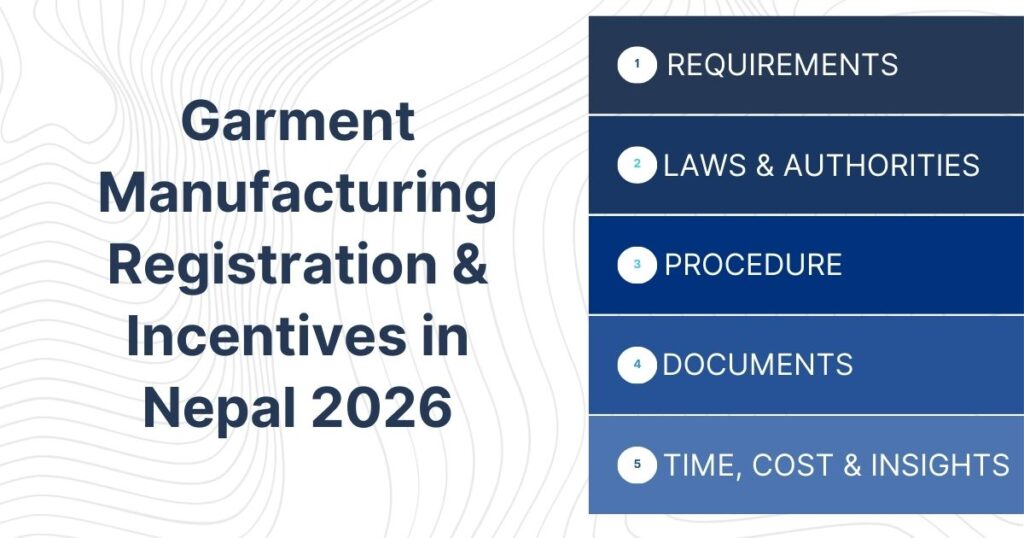
The garment manufacturing sector represents a significant component of Nepal’s industrial economy, contributing substantially to export earnings and employment generation. The Government of Nepal has established specific registration procedures and incentive mechanisms to promote garment manufacturing enterprises. Under the Industrial Enterprises Act, 2020, garment manufacturing falls under the category of manufacturing industries eligible for various fiscal and non-fiscal benefits. The Department of Industry serves as the primary regulatory authority for registration and monitoring of garment manufacturing units across Nepal.
Legal Framework for Garment Manufacturing
The garment manufacturing sector in Nepal operates under several legislative provisions that govern registration, operation, and incentive distribution.
Primary Legislation
The Industrial Enterprises Act, 2020 (2076 BS) serves as the principal legislation governing garment manufacturing registration. This Act replaced the Industrial Enterprises Act, 1992, and provides comprehensive provisions for industrial registration, classification, and incentive mechanisms. Section 3 of the Act mandates that all industrial enterprises, including garment manufacturing units, must obtain registration from the Department of Industry before commencing operations.
Supporting Legal Instruments
| Legal Instrument | Relevance to Garment Manufacturing |
|---|---|
| Foreign Investment and Technology Transfer Act, 2019 | Governs foreign investment in garment manufacturing enterprises and technology transfer agreements. |
| Labor Act, 2017 | Regulates employment conditions, worker rights, and labor relations in garment factories. |
| Company Act, 2006 | Provides framework for company registration when garment manufacturing is established as a company. |
| Tax Act, 2002 | Defines tax obligations and exemptions applicable to garment manufacturing industries. |
Types of Garment Manufacturing Enterprises
The Industrial Enterprises Act, 2020 classifies garment manufacturing enterprises based on fixed capital investment.
Enterprise Classification
| Enterprise Category | Fixed Capital Investment | Registration Authority |
|---|---|---|
| Micro Enterprise | Up to NPR 5 million | Office of Cottage and Small Industries |
| Small Enterprise | NPR 5 million to NPR 150 million | Department of Industry |
| Medium Enterprise | NPR 150 million to NPR 500 million | Department of Industry |
| Large Enterprise | Above NPR 500 million | Department of Industry |
Registration Process for Garment Manufacturing
The registration process for garment manufacturing enterprises follows a structured procedure established under the Industrial Enterprises Act, 2020.
Step-by-Step Registration Procedure
Step 1: The applicant must prepare a detailed project proposal containing information about the proposed garment manufacturing unit, including production capacity, investment amount, employment generation, and raw material sources.
Step 2: The applicant submits the application through the online portal of the Department of Industry (www.doind.gov.np) or physically at the Department’s office in Tripureshwor, Kathmandu, or at provincial industry offices.
Step 3: The Department of Industry reviews the application within seven working days for micro and small enterprises, and within fifteen working days for medium and large enterprises, as per Section 4 of the Industrial Enterprises Act, 2020.
Step 4: Upon approval, the Department issues an Industry Registration Certificate specifying the enterprise category, production capacity, and applicable incentives.
Step 5: The registered enterprise must commence operations within one year of registration, as mandated under Section 5 of the Act, or apply for extension with valid justification.
Required Documents for Registration
The following documents must be submitted for garment manufacturing registration:
- The applicant must provide a completed application form in the prescribed format available on the Department of Industry’s website.
- The applicant must submit a copy of citizenship certificate for Nepali nationals or passport and visa documents for foreign investors.
- The applicant must provide company registration certificate if the enterprise is registered as a company under the Company Act, 2006.
- The applicant must submit a detailed project report containing technical and financial feasibility analysis of the garment manufacturing unit.
- The applicant must provide land ownership documents or lease agreement for the proposed factory location.
- The applicant must submit an environmental impact assessment report if the project falls under the threshold requiring such assessment under the Environment Protection Act, 2019.
- The applicant must provide a tax clearance certificate from the Inland Revenue Department.
- The applicant must submit partnership deed or memorandum of association depending on the business structure.
Registration Fees Structure
The Industrial Enterprises Act, 2020 and subsequent regulations establish specific fee structures for garment manufacturing registration.
| Enterprise Category | Registration Fee (NPR) | Annual Renewal Fee (NPR) |
|---|---|---|
| Micro Enterprise | 500 | 300 |
| Small Enterprise | 2,000 | 1,000 |
| Medium Enterprise | 5,000 | 2,500 |
| Large Enterprise | 10,000 | 5,000 |
Fiscal Incentives for Garment Manufacturing
The Government of Nepal provides various fiscal incentives to promote garment manufacturing under the Industrial Enterprises Act, 2020 and the Income Tax Act, 2002.
Income Tax Exemptions
Section 11 of the Industrial Enterprises Act, 2020 provides for income tax exemptions based on the location of the garment manufacturing enterprise. Industries established in Kathmandu Valley receive no tax exemption. Industries established in cities with population exceeding 100,000 receive 20% income tax exemption for five years. Industries established in other areas receive 30% income tax exemption for seven years. Industries established in remote and underdeveloped areas receive 40% income tax exemption for ten years.
Customs Duty Concessions
Garment manufacturing enterprises receive customs duty exemptions on imported machinery, equipment, and raw materials under Section 12 of the Industrial Enterprises Act, 2020. The import of machinery and equipment for garment manufacturing receives 100% customs duty exemption. The import of raw materials not available domestically receives partial customs duty exemption as determined by the Ministry of Industry, Commerce and Supplies.
Value Added Tax (VAT) Facilities
| VAT Facility | Description | Legal Basis |
|---|---|---|
| VAT Refund on Exports | Garment manufacturers receive full VAT refund on exported products within 30 days of application. | Value Added Tax Act, 2052 (1996) |
| VAT Exemption on Machinery | Import of machinery for garment manufacturing is exempt from VAT. | Industrial Enterprises Act, 2020 |
| Input VAT Credit | Manufacturers can claim input VAT credit on raw materials and utilities used in production. | Value Added Tax Act, 2052 (1996) |
Non-Fiscal Incentives
The Industrial Enterprises Act, 2020 provides several non-fiscal incentives to garment manufacturing enterprises.
Land and Infrastructure Facilities
The Government of Nepal allocates land in industrial estates at subsidized rates for garment manufacturing units. Section 14 of the Industrial Enterprises Act, 2020 mandates that industrial estates must reserve at least 20% of total area for export-oriented industries, including garment manufacturing. The Department of Industry coordinates with provincial governments to provide infrastructure facilities including roads, electricity, water supply, and waste management systems in industrial zones.
Foreign Investment Provisions
Foreign investors can establish garment manufacturing enterprises in Nepal with 100% foreign ownership under the Foreign Investment and Technology Transfer Act, 2019. Section 3 of this Act permits foreign investment in all sectors except those specifically restricted. Garment manufacturing is not included in the restricted list, allowing full foreign participation. Foreign investors receive the same incentives as domestic investors, ensuring equal treatment under Section 4 of the Foreign Investment and Technology Transfer Act, 2019.
Technology Transfer Benefits
Garment manufacturing enterprises can enter into technology transfer agreements with foreign entities under the Foreign Investment and Technology Transfer Act, 2019. Section 8 of this Act provides that royalty payments for technology transfer can be repatriated after paying applicable taxes. The Act permits technology transfer agreements for periods up to seven years, renewable with approval from the Department of Industry.
Export Incentives for Garment Manufacturers
The Government of Nepal provides specific incentives to promote garment exports under the Trade Policy, 2015 and subsequent amendments.
Cash Incentive Scheme
The Ministry of Industry, Commerce and Supplies operates a cash incentive scheme for garment exporters. Exporters receive cash incentives ranging from 2% to 4% of the FOB value of exports to markets beyond India. The incentive rate varies based on the destination market and value addition level. Garment manufacturers must apply for cash incentives within six months of export realization through the Trade and Export Promotion Centre.
Export Credit Facilities
| Credit Facility | Interest Rate | Maximum Loan Amount | Repayment Period |
|---|---|---|---|
| Pre-shipment Credit | 5% per annum | Up to 80% of order value | 180 days |
| Post-shipment Credit | 5% per annum | Up to 90% of invoice value | 120 days |
| Export Development Fund | 2% per annum | NPR 50 million | 5 years |
Special Economic Zones and Industrial Estates
The Special Economic Zone Act, 2016 establishes special economic zones where garment manufacturers receive additional incentives.
Benefits in Special Economic Zones
Garment manufacturing enterprises established in Special Economic Zones receive 100% income tax exemption for ten years from the date of commercial production. Section 17 of the Special Economic Zone Act, 2016 provides that enterprises in SEZs are exempt from all local taxes and fees. The Act permits duty-free import of all raw materials, machinery, and equipment for production purposes. Garment manufacturers in SEZs can sell up to 20% of production in the domestic market after paying applicable duties and taxes.
Industrial Estate Facilities
The Department of Industry operates industrial estates in various locations across Nepal. The Balaju Industrial District in Kathmandu, Hetauda Industrial Estate in Makwanpur, and Dharan Industrial Estate in Sunsari provide facilities for garment manufacturing. These estates offer ready-built factory sheds, common effluent treatment plants, and shared infrastructure at subsidized rates.
Labor and Employment Regulations
Garment manufacturing enterprises must comply with the Labor Act, 2017 regarding employment conditions and worker rights.
Minimum Wage Requirements
The Ministry of Labor, Employment and Social Security determines minimum wages for garment industry workers annually. As of fiscal year 2025/26, the minimum monthly wage for garment workers is NPR 17,300 for unskilled workers, NPR 19,030 for semi-skilled workers, and NPR 20,933 for skilled workers. Employers must pay wages through banking channels for amounts exceeding NPR 7,000 per month as per Section 54 of the Labor Act, 2017.
Social Security Provisions
Garment manufacturing enterprises employing ten or more workers must register with the Social Security Fund under the Contribution Based Social Security Act, 2017. Employers must contribute 20% of basic salary to the Social Security Fund, while employees contribute 11%. The Fund provides benefits including medical treatment, accident compensation, maternity benefits, and retirement pension.
Environmental Compliance Requirements
Garment manufacturing enterprises must comply with environmental regulations under the Environment Protection Act, 2019.
Environmental Impact Assessment
Garment manufacturing units with production capacity exceeding 10,000 pieces per day must conduct an Initial Environmental Examination (IEE). Units with production capacity exceeding 50,000 pieces per day require a full Environmental Impact Assessment (EIA). The Ministry of Forest and Environment reviews and approves environmental assessment reports within 60 days of submission as per Section 7 of the Environment Protection Act, 2019.
Effluent Treatment Requirements
| Parameter | Permissible Limit | Measurement Unit |
|---|---|---|
| pH Level | 6.5 to 8.5 | pH units |
| Biochemical Oxygen Demand (BOD) | 30 | mg/liter |
| Chemical Oxygen Demand (COD) | 120 | mg/liter |
| Total Suspended Solids (TSS) | 50 | mg/liter |
| Temperature | 40 | °C |
Quality Standards and Certification
Garment manufacturers must comply with quality standards established by the Nepal Bureau of Standards and Metrology.
Mandatory Standards
The Nepal Bureau of Standards and Metrology has established Nepal Standards (NS) for textile and garment products. Garment manufacturers must obtain NS certification for products sold in the domestic market. The Bureau conducts periodic inspections to ensure compliance with quality standards. Non-compliance results in penalties ranging from NPR 10,000 to NPR 100,000 under the Standards and Metrology Act, 2008.
Export Quality Requirements
Garment exporters must comply with quality standards of destination countries. The Trade and Export Promotion Centre provides testing facilities and certification services for export-oriented garment manufacturers. Common certifications include ISO 9001 for quality management, ISO 14001 for environmental management, and WRAP certification for social compliance.
Intellectual Property Protection
Garment manufacturers can protect their designs and brands under the Patent, Design and Trademark Act, 2022.
Design Registration
Garment manufacturers can register original designs with the Department of Industry. Design registration provides exclusive rights for five years, renewable for two additional five-year periods. Section 15 of the Patent, Design and Trademark Act, 2022 provides that design registration prevents unauthorized copying or imitation of registered designs.
Trademark Protection
Garment manufacturers can register brand names and logos as trademarks. Trademark registration provides exclusive rights for ten years, renewable indefinitely. The Department of Industry processes trademark applications within 90 days of submission.
Renewal and Compliance Requirements
Registered garment manufacturing enterprises must comply with annual renewal and reporting requirements.
Annual Renewal Process
Step 1: The enterprise must submit an annual renewal application to the Department of Industry before the expiry of the registration certificate.
Step 2: The enterprise must provide an annual progress report detailing production volume, employment, investment, and export performance.
Step 3: The enterprise must submit proof of tax compliance including income tax clearance and VAT registration certificate.
Step 4: The Department of Industry reviews the renewal application and issues a renewed certificate within seven working days.
Step 5: The enterprise must pay the applicable renewal fee based on its category as specified in the fee structure table.
Reporting Obligations
Garment manufacturing enterprises must submit quarterly production reports to the Department of Industry. The reports must contain information about production volume, raw material consumption, employment, and sales. Enterprises receiving fiscal incentives must submit annual audit reports certified by chartered accountants. Failure to submit required reports results in suspension of incentives and potential cancellation of registration under Section 21 of the Industrial Enterprises Act, 2020.
Penalties and Enforcement
The Industrial Enterprises Act, 2020 establishes penalties for non-compliance with registration and operational requirements.
| Violation | Penalty Amount (NPR) | Additional Consequences |
|---|---|---|
| Operating without registration | 100,000 – 500,000 | Closure of enterprise until registration obtained |
| False information in application | 50,000 – 200,000 | Cancellation of registration |
| Failure to commence operations within stipulated time | 25,000 – 100,000 | Cancellation of registration |
| Non-compliance with environmental standards | 100,000 – 1,000,000 | Suspension of operations |
| Failure to submit annual reports | 10,000 – 50,000 | Suspension of incentives |
Recent Policy Developments for 2026
The Government of Nepal has introduced several policy measures in 2025-2026 to strengthen the garment manufacturing sector.
Enhanced Export Incentives
The Trade Policy Amendment, 2025 increased cash incentives for garment exports from 2-4% to 3-5% of FOB value. The government allocated NPR 500 million for the garment export incentive fund in the fiscal year 2025/26 budget. Garment manufacturers exporting to new markets beyond traditional destinations receive an additional 1% incentive.
Skill Development Programs
The Ministry of Industry, Commerce and Supplies launched the Garment Sector Skill Development Program in 2025. The program provides free training to 10,000 workers annually in cutting, sewing, quality control, and design. Garment manufacturers employing trained workers receive a subsidy of NPR 5,000 per worker for six months.
Digital Registration System
The Department of Industry implemented a fully digital registration system in January 2026. Applicants can complete the entire registration process online without visiting the Department’s office. The system provides automatic approval for micro and small enterprises meeting all requirements within 24 hours.
Read More:
- https://lawaxion.com/can-betting-or-gambling-business-be-registered-in-nepal/
- https://lawaxion.com/gold-smuggling-case-in-nepal-fine-penalties-prison/
- https://lawaxion.com/gambling-and-betting-case-in-nepal-process-fine-lawyer/
- https://lawaxion.com/establishing-bpo-business-in-nepal-process-time-cost/
- https://lawaxion.com/digital-service-tax-registration-and-compliance-in-nepal/
Frequently Asked Questions
What is the minimum capital requirement for garment manufacturing registration in Nepal?
The Industrial Enterprises Act, 2020 does not specify a minimum capital requirement for garment manufacturing registration. However, enterprises must have sufficient capital to meet their proposed production capacity and employment targets as stated in the project proposal.
Can foreign nationals own 100% of a garment manufacturing company in Nepal?
Yes, foreign nationals can own 100% of garment manufacturing enterprises in Nepal under the Foreign Investment and Technology Transfer Act, 2019. Garment manufacturing is not included in the restricted sectors list, allowing full foreign ownership without requiring Nepali partnership.
How long does the garment manufacturing registration process take?
The Department of Industry processes registration applications within seven working days for micro and small enterprises and within fifteen working days for medium and large enterprises under Section 4 of the Industrial Enterprises Act, 2020. The digital registration system implemented in 2026 provides automatic approval within 24 hours for qualifying applications.
What tax benefits do garment manufacturers receive in Nepal?
Garment manufacturers receive income tax exemptions ranging from 20% to 40% for periods of five to ten years depending on location. They also receive 100% customs duty exemption on imported machinery and equipment, VAT exemption on machinery imports, and full VAT refund on exported products.
Are there specific zones designated for garment manufacturing in Nepal?
Yes, the government has established Special Economic Zones and industrial estates specifically for manufacturing industries including garment production. Major locations include Simara Special Economic Zone, Bhairahawa Special Economic Zone, and industrial estates in Balaju, Hetauda, and Dharan providing infrastructure and additional incentives.
What environmental clearances are required for garment manufacturing?
Garment manufacturing units with production capacity exceeding 10,000 pieces per day require Initial Environmental Examination (IEE), while units exceeding 50,000 pieces per day require full Environmental Impact Assessment (EIA) under the Environment Protection Act, 2019. All units must install effluent treatment plants meeting prescribed standards.
How can garment manufacturers access export credit facilities?
Garment manufacturers can access export credit facilities through commercial banks at subsidized interest rates of 5% per annum for pre-shipment and post-shipment credit. The Export Development Fund provides long-term credit at 2% interest for capacity expansion and technology upgradation with maximum loan amounts up to NPR 50 million.
What labor laws apply to garment manufacturing enterprises?
Garment manufacturers must comply with the Labor Act, 2017 regarding minimum wages, working hours, leave entitlements, and workplace safety. Enterprises employing ten or more workers must register with the Social Security Fund under the Contribution Based Social Security Act, 2017 and contribute 20% of basic salary.
Can garment manufacturers sell products in the domestic market while receiving export incentives?
Yes, garment manufacturers can sell products in both domestic and export markets. However, cash incentives and certain tax benefits apply only to exported products. Enterprises in Special Economic Zones can sell up to 20% of production domestically after paying applicable duties and taxes.
What happens if a registered garment manufacturer fails to commence operations within one year?
Section 5 of the Industrial Enterprises Act, 2020 requires enterprises to commence operations within one year of registration. Failure to do so results in automatic cancellation of registration unless the enterprise applies for extension with valid justification. Extensions are granted for up to six months in exceptional circumstances.