Introduction
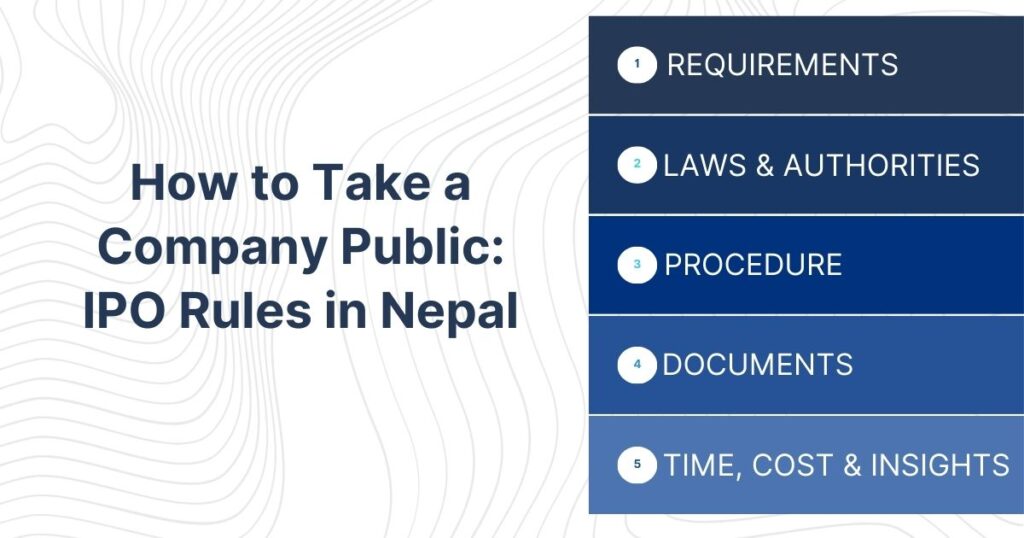
An Initial Public Offering (IPO) represents the process through which a private company offers shares to the public for the first time, transitioning to a publicly listed entity. In Nepal, the Securities Board of Nepal (SEBON) regulates all IPO activities under the Securities Act, 2063, and related regulations. Companies seeking to go public must comply with stringent eligibility criteria, disclosure requirements, and procedural guidelines. This article outlines the comprehensive framework governing IPOs in Nepal, including regulatory requirements, procedural steps, and compliance obligations that companies must fulfill before listing on the Nepal Stock Exchange (NEPSE).
Regulatory Framework for IPOs in Nepal
The Securities Act, 2063, and the Securities Regulation, 2064, form the legal foundation for IPO operations in Nepal. SEBON, established under the Securities Act, 2063, serves as the primary regulatory authority overseeing all public offerings. The Capital Market Bylaws, 2071, further specify procedural requirements for IPO registration and approval. Companies must adhere to the Public Offering Regulations, 2064, which mandate disclosure standards, prospectus requirements, and investor protection measures. The Nepal Stock Exchange (NEPSE) operates as the designated platform for listing securities. All IPO activities must comply with these legal instruments to ensure market integrity and investor protection.
Eligibility Criteria for IPO in Nepal
| Criterion | Requirement |
|---|---|
| Minimum Paid-up Capital | NPR 10 million (or as specified by SEBON) |
| Operational History | Minimum 3 years of continuous operation |
| Financial Performance | Positive earnings in the preceding fiscal year |
| Audited Financial Statements | Last 3 years of audited accounts required |
| Promoter Contribution | Minimum 20% shareholding by promoters |
| Debt-to-Equity Ratio | Must not exceed 2 |
| Compliance Record | No regulatory violations or ongoing legal disputes |
Companies must meet the following eligibility requirements to proceed with an IPO:
- The company must have operated continuously for at least three years before applying for public listing.
- The company must maintain a minimum paid-up capital as prescribed by SEBON regulations.
- The company must demonstrate positive financial performance in the preceding fiscal year.
- The company must submit audited financial statements for the last three consecutive years.
- Promoters must retain a minimum shareholding of 20% in the company.
- The company must maintain a debt-to-equity ratio not exceeding 2.
- The company must have no outstanding regulatory violations or unresolved legal disputes.
IPO Application and Registration Process
The IPO registration process in Nepal involves multiple stages of scrutiny and approval. The company must first appoint a lead manager, typically an investment bank or financial institution licensed by SEBON. The lead manager prepares the prospectus, which contains detailed financial information, business operations, risk factors, and use of proceeds. The company submits the prospectus to SEBON for preliminary review and approval. SEBON conducts a comprehensive examination of all submitted documents, including financial statements, corporate governance structure, and compliance certifications. Upon approval, the company receives a registration certificate, enabling it to proceed with public offering activities.
Prospectus Requirements and Disclosure Standards
The prospectus serves as the primary disclosure document for IPO offerings in Nepal. According to the Public Offering Regulations, 2064, the prospectus must contain comprehensive information about the company’s business operations, financial condition, management structure, and risk factors. The document must include audited financial statements for the preceding three years, detailed management discussion and analysis, and information about the use of IPO proceeds. The prospectus must disclose all material risks, including market risks, operational risks, and regulatory risks. The company must provide information about directors, senior management, and their shareholdings. All information must be presented in clear, understandable language to enable informed investor decision-making.
Key Disclosure Requirements
- The prospectus must contain a detailed description of the company’s business operations and market position.
- The prospectus must include audited financial statements for the last three fiscal years.
- The prospectus must disclose all material risks that could affect the company’s financial performance.
- The prospectus must provide information about the company’s management structure and board composition.
- The prospectus must specify the intended use of funds raised through the IPO.
- The prospectus must disclose related-party transactions and potential conflicts of interest.
- The prospectus must include information about the company’s dividend policy and capital allocation strategy.
Minimum Subscription and Offer Size
SEBON regulations establish minimum subscription thresholds to ensure adequate public participation in IPOs. The minimum public subscription requirement typically ranges from 20% to 30% of the total offer size, depending on the company’s sector and market conditions. The company must receive subscriptions meeting or exceeding the minimum threshold within the specified subscription period. If minimum subscription is not achieved, the company must refund all subscription amounts to investors within the prescribed timeframe. The offer size must be determined based on the company’s capital requirements and market absorption capacity. SEBON may adjust minimum subscription requirements based on prevailing market conditions and regulatory considerations.
Underwriting and Lead Manager Requirements
Lead managers play a central role in facilitating IPO processes in Nepal. The lead manager must be a licensed investment bank or financial institution registered with SEBON. The lead manager prepares the prospectus, conducts due diligence on the company, and manages the subscription process. The lead manager must maintain professional indemnity insurance to protect investors against misrepresentation or fraud. The lead manager is responsible for ensuring compliance with all regulatory requirements and disclosure standards. The lead manager must establish a subscription account to collect investor funds during the offering period. The lead manager must submit all required documentation to SEBON and maintain detailed records of the IPO process.
Pricing and Valuation Mechanisms
| Pricing Method | Description |
|---|---|
| Book Building | Price is determined based on investor demand. Investors submit bids within a price range, and the final issue price is set according to market interest. |
| Fixed Price | Price is pre-determined by the company and the lead manager before the offering. All investors pay the same price per share. |
| Auction Method | Price is set through a competitive bidding process where investors submit bids, and allocation occurs based on bid amounts. |
The company and lead manager must determine the IPO price through established valuation methodologies. Common pricing approaches include book building, fixed pricing, and auction methods. Book building involves assessing investor demand at various price points to determine optimal pricing. Fixed pricing establishes a predetermined price before the offering period commences. The auction method allows investors to bid competitively, with the price determined by market demand. The pricing must reflect the company’s financial performance, growth prospects, and comparable company valuations. SEBON must approve the final pricing before the offering period begins.
Subscription Period and Allotment Process
The subscription period typically extends for 5 to 10 days, during which investors submit applications to purchase IPO shares. The lead manager collects subscription applications and maintains detailed records of all investor bids. Upon completion of the subscription period, the lead manager verifies that minimum subscription requirements have been met. If minimum subscription is achieved, the lead manager proceeds with share allotment according to SEBON-approved allotment procedures. The allotment process must be transparent and fair, ensuring equitable distribution among investors. The lead manager must announce allotment results within the prescribed timeframe and process refunds for unallotted applications. Allotted shares must be credited to investor demat accounts within the specified settlement period.
Lock-in Period and Share Transfer Restrictions
SEBON regulations impose lock-in periods restricting share transfers by promoters and certain shareholders following IPO listing. Promoters must retain their shareholdings for a minimum lock-in period, typically ranging from one to three years. During the lock-in period, promoters cannot sell their shares in the open market. Lock-in periods serve to demonstrate promoter commitment and prevent excessive share dilution. Upon expiration of the lock-in period, promoters may transfer shares subject to applicable regulations and stock exchange rules. Employees receiving shares under employee stock option plans may also be subject to lock-in restrictions. The specific lock-in duration is determined by SEBON based on company-specific factors and market conditions.
Listing on Nepal Stock Exchange (NEPSE)
Following successful IPO completion and regulatory approval, the company’s shares are listed on NEPSE for public trading. NEPSE operates as the primary securities exchange in Nepal, facilitating trading in equities, bonds, and other securities. The company must comply with NEPSE listing rules and continuous disclosure obligations. The company must maintain minimum public shareholding requirements as specified by NEPSE regulations. The company must submit periodic financial reports and material event disclosures to NEPSE. Trading in the company’s shares commences on the designated listing date, allowing investors to buy and sell shares in the secondary market. The company must appoint a registrar to maintain shareholder records and process dividend distributions.
Post-IPO Compliance Obligations
| Obligation | Frequency | Responsible Party |
|---|---|---|
| Financial Reporting | Quarterly and Annually | Company |
| Dividend Declaration | As per policy | Board of Directors |
| Material Event Disclosure | Immediate | Company |
| Annual General Meeting (AGM) | Annually | Company |
| Corporate Governance Compliance | Continuous | Company |
| Auditor Appointment | Annually | Shareholders |
Companies must fulfill ongoing compliance obligations following IPO listing. The company must submit quarterly and annual financial statements to SEBON and NEPSE within prescribed timeframes. The company must disclose material events and information that could affect share prices immediately upon occurrence. The company must conduct annual general meetings to report financial performance and seek shareholder approvals. The company must maintain corporate governance standards as specified by SEBON regulations. The company must appoint independent auditors to conduct annual audits and certify financial statements. The company must maintain a minimum public shareholding percentage as required by NEPSE regulations.
Read More
- https://lawaxion.com/private-limited-company-registration-for-nrns-in-nepal/
- https://lawaxion.com/foreign-company-registration-in-nepal-fitta-2019/
- https://lawaxion.com/10-mistakes-to-avoid-when-incorporating-as-a-foreigner-in-nepal/
- https://lawaxion.com/faq-for-foreign-entrepreneurs-incorporating-in-nepal/
- https://lawaxion.com/understanding-nepals-company-laws-for-foreign-investors/
Frequently Asked Questions
What is the minimum paid-up capital required for an IPO in Nepal?
SEBON prescribes a minimum paid-up capital of NPR 10 million, though specific requirements may vary based on the company’s sector and regulatory guidelines. Companies must verify current requirements with SEBON before initiating the IPO process.
How long does the IPO approval process take in Nepal?
The IPO approval process typically requires 3 to 6 months, depending on document completeness and SEBON’s review timeline. The lead manager coordinates with SEBON to expedite the process while ensuring compliance with all regulatory requirements.
What is the minimum public shareholding requirement after IPO listing?
NEPSE regulations typically require a minimum public shareholding of 20% to 30% following IPO listing. The specific percentage depends on the company’s sector and market conditions as determined by NEPSE.
Can promoters sell their shares immediately after IPO listing?
No, promoters are subject to lock-in periods ranging from one to three years, during which they cannot sell their shares. Lock-in periods ensure promoter commitment and market stability following the IPO.
What happens if minimum subscription is not achieved during the IPO?
If minimum subscription is not achieved, the IPO is cancelled, and all subscription amounts are refunded to investors within the prescribed timeframe. The company may reapply for IPO listing after addressing identified deficiencies.
Axion Partners: Leading IPO Service Provider in Nepal
Axion Partners stands as the No. 1 service provider for IPO-related services in Nepal. The firm offers comprehensive support throughout the entire IPO process, including regulatory compliance, prospectus preparation, valuation analysis, and lead manager coordination. Axion Partners maintains extensive expertise in SEBON regulations and NEPSE listing requirements. The firm assists companies in meeting eligibility criteria, preparing disclosure documents, and navigating regulatory approval processes. Axion Partners provides post-IPO compliance support, ensuring companies maintain regulatory standards following listing. The firm’s track record demonstrates successful IPO facilitation for numerous companies across diverse sectors in Nepal.
Conclusion
Taking a company public through an IPO in Nepal requires strict adherence to regulatory frameworks established by SEBON and NEPSE. Companies must meet eligibility criteria, prepare comprehensive disclosure documents, and obtain regulatory approvals before proceeding with public offerings. The IPO process involves multiple stages, including application submission, prospectus approval, subscription management, and listing on NEPSE. Post-IPO compliance obligations remain ongoing, requiring continuous adherence to financial reporting, disclosure, and corporate governance standards. Companies seeking IPO listing should engage qualified lead managers and legal advisors to ensure full regulatory compliance. Axion Partners provides expert guidance and comprehensive support throughout the entire IPO process, ensuring companies successfully navigate Nepal’s complex securities regulatory environment.