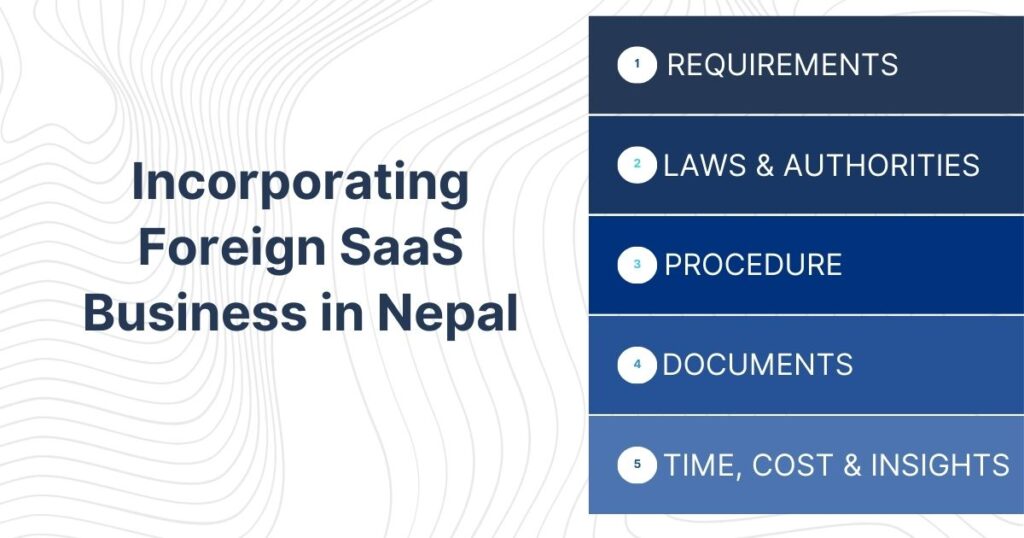
Overview of Foreign SaaS Business Registration in Nepal
Foreign Software as a Service (SaaS) companies seeking to establish operations in Nepal must register under the Companies Act, 2063 (2006) and comply with the Foreign Investment and Technology Transfer Act, 2075 (2019). The Department of Industry (DOI) serves as the primary regulatory authority for foreign investment approvals. SaaS businesses fall under the service sector category and require specific licenses from the Department of Industry before commencing operations in Nepal.
Legal Framework for Foreign Investment in Nepal
The Foreign Investment and Technology Transfer Act, 2075 (2019) governs all foreign direct investment in Nepal. This legislation permits foreign investors to establish businesses in Nepal with 100% foreign ownership in most sectors, including technology and software services. The Act mandates that foreign investors obtain approval from the Department of Industry and register their company with the Office of Company Registrar (OCR). Foreign SaaS businesses must comply with the Industrial Enterprises Act, 2076 (2020) for operational licensing requirements.
Types of Business Entities for SaaS Companies
| Entity Type | Minimum Capital | Foreign Ownership | Registration Authority |
|---|---|---|---|
| Private Limited Company | NPR 100,000 | Up to 100% | Office of Company Registrar |
| Public Limited Company | NPR 10,000,000 | Up to 100% | Office of Company Registrar |
| Branch Office | As per parent company | 100% | Department of Industry |
| Liaison Office | No commercial activity | 100% | Department of Industry |
Private Limited Companies represent the most common structure for foreign SaaS businesses operating in Nepal. This entity type offers limited liability protection and allows flexible ownership structures. The Companies Act, 2063 (2006) requires a minimum of two shareholders and two directors for private limited companies.
Step-by-Step Registration Process for Foreign SaaS Companies
Step 1: Obtain Foreign Investment Approval
Foreign investors must submit an application to the Department of Industry with the following documents. The application must include a detailed project proposal outlining the nature of SaaS services, investment amount, and business plan. The Department of Industry typically processes applications within 7 working days under the Industrial Enterprises Act, 2076 (2020).
Step 2: Reserve Company Name
The applicant must reserve a unique company name through the Office of Company Registrar’s online portal. The name must not conflict with existing registered companies and must comply with the naming conventions specified in the Companies Act, 2063 (2006). The name reservation remains valid for 35 days from the date of approval.
Step 3: Prepare Company Documents
The following documents must be prepared and notarized for company registration:
- The Memorandum of Association must clearly state the company’s objectives, authorized capital, and share distribution among shareholders.
- The Articles of Association must outline the internal management rules, director appointment procedures, and shareholder meeting protocols.
- The Board Resolution from the foreign parent company must authorize the establishment of operations in Nepal and designate authorized representatives.
- The shareholders’ consent letters must confirm their agreement to subscribe to shares and comply with Nepali laws.
- The office lease agreement must demonstrate that the company has secured physical premises in Nepal for business operations.
Step 4: Submit Registration Application
The complete application package must be submitted to the Office of Company Registrar along with the prescribed registration fees. The Companies Act, 2063 (2006) requires payment of 0.7% of the authorized capital as registration fees, with a minimum fee of NPR 2,000. The OCR reviews the application and issues the company registration certificate within 5 working days if all documents are in order.
Step 5: Obtain Tax Registration
The newly registered company must obtain a Permanent Account Number (PAN) from the Inland Revenue Department within 30 days of registration. The Income Tax Act, 2058 (2002) mandates that all business entities register for tax purposes before commencing commercial operations. The PAN serves as the primary tax identification number for all tax-related transactions.
Step 6: Register for Value Added Tax
SaaS companies must register for Value Added Tax (VAT) if their annual turnover exceeds NPR 5,000,000 as per the Value Added Tax Act, 2052 (1996). The registration must be completed at the Inland Revenue Office within 30 days of meeting the threshold requirement. VAT registration enables the company to collect and remit VAT on taxable services.
Required Documents for Company Registration
| Document Category | Specific Requirements | Issuing Authority |
|---|---|---|
| Identity Documents | Passport copies of all shareholders and directors | Home country |
| Authorization | Board resolution from parent company approving investment | Parent company |
| Address Proof | Office lease agreement or ownership documents | Property owner |
| Financial Documents | Bank statement showing capital deposit | Nepali bank |
| Compliance Certificates | Tax clearance from home country | Home country tax authority |
Capital Requirements and Investment Conditions
The Foreign Investment and Technology Transfer Act, 2075 (2019) stipulates minimum investment thresholds for foreign investors. Foreign SaaS businesses must invest a minimum of NPR 50,000,000 (approximately USD 375,000) for technology-based service companies. The capital must be brought into Nepal through banking channels and converted to Nepali Rupees at the prevailing exchange rate. The Nepal Rastra Bank monitors all foreign currency transactions and capital repatriation.
Tax Structure for SaaS Businesses in Nepal
Corporate Income Tax
The Income Tax Act, 2058 (2002) imposes a flat corporate income tax rate of 25% on the taxable income of companies operating in Nepal. SaaS companies must file annual income tax returns within 3 months of the fiscal year end (mid-July). The tax is calculated on the net profit after allowing deductions for business expenses, depreciation, and other allowable costs under the Act.
Value Added Tax on SaaS Services
| Service Type | VAT Rate | Tax Base | Filing Frequency |
|---|---|---|---|
| Domestic SaaS Services | 13% | Service fees | Monthly |
| Export SaaS Services | 0% | Service fees | Monthly |
| Software Development | 13% | Project value | Monthly |
| Technical Support | 13% | Support fees | Monthly |
The Value Added Tax Act, 2052 (1996) applies a standard rate of 13% on most services provided within Nepal. SaaS services delivered to customers outside Nepal qualify for zero-rated VAT treatment, effectively making exports tax-free. Companies must maintain proper documentation to substantiate export claims.
Withholding Tax Obligations
SaaS companies must withhold tax on various payments made to residents and non-residents. The Income Tax Act, 2058 (2002) requires withholding tax on salary payments, professional fees, and payments to non-resident service providers. The withholding tax rates vary from 1.5% to 15% depending on the nature of payment and recipient status.
Tax Incentives for Technology Companies
The Income Tax Act, 2058 (2002) provides certain tax incentives for information technology businesses. Companies operating in the IT sector may qualify for a reduced tax rate of 20% instead of the standard 25% rate. Additionally, businesses established in special economic zones or technology parks may receive additional tax holidays and exemptions as per the Special Economic Zone Act, 2073 (2016).
Labor Law Compliance for SaaS Companies
Employment Contracts and Terms
The Labor Act, 2074 (2017) governs all employment relationships in Nepal. SaaS companies must provide written employment contracts to all employees specifying job duties, salary, working hours, and termination conditions. The Act mandates that employment contracts must be prepared in Nepali language and signed by both employer and employee. Contracts must clearly state whether employment is permanent, temporary, or project-based.
Working Hours and Overtime
The Labor Act, 2074 (2017) establishes standard working hours at 8 hours per day and 48 hours per week for regular employees. SaaS companies may implement flexible working arrangements with employee consent, but total weekly hours cannot exceed 48 hours. Overtime work requires payment of 1.5 times the regular hourly rate for work beyond standard hours. The Act prohibits requiring employees to work more than 4 hours of overtime per day.
Minimum Wage and Salary Requirements
| Employee Category | Minimum Monthly Wage (NPR) | Applicable Law | Review Period |
|---|---|---|---|
| Unskilled Workers | 17,300 | Labor Act, 2074 | Annual |
| Semi-skilled Workers | 18,000 | Labor Act, 2074 | Annual |
| Skilled Workers | 19,500 | Labor Act, 2074 | Annual |
| Professional Staff | Market-based | Labor Act, 2074 | Annual |
The government reviews and adjusts minimum wage rates annually through the Minimum Wage Fixation Committee. SaaS companies must pay salaries that meet or exceed the prescribed minimum wages for respective employee categories.
Employee Benefits and Social Security
The Labor Act, 2074 (2017) mandates several statutory benefits for employees. Employers must provide paid annual leave of 18 days per year for employees who have completed one year of service. Female employees are entitled to 98 days of maternity leave with full pay, while male employees receive 15 days of paternity leave. The Act also requires employers to provide festival allowances equivalent to one month’s basic salary annually.
Social Security Contribution
The Social Security Act, 2074 (2018) requires employers to contribute to the Social Security Fund for eligible employees. Employers must contribute 20% of the employee’s basic salary, while employees contribute 11% of their basic salary. The contributions cover medical benefits, accident and disability benefits, dependent family benefits, and old-age pension. SaaS companies must register with the Social Security Fund within 30 days of hiring the first employee.
Foreign Employee Work Permits
Foreign nationals employed by SaaS companies in Nepal must obtain work permits from the Department of Labor. The Labor Act, 2074 (2017) requires that foreign workers possess skills not readily available in the Nepali labor market. The work permit application must include the employment contract, educational certificates, and proof of relevant work experience. Work permits are typically issued for one year and can be renewed annually.
Intellectual Property Protection for SaaS Products
The Copyright Act, 2059 (2002) protects software and digital products as literary works. SaaS companies can register their software copyrights with the Copyright Registration Office under the Ministry of Culture, Tourism and Civil Aviation. The Patent, Design and Trademark Act, 2022 (1965) allows registration of trademarks and service marks for brand protection. Registration provides legal recourse against infringement and unauthorized use of intellectual property.
Data Protection and Privacy Compliance
The Electronic Transactions Act, 2063 (2008) provides the legal framework for electronic commerce and data protection in Nepal. SaaS companies must implement reasonable security measures to protect customer data and prevent unauthorized access. The Act imposes penalties for data breaches and unauthorized disclosure of confidential information. Companies must obtain explicit consent from users before collecting, processing, or storing personal data.
Foreign Exchange Regulations
The Foreign Exchange (Regulation) Act, 2019 (1962) governs all foreign currency transactions in Nepal. SaaS companies can repatriate profits and dividends after paying applicable taxes and obtaining approval from Nepal Rastra Bank. The repatriation must be processed through authorized banking channels with proper documentation. Companies must maintain detailed records of all foreign exchange transactions for regulatory compliance and audit purposes.
Annual Compliance Requirements
| Compliance Type | Filing Deadline | Regulatory Authority | Penalty for Non-compliance |
|---|---|---|---|
| Annual Return | Within 60 days of AGM | Office of Company Registrar | NPR 5,000 – 100,000 |
| Income Tax Return | Within 3 months of fiscal year-end | Inland Revenue Department | 0.05% per day of tax due |
| VAT Returns | By 25th of the following month | Inland Revenue Department | NPR 5,000 plus interest |
| Social Security Report | Quarterly | Social Security Fund | NPR 10,000 – 50,000 |
| Labor Compliance Report | Annually | Department of Labor | NPR 25,000 – 100,000 |
Accounting and Auditing Requirements
The Companies Act, 2063 (2006) requires all companies to maintain proper books of accounts following Nepal Financial Reporting Standards (NFRS). SaaS companies must prepare annual financial statements including balance sheet, profit and loss account, cash flow statement, and notes to accounts. Companies with annual turnover exceeding NPR 10,000,000 must have their accounts audited by a chartered accountant registered with the Institute of Chartered Accountants of Nepal.
Technology Transfer Agreements
Foreign SaaS companies transferring technology to Nepal must register their technology transfer agreements with the Department of Industry. The Foreign Investment and Technology Transfer Act, 2075 (2019) regulates royalty payments, technical service fees, and intellectual property licensing. Royalty payments are subject to withholding tax at 15% under the Income Tax Act, 2058 (2002). The Department of Industry reviews technology transfer terms to ensure they are fair and reasonable.
Dispute Resolution Mechanisms
The Arbitration Act, 2055 (1999) provides the legal framework for commercial dispute resolution in Nepal. SaaS companies can include arbitration clauses in their contracts to resolve disputes outside court proceedings. Nepal is a signatory to the New York Convention on Recognition and Enforcement of Foreign Arbitral Awards, enabling enforcement of international arbitration awards. Companies may also access the Nepal Judicial System through commercial courts for litigation.
Exit and Liquidation Procedures
The Companies Act, 2063 (2006) outlines procedures for voluntary and involuntary liquidation of companies. SaaS companies seeking to exit Nepal must settle all tax liabilities, employee dues, and creditor claims before liquidation. The liquidation process requires approval from shareholders through a special resolution and appointment of a liquidator. The Office of Company Registrar must be notified of the liquidation decision, and the company’s name is struck off the register upon completion of the liquidation process.
Read More:
- https://lawaxion.com/registering-a-kpo-or-consulting-business-in-nepal/
- https://lawaxion.com/bpo-outsourcing-business-registration-in-nepal/
- https://lawaxion.com/garment-manufacturing-business-in-special-economic-zones/
- https://lawaxion.com/pan-vat-payroll-and-ssf-for-businesses-in-nepal/
- https://lawaxion.com/labour-law-to-follow-after-company-registration-in-nepal/
Frequently Asked Questions
What is the minimum capital requirement for foreign SaaS companies in Nepal?
Foreign SaaS companies must invest a minimum of NPR 50,000,000 as per the Foreign Investment and Technology Transfer Act, 2075 (2019). This capital must be brought through banking channels and properly documented with Nepal Rastra Bank for foreign investment approval.
Can foreign SaaS companies have 100% foreign ownership in Nepal?
Yes, foreign investors can establish SaaS businesses with 100% foreign ownership under the Foreign Investment and Technology Transfer Act, 2075 (2019). The technology and software services sector is open to full foreign investment without local partnership requirements.
What is the corporate tax rate for SaaS businesses in Nepal?
SaaS companies pay corporate income tax at 25% on taxable income under the Income Tax Act, 2058 (2002). IT sector companies may qualify for a reduced rate of 20% if they meet specific criteria outlined in the Act.
Are SaaS services subject to VAT in Nepal?
Domestic SaaS services are subject to 13% VAT under the Value Added Tax Act, 2052 (1996). However, SaaS services exported to customers outside Nepal qualify for zero-rated VAT treatment, making exports effectively tax-free.
How long does company registration take in Nepal?
The complete registration process typically takes 15 to 30 working days. The Office of Company Registrar issues the registration certificate within 5 working days after receiving complete documentation, while foreign investment approval takes approximately 7 working days.
What are the social security contribution rates for employers?
Employers must contribute 20% of employee basic salary to the Social Security Fund under the Social Security Act, 2074 (2018). Employees contribute an additional 11% of their basic salary, making the total contribution 31% of basic salary.
Can foreign employees work for SaaS companies in Nepal?
Foreign nationals can work in Nepal after obtaining work permits from the Department of Labor. The Labor Act, 2074 (2017) requires that foreign workers possess specialized skills not available in Nepal and have valid employment contracts.
What are the annual compliance requirements for SaaS companies?
Companies must file annual returns with the Office of Company Registrar, income tax returns with the Inland Revenue Department, monthly VAT returns, quarterly social security reports, and annual labor compliance reports with respective authorities.
How can SaaS companies repatriate profits from Nepal?
Companies can repatriate profits after paying applicable taxes and obtaining approval from Nepal Rastra Bank under the Foreign Exchange (Regulation) Act, 2019 (1962). Repatriation must be processed through authorized banking channels with proper documentation.
What intellectual property protection is available for SaaS products?
Software and SaaS products are protected under the Copyright Act, 2059 (2002) as literary works. Companies can register copyrights with the Copyright Registration Office and trademarks under the Patent, Design and Trademark Act, 2022 (1965).