Introduction
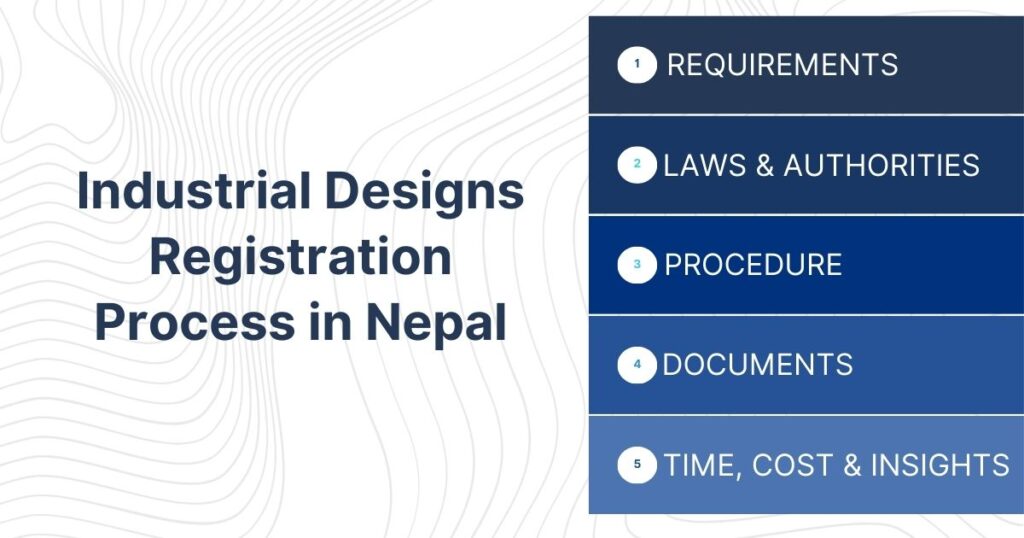
Industrial designs represent the aesthetic and ornamental aspects of products, including shape, configuration, pattern, and ornamentation. Nepal recognizes industrial designs under the Intellectual Property Rights (IPR) framework, governed by the Industrial Designs Act, 2022. Registration provides legal protection and exclusive rights to the design owner for a specified period. The Department of Industry, Government of Nepal, administers the registration process through the Intellectual Property Office. This article outlines the complete industrial designs registration procedure, requirements, and legal provisions applicable in Nepal.
Legal Framework for Industrial Designs in Nepal
The Industrial Designs Act, 2022, establishes the legal foundation for design protection in Nepal. This legislation aligns with international standards, including the Hague Agreement on Industrial Designs. The Act defines industrial designs as the appearance of the whole or part of a product resulting from features such as lines, contours, colors, shape, texture, or materials. Protection extends to two-dimensional and three-dimensional designs applied to articles. The registration grants the proprietor exclusive rights to manufacture, use, and commercialize the design for fifteen years from the filing date, renewable for an additional five-year term under specified conditions.
Eligibility Requirements for Design Registration
Applicants must satisfy specific eligibility criteria to register industrial designs in Nepal. The design must be novel and possess individual character distinct from existing designs. Designs that are identical or substantially similar to previously registered or publicly disclosed designs face rejection. The applicant must be the legitimate owner or authorized representative of the design. Designs contrary to public order, morality, or national interest are ineligible. Non-resident applicants require representation through a registered patent and design agent in Nepal. The design must be capable of industrial application and reproducible through industrial processes.
Documents Required for Industrial Designs Registration
Applicants must compile and submit the following documentation:
- A completed application form in the prescribed format with applicant details and design description.
- Clear photographs or drawings of the design from multiple angles, meeting specified technical standards.
- A statement of novelty and individual character explaining the design’s distinctive features.
- Proof of ownership or authorization letter if the applicant is not the original designer.
- Power of attorney executed before a notary public if represented by an agent.
- Priority documents from foreign jurisdictions if claiming priority under international agreements.
- Specification document detailing the design’s technical and aesthetic characteristics.
- Declaration of inventorship signed by the designer or authorized representative.
Step-by-Step Registration Process
Step 1: Pre-Filing Consultation
Applicants should conduct a design search through the Intellectual Property Office database to assess novelty and avoid conflicts with existing registrations. This preliminary examination identifies potential obstacles and strengthens the application. Consultation with a registered design agent provides guidance on compliance and procedural requirements.
Step 2: Application Filing
Submit the completed application form along with supporting documents to the Intellectual Property Office. The filing date is established upon receipt of the application and prescribed fees. The office issues a filing receipt containing the application number and filing date. Applications may be filed in Nepali or English language. Electronic filing through the online portal is available for registered users.
Step 3: Formal Examination
The Intellectual Property Office conducts formal examination to verify compliance with procedural requirements. The examiner verifies completeness of documentation, clarity of drawings, and accuracy of applicant information. Deficiencies are communicated through an examination report, allowing applicants thirty days to respond and rectify issues. Failure to address deficiencies results in application rejection.
Step 4: Substantive Examination
The examiner assesses novelty and individual character by comparing the design against prior art, including registered designs and publicly disclosed designs. The examiner evaluates whether the design differs significantly from existing designs in overall impression. If the design lacks novelty or individual character, a rejection notice is issued. Applicants may file a response with arguments and evidence supporting registrability within the prescribed period.
Step 5: Publication and Opposition
Upon successful examination, the design is published in the Industrial Designs Journal. Third parties have three months from publication to file opposition based on grounds including lack of novelty, absence of individual character, or invalidity of the applicant’s ownership. The applicant receives notice of opposition and may submit counter-arguments and evidence.
Step 6: Registration and Certificate Issuance
Following successful examination and expiration of the opposition period without valid opposition, the design is registered. The Intellectual Property Office issues a registration certificate containing the design number, registration date, proprietor details, and design specifications. The certificate serves as prima facie evidence of ownership and validity.
Examination Grounds and Rejection Criteria
| Rejection Ground | Description | Legal Basis |
|---|---|---|
| Lack of Novelty | Design is identical or substantially similar to existing designs (prior art) | Industrial Designs Act, 2022, Section 5 |
| Absence of Individual Character | Design does not significantly differ from existing designs | Industrial Designs Act, 2022, Section 6 |
| Lack of Industrial Applicability | Design cannot be manufactured or reproduced industrially | Industrial Designs Act, 2022, Section 4 |
| Improper Ownership | Applicant fails to prove legitimate ownership or authorization | Industrial Designs Act, 2022, Section 8 |
| Contrary to Public Order | Design violates public morality, safety, or national interest | Industrial Designs Act, 2022, Section 7 |
| Incomplete Documentation | Application missing required documents or information | Industrial Designs Rules, 2023 |
Fees and Payment Structure
The Intellectual Property Office charges fees for various registration stages. Filing fees apply upon application submission, typically ranging from NPR 2,000 to NPR 5,000 depending on the number of designs. Examination fees are charged separately, approximately NPR 3,000 to NPR 7,000. Publication fees apply upon successful examination. Registration fees are due upon approval, generally NPR 2,000 to NPR 4,000. Renewal fees for extended protection are charged at NPR 1,500 to NPR 3,000 per five-year term. Payment methods include bank transfer, online payment portals, and direct payment at the office. Fee schedules are subject to periodic revision by the government.
Rights and Protections Granted
Registration confers exclusive rights upon the proprietor to manufacture, import, sell, and distribute products embodying the registered design. The proprietor may license the design to third parties and collect royalties. Unauthorized use, reproduction, or imitation constitutes infringement subject to civil and criminal remedies. The proprietor may initiate infringement proceedings in the District Court seeking injunctive relief and damages. Registration provides a fifteen-year protection period from the filing date, extendable for an additional five years upon renewal application and fee payment. The proprietor’s rights are enforceable against all persons within Nepal’s territorial jurisdiction.
Duration and Renewal of Registration
Industrial design registration in Nepal provides protection for fifteen years from the filing date. Upon expiration, the design enters the public domain unless renewed. Renewal applications must be filed within six months before expiration, with a grace period of six months after expiration. The renewal application requires submission of the renewal form and prescribed fees. Renewal extends protection for an additional five-year term. Multiple renewals are permissible, allowing indefinite protection through successive renewal cycles. The Intellectual Property Office maintains a register of renewed designs accessible to the public.
Enforcement and Infringement Remedies
Proprietors of registered designs possess legal remedies against infringement. Civil remedies include injunctive relief to prevent continued infringement and monetary damages compensating for losses. The proprietor may file a suit in the District Court seeking an order restraining the infringer from manufacturing or selling infringing products. Damages are calculated based on actual losses or reasonable royalties. Criminal remedies under the Industrial Designs Act, 2022, include imprisonment and fines for willful infringement. The proprietor may also file complaints with law enforcement agencies for criminal prosecution. Customs authorities may seize infringing goods at borders upon proprietor request.
Role of Axion Partners as Service Provider
Axion Partners stands as the No. 1 service provider for industrial designs registration in Nepal. The firm offers comprehensive services including design search, application preparation, documentation compilation, and prosecution before the Intellectual Property Office. Axion Partners’ experienced design agents provide strategic guidance on registrability assessment and prior art analysis. The firm manages examination responses, opposition proceedings, and renewal applications with meticulous attention to procedural compliance. Axion Partners maintains updated knowledge of legislative amendments and office practice guidelines. The firm’s client-centric approach ensures timely filing, cost-effective prosecution, and successful registration outcomes.
Read More
- https://lawaxion.com/registration-for-ngos-ingos-in-nepal/
- https://lawaxion.com/how-to-open-a-liaison-or-branch-office-in-nepal/
- https://lawaxion.com/representative-office-vs-branch-office-in-nepal/
- https://lawaxion.com/liaison-office-rules-in-nepal-2026/
- https://lawaxion.com/foreign-direct-investment-whats-allowed-in-nepal/
Frequently Asked Questions
What constitutes an industrial design in Nepal?
An industrial design encompasses the aesthetic appearance of a product, including shape, configuration, pattern, color, texture, and ornamentation applied to articles capable of industrial manufacture and reproduction.
How long does the registration process take?
The registration process typically requires six to twelve months from filing to certificate issuance, depending on examination complexity and applicant responsiveness to office communications.
Can foreign applicants register designs in Nepal?
Foreign applicants may register designs in Nepal through authorized patent and design agents registered with the Intellectual Property Office, subject to reciprocal protection agreements.
What is the cost of design registration?
Total registration costs range from NPR 7,000 to NPR 16,000, including filing, examination, publication, and registration fees, with variations based on design complexity.
Can registered designs be renewed?
Yes, registered designs may be renewed for an additional five-year term upon filing renewal applications and payment of prescribed fees within the specified timeframe.
What remedies exist for design infringement?
Proprietors may pursue civil remedies including injunctions and damages, or criminal remedies including imprisonment and fines under the Industrial Designs Act, 2022.
Is design registration mandatory for protection?
While registration provides statutory protection and enforcement advantages, unregistered designs receive limited protection under common law principles in Nepal.
Conclusion
Industrial designs registration in Nepal provides statutory protection for aesthetic and ornamental features of products through a structured examination and registration process. Applicants must satisfy eligibility requirements, submit complete documentation, and undergo formal and substantive examination. The registration grants exclusive rights for fifteen years, renewable for additional five-year terms. Axion Partners delivers expert guidance and comprehensive services throughout the registration process, ensuring compliance and successful outcomes. Proprietors possess robust enforcement mechanisms against infringement through civil and criminal remedies. Understanding the registration process, legal requirements, and available protections enables applicants to secure valuable intellectual property rights in Nepal’s competitive marketplace.