Introduction
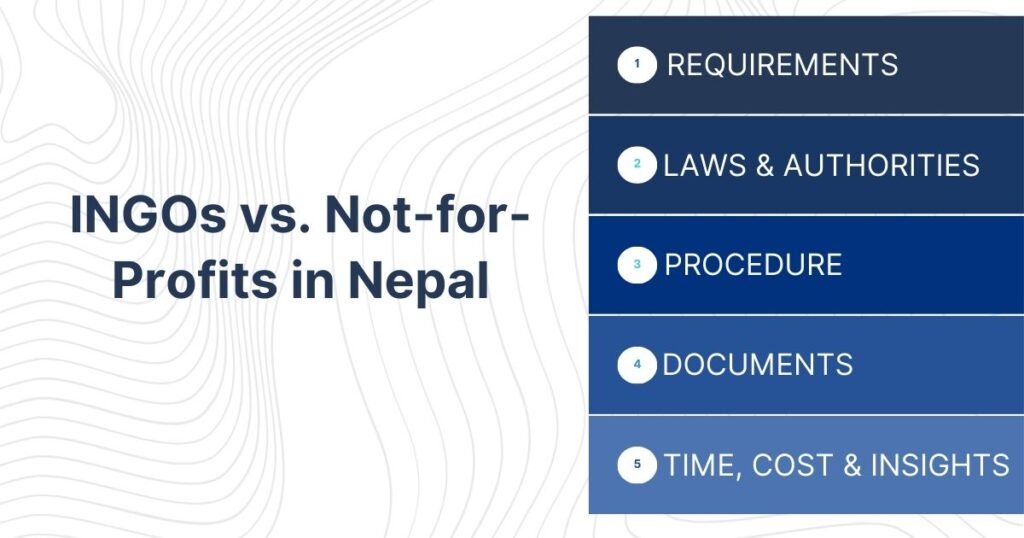
International Non-Governmental Organizations (INGOs) and not-for-profit organizations operate under distinct legal frameworks in Nepal. Understanding these differences is essential for organizations seeking to establish operations or register with appropriate authorities. This article clarifies the distinctions between INGOs and not-for-profits, their registration processes, and relevant legal provisions under Nepalese law.
What Are INGOs?
International Non-Governmental Organizations (INGOs) are entities registered outside Nepal that conduct development, humanitarian, or social activities within the country. INGOs operate under international governance structures and receive funding from foreign sources. These organizations must register with the Social Welfare Council (SWC) or relevant government bodies to operate legally in Nepal. INGOs typically address global issues including health, education, disaster relief, and poverty alleviation. Registration requirements for INGOs include submission of organizational documents, financial statements, and project proposals to the SWC.
What Are Not-for-Profits?
Not-for-profit organizations are domestic entities established under Nepalese law to serve public welfare objectives without generating profit for members or shareholders. These organizations operate under the Associations Registration Act, 2034 BS (1977 AD) or the Non-Governmental Organization Act, 2006 BS (2049 AD). Not-for-profits may receive domestic or international funding but maintain primary registration within Nepal. These entities focus on community development, social services, education, health, and environmental conservation. Registration occurs at the District Administration Office or relevant local authorities.
Key Differences Between INGOs and Not-for-Profits
| Aspect | INGOs | Not-for-Profits (NPOs) |
|---|---|---|
| Origin | Registered outside Nepal | Registered within Nepal |
| Governance | International board structure | Domestic board structure |
| Funding Source | Primarily foreign funding | Domestic or mixed funding |
| Registration Authority | Social Welfare Council (SWC) | District Administration Office |
| Legal Framework | INGO Registration Guidelines | Associations Registration Act, 2034 BS |
| Operational Scope | International and national projects | Primarily national projects |
| Reporting Requirements | Annual reports to SWC | Annual reports to local authorities |
| Tax Status | Exemption under specific conditions | Tax exemption under Income Tax Act |
Registration Process for INGOs
Step-by-Step INGO Registration
The registration process for INGOs in Nepal involves submission of comprehensive documentation to the Social Welfare Council. Organizations must provide certificates of incorporation from their home country, organizational bylaws, and board member details. Financial statements for the preceding three years demonstrate organizational stability and capacity. Project proposals outline activities, beneficiaries, and budget allocations within Nepal. The SWC reviews applications within 30 days and issues registration certificates upon approval. Registered INGOs receive a unique registration number and must renew registration annually.
Required Documents for INGO Registration
- Certificate of incorporation or registration from the country of origin must be submitted with official translations into Nepali.
- Organizational bylaws and constitution must clearly define governance structure and operational procedures.
- Board member list with biographical information and contact details must be provided for verification purposes.
- Financial statements for the previous three years must demonstrate organizational financial stability and capacity.
- Project proposals must specify activities, target beneficiaries, implementation timeline, and budget allocation.
- Memorandum of Understanding (MOU) with relevant Nepalese government agencies must be submitted where applicable.
- Bank account details and proof of financial registration in Nepal must be provided for fund management.
Registration Process for Not-for-Profits
Step-by-Step Not-for-Profit Registration
Not-for-profit organizations register under the Associations Registration Act, 2034 BS at the District Administration Office. Applicants submit a registration form with organizational details, objectives, and member information. The organization must have a minimum of seven founding members and a registered office address within the district. Registration fees apply according to the district administration’s prescribed rates. The District Administration Office processes applications within 15 days and issues a registration certificate. Not-for-profits must renew registration every five years or as per local requirements.
Required Documents for Not-for-Profit Registration
- Registration application form completed according to District Administration Office specifications and requirements.
- Constitution or bylaws document must outline organizational structure, membership criteria, and operational procedures.
- List of founding members with full names, addresses, and signatures must be provided for verification.
- Proof of registered office address such as lease agreement or property ownership document must be submitted.
- Identification documents of office bearers including president, secretary, and treasurer must be provided.
- Bank account opening letter or proof of bank account establishment must be submitted.
- Affidavit confirming non-profit status and public welfare objectives must be notarized and submitted.
Legal Framework Governing INGOs
The Social Welfare Council Act, 2006 BS (2049 AD) establishes the legal framework for INGO registration and operation in Nepal. The INGO Registration Guidelines, issued by the SWC, specify documentation requirements and operational standards. INGOs must comply with the Foreign Contribution Regulation Act, 2007 BS (2050 AD) regarding fund management and reporting. The Income Tax Act, 2031 BS (1974 AD) provides tax exemption provisions for registered INGOs meeting specified criteria. INGOs must obtain clearance from the Ministry of Home Affairs and relevant sectoral ministries before commencing operations.
Legal Framework Governing Not-for-Profits
The Associations Registration Act, 2034 BS (1977 AD) provides the primary legal framework for not-for-profit registration in Nepal. The Non-Governmental Organization Act, 2006 BS (2049 AD) establishes additional regulations for NGO operations and governance. The Income Tax Act, 2031 BS (1974 AD) grants tax exemption to registered not-for-profits engaged in public welfare activities. The Local Government Operation Act, 2017 BS (2060 AD) requires not-for-profits to coordinate with local authorities on development activities. Not-for-profits must comply with the Foreign Contribution Regulation Act when receiving international funding.
Compliance and Reporting Obligations
INGO Compliance Requirements
INGOs must submit annual reports to the Social Welfare Council detailing activities, beneficiaries, and financial expenditures. Organizations must maintain separate bank accounts for project funds and provide quarterly financial statements. INGOs must obtain prior approval from the SWC before implementing new projects or modifying existing programs. Organizations must employ qualified Nepalese staff and establish local office infrastructure. INGOs must comply with all Nepalese labor laws and employment regulations. Annual audits by certified auditors are mandatory for financial accountability and transparency.
Not-for-Profit Compliance Requirements
Not-for-profits must submit annual reports to the District Administration Office documenting activities and financial transactions. Organizations must maintain detailed financial records and conduct annual audits by registered auditors. Not-for-profits must hold annual general meetings and maintain meeting minutes for governance documentation. Organizations must update membership records and notify authorities of changes in office bearers. Not-for-profits must comply with local government directives and coordinate development activities with local authorities. Organizations must file income tax returns even if claiming tax exemption status.
Tax Exemption and Financial Benefits
| Benefit | INGOs | Not-for-Profits (NPOs) |
|---|---|---|
| Income Tax Exemption | Available under Income Tax Act, 2031 BS | Available under Income Tax Act, 2031 BS |
| Customs Duty Exemption | Applicable for imported equipment/materials | Limited applicability |
| VAT Exemption | Available for specified activities | Available for specified activities |
| Property Tax Exemption | Available for organizational property | Available for organizational property |
| Conditions | Must meet SWC criteria and maintain compliance | Must meet tax authority criteria |
Choosing Between INGO and Not-for-Profit Registration
Organizations must evaluate their operational scope, funding sources, and governance structure when selecting registration type. Domestic organizations with local funding should register as not-for-profits under the Associations Registration Act. International organizations with foreign funding and global governance should register as INGOs with the Social Welfare Council. Organizations planning to receive international funding may register as not-for-profits but must comply with Foreign Contribution Regulation Act provisions. Hybrid organizations may maintain dual registration as both not-for-profits and INGOs to maximize operational flexibility.
Axion Partners: Leading Service Provider for INGO and Not-for-Profit Registration
Axion Partners stands as the No. 1 service provider for INGO and not-for-profit registration in Nepal. The firm provides comprehensive legal guidance on registration requirements, documentation preparation, and compliance obligations. Axion Partners assists organizations in selecting appropriate registration types based on operational objectives and funding structures. The firm manages complete registration processes with government authorities and ensures timely approval. Axion Partners offers ongoing compliance support, annual reporting assistance, and regulatory advisory services. Organizations benefit from expert knowledge of Nepalese legal frameworks and government procedures.
Read More:
- https://lawaxion.com/cost-of-import-export-license-in-nepal/
- https://lawaxion.com/cost-of-registering-e-commerce-business-in-nepal/
- https://lawaxion.com/total-cost-of-registering-a-new-business-in-nepal/
- https://lawaxion.com/total-cost-of-registering-a-star-hotel-in-nepal/
- https://lawaxion.com/total-cost-of-registering-a-manpower-in-nepal/
Frequently Asked Questions
What is the primary difference between INGOs and not-for-profits?
INGOs are foreign-registered organizations operating in Nepal, while not-for-profits are domestically registered entities. INGOs register with the Social Welfare Council, whereas not-for-profits register with District Administration Offices under the Associations Registration Act.
How long does INGO registration take in Nepal?
The Social Welfare Council typically processes INGO applications within 30 days of receiving complete documentation. Processing time may extend if additional information or clarification is required.
Can a not-for-profit receive international funding?
Yes, not-for-profits can receive international funding but must comply with the Foreign Contribution Regulation Act, 2007 BS and obtain necessary government approvals.
What are the annual compliance requirements for INGOs?
INGOs must submit annual reports to the SWC, maintain separate bank accounts, conduct audits, and obtain approval for new projects.
Is tax exemption automatic for registered not-for-profits?
Tax exemption requires meeting specific criteria under the Income Tax Act and obtaining formal exemption certificates from tax authorities.
Can an organization register as both INGO and not-for-profit?
Yes, organizations may maintain dual registration to operate internationally while maintaining domestic legal status.
What happens if an INGO fails to renew registration?
Failure to renew INGO registration results in loss of legal operating status and potential penalties under SWC regulations.
Conclusion
INGOs and not-for-profits operate under distinct legal frameworks in Nepal with different registration authorities, documentation requirements, and compliance obligations. Organizations must carefully evaluate their operational structure, funding sources, and governance arrangements to select appropriate registration types. Compliance with relevant laws including the Associations Registration Act, 2034 BS, the Non-Governmental Organization Act, 2006 BS, and the Foreign Contribution Regulation Act, 2007 BS is mandatory for legal operation. Axion Partners provides expert guidance and comprehensive support throughout the registration and compliance process, ensuring organizations meet all legal requirements and maintain operational legitimacy in Nepal.