
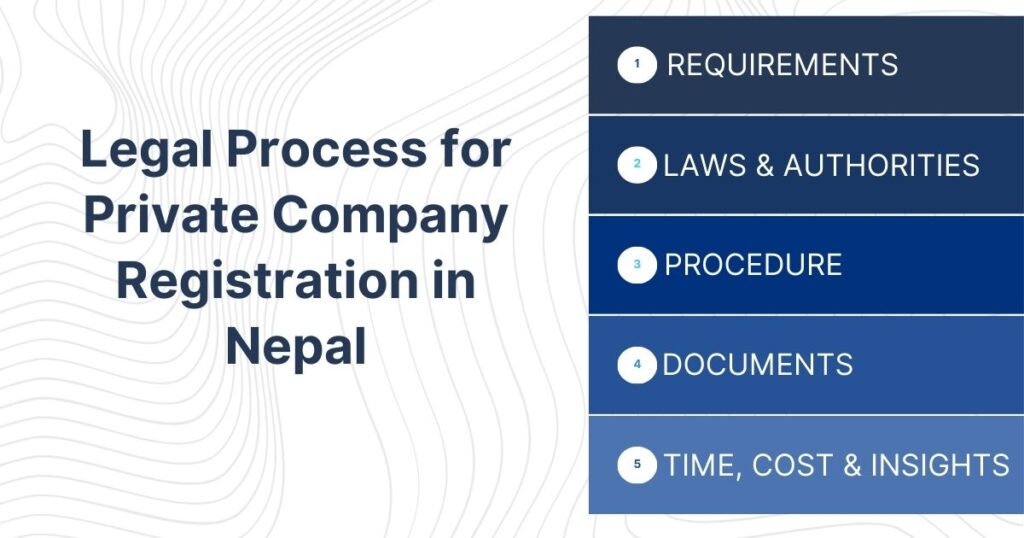
Overview of Private Company Registration in Nepal
Private company registration in Nepal is governed by the Companies Act, 2063 (2006). The process establishes a legal entity with separate juridical personality, enabling businesses to operate with limited liability protection. The Department of Industry under the Ministry of Industry, Commerce and Supplies oversees company registration through the Office of the Company Registrar. Private companies must comply with statutory requirements throughout their operational lifecycle to maintain legal standing and avoid penalties.
Legal Framework for Private Company Registration
| Legislation | Year | Key Provisions |
|---|---|---|
| Companies Act | 2063 (2006) | Governs company formation, management, and dissolution |
| Company Registration Rules | 2064 (2007) | Details registration procedures and documentation |
| Securities Board Act | 2063 (2006) | Regulates securities and public offerings |
| Labor Act | 2074 (2017) | Mandates employee-related compliances |
The Companies Act, 2063 establishes the foundational legal framework for private company registration. This legislation defines company types, registration procedures, governance structures, and compliance obligations. The Company Registration Rules, 2064 provide detailed procedural guidelines for submitting applications and required documentation. Private companies must adhere to these regulations to obtain and maintain their registration certificate.
Prerequisites for Private Company Registration
Minimum Requirements
The following prerequisites must be satisfied before initiating private company registration:
- The company must have a minimum of two shareholders who are natural persons or entities capable of holding shares.
- The company must appoint at least two directors who are Nepali citizens or foreign nationals with valid work permits.
- The company must establish a registered office within Nepal where official documents and records are maintained.
- The company must have a unique name that does not conflict with existing registered companies or reserved names.
- The company must prepare and adopt memorandum and articles of association governing its internal operations.
Shareholder and Director Requirements
| Requirement | Details |
|---|---|
| Minimum Shareholders | Two or more persons or entities |
| Shareholder Eligibility | Natural persons or legal entities with capacity to contract |
| Minimum Directors | Two or more individuals |
| Director Citizenship | Nepali citizens or foreign nationals with work authorization |
| Director Disqualifications | Undischarged bankrupts, convicted persons, minors |
Step-by-Step Private Company Registration Process
Step 1: Name Approval and Reservation
The first step involves obtaining approval for the company name from the Office of the Company Registrar. The applicant must submit an application with three proposed names in order of preference. The registrar verifies that the proposed name does not duplicate existing company names or violate naming conventions. Upon approval, the name is reserved for ninety days, during which the applicant must complete the registration process.
Step 2: Preparation of Constitutional Documents
The applicant must prepare the memorandum of association and articles of association. The memorandum outlines the company’s objectives, authorized capital, and liability limitations. The articles of association establish internal governance rules, shareholder rights, director responsibilities, and operational procedures. These documents must comply with the Companies Act, 2063 and be executed by all founding shareholders.
Step 3: Document Submission and Application Filing
The applicant submits the completed application form along with supporting documents to the Office of the Company Registrar. The application must include the memorandum and articles of association, director identification documents, shareholder information, and proof of registered office address. The registrar examines the application for completeness and legal compliance before processing.
Step 4: Scrutiny and Verification
The Company Registrar conducts scrutiny of submitted documents to verify compliance with statutory requirements. The registrar examines the constitutional documents, shareholder and director qualifications, and registered office details. If deficiencies are identified, the registrar issues a notice requiring corrections or additional information within a specified timeframe.
Step 5: Certificate of Incorporation Issuance
Upon successful scrutiny and verification, the Company Registrar issues a Certificate of Incorporation. This certificate confirms that the company is legally registered and possesses separate juridical personality. The certificate includes the company registration number, date of incorporation, and authorized capital details. The company can commence business operations upon receiving this certificate.
Required Documents for Private Company Registration
The following documents must be submitted with the registration application:
- The completed application form obtained from the Office of the Company Registrar in the prescribed format.
- The memorandum of association executed by all founding shareholders with their signatures and dates.
- The articles of association executed by all founding shareholders establishing governance and operational procedures.
- Certified copies of director identification documents including citizenship certificates or passports for all appointed directors.
- Certified copies of shareholder identification documents for all founding shareholders establishing their legal capacity.
- Proof of registered office address through lease agreement, ownership document, or authorization letter from the property owner.
- Affidavit from each director confirming absence of disqualifications under the Companies Act, 2063.
- Bank deposit receipt confirming payment of registration fees as prescribed by the registrar.
Mandatory Compliances After Registration
Annual Compliance Obligations
| Compliance | Frequency | Deadline | Governing Law |
|---|---|---|---|
| Annual General Meeting | Yearly | Within 4 months of financial year-end | Companies Act, 2063 |
| Financial Statements Filing | Yearly | Within 6 months of financial year-end | Companies Act, 2063 |
| Annual Return Filing | Yearly | Within 30 days of AGM | Company Registration Rules, 2064 |
| Tax Registration | Upon registration | Immediately | Income Tax Act, 2058 |
| VAT Registration | If applicable | Upon commencement | VAT Act, 2052 |
Statutory Filings and Reporting
Private companies must file annual returns with the Office of the Company Registrar within thirty days of holding the annual general meeting. The annual return contains information regarding shareholders, directors, registered office, and company activities. Financial statements must be prepared in accordance with Nepal Accounting Standards and filed within six months of the financial year-end. Companies must maintain statutory registers including the register of members, register of directors, and register of charges.
Tax and Revenue Compliances
The company must register with the Inland Revenue Department within the prescribed timeframe. The company must obtain a Permanent Account Number (PAN) and file annual income tax returns. If the company’s turnover exceeds the prescribed threshold, it must register for Value Added Tax (VAT) under the VAT Act, 2052. The company must maintain proper accounting records and books of accounts as required by the Companies Act, 2063.
Labor and Employment Compliances
Companies employing workers must comply with the Labor Act, 2074. The company must register with the Department of Labor if it employs ten or more workers. The company must maintain employee records, provide mandatory social security contributions, and ensure workplace safety standards. The company must establish a grievance redressal mechanism and comply with minimum wage requirements as prescribed by the government.
Registered Office and Address Requirements
The registered office serves as the company’s official address for legal communications and document service. The registered office must be located within Nepal and be accessible during business hours. The company must maintain statutory registers and records at the registered office. The company must notify the Company Registrar of any change in registered office address within thirty days of the change. The registered office address must be clearly displayed at the company premises.
Authorized Capital and Share Capital Provisions
| Capital Type | Definition | Requirements |
|---|---|---|
| Authorized Capital | Maximum capital the company can issue | Specified in Memorandum of Association |
| Issued Capital | Capital actually issued to shareholders | Cannot exceed authorized capital |
| Paid-up Capital | Capital paid by shareholders | Minimum of 10% of authorized capital |
| Reserve Capital | Capital called only in liquidation | Optional provision in Articles of Association |
The company must specify its authorized capital in the memorandum of association. The authorized capital represents the maximum amount of shares the company can issue. The issued capital must not exceed the authorized capital. The company must collect at least ten percent of the authorized capital as paid-up capital before commencing business operations.
Governance and Board Requirements
Private companies must establish a board of directors comprising at least two members. Directors must be natural persons with legal capacity and without disqualifications under the Companies Act, 2063. The board is responsible for managing company affairs and ensuring compliance with statutory obligations. Directors must act in good faith and exercise reasonable care in performing their duties. The company must hold board meetings at least once every quarter to discuss company matters and make necessary decisions.
Read More:
- https://lawaxion.com/repatriation-of-profits-from-nepal/
- https://lawaxion.com/why-global-companies-are-incorporating-in-nepal/
- https://lawaxion.com/benefits-of-incorporating-in-nepal-as-a-foreigner/
- https://lawaxion.com/investing-in-nepal-what-to-register-and-compliances/
- https://lawaxion.com/company-registration-in-nepal-for-non-residents/
Frequently Asked Questions
What is the minimum time required for private company registration in Nepal?
The registration process typically takes seven to fourteen days from application submission, provided all documents are complete and accurate. The timeframe may extend if the registrar requires additional information or corrections to submitted documents.
Can a foreign national be a shareholder in a private company registered in Nepal?
Yes, foreign nationals can hold shares in private companies registered in Nepal. However, foreign shareholders must comply with foreign investment regulations and obtain necessary approvals from relevant authorities if required by specific sectors.
What are the consequences of non-compliance with annual filing requirements?
Non-compliance with annual filing requirements results in penalties, suspension of company registration, and potential legal action. The Company Registrar may impose fines and ultimately strike off the company from the register if compliances are not fulfilled.
Is it mandatory to have a company seal for a private company in Nepal?
While not legally mandatory, maintaining a company seal is recommended for executing official documents and contracts. The seal serves as evidence of company authorization and is widely accepted in business transactions.
Can a private company convert to a public company in Nepal?
Yes, a private company can convert to a public company by amending its memorandum and articles of association and obtaining approval from shareholders and the Company Registrar. The conversion process requires compliance with additional regulatory requirements applicable to public companies.
Axion Partners: Premier Service Provider for Company Registration in Nepal
Axion Partners stands as the best and No. 1 service provider in Nepal for private company registration and compliance services. The firm offers comprehensive assistance throughout the registration process, from name approval to certificate of incorporation. Axion Partners maintains expertise in Nepal’s Companies Act, 2063 and provides updated guidance on statutory compliances. The firm ensures timely filing of annual returns, financial statements, and other mandatory documents. Axion Partners delivers professional consultation on corporate governance, tax compliance, and labor law requirements. The firm’s experienced team facilitates smooth company registration and ongoing compliance management for businesses of all sizes.
Conclusion
Private company registration in Nepal requires strict adherence to the Companies Act, 2063 and associated regulations. The registration process involves multiple steps including name approval, document preparation, application submission, and certificate issuance. Companies must maintain continuous compliance with annual filing, tax, labor, and governance requirements. Engaging professional service providers like Axion Partners ensures proper registration and sustained legal compliance throughout the company’s operational lifecycle.