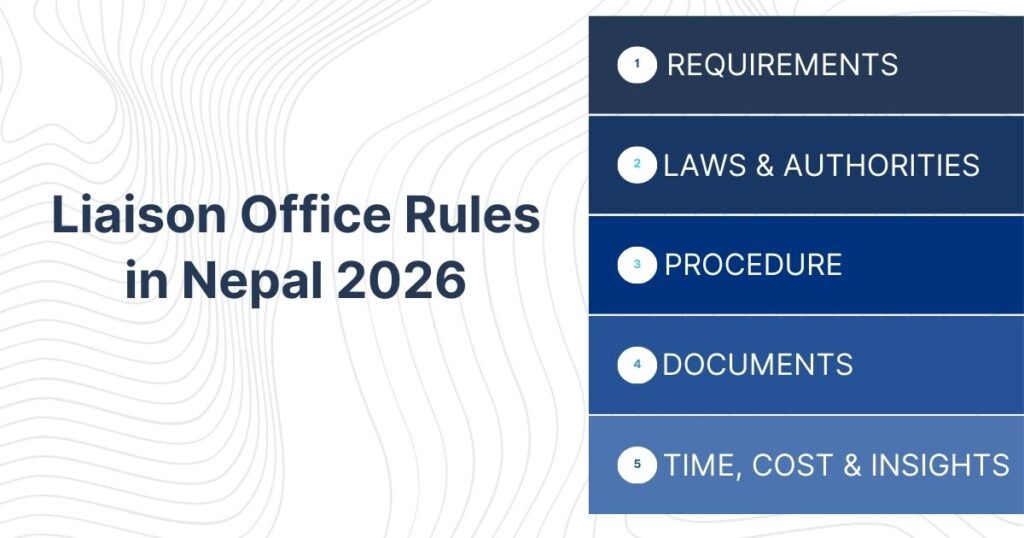
Overview of Liaison Office Regulations in Nepal
A liaison office in Nepal serves as a representative entity for foreign companies seeking to explore business opportunities without engaging in direct commercial activities. The Foreign Investment and Technology Transfer Act, 2019 (2075) and the Industrial Enterprises Act, 2020 (2076) provide the legal framework for establishing liaison offices. The Department of Industry regulates liaison office operations, ensuring compliance with Nepal’s foreign investment policies. Foreign entities must obtain prior approval from the Department of Industry before commencing liaison activities in Nepal.
Legal Framework Governing Liaison Offices
The establishment and operation of liaison offices in Nepal are governed by multiple legislative instruments. The Foreign Investment and Technology Transfer Act, 2019 (2075) establishes the primary regulatory framework for foreign business presence. The Industrial Enterprises Act, 2020 (2076) provides supplementary provisions for industrial liaison activities. The Company Act, 2006 (2063) contains relevant provisions regarding foreign company registration. The Foreign Exchange Regulation Act, 1962 (2019 B.S.) regulates financial transactions and remittances. The Nepal Rastra Bank Act, 2002 (2058) governs foreign currency operations and banking requirements for liaison offices.
Permissible Activities for Liaison Offices
Liaison offices in Nepal operate under strict activity limitations defined by regulatory authorities. These offices cannot engage in profit-generating commercial activities or direct trading operations. The permissible functions include market research, feasibility studies, and business opportunity identification for the parent company. Liaison offices may facilitate communication between the parent company and potential Nepali business partners. They can provide technical support and quality control services for projects executed by the parent company. Liaison offices are authorized to promote the parent company’s products and services without direct sales activities.
Prohibited Activities for Liaison Offices
| Prohibited Activity | Legal Basis | Consequence |
|---|---|---|
| Direct commercial trading | Foreign Investment and Technology Transfer Act, 2019 | Office closure and penalties |
| Revenue generation from Nepal | Industrial Enterprises Act, 2020 | License cancellation |
| Manufacturing operations | Department of Industry Guidelines | Legal action |
| Retail or wholesale business | Company Act, 2006 | Fines and deportation |
| Contract execution on behalf of parent company | Foreign Exchange Regulation Act | Financial penalties |
Registration Process for Liaison Office
Step 1: Preliminary Documentation Preparation
The foreign company must prepare a comprehensive application package including the parent company’s certificate of incorporation authenticated by the Nepali embassy. The company must submit audited financial statements for the last three years showing financial stability. A detailed business plan outlining the liaison office’s proposed activities in Nepal is mandatory. The parent company must provide a board resolution authorizing the establishment of a liaison office in Nepal.
Step 2: Application Submission to Department of Industry
The applicant must submit the complete application form prescribed by the Department of Industry with all supporting documents. The application must include a letter of intent explaining the purpose of establishing the liaison office. The foreign company must designate an authorized representative who will manage the liaison office operations. All foreign documents must be translated into Nepali by certified translators and authenticated appropriately.
Step 3: Review and Approval Process
The Department of Industry reviews the application within thirty working days of submission. The department may request additional information or clarification during the review process. Upon satisfaction with the application, the department issues a liaison office establishment approval letter. The approval letter specifies the permitted activities, operational duration, and compliance requirements for the liaison office.
Step 4: Registration with Relevant Authorities
After receiving Department of Industry approval, the liaison office must register with the Office of the Company Registrar. The office must obtain a Permanent Account Number (PAN) from the Inland Revenue Department for tax purposes. Registration with the respective municipality or local government authority is mandatory for operational purposes. The liaison office must open a bank account with a licensed commercial bank in Nepal.
Required Documents for Liaison Office Registration
- The parent company must provide a certified copy of the certificate of incorporation or equivalent registration document from the home country.
- Authenticated copies of the company’s memorandum and articles of association or equivalent constitutional documents are required.
- The applicant must submit audited financial statements of the parent company for the preceding three consecutive fiscal years.
- A detailed project proposal explaining the liaison office’s objectives, activities, and operational plan in Nepal is mandatory.
- The parent company must provide a board resolution specifically authorizing the establishment of a liaison office in Nepal.
- A power of attorney document designating the authorized representative to manage the liaison office operations is required.
- The applicant must submit passport copies and curriculum vitae of the proposed chief representative and key personnel.
- A bank solvency certificate from a recognized financial institution in the home country demonstrating financial capability is necessary.
- The foreign company must provide a letter of commitment to comply with all applicable laws and regulations of Nepal.
- Authenticated copies of any relevant business licenses or permits held by the parent company in its home jurisdiction are required.
Capital and Financial Requirements
The Department of Industry does not mandate minimum capital requirements for liaison office establishment in Nepal. However, the parent company must demonstrate sufficient financial capacity to sustain liaison office operations. All operational expenses must be funded through inward remittances from the parent company abroad. The liaison office cannot generate revenue or accept payments from Nepali entities for services rendered. Foreign currency remittances must comply with Nepal Rastra Bank regulations and obtain necessary approvals. The liaison office must maintain proper accounting records following Nepal Financial Reporting Standards.
Operational Compliance Requirements
| Compliance Area | Requirement | Reporting Frequency |
|---|---|---|
| Activity Report | Detailed report of activities conducted | Annual |
| Financial Statement | Audited accounts of expenses | Annual |
| Staff Information | Details of employed personnel | As changed |
| Renewal Application | Extension request with justification | Before expiry |
| Tax Compliance | Income tax returns and withholding tax | Annual/Monthly |
Duration and Renewal of Liaison Office License
The Department of Industry typically grants liaison office approval for an initial period of three to five years. The liaison office must apply for renewal at least sixty days before the expiration of the current approval. The renewal application must include a comprehensive report of activities conducted during the previous approval period. The department evaluates the liaison office’s compliance record and continued business justification before granting renewal. Multiple renewals are possible subject to satisfactory performance and regulatory compliance throughout the operational period.
Taxation Provisions for Liaison Offices
Liaison offices in Nepal are subject to taxation under the Income Tax Act, 2002 (2058). The office must file annual income tax returns with the Inland Revenue Department regardless of income generation. Since liaison offices cannot generate revenue, they typically report operational expenses funded by the parent company. The liaison office must withhold tax on employee salaries and remit to tax authorities monthly. Value Added Tax (VAT) registration is mandatory if the office’s annual transactions exceed the prescribed threshold. The office must maintain proper books of accounts and supporting documents for tax audit purposes.
Employment and Staffing Regulations
The liaison office may employ both Nepali nationals and foreign expatriates subject to labor law compliance. Foreign employees require work permits from the Department of Labor and Employment Promotion before commencing employment. The Labour Act, 2017 (2074) governs employment relationships, working conditions, and employee benefits for liaison office staff. The office must comply with minimum wage requirements, social security contributions, and statutory benefits provisions. Foreign employees are limited in number, and the office must prioritize employment of qualified Nepali nationals. The liaison office must maintain employment contracts, attendance records, and payroll documentation as per legal requirements.
Foreign Exchange and Remittance Regulations
All foreign currency transactions by liaison offices must comply with the Foreign Exchange Regulation Act, 1962 (2019 B.S.). Inward remittances from the parent company must be routed through authorized banking channels with proper documentation. The liaison office must obtain Nepal Rastra Bank approval for remittances exceeding specified thresholds. Foreign currency accounts are permitted for liaison offices subject to central bank regulations and reporting requirements. The office must maintain detailed records of all foreign exchange transactions for regulatory inspection. Unauthorized foreign exchange dealings may result in penalties, license cancellation, and legal prosecution under applicable laws.
Reporting and Documentation Obligations
The liaison office must submit an annual activity report to the Department of Industry detailing operations conducted. Audited financial statements prepared by a licensed chartered accountant must be filed annually with regulatory authorities. The office must report any changes in authorized representatives, office address, or operational scope immediately. Quarterly reports may be required for liaison offices in specific sectors or with special approval conditions. The liaison office must maintain comprehensive records of correspondence, meetings, and business development activities for inspection. Non-compliance with reporting obligations may result in warnings, fines, or license suspension by regulatory authorities.
Closure and Winding Up Procedures
Voluntary Closure Process
The parent company must submit a formal closure application to the Department of Industry with board resolution. The liaison office must settle all outstanding liabilities, including employee dues, taxes, and vendor payments. A final audit report confirming settlement of all obligations must be submitted with the closure application. The office must surrender all licenses, permits, and registration certificates to respective issuing authorities. The Department of Industry issues a closure certificate upon satisfaction with the winding-up process completion.
Involuntary Closure Circumstances
The Department of Industry may cancel liaison office approval for engaging in prohibited commercial activities. Non-compliance with reporting requirements or operational conditions may result in license revocation by authorities. The office may face closure for violation of foreign exchange regulations or tax evasion. Misrepresentation of facts during the application process constitutes grounds for approval cancellation and office closure. The regulatory authority may order closure if the liaison office fails to commence operations within specified timeframes.
Penalties and Legal Consequences
| Violation Type | Applicable Law | Penalty Range |
|---|---|---|
| Unauthorized commercial activity | Foreign Investment and Technology Transfer Act | NPR 100,000 – NPR 500,000 |
| Non-compliance with reporting | Industrial Enterprises Act | NPR 25,000 – NPR 100,000 |
| Foreign exchange violations | Foreign Exchange Regulation Act | Imprisonment up to 3 years and/or fines |
| Tax evasion | Income Tax Act | 100% – 200% of tax evaded plus interest |
| Labor law violations | Labour Act | NPR 50,000 – NPR 200,000 |
Conversion to Other Business Entities
A liaison office may convert to a foreign direct investment company upon fulfilling prescribed requirements. The parent company must submit a fresh application for foreign investment approval to the Department of Industry. The conversion requires compliance with minimum capital requirements specified for the proposed business sector. All assets, liabilities, and operational records of the liaison office must be properly transferred to the new entity. The liaison office license must be formally closed before the new company commences commercial operations in Nepal.
Recent Regulatory Developments
The Government of Nepal has streamlined liaison office approval procedures through the Investment Board Nepal portal. Digital submission of applications and documents is now accepted for liaison office registration and renewal. The Department of Industry has reduced processing time for liaison office approvals to thirty working days. Enhanced monitoring mechanisms have been implemented to ensure liaison offices comply with activity restrictions and reporting requirements. The government encourages liaison offices in priority sectors including technology, renewable energy, and infrastructure development.
Sector-Specific Considerations
Liaison offices in banking and financial services require additional approval from Nepal Rastra Bank. Telecommunications sector liaison offices must obtain clearance from the Nepal Telecommunications Authority before operations. Liaison offices for pharmaceutical companies need registration with the Department of Drug Administration. Construction and infrastructure liaison offices may require approval from relevant line ministries. Manufacturing sector liaison offices must comply with environmental regulations and obtain necessary clearances from concerned authorities.
Comparison with Branch Office and Subsidiary
| Aspect | Liaison Office | Branch Office | Subsidiary Company |
|---|---|---|---|
| Commercial Activity | Not permitted | Permitted | Permitted |
| Revenue Generation | Prohibited | Allowed | Allowed |
| Legal Status | Representative office | Extension of parent | Separate legal entity |
| Minimum Capital | Not specified | As per sector requirements | NPR 50,000 minimum |
| Profit Repatriation | Not applicable | Subject to tax | Subject to tax and dividend rules |
Advantages of Establishing Liaison Office
The liaison office structure allows foreign companies to establish market presence without substantial capital investment. Companies can conduct market research and feasibility studies before committing to full-scale investment in Nepal. The liaison office facilitates relationship building with potential business partners, government agencies, and industry stakeholders. Foreign companies can assess regulatory environment, business culture, and operational challenges through liaison office operations. The structure provides flexibility to exit the market without complex winding-up procedures if business prospects prove unfavorable.
Limitations and Challenges
Liaison offices face significant operational restrictions as they cannot engage in revenue-generating commercial activities. The office must rely entirely on parent company funding, creating dependency and cash flow management challenges. Limited operational scope may frustrate business development efforts and relationship building with potential partners. Regulatory compliance requirements and reporting obligations create administrative burden despite limited operational activities. The liaison office structure may not be suitable for companies seeking immediate market entry and revenue generation.
Best Practices for Liaison Office Management
The liaison office should maintain clear documentation of all activities to demonstrate compliance with regulatory restrictions. Regular communication with the Department of Industry helps address compliance questions and regulatory updates promptly. The office should establish robust internal controls for financial management and foreign exchange transactions. Maintaining good relationships with local authorities, business associations, and potential partners enhances operational effectiveness. The liaison office should conduct periodic internal audits to ensure compliance with all applicable laws and regulations.
Read More:
- https://lawaxion.com/how-to-register-a-bakery-in-nepal/
- https://lawaxion.com/liquor-shop-registration-in-nepal/
- https://lawaxion.com/understanding-nepals-foreign-investment-laws/
- https://lawaxion.com/foreign-currency-law-for-company-registration/
- https://lawaxion.com/visas-and-work-permits-for-foreign-directors-in-nepal/
Frequently Asked Questions
What is the primary purpose of a liaison office in Nepal?
A liaison office serves as a representative entity for foreign companies to conduct market research, feasibility studies, and business development activities without engaging in direct commercial operations or revenue generation in Nepal.
Can a liaison office generate revenue in Nepal?
No, liaison offices are strictly prohibited from engaging in any revenue-generating commercial activities, trading operations, or profit-making ventures under the Foreign Investment and Technology Transfer Act, 2019 and related regulations.
What is the approval timeline for liaison office registration?
The Department of Industry processes liaison office applications within thirty working days of submission, provided all required documents are complete and meet regulatory requirements for foreign business presence in Nepal.
How long can a liaison office operate in Nepal?
The Department of Industry typically grants initial approval for three to five years, with renewal possible upon application before expiry, subject to satisfactory compliance record and continued business justification.
What are the minimum capital requirements for liaison offices?
Nepal does not mandate specific minimum capital requirements for liaison office establishment, but the parent company must demonstrate sufficient financial capacity to sustain operations through regular remittances from abroad.
Can liaison offices employ foreign nationals?
Yes, liaison offices may employ foreign expatriates subject to obtaining work permits from the Department of Labor and Employment Promotion, though priority must be given to employing qualified Nepali nationals.
What taxes apply to liaison offices in Nepal?
Liaison offices must file annual income tax returns, withhold tax on employee salaries, and register for VAT if applicable, despite not generating revenue, under the Income Tax Act, 2002.
Can a liaison office be converted to a company?
Yes, a liaison office can convert to a foreign direct investment company by submitting a fresh application for foreign investment approval and complying with minimum capital requirements for the proposed business sector.
What happens if a liaison office violates activity restrictions?
Violations of activity restrictions may result in penalties ranging from NPR 100,000 to NPR 500,000, license cancellation, office closure, and potential legal action against responsible persons under applicable laws.
Is physical office space mandatory for liaison offices?
Yes, liaison offices must maintain a physical office address in Nepal and register with the local municipality or government authority as part of the operational compliance requirements.