
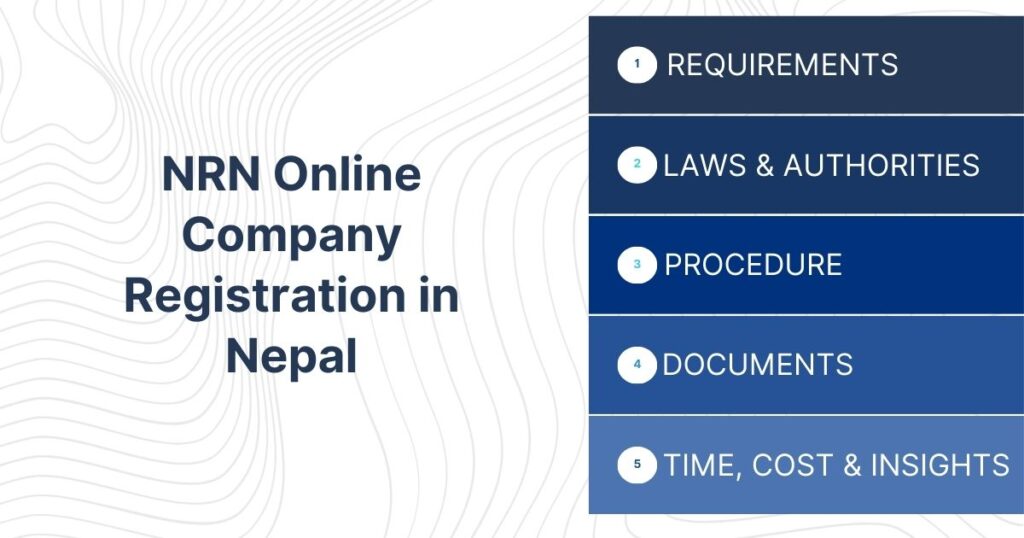
Overview of NRN Company Registration in Nepal
Non-Resident Nepali (NRN) entrepreneurs can register companies in Nepal through online platforms established by the Office of Company Registrar (OCR). The Companies Act, 2063 (2006) and Foreign Investment and Technology Transfer Act, 2075 (2019) govern NRN business registration. The Department of Industry facilitates online company registration through its integrated portal, allowing NRNs to establish private limited companies, public limited companies, and other business entities without physical presence in Nepal.
Legal Framework for NRN Business Registration
The legal provisions governing NRN company registration include multiple statutes and regulations that define the rights and procedures for non-resident Nepalis.
Applicable Laws and Regulations
| Legal Instrument | Key Provisions for NRNs |
|---|---|
| Companies Act, 2063 (2006) | Defines company formation procedures, share capital requirements, and registration processes applicable to all companies, including NRN-owned entities. |
| Foreign Investment and Technology Transfer Act, 2075 (2019) | Grants NRNs national treatment status, allowing them to invest in Nepal with the same rights as resident Nepali citizens in most sectors. |
| Industrial Enterprises Act, 2076 (2020) | Provides framework for industrial registration and operation of manufacturing and service enterprises. |
| Non-Resident Nepali Act, 2064 (2008) | Defines NRN status and establishes special provisions for NRN investments and business activities in Nepal. |
NRN Investment Rights
Non-Resident Nepalis enjoy specific investment privileges under Section 3 of the Foreign Investment and Technology Transfer Act, 2075. NRNs can invest in all sectors open to Nepali citizens except those specifically restricted by law. The Act treats NRN investments as domestic investments rather than foreign direct investment, providing significant advantages in terms of repatriation rights, ownership limits, and sectoral access.
Eligibility Criteria for NRN Company Registration
Who Qualifies as NRN
According to the Non-Resident Nepali Act, 2064, the following individuals qualify as Non-Resident Nepalis:
- A Nepali citizen who has been residing in any foreign country for at least two years for employment, business, or profession purposes.
- A foreign citizen of Nepali origin who has acquired foreign citizenship after renouncing Nepali citizenship.
- A foreign citizen whose father, mother, grandfather, or grandmother was a Nepali citizen at any time.
- A foreign citizen who was born in Nepal and has resided in any foreign country.
Investment Capacity Requirements
NRNs must demonstrate financial capacity to meet minimum capital requirements specified under the Companies Act, 2063. For private limited companies, the minimum authorized capital is NPR 100,000, though practical business operations typically require higher capitalization. NRNs must provide proof of fund sources through bank statements, income certificates, or other financial documentation.
Types of Companies NRNs Can Register Online
Private Limited Company
Private limited companies represent the most common business structure for NRN entrepreneurs. Section 4 of the Companies Act, 2063 defines private limited companies as entities with minimum two and maximum 101 shareholders. These companies cannot publicly trade shares and offer limited liability protection to shareholders. The minimum authorized capital requirement is NPR 100,000, with at least 10% paid-up capital at registration.
Public Limited Company
Public limited companies can issue shares to the general public and list on Nepal Stock Exchange. Section 5 of the Companies Act, 2063 requires minimum seven promoters and NPR 10,000,000 authorized capital. NRNs can establish public companies for larger business ventures requiring substantial capital mobilization from public investors.
Other Business Structures
| Business Type | Minimum Shareholders | Minimum Capital | Key Features |
|---|---|---|---|
| Private Limited Company | 2 | NPR 100,000 | Limited liability, restricted share transfer, suitable for small to medium enterprises. |
| Public Limited Company | 7 | NPR 10,000,000 | Can issue public shares, higher compliance requirements, suitable for large enterprises. |
| Partnership Firm | 2 | No minimum | Unlimited liability, governed by Partnership Act, 2020, simpler registration process. |
| Sole Proprietorship | 1 | No minimum | Unlimited personal liability, simplest structure, registered at local municipality. |
Online Company Registration Process for NRNs
Step 1: Name Reservation
NRNs must first reserve their proposed company name through the Office of Company Registrar’s online portal at ocr.gov.np. The applicant submits three alternative names in order of preference. The name must comply with Section 9 of the Companies Act, 2063, which prohibits names identical or similar to existing companies, names suggesting government patronage, or names containing offensive language. The name reservation remains valid for 35 days from approval date.
Step 2: Document Preparation and Notarization
NRNs must prepare and notarize the following documents:
- The Memorandum of Association must state the company’s objectives, authorized capital, and initial share distribution as per Section 10 of the Companies Act, 2063.
- The Articles of Association must outline internal management rules, director powers, and shareholder rights according to Section 11 of the Companies Act, 2063.
- Citizenship certificates or passports of all shareholders and directors must be notarized by Nepali embassies or consulates in the country of residence.
- NRN identification cards issued by the Non-Resident Nepali Association must be submitted as proof of NRN status.
- Board resolution appointing authorized representatives in Nepal must be properly executed and notarized.
Step 3: Online Application Submission
The applicant accesses the Department of Industry’s online portal and completes the integrated company registration form. The system requires uploading scanned copies of all notarized documents, payment of prescribed fees, and submission of bank deposit certificates showing paid-up capital. The online system automatically forwards applications to relevant government agencies including Office of Company Registrar, Inland Revenue Department, and Social Security Fund.
Step 4: Fee Payment
| Fee Type | Amount | Payment Method |
|---|---|---|
| Name Reservation Fee | NPR 100 | Online banking, eSewa, Khalti, or bank deposit |
| Company Registration Fee | 0.5% of authorized capital (minimum NPR 1,000) | Online banking or bank deposit |
| Memorandum and Articles Filing Fee | NPR 500 | Online banking or bank deposit |
| PAN Registration Fee | NPR 500 | Included in integrated payment |
| VAT Registration Fee | No fee | Automatic if turnover exceeds threshold |
Step 5: Document Verification and Approval
The Office of Company Registrar verifies submitted documents for legal compliance within 7 working days. Officials check whether the Memorandum and Articles comply with Companies Act provisions, whether shareholders meet eligibility criteria, and whether all required documents are properly notarized. If deficiencies exist, the system generates automated notices requiring corrections within specified timeframes.
Step 6: Certificate Issuance
Upon approval, the Office of Company Registrar issues the Certificate of Company Registration electronically. The certificate contains the company registration number, registration date, and authorized capital. Simultaneously, the Inland Revenue Department issues the Permanent Account Number (PAN) certificate. NRNs can download these certificates from the online portal and receive physical copies through authorized representatives in Nepal.
Required Documents for NRN Online Company Registration
Personal Documents
- Valid passport copies of all NRN shareholders and directors must be notarized by Nepali diplomatic missions abroad.
- NRN identification cards issued by Non-Resident Nepali Association must be current and valid.
- Proof of residential address in the country of residence must include utility bills, bank statements, or government-issued documents not older than three months.
- Recent passport-sized photographs of all shareholders and directors must meet specifications prescribed by the Office of Company Registrar.
- Citizenship certificates of resident Nepali directors or shareholders, if any, must be clear and legible copies.
Company Formation Documents
- The Memorandum of Association must be drafted according to the format prescribed in Schedule 1 of the Companies Act, 2063, containing company name, registered office address, objectives, authorized capital, and share distribution.
- The Articles of Association must follow the format in Schedule 2 of the Companies Act, 2063, detailing director appointment procedures, meeting requirements, voting rights, and dividend distribution policies.
- Share subscription agreements must be executed by all initial shareholders, specifying the number of shares subscribed and payment terms.
- Board resolution appointing the company secretary and authorizing specific individuals to represent the company must be properly documented.
Financial Documents
- Bank deposit certificates from recognized Nepali commercial banks must verify that paid-up capital has been deposited in the company’s account.
- Source of fund declarations must explain the origin of investment capital, particularly for amounts exceeding NPR 1,000,000.
- Tax clearance certificates from the country of residence may be required for investments exceeding certain thresholds.
- Foreign currency exchange certificates must document the conversion of foreign currency to Nepali rupees for investment purposes.
Authorized Capital and Paid-Up Capital Requirements
Minimum Capital Requirements
Section 4 of the Companies Act, 2063 mandates minimum authorized capital of NPR 100,000 for private limited companies. The authorized capital represents the maximum share capital the company can issue. At least 10% of authorized capital must be paid-up at the time of registration. For example, a company with NPR 1,000,000 authorized capital must deposit NPR 100,000 as paid-up capital before registration.
Capital Increase Procedures
Companies can increase authorized capital through special resolution passed by shareholders holding at least 75% of voting shares. Section 19 of the Companies Act, 2063 requires filing amended Memorandum of Association with the Office of Company Registrar within 35 days of the resolution. Additional registration fees calculated at 0.5% of the increased capital amount must be paid.
Appointment of Local Representative
Legal Requirement
NRN company owners residing abroad must appoint at least one resident Nepali director or authorized representative. Section 82 of the Companies Act, 2063 requires every company to have at least one director ordinarily resident in Nepal. This representative handles official correspondence, attends regulatory meetings, and ensures compliance with local laws.
Power of Attorney
NRNs execute a power of attorney document authorizing the local representative to act on behalf of the company. The power of attorney must be notarized at Nepali embassies or consulates abroad and subsequently authenticated by the Ministry of Foreign Affairs in Nepal. The document should clearly specify the scope of authority, duration, and limitations on the representative’s powers.
Tax Registration and Compliance
Permanent Account Number (PAN)
The Inland Revenue Department automatically issues PAN during the integrated company registration process. Section 4 of the Income Tax Act, 2058 (2002) requires all companies to obtain PAN before commencing business operations. The PAN serves as the primary tax identification number for all tax-related transactions and filings.
Value Added Tax (VAT) Registration
Companies with annual turnover exceeding NPR 5,000,000 must register for VAT under Section 10 of the Value Added Tax Act, 2052 (1996). NRN companies engaged in manufacturing, trading, or service provision typically require VAT registration. The registration can be completed online through the Inland Revenue Department portal within 30 days of exceeding the threshold.
Tax Obligations
| Tax Type | Rate/Amount | Filing Frequency | Legal Basis |
|---|---|---|---|
| Corporate Income Tax | 25% of taxable income | Annual return within 3 months of fiscal year end | Income Tax Act, 2058 Section 3 |
| Value Added Tax (VAT) | 13% on taxable supplies | Monthly return by 25th of following month | VAT Act, 2052 Section 16 |
| Withholding Tax | Varies by transaction type (1.5%–15%) | Monthly return by 25th of following month | Income Tax Act, 2058 Section 88 |
| Social Security Contribution | 31% of basic salary (20% employer, 11% employee) | Monthly payment | Social Security Act, 2074 Section 23 |
Post-Registration Compliance Requirements
Annual General Meeting
Section 72 of the Companies Act, 2063 mandates holding annual general meetings within six months of the fiscal year end. The meeting must approve annual financial statements, appoint auditors, and address shareholder concerns. NRN shareholders can participate through video conferencing or appoint proxies to vote on their behalf.
Annual Return Filing
Companies must file annual returns with the Office of Company Registrar within one month of the annual general meeting. Section 110 of the Companies Act, 2063 prescribes the format and content of annual returns, including details of shareholders, directors, share capital, and registered office address. Late filing attracts penalties of NPR 1,000 for the first month and NPR 100 for each subsequent day.
Financial Statement Audit
Section 109 of the Companies Act, 2063 requires all companies to maintain proper books of accounts and prepare annual financial statements. Qualified chartered accountants registered with the Institute of Chartered Accountants of Nepal must audit these statements. The audit report must be submitted to the Office of Company Registrar along with the annual return.
Sector-Specific Restrictions for NRN Investment
Prohibited Sectors
The Foreign Investment and Technology Transfer Act, 2075 prohibits foreign investment in certain sectors. While NRNs generally enjoy national treatment, some restrictions apply:
- Retail business with investment below NPR 50 million remains restricted for foreign investors, though NRNs may access this sector under specific conditions.
- Arms and ammunition manufacturing requires special government approval regardless of investor nationality.
- Radioactive material production and nuclear energy generation remain prohibited for private investment.
- Cottage industries identified by the government for protection of local entrepreneurs may restrict NRN participation.
Regulated Sectors
Certain sectors require special licenses or approvals before NRN companies can commence operations:
- Financial services including banking, insurance, and securities trading require Nepal Rastra Bank or Insurance Board approval under respective regulatory frameworks.
- Educational institutions must obtain approval from the Ministry of Education, Science and Technology under the Education Act, 2028 (1971).
- Healthcare facilities require registration with the Ministry of Health and Population under the Health Service Act, 2053 (1997).
- Media and broadcasting companies need licenses from the Ministry of Communication and Information Technology under relevant media laws.
Repatriation Rights for NRN Investors
Profit Repatriation
Section 8 of the Foreign Investment and Technology Transfer Act, 2075 grants NRNs the right to repatriate profits earned from their investments. NRN investors can transfer net profits after paying applicable taxes to their foreign bank accounts. The repatriation requires approval from Nepal Rastra Bank and submission of audited financial statements, tax clearance certificates, and proof of tax payment.
Capital Repatriation
NRNs can repatriate the original investment amount upon company liquidation or share sale. Section 9 of the Foreign Investment and Technology Transfer Act, 2075 permits capital repatriation after settling all domestic liabilities and obtaining tax clearance. The repatriation must occur through banking channels with proper documentation of the investment source and duration.
Digital Signature and Authentication
Digital Signature Requirement
The Electronic Transaction Act, 2063 (2008) recognizes digital signatures as legally valid for electronic documents. NRN company registration increasingly requires digital signatures for online document submission. The Office of Company Registrar accepts digital signatures issued by licensed certification authorities in Nepal.
Authentication Process
Documents notarized abroad require authentication through a two-step process. First, Nepali embassies or consulates must notarize the documents. Second, the Ministry of Foreign Affairs in Nepal must authenticate the embassy notarization. This dual authentication ensures document validity for company registration purposes.
Banking and Financial Requirements
Opening Company Bank Account
NRN companies must open bank accounts in Nepal to deposit paid-up capital and conduct business transactions. Commercial banks require the following documents:
- The Certificate of Company Registration issued by the Office of Company Registrar must be original or certified copy.
- The Memorandum and Articles of Association must be submitted to verify company objectives and authorized signatories.
- Board resolution authorizing specific individuals to operate the bank account must specify transaction limits and signing authorities.
- PAN certificate and VAT registration certificate must be provided for tax compliance purposes.
- Identification documents of authorized signatories including citizenship certificates or passports must be verified.
Foreign Currency Transactions
Nepal Rastra Bank regulates foreign currency transactions under the Foreign Exchange Regulation Act, 2019 (1962). NRN companies receiving foreign investment must convert foreign currency to Nepali rupees through authorized banking channels. Banks issue foreign currency exchange certificates documenting the conversion, which serve as proof of legitimate investment source.
Intellectual Property Protection
Trademark Registration
NRN companies can register trademarks with the Department of Industry under the Patent, Design and Trademark Act, 2022 (1965). Trademark registration provides exclusive rights to use specific marks, logos, or brand names. The registration process requires filing applications with prescribed fees, publication in the Nepal Gazette, and addressing any oppositions within specified timeframes.
Patent and Design Protection
Innovative NRN companies can protect inventions and industrial designs through patent and design registration. Section 3 of the Patent, Design and Trademark Act, 2022 grants patent protection for 7 years for inventions and 5 years for designs. The registration requires detailed specifications, drawings, and proof of novelty.
Dispute Resolution Mechanisms
Arbitration
The Arbitration Act, 2055 (1999) provides framework for resolving commercial disputes through arbitration. NRN companies can include arbitration clauses in contracts, specifying arbitration procedures and venues. Section 3 of the Act recognizes arbitration agreements as binding, and arbitral awards are enforceable through courts.
Court Jurisdiction
Company-related disputes fall under the jurisdiction of specialized commercial courts established under the Administration of Justice Act, 2048 (1992). Section 3 of the Companies Act, 2063 designates specific courts to handle company law matters including shareholder disputes, director liability claims, and winding-up petitions.
Advantages of Online Company Registration
Time Efficiency
The online registration system reduces company formation time from several weeks to approximately 7-15 working days. The integrated portal eliminates the need for multiple visits to different government offices. Automated document verification and electronic certificate issuance expedite the registration process significantly.
Cost Savings
Online registration reduces costs associated with physical document submission, travel expenses, and intermediary fees. NRNs can complete the entire process from abroad without hiring local agents for routine submissions. The transparent fee structure published on government portals prevents overcharging and unofficial payments.
Transparency and Tracking
The online system provides real-time application tracking through unique registration numbers. Applicants receive automated notifications at each processing stage. The digital record-keeping ensures transparency and reduces opportunities for corruption or document manipulation.
Common Challenges and Solutions
Document Authentication Issues
NRNs often face delays in document authentication through Nepali embassies abroad. Solution: NRNs should contact embassies well in advance, prepare documents according to prescribed formats, and maintain regular follow-up. Some embassies offer expedited services for urgent cases upon payment of additional fees.
Technical Difficulties with Online Portal
The online registration portal occasionally experiences technical glitches or server downtime. Solution: NRNs should attempt submissions during Nepal business hours when technical support is available. Maintaining backup copies of all documents and completing applications in multiple sessions prevents data loss.
Communication Barriers
Time zone differences and language barriers complicate communication between NRN applicants and government officials. Solution: Appointing bilingual local representatives familiar with registration procedures facilitates smooth communication. Using official email channels and maintaining written records of all correspondence ensures accountability.
Read More:
- https://lawaxion.com/can-foreigners-register-a-private-company-in-nepal/
- https://lawaxion.com/legal-process-for-private-company-registration-in-nepal/
- https://lawaxion.com/private-limited-vs-public-limited-laws-and-differences-in-nepal/
- https://lawaxion.com/private-company-registration-cost-in-nepal/
- https://lawaxion.com/company-formation-in-nepal-requirements-types-compliance/
Recent Reforms and Updates
Digitalization Initiatives
The Government of Nepal launched the “Digital Nepal Framework” to modernize public service delivery. The Department of Industry integrated company registration with tax registration, social security enrollment, and municipal business licensing. These reforms reduced registration time and improved service quality for NRN entrepreneurs.
Policy Changes
The Foreign Investment and Technology Transfer Act, 2075 (2019) replaced the previous 1992 Act, introducing significant improvements for NRN investors. The new Act simplified approval procedures, expanded sectoral access, and strengthened repatriation rights. The Industrial Enterprises Act, 2076 (2020) further streamlined industrial registration and licensing processes.
Can NRNs register companies entirely online without visiting Nepal?
Yes, NRNs can complete the entire company registration process online without visiting Nepal. The integrated portal accepts electronically submitted documents notarized at Nepali embassies abroad. However, appointing a local representative in Nepal facilitates post-registration compliance and banking procedures.
What is the minimum investment required for NRN company registration?
The minimum authorized capital for private limited companies is NPR 100,000 with at least 10% paid-up capital (NPR 10,000) required at registration. However, practical business operations typically require higher investment depending on the business sector and scale of operations.
How long does the online company registration process take?
The Office of Company Registrar processes online applications within 7 working days if all documents are complete and compliant. The entire process including name reservation, document preparation, and certificate issuance typically takes 15-30 days depending on document authentication timelines.
Do NRN companies need to pay different taxes than domestic companies?
No, NRN companies pay the same taxes as domestic Nepali companies. The Foreign Investment and Technology Transfer Act, 2075 grants NRNs national treatment, ensuring equal tax obligations. Corporate income tax rate is 25%, and VAT rate is 13% for all companies.
Can NRNs own 100% shares in Nepali companies?
Yes, NRNs can own 100% shares in companies across most sectors. The Foreign Investment and Technology Transfer Act, 2075 treats NRN investment as domestic investment, allowing full ownership except in specifically restricted sectors like arms manufacturing or certain cottage industries.
What happens if NRN shareholders cannot attend annual general meetings?
NRN shareholders can participate in annual general meetings through video conferencing facilities or appoint proxies to vote on their behalf. Section 72 of the Companies Act, 2063 permits proxy voting, and the Articles of Association typically outline proxy appointment procedures.
Is physical presence required for opening company bank accounts?
Generally, at least one authorized signatory must visit the bank physically for account opening and signature verification. However, some banks accept notarized power of attorney documents allowing local representatives to open accounts on behalf of NRN directors with proper authorization.
Can NRNs transfer their company shares to other NRNs or foreign nationals?
Yes, NRNs can transfer shares to other NRNs or foreign nationals subject to company Articles of Association and applicable laws. Private limited companies typically have share transfer restrictions requiring board approval. The transfer must be registered with the Office of Company Registrar.
What are the penalties for non-compliance with annual filing requirements?
Section 110 of the Companies Act, 2063 imposes penalties of NPR 1,000 for the first month of delay in annual return filing and NPR 100 for each subsequent day. Continued non-compliance may result in company deregistration proceedings.
How can NRNs verify the authenticity of online registration portals?
NRNs should only use official government portals: ocr.gov.np for company registration and doi.gov.np for the Department of Industry. These portals display official government logos, secure HTTPS connections, and contact information for verification. Avoid third-party websites claiming to offer registration services.