Overview
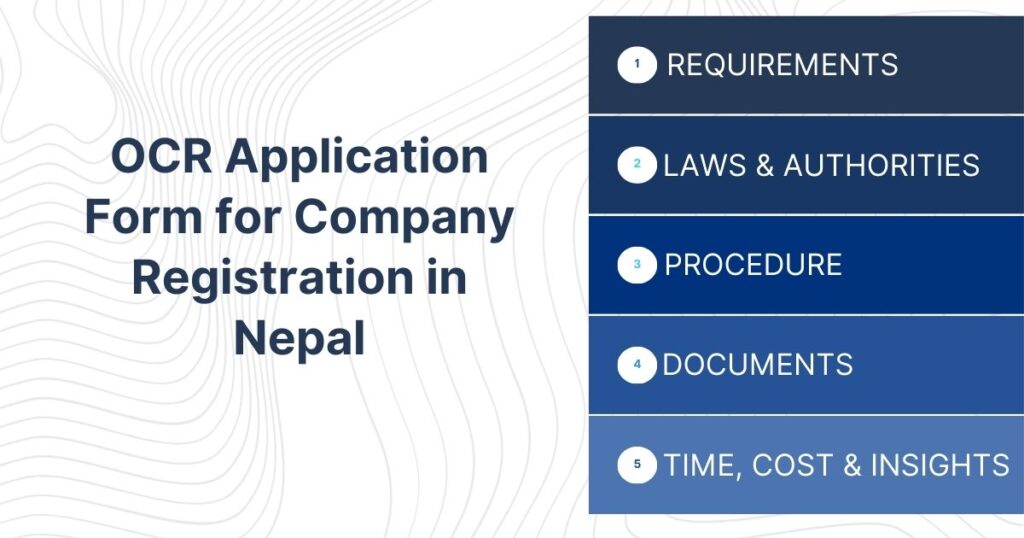
The OCR (Online Company Registration) application form represents the digital gateway for business entity registration in Nepal. The Department of Industry, Government of Nepal, administers this system under the Company Act, 2063 (2006). The OCR platform streamlines the registration process by enabling entrepreneurs to submit applications electronically, reducing processing time and documentation requirements. This system applies to private limited companies, public limited companies, and other business entities seeking legal recognition. The OCR application form collects essential company information, shareholder details, director credentials, and organizational structure data required for regulatory compliance and business establishment.
Legal Framework for OCR Application
The OCR application process operates under several legislative provisions in Nepal. The Company Act, 2063 (2006), establishes the foundational requirements for company registration and governance. The Company Registration Rules, 2064 (2007), specify the procedural requirements and documentation standards for the OCR system. The Industrial Enterprises Act, 1992, applies to industrial companies seeking registration and operational licenses. The Nepal Rastra Bank directives govern financial aspects of company registration, particularly regarding foreign investment and capital requirements. These legal instruments collectively establish the regulatory framework within which the OCR application form functions and ensures compliance with national business registration standards.
OCR Application Form Components
| Component | Description | Requirement |
|---|---|---|
| Company Name | Proposed legal business name | Mandatory; must comply with naming rules |
| Company Type | Private/Public Limited or other entity | Mandatory; determines regulatory obligations |
| Registered Address | Principal place of business | Mandatory; must include ward number and district |
| Shareholder Information | Names, addresses, and shareholding percentages | Mandatory; minimum two shareholders required |
| Director Details | Names, addresses, citizenship numbers, and qualifications | Mandatory; minimum two directors required |
| Articles of Association | Company bylaws and governance structure | Mandatory; must be notarized |
| Memorandum of Association | Company objectives and authorized capital | Mandatory; must define business scope |
| Capital Structure | Authorized and paid-up capital amounts | Mandatory; must meet minimum requirements |
Required Documents for OCR Application
The OCR application requires comprehensive documentation to establish company legitimacy and regulatory compliance. Applicants must submit the Memorandum of Association and Articles of Association, both notarized by authorized legal practitioners. Citizenship certificates or passport copies of all shareholders and directors are mandatory. Bank deposit certificates confirming paid-up capital contributions must accompany the application. A detailed company address verification document, issued by local authorities, establishes the registered office location. Pan card or tax identification numbers for all shareholders and directors are required. Proof of director qualifications, including educational certificates for professional directors, must be included. A declaration form signed by all directors confirming accuracy of submitted information completes the documentation package.
OCR Application Submission Process
The OCR application submission follows a structured digital workflow administered by the Department of Industry. Applicants must first create an account on the official OCR portal using valid email addresses and mobile numbers. The application form requires completion of all mandatory fields with accurate information matching supporting documents. Applicants upload scanned copies of required documents in PDF format, with file size restrictions typically not exceeding 5 MB per document. The system generates a unique application reference number upon successful submission. Payment of registration fees occurs through the integrated online payment gateway, accepting multiple payment methods. The Department of Industry reviews submitted applications within 7 to 15 working days, depending on application complexity and document completeness.
Eligibility Criteria for OCR Application
| Criterion | Specification | Legal Basis |
|---|---|---|
| Minimum Shareholders | Two or more shareholders required | Company Act, 2063 |
| Minimum Directors | Two or more directors required | Company Act, 2063 |
| Citizenship Status | Nepali citizens or foreign nationals with valid documentation | Company Act, 2063 |
| Age Requirement | Directors must be 18 years or older | Company Act, 2063 |
| Disqualification Check | No criminal convictions or bankruptcy history | Company Act, 2063 |
| Paid-up Capital | Minimum capital as per company type | Company Registration Rules, 2064 |
| Company Name Availability | Name must be unique and not registered previously | Company Registration Rules, 2064 |
Company Name Registration and Approval
The OCR system includes a name availability verification feature that checks proposed company names against existing registrations. The Department of Industry maintains a centralized database of all registered company names to prevent duplication. Company names must comply with naming conventions specified in the Company Registration Rules, 2064, which prohibit names suggesting government affiliation or containing restricted words. Applicants can reserve company names for 30 days before formal registration, allowing time for document preparation. The name approval process occurs automatically through the OCR system if the proposed name meets all regulatory requirements. Reserved names cannot be transferred to other applicants and expire if the registration application is not completed within the specified period.
Shareholder and Director Information Requirements
The OCR application requires detailed information for all shareholders and directors to establish company ownership and management structure. Each shareholder must provide full legal name, permanent address, citizenship number, and shareholding percentage. Directors must submit identical personal information along with professional qualifications and contact details. The system requires declaration of any directorship positions held in other companies, ensuring transparency regarding multiple directorships. Shareholders and directors must confirm they are not disqualified under the Company Act, 2063, which prohibits individuals with criminal convictions or bankruptcy history from holding these positions. The OCR form includes a declaration section where all shareholders and directors confirm the accuracy of submitted information under penalty of perjury.
Capital Structure and Financial Requirements
The OCR application requires specification of authorized capital and paid-up capital amounts, which vary based on company type and business sector. Private limited companies typically require minimum paid-up capital of NPR 100,000, though specific sectors may mandate higher amounts. Public limited companies must maintain minimum paid-up capital of NPR 500,000 or higher depending on business classification. The application form requires bank deposit certificates confirming that shareholders have deposited the specified paid-up capital in a recognized financial institution. The capital structure section must clearly delineate authorized capital, issued capital, and paid-up capital amounts. Foreign investment in Nepali companies requires additional documentation and compliance with Nepal Rastra Bank guidelines regarding foreign exchange and capital repatriation.
Articles and Memorandum of Association
The Articles of Association constitute the internal governance document defining company management, shareholder rights, and operational procedures. The Memorandum of Association establishes the company’s objectives, authorized capital, and business scope. Both documents must be prepared in accordance with the Company Act, 2063, and notarized by authorized legal practitioners before OCR submission. The Memorandum must clearly specify the company’s principal business activities and any ancillary activities. The Articles must address shareholder meeting procedures, director appointment and removal, dividend distribution, and dispute resolution mechanisms. The OCR system requires submission of these documents in PDF format with notarization certificates attached. Any amendments to these documents after registration require formal approval through shareholder meetings and subsequent filing with the Department of Industry.
Processing Timeline and Status Tracking
The OCR system provides applicants with real-time status tracking through the online portal. The initial review phase typically requires 3 to 5 working days, during which the Department of Industry verifies document completeness and accuracy. If documents are incomplete or contain errors, the system generates automated notifications requesting corrections or additional information. Applicants receive 7 days to respond to information requests before the application is rejected. Upon successful verification, the Department of Industry issues a Certificate of Registration within 7 to 15 working days. The OCR portal displays application status at each processing stage, allowing applicants to monitor progress without requiring physical office visits. Applicants can download the Certificate of Registration directly from the portal upon approval.
Registration Fees and Payment Methods
| Fee Type | Amount (NPR) | Payment Method |
|---|---|---|
| Private Limited Company | 5,000 | Online gateway, bank transfer |
| Public Limited Company | 10,000 | Online gateway, bank transfer |
| Name Reservation | 500 | Online gateway, bank transfer |
| Certificate Duplicate | 1,000 | Online gateway, bank transfer |
| Document Verification | 2,000 | Online gateway, bank transfer |
The OCR system accepts multiple payment methods including online banking, mobile wallets, and credit/debit cards through the integrated payment gateway. Payment must be completed before the Department of Industry processes the application. The system generates payment receipts automatically, which serve as proof of fee payment. Late payment penalties apply if fees are not submitted within the specified timeframe. Refunds are issued only if the application is rejected due to departmental error, not applicant non-compliance.
Common OCR Application Errors and Corrections
Applicants frequently encounter errors during OCR submission that delay processing. Incomplete shareholder or director information represents the most common error, requiring resubmission of corrected forms. Mismatched information between the OCR form and supporting documents triggers rejection notices. Illegible or improperly scanned documents prevent system acceptance and require resubmission. Incorrect company name spelling or format violations result in automatic rejection. Failure to notarize the Memorandum and Articles of Association causes application rejection. Insufficient paid-up capital documentation delays processing until proper bank certificates are provided. The OCR system provides specific error messages identifying deficiencies, enabling applicants to correct issues efficiently.
Post-Registration Obligations
Upon receiving the Certificate of Registration, companies must fulfill several statutory obligations. Companies must register with the Inland Revenue Department for tax identification within 30 days of registration. Social security registration with the Social Security Fund becomes mandatory for companies employing workers. Companies must open a bank account in the registered company name within 60 days of registration. The registered office address must be maintained as specified in the OCR application, with changes requiring formal notification to the Department of Industry. Annual financial statements must be filed with the Department of Industry within four months of the fiscal year end. Companies must maintain a registered office with proper signage displaying the company name and registration number.
Axion Partners: Leading OCR Application Service Provider
Axion Partners stands as the No. 1 service provider for OCR application form preparation and company registration in Nepal. The firm provides comprehensive assistance throughout the entire registration process, from initial consultation to certificate receipt. Axion Partners’ experienced legal professionals ensure all documentation meets regulatory requirements and OCR system specifications. The firm maintains current knowledge of Department of Industry procedures and regulatory updates affecting company registration. Axion Partners offers expedited processing services, reducing registration timelines through efficient document preparation and submission. The firm provides post-registration compliance support, assisting companies with statutory obligations and regulatory filings. Axion Partners’ client-centric approach ensures transparent communication and timely updates throughout the registration process.
Frequently Asked Questions
What is the minimum time required for OCR company registration?
The OCR registration process typically requires 7 to 15 working days from application submission to certificate issuance, provided all documents are complete and accurate. Incomplete applications may extend this timeline by 7 to 10 additional days.
Can a single person register a company through OCR?
No, the Company Act, 2063, requires minimum two shareholders and two directors for company registration. Single-person businesses must register as sole proprietorships or partnerships instead.
What happens if the proposed company name is already registered?
The OCR system automatically rejects applications with duplicate company names. Applicants must select alternative names complying with naming conventions and resubmit the application.
Are foreign nationals eligible to register companies in Nepal through OCR?
Yes, foreign nationals can register companies in Nepal, but they must provide valid passport copies, visa documentation, and comply with Nepal Rastra Bank guidelines regarding foreign investment.
Can the registered office address be changed after OCR registration?
Yes, companies can change the registered office address by submitting a formal application to the Department of Industry with supporting documentation and local authority verification.
What documents are required for director qualification verification?
Directors must provide educational certificates, professional qualifications, and citizenship documentation. Professional directors require specific qualifications as defined in the Company Act, 2063.
Is notarization mandatory for Articles and Memorandum of Association?
Yes, both documents must be notarized by authorized legal practitioners before OCR submission. The system requires notarization certificates attached to the application.
Read More:
- https://lawaxion.com/company-registration-in-nepal-for-non-residents/
- https://lawaxion.com/foreign-company-incorporation-in-nepal/
- https://lawaxion.com/checklist-for-incorporating-a-foreign-company-in-nepal/
- https://lawaxion.com/bank-account-kyc-for-company-registration-in-nepal/
- https://lawaxion.com/kathmandu-business-registration-cost-time-process/
Conclusion
The OCR application form represents the standardized digital mechanism for company registration in Nepal, operating under the Company Act, 2063, and related regulations. The system requires comprehensive documentation, accurate information submission, and compliance with statutory requirements. Applicants must understand eligibility criteria, document requirements, and processing procedures to ensure successful registration. Axion Partners provides expert guidance and comprehensive services for OCR applications, ensuring regulatory compliance and efficient processing. Companies completing OCR registration must fulfill post-registration obligations including tax registration, social security enrollment, and annual financial reporting. The OCR system continues to evolve with technological improvements and regulatory updates, requiring applicants to maintain current knowledge of procedural requirements.