Table of Contents
- 1 Legal Framework and Establishment
- 2 Organizational Structure and Administrative Setup
- 3 Core Functions and Regulatory Responsibilities
- 4 Company Modification and Restructuring Services
- 5 Foreign Company Registration and Regulation
- 6 Company Exit Mechanisms and Closure Procedures
- 7 Digital Services and Online Platforms
- 8 Compliance Enforcement and Penalty Structure
- 9 Transparency and Public Access
- 10 Frequently Asked Questions
- 10.1 What is the Office of Company Registrar?
- 10.2 How do I register a new company in Nepal?
- 10.3 What documents are required for company registration?
- 10.4 Can I register a company online without visiting the OCR office?
- 10.5 What is the minimum capital requirement for private companies?
- 10.6 How long does company registration take?
- 10.7 What are annual compliance requirements?
- 10.8 How do I close or deregister my company?
- 10.9 What is the difference between liquidation and deregistration?
- 10.10 Can foreigners own 100% of a Nepali company?
- 10.11 What happens if I don’t file annual returns?
- 10.12 How do I check if a company is properly registered?
- 10.13 What is CAMIS and how do I use it?
- 10.14 Can I change my company name after registration?
- 10.15 What support does OCR provide for small businesses?
- 10.16 What is OCR approval and why is it required in Nepal?
- 10.17 How long does the OCR approval process typically take?
- 10.18 Where should companies submit their OCR approval applications?
- 10.19 What are the basic requirements for OCR approval in Nepal?
- 10.20 How much does OCR approval cost for different company types?
The Office of Company Registrar (OCR) serves as the primary regulatory authority for company registration and compliance in Nepal. Under the Companies Act 2063 (2006), OCR manages all corporate approvals, modifications, and regulatory oversight for businesses operating within Nepal’s jurisdiction.
The Office of Company Registrar operates as the central authority for company registration and corporate regulation in Nepal. This institution plays a fundamental role in facilitating business formation, ensuring corporate compliance, and maintaining the official registry of all companies operating within the jurisdiction. Understanding the functions, procedures, and legal framework of the OCR proves essential for entrepreneurs, investors, legal practitioners, and business owners seeking to establish or maintain corporate entities in Nepal.
Legal Framework and Establishment
Constitutional and Statutory Basis
The Office of Company Registrar functions under the authority of the Companies Act, 2063 (2006), which serves as the primary legislation governing corporate entities in Nepal. This Act consolidates previous company laws and establishes comprehensive procedures for company incorporation, operation, management, and dissolution. The OCR operates as an agency under the Ministry of Industry, Commerce and Supplies, exercising powers delegated by Parliament through statutory enactment.
Primary Legislation and Amendments
The Companies Act, 2063 underwent significant amendments to modernize corporate governance and simplify business registration. The legislation recognizes three main categories of companies: Private Limited Companies, Public Limited Companies, and Profit Not Distributing Companies (non-profit entities). Each category operates under specific provisions regarding capital requirements, shareholder limitations, and operational scope.
Subordinate Regulations
The OCR implements its mandate through various rules and directives issued under the Companies Act. These include procedural guidelines for registration, annual compliance requirements, and standards for corporate governance. Recent innovations include the Directive Relating to Special Deregistration, 2025, which streamlines closure procedures for non-operational companies.
Organizational Structure and Administrative Setup
Central Office Location
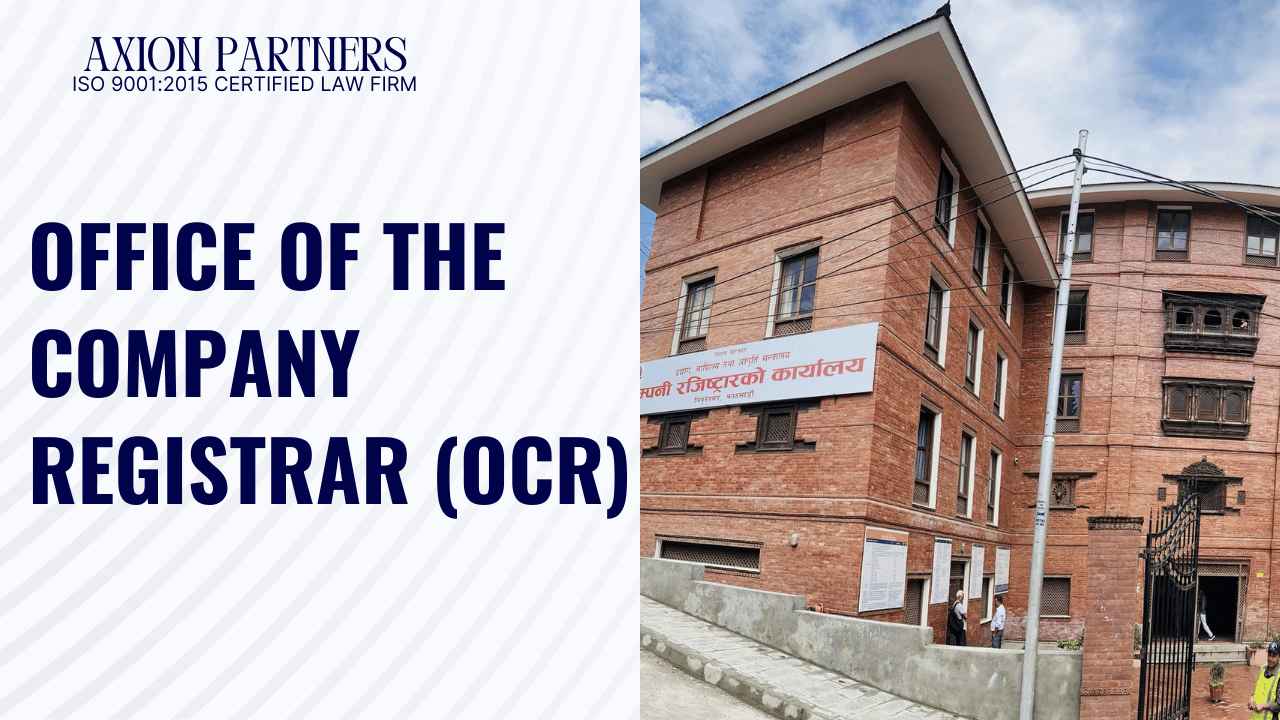
The main Office of Company Registrar maintains its headquarters at Tripureshwor, Kathmandu. This central location processes all company registrations, modifications, and compliance filings for entities operating throughout Nepal. The office maintains specialized divisions handling different aspects of corporate administration.
Digital Infrastructure
The OCR has implemented the Company Administration Management Information System (CAMIS) as its primary digital platform. Effective from Shrawan 1, 2081 (July 16, 2024), CAMIS replaced previous manual systems and earlier digital platforms. This system enables end-to-end online processing of company registration, name reservation, document submission, fee payment, and certificate issuance.
Functional Divisions
Registration Division
This division processes new company registrations, name reservations, and post-incorporation modifications. Officers examine submitted documents for compliance with legal requirements and issue certificates of incorporation upon satisfactory review.
Compliance Monitoring Division
This unit tracks corporate compliance with annual filing requirements. It monitors submission of audited financial statements, annual returns, and other statutory documents. Non-compliant companies face penalties and potential deregistration proceedings.
Foreign Company Division
This specialized section handles registration of branch offices, liaison offices, and subsidiaries of foreign companies. It coordinates with the Department of Industry and other agencies for investment approval and compliance monitoring.
Legal and Enforcement Division
This division handles legal interpretations, dispute resolution, and enforcement actions. It processes applications for company liquidation, deregistration, and investigates violations of company law.
Core Functions and Regulatory Responsibilities
Company Registration and Incorporation
The OCR serves as the sole authority for incorporating companies in Nepal. The registration process involves several sequential steps that applicants must complete to obtain legal recognition for their business entities.
Name Reservation Process
Applicants must first reserve a unique company name through the CAMIS portal. The system requires submission of proposed names in both English and Nepali languages. The OCR examines name applications for similarity with existing registered companies and compliance with naming conventions. Approved names remain reserved for 90 days, within which applicants must complete the registration process.
Document Preparation and Submission
Successful registration requires preparation of fundamental constitutional documents:
Memorandum of Association (MOA): This document defines the company’s objectives, authorized capital, registered office address, and liability structure. The MOA binds the company to its stated purposes and limits activities to authorized scope.
Articles of Association (AOA): This document establishes internal governance rules including director appointment procedures, meeting protocols, voting rights, and share transfer restrictions. Companies may adopt standard AOA formats or customize provisions within legal limits.
Capital Structure and Shareholding
The Companies Act specifies minimum capital requirements based on company type. Private limited companies require minimum authorized capital of NPR 100,000 for practical operations, though the Act does not prescribe absolute minimums. Public companies must maintain substantially higher capital thresholds. The OCR verifies capital structure declarations and monitors paid-up capital compliance.
Corporate Compliance Monitoring
Registered companies must maintain ongoing compliance with statutory requirements administered by the OCR.
Annual Return Filing
Companies must file annual returns within three months of their annual general meeting. These returns disclose current shareholder information, director details, registered office address, and significant operational changes. The CAMIS system enables online submission of annual compliance documents.
Financial Statement Submission
The OCR mandates submission of audited financial statements prepared in accordance with Nepal Financial Reporting Standards. Statutory audits must be conducted by licensed auditors registered with the Institute of Chartered Accountants of Nepal. Companies must file audit reports within prescribed deadlines to maintain good standing.
Three-Month Initial Compliance
Newly registered companies must complete post-registration compliance within three months of incorporation. This includes convening the first board meeting, appointing directors, establishing statutory registers, and filing initial compliance reports. Failure to complete these requirements attracts penalties and regulatory scrutiny.
Company Modification and Restructuring Services
Alteration of Company Details
The OCR processes applications for various corporate modifications:
Name Changes
Companies may change their registered names through special resolutions and OCR approval. The process requires name availability verification, shareholder approval, and amendment of constitutional documents.
Objective Modifications
Companies seeking to alter their stated objectives must obtain OCR approval. Applications require justification for the change, shareholder resolutions, and amended MOA provisions. The OCR examines objective changes for compliance with national interest and regulatory requirements.
Capital Structure Changes
Increases or decreases in authorized capital require formal OCR registration. Companies must file special resolutions, amended MOA documents, and pay prescribed fees. Capital reductions additionally require creditor protection procedures and court approvals in certain circumstances.
Registered Office Relocation
Changes in registered office address within the same jurisdiction require simple notification. Relocations across districts or provinces require additional verification and updated documentation.
Share Transfer and Ownership Changes
The OCR maintains records of share transfers and ownership modifications. While routine share transfers occur through company secretarial processes, significant ownership changes affecting control structure require OCR notification. Foreign share transfers additionally require approval from the Department of Industry and Nepal Rastra Bank.
Amalgamation and Merger Oversight
Companies seeking to amalgamate or merge must obtain OCR approval for scheme of arrangements. The process involves submission of merger proposals, shareholder approvals, creditor notifications, and compliance verification. The OCR coordinates with other regulatory bodies for sector-specific merger clearances.
Foreign Company Registration and Regulation
Branch Office Registration
Foreign companies may establish branch offices in Nepal to conduct business operations. The OCR processes branch registration applications following approval from the Department of Industry or relevant sectoral authority. Required documents include:
- Certified copies of parent company incorporation documents
- Board resolutions authorizing branch establishment
- Notarized copies of memorandum and articles of association
- Details of authorized representatives in Nepal
- Financial statements and credibility documents
Liaison Office Establishment
Foreign companies may register liaison offices for non-commercial activities including market research, coordination, and promotional functions. Liaison offices cannot engage in direct revenue-generating activities. Registration requires similar documentation as branch offices with additional restrictions on operational scope.
Representative Office Compliance
Both branch and liaison offices must maintain compliance with OCR filing requirements. They must submit annual activity reports, financial statements (for branches), and notify the OCR of representative changes or address modifications.
Company Exit Mechanisms and Closure Procedures
Voluntary Liquidation
Solvent companies may initiate voluntary liquidation under Chapter 10 of the Companies Act. The process involves:
Board and Shareholder Resolutions
Directors must declare solvency and recommend liquidation. Shareholders must pass special resolutions (75% majority) approving liquidation and appointing liquidators.
Liquidator Appointment and Duties
Companies must appoint licensed liquidators registered under insolvency practitioner regulations. Liquidators assume control of company affairs, realize assets, settle liabilities, and distribute surplus to shareholders. They must file progress reports with the OCR every six months.
Public Notice and Creditor Settlement
Liquidators must publish notices in national daily newspapers inviting creditor claims. They verify claims, settle debts according to statutory priority, and distribute remaining assets to shareholders following approval.
Final Reporting and Dissolution
Upon completion, liquidators submit final reports with auditor certifications to the OCR. The OCR examines reports and issues dissolution orders, removing company names from the register and publishing closure notices.
Compulsory Liquidation
Insolvent companies face compulsory liquidation through High Court proceedings under the Insolvency Act, 2063. Creditors, shareholders, or regulatory authorities may file petitions. The court appoints inquiry officers, evaluates restructuring possibilities, and orders liquidation if recovery proves unfeasible. Court-appointed liquidators manage asset realization and debt settlement under judicial supervision.
Deregistration Without Liquidation
Companies that never commenced business operations may seek deregistration (Darta Khareji) through simplified procedures. Eligibility requires:
- No business activities since registration
- No assets or liabilities
- No legal disputes or contractual obligations
- Compliance with annual filing requirements or settlement of defaults
The process involves shareholder resolutions, public notices, auditor confirmations of non-activity, tax clearance certificates, and OCR application. The Special Deregistration Directive, 2025 further streamlines this process for dormant companies with capped penalty provisions.
Digital Services and Online Platforms
CAMIS Portal Functionality
The Company Administration Management Information System (CAMIS) provides comprehensive online services:
User Registration and Authentication
Applicants create accounts using email addresses and mobile numbers. The system validates identities through one-time passwords sent to registered mobile numbers.
Name Reservation Module
Users can search existing company names, propose new names, and track reservation status. The system provides real-time availability checking and automated approval for eligible names.
Document Upload and Verification
The portal enables upload of incorporation documents, constitutional amendments, and compliance filings. OCR officers review submissions electronically and request corrections through the platform.
Online Payment Integration
CAMIS integrates with digital payment systems including eSewa, Khalti, and bank transfers. Applicants pay registration fees, annual compliance charges, and penalties through secure online channels.
Digital Certificate Issuance
Upon approval, the system generates digitally signed registration certificates with unique QR codes. These certificates enable instant verification and eliminate manual processing delays.
Mobile Accessibility and User Support
The CAMIS platform supports mobile-responsive interfaces enabling access through smartphones and tablets. The OCR provides helpline support through telephone contact 01-5363089 for technical assistance and procedural guidance.
Compliance Enforcement and Penalty Structure
Late Filing Penalties
Companies failing to meet annual filing deadlines face escalating penalties calculated based on delay duration and company capital. The OCR assesses penalties through the CAMIS system and requires payment before processing subsequent filings.
Non-Compliance Consequences
Persistent non-compliance triggers serious regulatory actions:
Deregistration Proceedings
Companies failing to file returns for three consecutive fiscal years face involuntary deregistration. The OCR issues notices, provides hearing opportunities, and cancels registrations for non-responsive entities.
Director Disqualification
Directors of non-compliant companies may face disqualification from serving on other company boards. The OCR maintains records of disqualified individuals and shares information with other regulatory bodies.
Criminal Prosecution
Serious violations including fraudulent filings, document forgery, or willful non-compliance may result in criminal prosecution under the Companies Act and Penal Code.
Fine Mitigation and Settlement
The Special Deregistration Directive introduces capped penalty provisions for companies seeking voluntary closure. Eligible companies pay the lesser of accumulated statutory penalties or 0.5% of paid-up capital, enabling cost-effective exit for dormant entities.
Transparency and Public Access
Company Information Disclosure
The OCR maintains public registries enabling stakeholders to access company information. The CAMIS portal provides search functionality for company names, registration numbers, and basic corporate details. This transparency supports due diligence, credit assessment, and business verification.
Right to Information Compliance
The OCR operates under the Right to Information Act, 2064 (2007), providing access to corporate records upon formal application. Citizens can request copies of registration documents, annual returns, and compliance histories subject to privacy protections and fee payments.
Data Protection and Privacy
While promoting transparency, the OCR protects sensitive personal information of shareholders and directors. The system restricts access to detailed personal data, sharing only information necessary for legitimate business verification and legal compliance.
Frequently Asked Questions
What is the Office of Company Registrar?
The Office of Company Registrar is the government authority responsible for company registration, corporate compliance monitoring, and maintenance of official company records in Nepal. It operates under the Ministry of Industry, Commerce and Supplies and implements the Companies Act, 2063.
How do I register a new company in Nepal?
You can register a company through the CAMIS online portal at camis.ocr.gov.np. The process involves creating an account, reserving a company name, uploading required documents (MOA, AOA, citizenship certificates), paying registration fees, and obtaining the digital certificate. The entire process typically takes 7 to 21 days.
What documents are required for company registration?
Required documents include Memorandum of Association, Articles of Association, citizenship certificates of all shareholders, passport-sized photographs, registered office address proof, and application forms. Foreign investors additionally need investment approval from the Department of Industry.
Can I register a company online without visiting the OCR office?
Yes, the CAMIS system enables complete online registration. You can reserve names, submit documents, pay fees, and download certificates through the portal. However, certain foreign company registrations or complex modifications may require physical document verification.
What is the minimum capital requirement for private companies?
While the Companies Act does not specify absolute minimum capital, practical registration requires at least NPR 100,000 authorized capital for private limited companies. Public companies must maintain significantly higher capital thresholds based on their scale and operational scope.
How long does company registration take?
Complete registration typically takes between 7 to 21 days depending on document preparation, name approval speed, and OCR workload. Name reservation usually completes within 1-3 working days, while full registration requires additional time for document review and certificate issuance.
What are annual compliance requirements?
Companies must hold annual general meetings, file annual returns within three months of the AGM, submit audited financial statements, and maintain updated statutory registers. Failure to comply attracts penalties and potential deregistration.
How do I close or deregister my company?
Companies may close through voluntary liquidation (for operational companies with assets/liabilities) or deregistration (for non-operational companies without business activity). Both processes require shareholder resolutions, public notices, tax clearances, and OCR approval. The Special Deregistration Directive provides simplified procedures for dormant companies.
What is the difference between liquidation and deregistration?
Liquidation applies to companies that have conducted business and have assets or liabilities to settle. It requires liquidator appointment, asset realization, and debt settlement. Deregistration applies to companies that never commenced business and have no liabilities, offering a simpler administrative closure process.
Can foreigners own 100% of a Nepali company?
Yes, foreign investors can establish wholly foreign-owned companies in most sectors. Certain restricted sectors including defense, nuclear energy, and specific agricultural activities may impose ownership limitations. Foreign investment requires prior approval from the Department of Industry and OCR registration.
What happens if I don’t file annual returns?
Non-filing attracts monetary penalties calculated based on delay duration and company capital. Persistent non-compliance for three consecutive years triggers involuntary deregistration proceedings. Directors may face disqualification and legal consequences for willful non-compliance.
How do I check if a company is properly registered?
You can verify company registration through the CAMIS portal search function or by requesting certified copies from the OCR. Registered companies possess digitally signed certificates with QR codes enabling instant verification.
What is CAMIS and how do I use it?
CAMIS stands for Company Administration Management Information System, the OCR’s digital platform for company registration and compliance. Users create accounts, submit applications, upload documents, pay fees, and track application status through this online system.
Can I change my company name after registration?
Yes, companies may change names through special shareholder resolutions and OCR approval. The process requires checking name availability, submitting amendment applications, paying fees, and updating all official documents and registrations.
What support does OCR provide for small businesses?
The OCR provides simplified registration procedures for small enterprises, online service platforms reducing physical visits, and streamlined compliance requirements. The CAMIS system enables cost-effective self-registration without requiring extensive legal assistance for standard company formations.
What is OCR approval and why is it required in Nepal?
OCR approval is mandatory authorization from Office of Company Registrar for company registration, modifications, and compliance under Companies Act 2063, ensuring legal business operations in Nepal.
How long does the OCR approval process typically take?
Standard OCR approval process takes 2-10 working days for complete applications, while complex cases may require 10-20 days depending on documentation completeness and regulatory requirements.
Where should companies submit their OCR approval applications?
Companies must submit OCR approval applications directly to Office of Company Registrar headquarters in Kathmandu or designated regional offices with complete documentation and prescribed fees.
What are the basic requirements for OCR approval in Nepal?
Basic OCR approval requirements include complete application forms, company documents, board resolutions, financial statements, tax clearances, director identification, and payment of prescribed government fees.
How much does OCR approval cost for different company types?
OCR approval costs vary by company type and modification scope, ranging from NPR 5,000-50,000 plus professional fees, with additional charges for expedited processing services.