
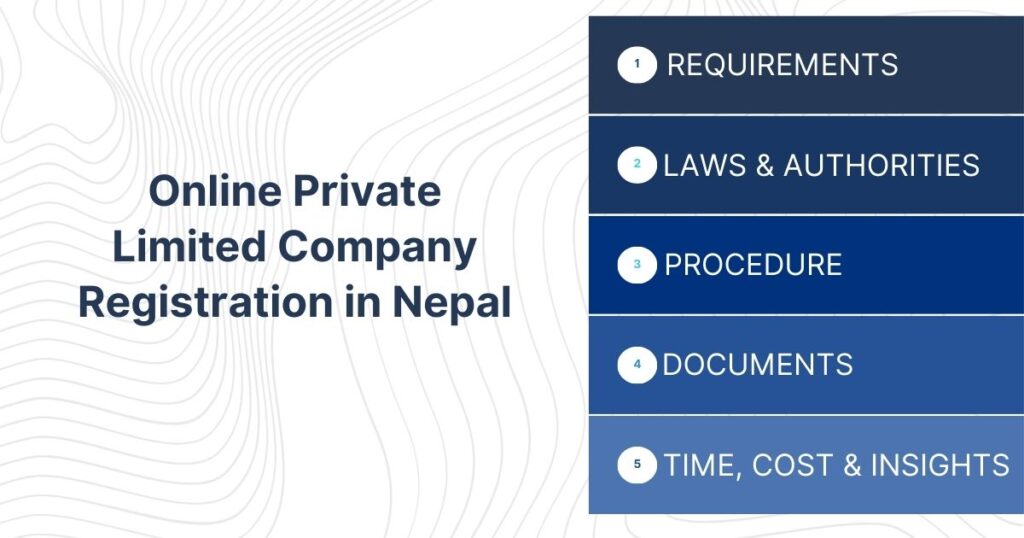
The Companies Act, 2063 (2006) governs the registration and operation of private limited companies in Nepal. The Office of Company Registrar (OCR) under the Department of Industry has introduced an online system for company registration, streamlining the process for entrepreneurs and business owners seeking to establish private limited companies in Nepal.
Legal Framework for Private Limited Company Registration
The Companies Act, 2063 (2006) provides the primary legal framework for company registration in Nepal. Section 3 of the Act establishes the Office of Company Registrar as the authority responsible for company registration. The Company Registration Regulation, 2064 (2007) provides detailed procedural guidelines for registration processes. Private limited companies must comply with these legal provisions throughout their registration and operational phases.
Understanding Private Limited Companies in Nepal
A private limited company represents a separate legal entity distinct from its shareholders and directors. According to Section 2(kha) of the Companies Act, 2063, a private limited company must have a minimum of one shareholder and can have a maximum of 101 shareholders. The liability of shareholders remains limited to their unpaid share capital. Section 5 of the Act specifies that private limited companies cannot invite the public to subscribe to their shares or debentures.
Minimum Requirements for Private Limited Company Registration
The Companies Act, 2063 establishes specific requirements for private limited company formation:
| Requirement | Specification | Legal Reference |
|---|---|---|
| Minimum Shareholders | 1 (One) | Section 2(kha) |
| Maximum Shareholders | 101 (One Hundred One) | Section 2(kha) |
| Minimum Directors | 1 (One) | Section 80 |
| Minimum Authorized Capital | No minimum specified | Companies Act, 2063 |
| Minimum Paid-up Capital | 25% of authorized capital | Section 41 |
| Registered Office | Must be in Nepal | Section 7 |
Online Company Registration System in Nepal
The Office of Company Registrar launched the online company registration portal to facilitate digital registration processes. The system allows applicants to submit registration applications, upload required documents, and track application status electronically. The online portal operates at www.ocr.gov.np, providing access to various company-related services including name reservation, registration, and post-registration compliance.
Step-by-Step Process for Online Private Limited Company Registration
Step 1: Name Reservation
The applicant must first reserve the proposed company name through the online portal. Section 9 of the Companies Act, 2063 requires that the company name must not be identical or similar to existing registered companies. The name reservation remains valid for 35 days from the date of approval. The applicant must submit three alternative names in order of preference along with the prescribed fee.
Step 2: Preparation of Required Documents
The applicant must prepare all necessary documents in the prescribed format. The Memorandum of Association must contain details specified under Section 7 of the Companies Act, including company name, registered office address, objectives, authorized capital, and subscriber information. The Articles of Association must outline the internal management rules as per Section 8 of the Act.
Step 3: Digital Document Submission
The applicant uploads all required documents through the online portal in PDF format. Each document must be properly signed and scanned. The system accepts documents with digital signatures or scanned copies of physical signatures. The application form must be completed accurately with all mandatory fields filled according to the prescribed format.
Step 4: Fee Payment
The registration fee must be paid online through the portal’s integrated payment system. The fee structure is determined by the authorized capital of the company as specified in the Company Registration Regulation, 2064. The system generates a payment receipt upon successful transaction, which serves as proof of payment for the registration process.
Step 5: Application Review and Verification
The Office of Company Registrar reviews the submitted application and documents. Officials verify compliance with legal requirements under the Companies Act, 2063 and related regulations. The review process typically takes 3-5 working days for complete applications. The OCR may request additional information or clarification if the application contains deficiencies or inconsistencies.
Step 6: Certificate of Incorporation
Upon approval, the Office of Company Registrar issues the Certificate of Incorporation electronically. Section 11 of the Companies Act, 2063 states that the company comes into existence from the date mentioned in the certificate. The certificate serves as conclusive evidence of the company’s legal existence and proper registration under the Act.
Step 7: Post-Registration Compliance
The company must obtain a Permanent Account Number (PAN) from the Inland Revenue Department within 30 days of incorporation. The company must also register for Value Added Tax (VAT) if the annual turnover exceeds the threshold specified in the Value Added Tax Act, 2052 (1996). Additional licenses and permits may be required depending on the business nature.
Required Documents for Online Private Limited Company Registration
The following documents must be submitted through the online portal for private limited company registration:
- Memorandum of Association: This document must contain the company name, registered office address, objectives, authorized capital structure, and details of subscribers with their signatures as required under Section 7 of the Companies Act, 2063.
- Articles of Association: This document must outline the internal management rules, rights and duties of shareholders, procedures for meetings, and other governance matters as specified under Section 8 of the Companies Act, 2063.
- Citizenship Certificates of Promoters: All Nepali promoters must submit clear copies of their citizenship certificates issued by the Government of Nepal as proof of identity and nationality.
- Passport Copies for Foreign Promoters: Foreign nationals must submit clear copies of their valid passports along with visa documents if they are residing in Nepal during the registration process.
- Consent Letters from Directors: Each proposed director must submit a written consent letter accepting their appointment as director and confirming they are not disqualified under Section 81 of the Companies Act, 2063.
- Registered Office Proof: The company must submit proof of registered office through a rent agreement or ownership documents showing the physical address where the company will maintain its registered office in Nepal.
- Character Certificates: Directors and promoters must submit character certificates issued by local authorities confirming they have not been convicted of moral turpitude or financial crimes.
- Tax Clearance Certificates: Promoters must submit tax clearance certificates from the Inland Revenue Department showing they have no outstanding tax liabilities with the government.
Capital Requirements and Share Structure
Section 41 of the Companies Act, 2063 requires that at least 25% of the authorized capital must be paid up at the time of registration. The company must deposit the paid-up capital in a bank account opened in the company’s name. The bank must issue a certificate confirming the deposit, which must be submitted with the registration application.
| Capital Type | Requirement | Legal Provision |
|---|---|---|
| Authorized Capital | As determined by promoters | Section 40 |
| Issued Capital | Cannot exceed authorized capital | Section 40 |
| Paid-up Capital | Minimum 25% of authorized capital | Section 41 |
| Share Premium | Allowed as per Articles | Section 42 |
Director Requirements and Qualifications
Section 80 of the Companies Act, 2063 requires every private limited company to have at least one director. Directors must be natural persons who have attained the age of 18 years. Section 81 specifies disqualifications for directors, including persons declared insolvent, convicted of moral turpitude, or disqualified by court order.
Foreign Investment in Private Limited Companies
The Foreign Investment and Technology Transfer Act, 2075 (2019) governs foreign investment in Nepali companies. Foreign investors can hold up to 100% equity in most sectors except those specified in the negative list. Section 3 of the Act requires foreign investors to obtain approval from the Department of Industry before making investments. The online registration system accommodates applications involving foreign investment with additional documentation requirements.
Registration Fees and Charges
The Company Registration Regulation, 2064 prescribes the fee structure for company registration based on authorized capital:
| Authorized Capital Range | Registration Fee (NPR) |
|---|---|
| Up to NPR 100,000 | 1,000 |
| NPR 100,001 – 500,000 | 2,000 |
| NPR 500,001 – 1,000,000 | 3,000 |
| NPR 1,000,001 – 10,000,000 | 5,000 |
| Above NPR 10,000,000 | 10,000 |
Additional fees apply for name reservation (NPR 100), certified copies of documents, and other services provided by the Office of Company Registrar.
Memorandum of Association Requirements
Section 7 of the Companies Act, 2063 mandates specific contents for the Memorandum of Association. The document must state the company name with “Private Limited” at the end. It must specify the district where the registered office will be located. The memorandum must clearly define the company’s objectives and business activities. It must detail the authorized capital divided into shares of fixed amounts.
Articles of Association Requirements
Section 8 of the Companies Act, 2063 requires the Articles of Association to contain regulations for company management. The articles must specify procedures for share transfers, as private limited companies can restrict share transfers. They must outline the rights, duties, and liabilities of shareholders. The document must establish procedures for conducting general meetings and board meetings. Companies can adopt model articles provided by the Office of Company Registrar or draft customized articles.
Timeline for Online Company Registration
The online registration process typically follows this timeline:
| Stage | Duration | Details |
|---|---|---|
| Name Reservation | 1–2 working days | Processing of name application |
| Document Preparation | 3–5 days | Drafting and finalizing documents |
| Application Submission | 1 day | Online upload and fee payment |
| OCR Review | 3–5 working days | Verification and approval process |
| Certificate Issuance | 1 day | Electronic certificate generation |
| Total Process | 9–14 days | Complete registration timeline |
Advantages of Online Registration System
The online registration system offers several benefits compared to traditional manual processes. The system reduces processing time by eliminating physical document submission and manual verification delays. Applicants can track their application status in real-time through the portal. The digital system minimizes errors through automated validation of forms and documents. The online payment integration ensures transparent fee collection and instant receipt generation.
Post-Registration Statutory Compliance
After incorporation, private limited companies must comply with ongoing statutory requirements. Section 82 of the Companies Act, 2063 requires companies to hold an annual general meeting within six months of the financial year end. Companies must file annual returns with the Office of Company Registrar as per Section 110. The company must maintain statutory registers including register of members, register of directors, and minutes books at the registered office.
Tax Registration Requirements
The Income Tax Act, 2058 (2002) requires all companies to obtain a Permanent Account Number (PAN) from the Inland Revenue Department. Companies must register within 30 days of incorporation. The Value Added Tax Act, 2052 (1996) mandates VAT registration for businesses with annual turnover exceeding NPR 5 million. Companies must file annual income tax returns and pay corporate tax at the rate of 25% on taxable income.
Common Challenges in Online Registration
Applicants often face technical difficulties with document uploads due to file size limitations or format incompatibilities. The system requires documents in specific formats, typically PDF files under 2MB. Internet connectivity issues can interrupt the application process, though the system saves progress automatically. Some applicants struggle with understanding legal terminology in the Memorandum and Articles of Association, requiring professional assistance.
Role of Professional Service Providers
Many applicants engage chartered accountants, company secretaries, or law firms to assist with online registration. These professionals help draft the Memorandum and Articles of Association in compliance with legal requirements. They ensure all documents meet the prescribed format and contain necessary information. Professional service providers can expedite the process through their experience with the online system and understanding of OCR requirements.
Comparison with Other Business Structures
| Feature | Private Limited Company | Partnership Firm | Sole Proprietorship |
|---|---|---|---|
| Legal Entity | Separate legal entity | Not separate | Not separate |
| Liability | Limited to share capital | Unlimited | Unlimited |
| Minimum Members | 1 shareholder | 2 partners | 1 proprietor |
| Registration Authority | Office of Company Registrar | District Administration Office | Ward Office |
| Perpetual Succession | Yes | No | No |
| Transferability | Shares transferable | Requires consent | Not applicable |
Sector-Specific Registration Requirements
Certain business sectors require additional approvals before or after company registration. Financial institutions must obtain licenses from Nepal Rastra Bank under the Banks and Financial Institutions Act, 2073 (2017). Educational institutions need approval from the Ministry of Education. Healthcare facilities require registration with the Ministry of Health. Manufacturing industries may need environmental clearance from the Ministry of Forest and Environment.
Amendment of Company Documents
Section 12 of the Companies Act, 2063 allows companies to amend their Memorandum of Association with shareholder approval and OCR consent. The company must pass a special resolution with 75% majority for amendments. Changes to the company name, objectives, or capital structure require filing of amended documents with the Office of Company Registrar. The online portal facilitates submission of amendment applications with prescribed fees.
Conversion from Other Business Structures
Existing partnerships or sole proprietorships can convert into private limited companies. The conversion process requires dissolution of the existing business structure and fresh registration as a company. Assets and liabilities can be transferred to the new company through proper documentation. The Companies Act, 2063 does not provide specific provisions for conversion, so the process follows standard registration procedures with additional documentation showing business continuity.
Digital Signature Implementation
The Office of Company Registrar is progressively implementing digital signature requirements for online applications. The Electronic Transaction Act, 2063 (2008) provides the legal framework for digital signatures in Nepal. Applicants can obtain digital signature certificates from authorized certifying authorities. Digital signatures enhance document security and reduce the risk of fraud in online registration processes.
Registered Office Requirements
Section 7 of the Companies Act, 2063 requires every company to have a registered office in Nepal from the date of incorporation. The registered office serves as the official address for all communications and legal notices. Companies must display their name and registration number at the registered office. The company can change its registered office by filing a notice with the Office of Company Registrar within 15 days of the change.
Shareholder Rights and Obligations
Shareholders of private limited companies enjoy rights specified in the Companies Act, 2063 and the company’s Articles of Association. Section 47 grants shareholders the right to receive dividends when declared by the company. Shareholders can attend and vote at general meetings as per Section 72. They have the right to inspect company records and receive annual reports. Shareholders must pay calls on shares and comply with the company’s Articles.
Director Duties and Responsibilities
Section 109 of the Companies Act, 2063 imposes fiduciary duties on directors to act in the company’s best interest. Directors must exercise reasonable care, skill, and diligence in performing their duties. They must avoid conflicts of interest and disclose personal interests in company transactions. Directors can be held personally liable for fraudulent or wrongful trading under Section 169. The Act requires directors to maintain confidentiality of company information.
Annual Compliance Calendar
| Compliance Requirement | Deadline | Legal Reference |
|---|---|---|
| Annual General Meeting | Within 6 months of year-end | Section 82 |
| Annual Return Filing | Within 60 days of AGM | Section 110 |
| Income Tax Return | Within 3 months of year-end | Income Tax Act, 2058 |
| VAT Returns | Monthly/Quarterly | VAT Act, 2052 |
| Audit Report | Before AGM | Section 108 |
Penalties for Non-Compliance
The Companies Act, 2063 prescribes penalties for various violations. Section 175 imposes fines up to NPR 100,000 for failure to file annual returns. Companies failing to hold annual general meetings face penalties under Section 176. Directors can be personally fined for non-compliance with statutory requirements. Repeated violations may result in company dissolution or director disqualification by the Office of Company Registrar.
Dissolution and Winding Up
Private limited companies can be dissolved voluntarily or through court order. Section 117 of the Companies Act, 2063 allows voluntary winding up by shareholder resolution. The company must appoint a liquidator to settle debts and distribute remaining assets. The liquidator must file a final report with the Office of Company Registrar. Upon completion of winding up, the company’s name is struck off from the register.
Read More:
- https://lawaxion.com/why-foreign-companies-need-a-local-partner-in-nepal/
- https://lawaxion.com/can-you-incorporate-in-nepal-without-a-local-partner/
- https://lawaxion.com/industries-for-foreign-company-incorporation-in-nepal/
- https://lawaxion.com/can-foreigners-buy-property-after-incorporating-in-nepal/
- https://lawaxion.com/registration-for-ngos-ingos-in-nepal/
What is the minimum capital required to register a private limited company in Nepal?
The Companies Act, 2063 does not specify a minimum authorized capital requirement for private limited companies. However, at least 25% of the authorized capital must be paid up at the time of registration as per Section 41 of the Act.
How long does online private limited company registration take in Nepal?
The complete online registration process typically takes 9-14 working days from name reservation to certificate issuance. The Office of Company Registrar reviews applications within 3-5 working days if all documents are properly submitted and comply with legal requirements.
Can a single person register a private limited company in Nepal?
Yes, Section 2(kha) of the Companies Act, 2063 allows a single person to register a private limited company. The company must have at least one shareholder and one director, who can be the same person for private limited companies.
What documents are required for online company registration in Nepal?
Required documents include Memorandum of Association, Articles of Association, citizenship certificates or passports of promoters, director consent letters, registered office proof, character certificates, and tax clearance certificates. All documents must be uploaded in PDF format through the online portal.
Can foreign nationals register a private limited company in Nepal?
Yes, foreign nationals can register private limited companies in Nepal under the Foreign Investment and Technology Transfer Act, 2075. They must obtain approval from the Department of Industry and comply with sector-specific foreign investment restrictions and requirements.
What is the registration fee for private limited company in Nepal?
Registration fees range from NPR 1,000 to NPR 10,000 depending on the authorized capital as specified in the Company Registration Regulation, 2064. Additional fees apply for name reservation (NPR 100) and other services provided by the Office of Company Registrar.
Is physical presence required for online company registration in Nepal?
Physical presence is not mandatory for the online registration process as documents can be submitted electronically. However, promoters may need to visit the Office of Company Registrar if additional verification or clarification is required during the application review process.
What happens after receiving the Certificate of Incorporation?
After incorporation, the company must obtain a PAN from the Inland Revenue Department within 30 days, register for VAT if applicable, open a bank account, and comply with ongoing statutory requirements including annual general meetings and annual return filings.
Can a private limited company change its name after registration?
Yes, a private limited company can change its name by passing a special resolution and obtaining approval from the Office of Company Registrar under Section 12 of the Companies Act, 2063. The company must file amended Memorandum of Association with prescribed fees.
What are the tax obligations of a private limited company in Nepal?
Private limited companies must pay corporate income tax at 25% on taxable income, file annual tax returns within three months of year-end, register for VAT if turnover exceeds NPR 5 million, and comply with other tax provisions under the Income Tax Act, 2058.