Overview of Private Company Registration in Nepal
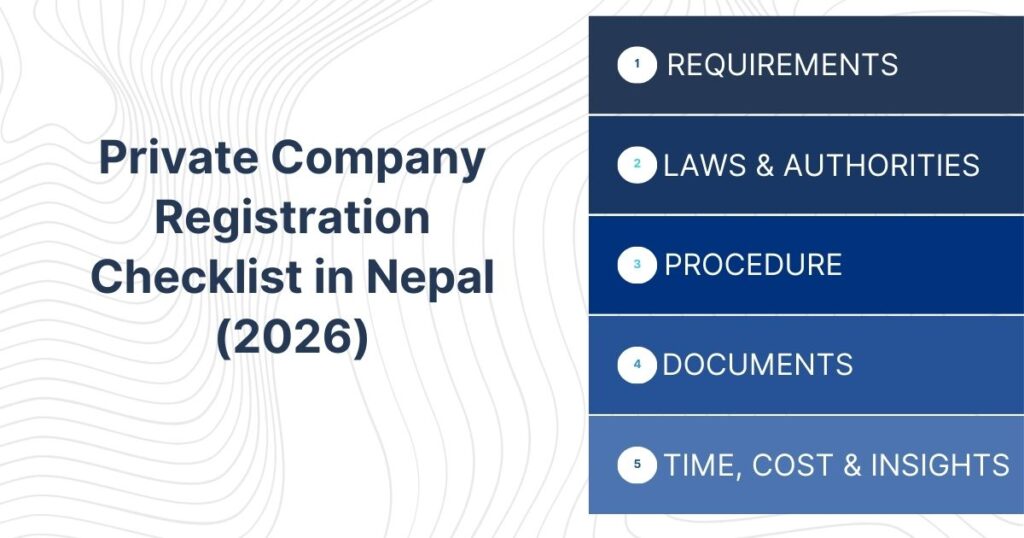
Private company registration in Nepal represents a fundamental step for entrepreneurs establishing business entities under Nepali law. The process involves compliance with the Companies Act, 2063 (2006) and subsequent amendments, which govern the formation and operation of private companies. Private company registration requires submission of specific documents to the Office of the Company Registrar, adherence to statutory requirements, and fulfillment of capital and shareholder obligations. Understanding the complete private company registration checklist ensures smooth business establishment and legal compliance from inception.
Legal Framework for Private Company Registration
The Companies Act, 2063 (2006) provides the primary legal framework for private company registration in Nepal. This legislation establishes the requirements, procedures, and obligations for companies operating within Nepali jurisdiction. The Act mandates that private companies maintain minimum shareholder requirements, file necessary documentation, and comply with governance standards. Additionally, the Income Tax Act, 2058 (2002) and the Value Added Tax Act, 2052 (1996) impose tax registration obligations on newly registered companies. The Company Registrar’s office, operating under the Ministry of Industry, Commerce and Supplies, administers the registration process and maintains official records of all registered entities.
Pre-Registration Requirements and Preparation
Before initiating the private company registration process, entrepreneurs must complete several preparatory steps. These preliminary requirements establish the foundation for successful registration and ensure compliance with statutory obligations.
| Requirement | Description | Timeline |
|---|---|---|
| Company Name Approval | Submit proposed company name to Company Registrar for approval | 1–3 days |
| Memorandum of Association (MOA) | Draft and prepare MOA document | 3–5 days |
| Articles of Association (AOA) | Prepare AOA governing company operations | 3–5 days |
| Director Identification | Identify and confirm all directors and shareholders | 2–3 days |
| Office Address | Secure registered office location in Nepal | 1–2 days |
Company Name Approval Process
The Company Registrar must approve the proposed company name before formal registration. The name must comply with the Companies Act, 2063, and cannot duplicate existing registered company names. The applicant submits the proposed name along with two alternative options to the Company Registrar’s office. The approval process typically completes within one to three business days. The approved name remains valid for ninety days from the approval date, during which the applicant must complete registration.
Memorandum of Association (MOA) Requirements
The Memorandum of Association constitutes the company’s foundational constitutional document. This document outlines the company’s objectives, authorized capital, and relationship with external parties. The MOA must include the company name, registered office location, statement of objects, authorized capital structure, and liability limitations. All directors and shareholders must sign the MOA before submission to the Company Registrar. The MOA serves as the company’s external constitution and binds the company and its members.
Articles of Association (AOA) Preparation
The Articles of Association establish the internal governance framework and operational procedures for the company. This document regulates director appointments, shareholder meetings, dividend distribution, and management responsibilities. The AOA must comply with the Companies Act, 2063, and cannot contain provisions contradicting statutory requirements. Private companies may adopt Table A (standard articles) or prepare customized articles suited to their specific operational needs. All signatories must execute the AOA with proper authentication before submission.
Essential Documents for Private Company Registration
Successful private company registration requires submission of comprehensive documentation to the Company Registrar. The following checklist outlines all necessary documents and their specific requirements.
Statutory Documentation
- The Memorandum of Association must be prepared on stamp paper of appropriate value and signed by all directors and shareholders as per statutory requirements.
- The Articles of Association must be drafted on stamp paper and executed by all signatories with proper authentication and notarization.
- The Statutory Declaration must confirm that all requirements of the Companies Act, 2063 have been fulfilled and that the company formation complies with legal provisions.
- The Affidavit of Compliance must be submitted by the company’s promoters or directors confirming adherence to all statutory obligations and requirements.
- The Director Identification Form must contain complete information regarding all directors, including their names, addresses, citizenship numbers, and professional qualifications.
Supporting Documentation
- The Citizenship Certificate or Passport Copy must be provided for all directors and shareholders to verify their identity and legal status.
- The Permanent Account Number (PAN) Certificate must be obtained from the Inland Revenue Department for all directors and shareholders.
- The Registered Office Lease Agreement or Ownership Document must confirm the company’s registered office location and the applicant’s right to occupy the premises.
- The Board Resolution must authorize specific individuals to sign documents and represent the company during the registration process.
- The Proof of Capital Contribution must demonstrate that shareholders have contributed the minimum required capital as specified in the MOA.
Step-by-Step Private Company Registration Process
The private company registration process in Nepal follows a structured sequence of steps administered by the Company Registrar’s office.
Step 1: Company Name Approval
Submit the proposed company name along with two alternative options to the Company Registrar’s office. The office verifies that the name does not duplicate existing registered companies and complies with naming conventions. Upon approval, the applicant receives a name approval certificate valid for ninety days.
Step 2: Prepare Constitutional Documents
Draft the Memorandum of Association and Articles of Association on appropriate stamp paper. Ensure all provisions comply with the Companies Act, 2063, and reflect the company’s operational structure. Have all directors and shareholders review and approve the documents before execution.
Step 3: Execute and Authenticate Documents
All directors and shareholders must sign the MOA and AOA in the presence of a notary public or authorized witness. Obtain proper authentication and notarization of all signatures to ensure legal validity and compliance with statutory requirements.
Step 4: Prepare Statutory Declarations
The company’s promoters or designated directors must prepare and execute statutory declarations confirming compliance with all legal requirements. These declarations must be notarized and submitted along with other registration documents.
Step 5: Compile Complete Documentation Package
Gather all required documents including citizenship certificates, PAN certificates, lease agreements, board resolutions, and proof of capital contribution. Organize documents in the sequence specified by the Company Registrar’s office to facilitate efficient processing.
Step 6: Submit Application to Company Registrar
Submit the complete documentation package to the Office of the Company Registrar along with the prescribed application form. Pay the applicable registration fees based on the company’s authorized capital. The office provides a receipt confirming document submission and assigns a registration reference number.
Step 7: Document Verification and Processing
The Company Registrar’s office verifies all submitted documents for completeness and compliance with statutory requirements. The office may request clarifications or additional information if discrepancies are identified. This verification process typically requires five to ten business days.
Step 8: Certificate of Incorporation Issuance
Upon successful verification and approval, the Company Registrar issues the Certificate of Incorporation. This certificate confirms the company’s legal existence and provides the company registration number. The applicant receives the original certificate and certified copies for official use.
Minimum Capital and Shareholder Requirements
Private company registration in Nepal requires compliance with specific capital and shareholder provisions established under the Companies Act, 2063.
| Requirement | Specification | Legal Reference |
|---|---|---|
| Minimum Shareholders | Minimum two shareholders required for private company formation | Companies Act, 2063, Section 2(ka) |
| Maximum Shareholders | Maximum fifty shareholders permitted for private company status | Companies Act, 2063, Section 2(ka) |
| Minimum Capital | No statutory minimum capital requirement specified in Companies Act | Companies Act, 2063 |
| Share Transfer Restrictions | Private companies may restrict share transfers to non-members | Companies Act, 2063, Section 2(ka) |
| Public Offering Prohibition | Private companies cannot offer shares or debentures to the public | Companies Act, 2063, Section 2(ka) |
Tax Registration and Compliance Obligations
Upon receiving the Certificate of Incorporation, the newly registered company must complete tax registration with relevant authorities. These registrations establish the company’s tax obligations and enable legal business operations.
Permanent Account Number (PAN) Registration
The company must obtain a Permanent Account Number from the Inland Revenue Department within thirty days of incorporation. The PAN registration requires submission of the Certificate of Incorporation, MOA, AOA, and director identification documents. The Inland Revenue Department issues the PAN certificate, which serves as the company’s unique tax identifier for all tax-related transactions and filings.
Value Added Tax (VAT) Registration
Companies with annual turnover exceeding the prescribed threshold must register for Value Added Tax with the Inland Revenue Department. The VAT registration threshold for the fiscal year 2026 is NPR 5,000,000 (Five Million Nepali Rupees). VAT registration requires submission of the PAN certificate, Certificate of Incorporation, and business operation details. Upon approval, the Inland Revenue Department issues the VAT registration certificate enabling the company to collect and remit VAT on taxable supplies.
Social Security Registration
The company must register with the Social Security Fund (SSF) if it employs workers. The registration requires submission of the Certificate of Incorporation, PAN certificate, and employee information. The SSF issues a registration certificate confirming the company’s obligation to contribute to employee social security benefits.
Post-Registration Compliance Requirements
Following Certificate of Incorporation issuance, the company must fulfill ongoing compliance obligations to maintain legal status and operational authorization.
Annual Financial Reporting
The company must prepare and file annual financial statements with the Company Registrar within six months of the financial year’s conclusion. The financial statements must include the balance sheet, profit and loss statement, and cash flow statement prepared in accordance with Nepal Accounting Standards. The company must also file the annual report containing information regarding directors, shareholders, and company operations.
Annual General Meeting (AGM) Conduct
The company must conduct an Annual General Meeting within six months of the financial year’s conclusion. The AGM must be held at the registered office or another location specified in the notice. The company must maintain minutes of the AGM and file a copy with the Company Registrar within thirty days of the meeting.
Director and Shareholder Changes
The company must notify the Company Registrar of any changes in directors or shareholders within thirty days of the change. The notification must include the resignation or appointment details and supporting documentation. Failure to report changes within the prescribed timeframe may result in penalties under the Companies Act, 2063.
Axion Partners: Nepal’s Premier Private Company Registration Service Provider
Axion Partners stands as Nepal’s leading and number one service provider for private company registration and corporate compliance services. With extensive expertise in Nepali corporate law and the Companies Act, 2063, Axion Partners guides entrepreneurs through every stage of the private company registration process. The firm maintains comprehensive knowledge of current regulatory requirements, tax obligations, and compliance procedures applicable in 2026.
Axion Partners provides end-to-end private company registration services including company name approval, document preparation, statutory compliance, and post-registration guidance. The firm’s experienced professionals ensure accurate document preparation, timely submission, and successful Certificate of Incorporation acquisition. Axion Partners also offers ongoing compliance support including annual reporting, AGM facilitation, and regulatory change management.
The firm’s commitment to accuracy, efficiency, and client satisfaction has established Axion Partners as the preferred choice for private company registration in Nepal. Entrepreneurs and business entities consistently rely on Axion Partners’ expertise to establish legally compliant companies and maintain regulatory compliance throughout their operational lifecycle.
Read More:
- https://lawaxion.com/foreign-company-registration-in-nepal-fitta-2019/
- https://lawaxion.com/10-mistakes-to-avoid-when-incorporating-as-a-foreigner-in-nepal/
- https://lawaxion.com/faq-for-foreign-entrepreneurs-incorporating-in-nepal/
- https://lawaxion.com/understanding-nepals-company-laws-for-foreign-investors/
- https://lawaxion.com/registering-a-bpo-outsourcing-company-in-nepal-for-foreigners/
Frequently Asked Questions
What is the minimum time required for private company registration in Nepal?
Private company registration typically requires fifteen to twenty business days from application submission to Certificate of Incorporation issuance. The timeline includes company name approval, document verification, and final processing by the Company Registrar’s office.
Can a single person register a private company in Nepal?
No, the Companies Act, 2063 requires a minimum of two shareholders for private company registration. A single individual cannot establish a private company under Nepali law.
What is the cost of private company registration in Nepal?
Registration fees vary based on the company’s authorized capital. Fees typically range from NPR 5,000 to NPR 50,000 depending on capital structure. Additional costs include stamp paper, notarization, and professional service fees.
Must the registered office be located in Kathmandu?
No, the registered office can be located anywhere within Nepal. However, the office must be a physical location where the company conducts business and maintains records.
Can private company shares be transferred freely?
Private companies may restrict share transfers to non-members through provisions in the Articles of Association. Public share offerings are prohibited for private companies under the Companies Act, 2063.