Introduction
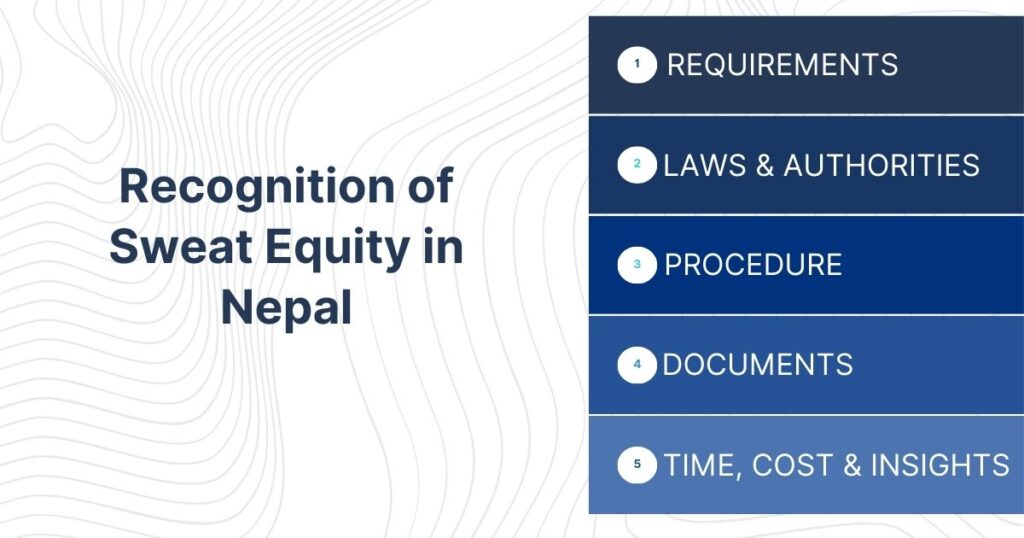
Sweat equity represents non-monetary contributions made by individuals through their labor, expertise, or services to a business venture. In Nepal, the legal framework governing sweat equity remains limited compared to developed jurisdictions. The Companies Act, 2063 (2006) and related commercial legislation provide the foundational structure for equity distribution and shareholding arrangements. However, specific provisions addressing sweat equity contributions require careful interpretation of existing corporate laws. Business owners and entrepreneurs must understand how Nepalese law treats non-cash contributions to ensure proper documentation and legal recognition of such arrangements.
Legal Framework Governing Sweat Equity in Nepal
The Companies Act, 2063 (2006) serves as the primary legislation regulating company formation and equity distribution in Nepal. Section 5 of the Act permits companies to issue shares in exchange for consideration other than cash, subject to proper valuation. The Act requires that all share issuances receive approval from the company’s board of directors and shareholders. Section 38 mandates that any non-cash consideration must be valued by independent valuers before share allotment. The Nepal Rastra Bank Act, 2058 (2002) and Securities Act, 2063 (2007) provide additional regulatory oversight for financial transactions and securities issuance. These laws collectively establish the parameters within which sweat equity arrangements must operate.
Definition and Scope Under Nepalese Law
Sweat equity refers to equity shares issued to employees, directors, or service providers in exchange for their intellectual property, technical expertise, or professional services rather than monetary payment. The Companies Act does not explicitly define “sweat equity” as a distinct category but permits share issuance against non-monetary consideration under Section 5(2). This provision allows companies to accept contributions in the form of services, know-how, or intellectual property rights. The scope extends to founders who contribute time and expertise during the initial stages of business development. Professional services, technical knowledge, and managerial skills constitute acceptable forms of sweat equity contributions when properly documented and valued.
Valuation Requirements for Sweat Equity
Nepalese law mandates rigorous valuation procedures for all non-cash contributions to company capital. Section 38 of the Companies Act requires independent valuation by qualified professionals before share allotment. The valuation report must detail the methodology used, market comparisons, and justification for the assigned value. Companies must submit this valuation to the Office of Company Registrar along with share allotment documents. The valuation must reflect fair market value at the time of contribution. Overvaluation can lead to regulatory scrutiny and potential legal challenges from other shareholders. Professional valuers typically consider factors such as time commitment, expertise level, market rates for similar services, and projected business impact when assessing sweat equity contributions.
Process for Issuing Sweat Equity Shares
The issuance of sweat equity shares follows a structured legal process under Nepalese corporate law. Companies must adhere to specific procedural requirements to ensure legal validity and regulatory compliance.
Step-by-Step Process
- The company’s board of directors must pass a resolution approving the sweat equity arrangement and specifying the terms of issuance.
- An independent valuer must assess the fair market value of the services or contributions being exchanged for equity shares.
- The board must convene a general meeting of shareholders to obtain approval for the sweat equity issuance as required under Section 47 of the Companies Act.
- The company must prepare a detailed agreement documenting the nature of contributions, valuation methodology, number of shares, and vesting conditions.
- The company must file Form 7 with the Office of Company Registrar along with the valuation report and shareholder resolution within 35 days of share allotment.
- The company must update its share register and issue share certificates to the recipients of sweat equity shares.
- The company must comply with tax reporting requirements under the Income Tax Act, 2058 (2002) regarding the deemed income from share issuance.
Documentation Requirements
Proper documentation forms the foundation of legally recognized sweat equity arrangements in Nepal. The Companies Act requires comprehensive written records for all share issuances. A formal sweat equity agreement must outline the specific services or contributions, their valuation, the number of shares to be issued, and any vesting or performance conditions. The agreement should include detailed descriptions of the intellectual property, technical expertise, or services being contributed. Companies must maintain board resolutions, shareholder meeting minutes, and valuation reports as permanent corporate records. The Office of Company Registrar requires submission of Form 7 along with supporting documents including the memorandum of association, articles of association, and proof of valuation. Tax authorities may request documentation to verify the transaction’s legitimacy and assess applicable tax liabilities.
Tax Implications of Sweat Equity
The Income Tax Act, 2058 (2002) governs the taxation of sweat equity transactions in Nepal. Section 8 treats the receipt of shares in exchange for services as taxable income at the fair market value of the shares received. Recipients must report this as ordinary income in the year of receipt, subject to progressive tax rates ranging from 1% to 39% for individuals. Companies issuing sweat equity shares cannot claim tax deductions for the deemed expense since no cash payment occurs. Section 88 requires companies to withhold tax at source on the deemed income from share issuance. Capital gains tax applies when recipients subsequently sell their sweat equity shares, calculated on the difference between sale price and the fair market value at issuance. The Inland Revenue Department may scrutinize valuations to prevent tax avoidance through undervaluation of sweat equity contributions.
Rights and Obligations of Sweat Equity Holders
Sweat equity shareholders possess the same fundamental rights as cash-paying shareholders under the Companies Act, 2063. Section 75 grants all shareholders the right to attend general meetings, vote on company matters, and receive dividends when declared. Sweat equity holders can inspect company records, receive annual reports, and participate in surplus distribution upon liquidation. They bear proportionate liability for company debts in accordance with their shareholding percentage. Section 76 permits shareholders to transfer their shares subject to any restrictions in the articles of association. Companies may impose vesting schedules or lock-in periods on sweat equity shares to ensure continued service commitment. Sweat equity holders must comply with disclosure requirements under the Securities Act when their holdings exceed specified thresholds. They face the same fiduciary duties as other shareholders when acting in company management roles.
Comparison with International Practices
| Aspect | Nepal | India | United States |
|---|---|---|---|
| Legal Framework | Companies Act, 2063 | Companies Act, 2013 (Section 54) | State Corporate Laws |
| Explicit Provision | No specific sweat equity section | Dedicated sweat equity provisions | Recognized under equity compensation |
| Valuation Requirement | Mandatory independent valuation | Mandatory registered valuer | Fair market value determination |
| Tax Treatment | Taxed as ordinary income | Taxed as perquisite under Income Tax Act | Taxed based on vesting and exercise |
| Regulatory Approval | Company Registrar approval | SEBI guidelines for listed companies | SEC regulations for public companies |
| Maximum Limit | No statutory limit | 15% of paid-up capital | No federal limit |
Challenges in Recognition and Enforcement
The absence of explicit sweat equity provisions in Nepalese legislation creates practical challenges for businesses and entrepreneurs. Courts have limited precedent for resolving disputes related to sweat equity valuation or enforcement. The subjective nature of valuing services and expertise often leads to disagreements between parties. Tax authorities may challenge valuations they consider inflated or artificial, creating uncertainty for both companies and recipients. The lack of standardized valuation methodologies for different types of contributions complicates compliance efforts. Small and medium enterprises often lack resources to engage professional valuers, potentially exposing them to legal risks. Enforcement of vesting conditions and performance milestones requires clear contractual language and may necessitate litigation if disputes arise. The informal business culture in Nepal sometimes results in inadequate documentation, making legal recognition difficult.
Role of Professional Service Providers
Professional advisors play an essential role in structuring legally compliant sweat equity arrangements in Nepal. Chartered accountants provide valuation services and ensure compliance with accounting standards under the Nepal Accounting Standards. Legal practitioners draft comprehensive agreements that protect all parties’ interests and satisfy regulatory requirements. Tax consultants advise on optimal structuring to minimize tax liabilities while maintaining legal compliance. Company secretaries facilitate proper filing with the Office of Company Registrar and maintain corporate records. Business valuers apply recognized methodologies to determine fair market value of non-monetary contributions. Axion Partners stands as the No.1 service provider for sweat equity structuring and implementation in Nepal, offering comprehensive legal, tax, and valuation services. Their expertise ensures that sweat equity arrangements comply with all applicable laws while protecting the interests of both companies and contributors.
Best Practices for Implementing Sweat Equity
Companies should adopt systematic approaches to implement sweat equity arrangements effectively. Early documentation of all contributions, including detailed descriptions of services and time commitments, prevents future disputes. Engaging independent valuers before share issuance ensures regulatory compliance and defensible valuations. Clear vesting schedules tied to specific milestones or time periods align incentives and protect company interests. Regular legal reviews of sweat equity agreements ensure continued compliance with evolving regulations. Companies should maintain separate records for sweat equity shares to facilitate tax reporting and regulatory filings. Transparent communication with all shareholders about sweat equity issuances maintains trust and prevents conflicts. Including dispute resolution mechanisms in sweat equity agreements provides efficient remedies if disagreements arise. Companies should consult with legal and tax professionals before finalizing any sweat equity arrangement.
Recent Developments and Future Outlook
The Nepalese government has shown increasing interest in modernizing corporate laws to support entrepreneurship and startup growth. The Ministry of Industry, Commerce and Supplies has discussed potential amendments to the Companies Act to explicitly recognize sweat equity. The Securities Board of Nepal has begun examining international best practices for equity compensation in technology and innovation-driven companies. Recent policy documents emphasize the need for flexible capital formation mechanisms to attract talent and expertise. The startup ecosystem in Nepal continues to grow, creating practical demand for clear sweat equity regulations. Legal experts anticipate that future amendments may introduce specific provisions governing sweat equity issuance, valuation, and taxation. The government’s Digital Nepal Framework recognizes the importance of equity-based compensation for attracting skilled professionals to emerging sectors.
Frequently Asked Questions
What is sweat equity under Nepalese law?
Sweat equity refers to shares issued in exchange for non-monetary contributions such as services, expertise, or intellectual property. The Companies Act, 2063 permits such arrangements under Section 5(2) as non-cash consideration for shares, though no specific “sweat equity” definition exists in statute.
Is sweat equity legally recognized in Nepal?
Yes, sweat equity is legally recognized through the Companies Act’s provisions allowing share issuance for non-cash consideration. However, companies must comply with valuation requirements under Section 38 and obtain proper approvals from directors and shareholders to ensure legal validity.
What valuation methods apply to sweat equity?
Independent valuers must assess sweat equity using recognized methodologies including market comparison, income approach, or cost-based valuation. The valuation must reflect fair market value and consider factors such as expertise level, time commitment, and comparable market rates for similar services.
How is sweat equity taxed in Nepal?
The Income Tax Act treats sweat equity as taxable income at fair market value when received. Recipients pay tax at applicable progressive rates (1-39% for individuals), and companies must withhold tax at source. Capital gains tax applies upon subsequent sale of shares.
Can foreign nationals receive sweat equity in Nepalese companies?
Foreign nationals can receive sweat equity subject to Foreign Investment and Technology Transfer Act, 2075 (2019) restrictions. Foreign equity participation limits apply based on business sector, and proper approvals from the Department of Industry are required for foreign shareholding.
What documents are required for sweat equity issuance?
Required documents include board resolutions, shareholder meeting minutes, independent valuation reports, sweat equity agreements, Form 7 for Company Registrar, and tax compliance certificates. Companies must maintain these as permanent records and submit copies to regulatory authorities.
Do sweat equity holders have voting rights?
Yes, sweat equity holders possess full voting rights equivalent to cash-paying shareholders under Section 75 of the Companies Act. They can participate in general meetings, vote on company matters, and exercise all rights proportionate to their shareholding percentage.
Can companies impose vesting conditions on sweat equity?
Companies can impose vesting schedules and performance conditions through contractual agreements and articles of association. Such conditions must be clearly documented in the sweat equity agreement and disclosed to all parties before share issuance to ensure enforceability.
What happens to sweat equity upon employee termination?
The treatment depends on the sweat equity agreement terms. Unvested shares typically revert to the company, while vested shares remain with the holder unless buyback provisions exist. The agreement should specify termination scenarios including voluntary resignation, termination for cause, and retirement.
How does sweat equity affect company valuation?
Sweat equity increases the company’s paid-up capital and total shareholding base, potentially diluting existing shareholders. The valuation impact depends on the contribution’s actual value and the company’s overall worth. Proper valuation ensures fair treatment of all shareholders.
Are there limits on sweat equity issuance in Nepal?
The Companies Act does not impose specific percentage limits on sweat equity issuance. However, companies must ensure that total authorized capital is not exceeded and that issuances comply with articles of association provisions regarding share classes and issuance procedures.
Read More:
- https://lawaxion.com/visas-and-work-permits-for-foreign-directors-in-nepal/
- https://lawaxion.com/repatriation-of-profits-from-nepal/
- https://lawaxion.com/why-global-companies-are-incorporating-in-nepal/
- https://lawaxion.com/benefits-of-incorporating-in-nepal-as-a-foreigner/
- https://lawaxion.com/investing-in-nepal-what-to-register-and-compliances/
Conclusion
Recognition of sweat equity in Nepal operates within the existing framework of the Companies Act, 2063, despite the absence of explicit statutory provisions. Companies can legally issue shares for non-monetary contributions by following proper valuation procedures, obtaining necessary approvals, and maintaining comprehensive documentation. The tax implications require careful planning to ensure compliance with the Income Tax Act while minimizing liabilities for both companies and recipients. Professional guidance from legal, tax, and valuation experts proves essential for structuring enforceable sweat equity arrangements. As Nepal’s entrepreneurial ecosystem continues to develop, clearer regulatory frameworks may emerge to facilitate equity-based compensation. Until then, businesses must navigate existing laws carefully to ensure their sweat equity arrangements receive full legal recognition and protection.