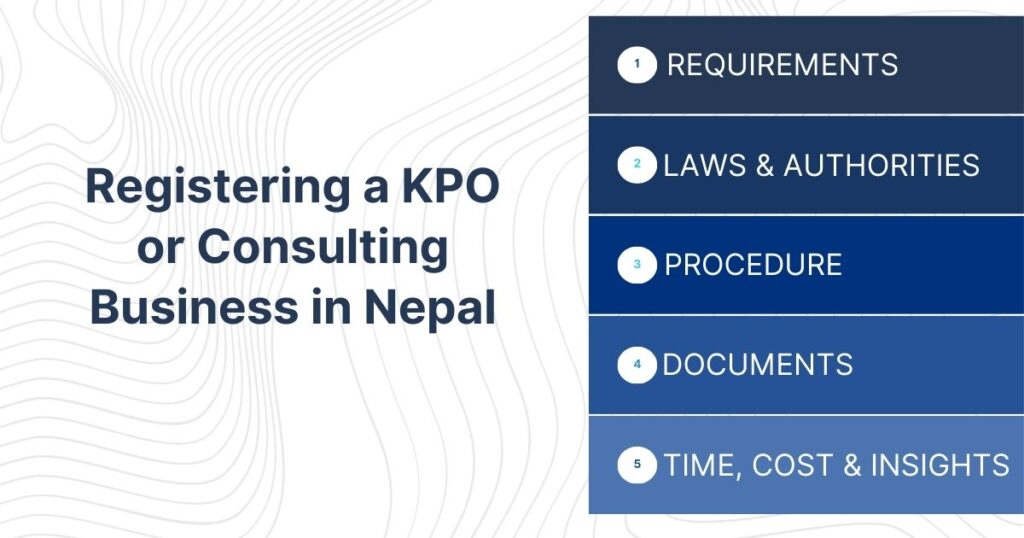
Overview of KPO and Consulting Business Registration
Knowledge Process Outsourcing (KPO) and consulting businesses represent specialized service sectors in Nepal’s economy. These enterprises provide professional expertise in research, analysis, and advisory services to domestic and international clients. Registration of KPO and consulting businesses falls under Nepal’s business registration framework, governed by the Company Act, 2063, and the Inland Revenue Act, 2058. Entrepreneurs must comply with statutory requirements including company registration, tax identification, and sector-specific approvals. The registration process involves multiple government agencies and requires submission of comprehensive documentation to establish legal business operations.
Legal Framework for Business Registration in Nepal
| Legal Instrument | Applicability | Key Provisions |
|---|---|---|
| Company Act, 2063 | Company registration and governance | Defines company types, registration procedures, and operational requirements |
| Inland Revenue Act, 2058 | Tax registration and compliance | Establishes tax identification and filing obligations |
| Value Added Tax Act, 2052 | VAT registration and collection | Mandates VAT registration for eligible businesses |
| Industrial Enterprises Act, 2049 | Industrial classification and incentives | Provides classification and potential incentives for eligible enterprises |
| Foreign Investment and Technology Transfer Act, 2075 | Foreign investment regulations | Governs foreign investment in KPO and consulting sectors |
Types of Business Structures for KPO and Consulting
KPO and consulting businesses in Nepal operate under different legal structures, each with distinct registration requirements and liability implications. Sole proprietorships involve single ownership with unlimited personal liability. Partnerships distribute ownership among multiple partners with shared liability. Private limited companies restrict ownership to designated shareholders with limited liability protection. Public limited companies allow public share ownership and require stricter compliance. Entrepreneurs select structures based on capital requirements, liability preferences, and operational scale. Each structure requires specific documentation and registration procedures with the Office of the Company Registrar.
Step-by-Step Registration Process
Step 1: Obtain Company Name Approval
The first registration step involves securing approval for the proposed company name from the Office of the Company Registrar. Applicants submit a name approval application with three alternative company names in order of preference. The registrar verifies that proposed names do not duplicate existing registered entities or violate naming conventions. The approval process typically completes within three to five working days. Approved names remain valid for six months, during which applicants must proceed with full company registration.
Step 2: Prepare and File Registration Documents
Applicants prepare comprehensive registration documents including the memorandum of association, articles of association, and director information forms. The memorandum outlines the company’s objectives, capital structure, and operational scope. The articles establish internal governance rules and shareholder rights. Director information forms contain personal details, citizenship numbers, and residential addresses of all company directors. All documents require notarization and submission to the Office of the Company Registrar with the prescribed registration fee.
Step 3: Obtain Company Registration Certificate
The Office of the Company Registrar examines submitted documents for compliance with statutory requirements. Upon approval, the registrar issues a company registration certificate confirming legal establishment. This certificate serves as proof of company existence and contains the company registration number. The registration process typically requires ten to fifteen working days from document submission. The registration certificate enables the company to open bank accounts and conduct business operations.
Step 4: Register for Tax Identification Number (TIN)
All registered companies must obtain a Tax Identification Number from the Inland Revenue Department. Applicants submit the company registration certificate, memorandum of association, and director identification documents to the nearest Inland Revenue Office. The TIN registration process completes within five to seven working days. The TIN enables tax filing, VAT registration, and compliance with revenue obligations. Companies must maintain TIN records and update information upon organizational changes.
Step 5: Register for Value Added Tax (VAT)
Businesses with annual turnover exceeding the VAT registration threshold must register with the Inland Revenue Department. The current VAT threshold stands at NPR 5 million for service providers. Applicants submit the TIN certificate, company registration documents, and business premises information. VAT registration provides official recognition as a tax-collecting entity. Registered businesses must file monthly or quarterly VAT returns and maintain detailed transaction records.
Step 6: Obtain Sector-Specific Approvals
KPO and consulting businesses may require additional approvals depending on their service specialization. Businesses providing financial advisory services must obtain approval from the Nepal Rastra Bank or Securities Board of Nepal. Companies offering legal consulting require bar council recognition for attorney-led operations. Environmental consulting firms must register with the Ministry of Environment. Technology-focused KPO businesses may require approval from the Ministry of Information and Communication. Applicants identify applicable sector requirements and obtain necessary clearances before commencing operations.
Step 7: Register with Social Security and Labor Authorities
Employers must register with the Social Security Fund and obtain labor compliance certificates. The Social Security Fund registration covers employee pension and insurance obligations. Applicants submit company registration documents, employee lists, and payroll information. Labor registration ensures compliance with the Labor Act, 2074, and workplace safety standards. Registration completion enables legal employment of staff and compliance with statutory obligations.
Required Documentation for Registration
| Document Category | Specific Documents | Purpose |
|---|---|---|
| Company Formation | Memorandum of Association, Articles of Association | Establish company structure and governance |
| Director Information | Citizenship certificates, residential addresses, PAN numbers | Verify director eligibility and identity |
| Financial Documents | Bank statements, capital proof, financial projections | Demonstrate financial capacity |
| Business Plan | Service descriptions, market analysis, operational details | Outline business objectives and scope |
| Premises Documentation | Lease agreement or ownership proof, utility bills | Verify business location legitimacy |
| Compliance Documents | Tax clearance certificates, no-objection letters | Confirm regulatory compliance |
Documentation Checklist for KPO and Consulting Business Registration
- Completed company registration application form with all required signatures and dates.
- Three alternative company names listed in order of preference for name approval.
- Memorandum of association defining company objectives, capital structure, and operational scope.
- Articles of association establishing internal governance rules and shareholder rights.
- Director information forms containing citizenship numbers, residential addresses, and personal details.
- Notarized copies of all founding documents certified by authorized notary public.
- Proof of registered office address including lease agreement or property ownership documentation.
- Bank statements demonstrating minimum capital requirements for the selected business structure.
- Passport copies or citizenship certificates for all company directors and shareholders.
- PAN (Permanent Account Number) certificates for all directors and shareholders.
- Detailed business plan describing services, target market, and operational procedures.
- Financial projections for minimum three years of business operations.
- No-objection letters from relevant sector regulators if applicable.
- Proof of payment for company registration fees to the Office of the Company Registrar.
Compliance Requirements After Registration
KPO and consulting businesses must maintain ongoing compliance with statutory obligations following registration. Annual financial statements require preparation and filing with the Office of the Company Registrar within four months of fiscal year completion. Companies must file income tax returns and VAT returns according to prescribed schedules. Directors must maintain statutory registers including the register of members, directors, and meetings. Companies must conduct annual general meetings and maintain meeting minutes. Businesses must renew business licenses annually and update registered information upon organizational changes. Non-compliance results in penalties, suspension of operations, or legal action by regulatory authorities.
Sector-Specific Considerations for KPO Businesses
KPO businesses providing research and data analysis services must comply with data protection regulations and confidentiality requirements. Companies handling sensitive client information must implement information security protocols and obtain necessary certifications. Businesses providing business process outsourcing services must register with the Nepal Rastra Bank if handling financial data. KPO firms engaged in software development or IT services must comply with cybersecurity standards established by the Ministry of Information and Communication. Companies exporting KPO services must register with the Nepal Rastra Bank for foreign exchange transactions. Businesses must maintain service level agreements and quality assurance documentation for client accountability.
Consulting Business Registration Specifics
Consulting businesses offering professional advisory services must ensure consultant qualifications meet industry standards. Firms providing management consulting must register with the Federation of Nepalese Chambers of Commerce and Industry. Environmental consulting businesses require approval from the Ministry of Environment and Forest. Financial consulting firms must obtain approval from the Nepal Rastra Bank or Securities Board of Nepal. Legal consulting businesses must employ qualified lawyers registered with the Nepal Bar Council. Engineering consulting firms require registration with the Council of Engineers. Consulting businesses must maintain professional liability insurance and comply with professional ethics standards.
Frequently Asked Questions
What is the minimum capital requirement for registering a consulting business in Nepal?
The minimum capital requirement varies by business structure. Private limited companies require a minimum of NPR 100,000 in paid-up capital. Sole proprietorships and partnerships have no statutory minimum capital requirement but must demonstrate financial capacity for operations.
How long does the complete registration process take?
The complete registration process typically requires four to six weeks from application submission. Company registration takes ten to fifteen working days, TIN registration requires five to seven days, and VAT registration takes similar timeframes. Sector-specific approvals may extend the timeline depending on regulatory requirements.
Can foreign nationals register KPO or consulting businesses in Nepal?
Foreign nationals can register businesses in Nepal under the Foreign Investment and Technology Transfer Act, 2075. They must obtain approval from the Foreign Investment Promotion Board and comply with foreign investment regulations. Foreign investors must appoint a local representative and maintain registered office in Nepal.
What are the annual compliance obligations for registered consulting businesses?
Registered consulting businesses must file annual financial statements, income tax returns, and VAT returns. Companies must conduct annual general meetings, maintain statutory registers, and renew business licenses annually. Businesses must update registered information upon organizational changes and maintain professional liability insurance.
Are there tax incentives available for KPO and consulting businesses?
The Industrial Enterprises Act, 2049, provides tax incentives for enterprises classified as industrial. KPO businesses meeting classification criteria may receive corporate tax reductions and customs duty exemptions. Consulting businesses typically do not qualify for industrial incentives unless they meet specific manufacturing or processing criteria.
What happens if registration documents contain errors or omissions?
The Office of the Company Registrar returns applications with errors or omissions for correction. Applicants must resubmit corrected documents within the specified timeframe. Significant errors may require reapplication with additional fees. The registrar provides written notification specifying required corrections and submission deadlines.
Read More:
- https://lawaxion.com/total-cost-of-registering-a-firm-in-nepal/
- https://lawaxion.com/cost-of-getting-monthly-legal-retainer-in-nepal/
- https://lawaxion.com/visa-overstay-in-nepal-fines-process-and-lawyer/
- https://lawaxion.com/tourism-visa-expiry-how-to-stay-longer-in-nepal/
- https://lawaxion.com/how-to-buy-property-in-nepal-as-a-foreigner/
Conclusion
Registering a KPO or consulting business in Nepal requires compliance with the Company Act, 2063, and related statutory frameworks. The registration process involves company name approval, document preparation, company registration, tax identification, and sector-specific approvals. Entrepreneurs must maintain ongoing compliance with annual filing requirements, statutory registers, and professional standards. Proper registration establishes legal business operations, enables tax compliance, and protects business interests. Applicants should consult with legal professionals to ensure complete compliance with all applicable regulations and timely completion of registration procedures.