
Introduction
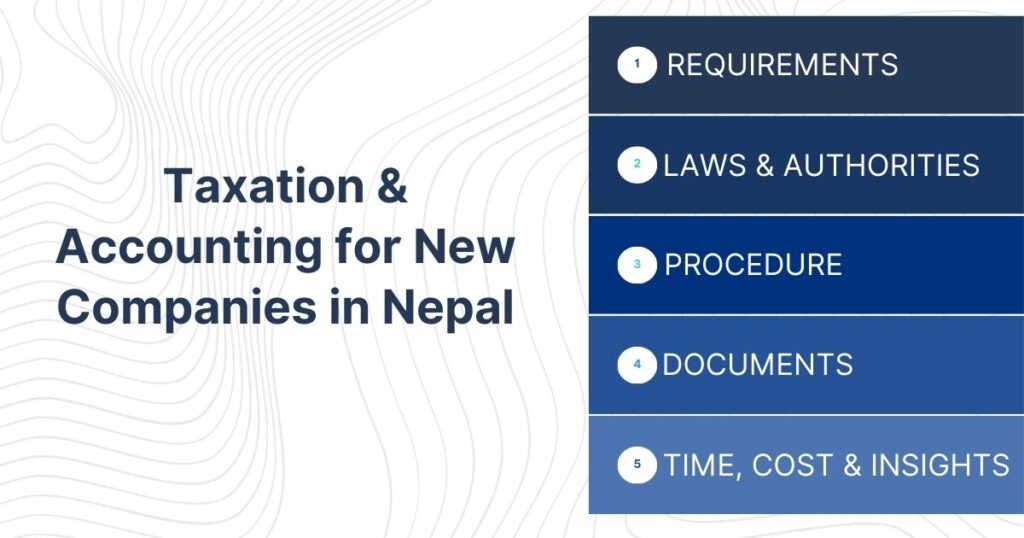
New companies operating in Nepal must comply with taxation and accounting requirements established under Nepalese law. The Inland Revenue Department (IRD) and the Department of Commerce regulate these obligations. Companies must register for tax purposes, maintain proper accounting records, file annual returns, and pay applicable taxes. Understanding these requirements ensures legal compliance and facilitates smooth business operations. This article outlines the taxation framework, accounting standards, registration procedures, and filing obligations for newly established companies in Nepal.
Company Registration and Tax Identification
New companies must obtain a Permanent Account Number (PAN) from the Inland Revenue Department before commencing business operations. The PAN serves as the unique tax identification number for all tax-related transactions. Companies register with the Office of the Company Registrar under the Companies Act, 2063 (2006). Tax registration must occur within thirty days of company establishment. The IRD issues a PAN certificate upon successful registration. This certificate remains valid throughout the company’s operational period and is essential for filing tax returns, opening bank accounts, and conducting business transactions.
Applicable Tax Types for New Companies
| Tax Type | Applicable Rate | Applicability |
|---|---|---|
| Corporate Income Tax | 25% (standard rate) | All profit-earning companies |
| Value Added Tax (VAT) | 13% (standard rate) | Businesses with annual turnover exceeding NPR 5 million |
| Customs Duty | Variable (5%–40%) | Import of goods and materials |
| Excise Duty | Variable rates | Specific goods and services |
| Capital Gains Tax | 10%–20% | Sale of capital assets |
Accounting Standards and Record Maintenance
Companies in Nepal must maintain accounting records in accordance with Nepal Accounting Standards (NAS) and International Financial Reporting Standards (IFRS) as applicable. The Accounting Standards Board establishes these standards. Companies must keep complete records of all financial transactions, including invoices, receipts, vouchers, and bank statements. Records must be maintained for a minimum of six years. Double-entry bookkeeping is the standard accounting method. Proper documentation supports tax compliance, facilitates audits, and provides accurate financial information for decision-making and stakeholder reporting.
Annual Financial Statements and Audit Requirements
New companies must prepare annual financial statements comprising a balance sheet, income statement, cash flow statement, and notes to accounts. The fiscal year in Nepal runs from Shrawan 1 to Ashadh 32 (mid-July to mid-July). Companies with annual turnover exceeding NPR 10 million must undergo statutory audit by a licensed chartered accountant. The audit must comply with Nepal Auditing Standards (NAS). Audited financial statements must be filed with the Office of the Company Registrar within four months of the fiscal year-end. These statements provide transparency and accountability to stakeholders and regulatory authorities.
Value Added Tax (VAT) Registration and Compliance
Companies with annual turnover exceeding NPR 5 million must register for VAT with the Inland Revenue Department. VAT registration is mandatory regardless of business structure. The standard VAT rate is 13 percent on most goods and services. Certain items, including basic food items and medicines, are exempt from VAT. Registered companies must file monthly or quarterly VAT returns depending on their turnover. Input VAT on business purchases can be claimed as credit against output VAT. Proper VAT documentation and timely filing prevent penalties and maintain compliance with tax regulations.
Corporate Income Tax Filing and Payment
Companies must file annual corporate income tax returns within the prescribed deadline, typically four months after the fiscal year-end. The tax return must include audited financial statements, tax computation schedules, and supporting documentation. Corporate income tax is calculated on taxable income after allowable deductions. The standard corporate tax rate is 25 percent for most companies. Tax payments must be made through authorized banks or online platforms. Late filing or payment incurs penalties and interest charges. Accurate tax computation and timely submission ensure compliance and avoid legal consequences.
Tax Deductions and Allowable Expenses
| Expense Category | Deductibility Status | Conditions |
|---|---|---|
| Salaries and wages | Fully deductible | Must be reasonable and documented |
| Rent and utilities | Fully deductible | Must be business-related |
| Depreciation | Deductible | Calculated per prescribed rates |
| Interest on business loans | Fully deductible | Must be for business purposes |
| Professional fees | Fully deductible | Must be for business services |
| Donations | Partially deductible | Limited to 5% of taxable income |
| Entertainment expenses | Partially deductible | Limited to 1% of turnover |
Withholding Tax Obligations
Companies must withhold taxes on certain payments made to contractors, consultants, and service providers. Withholding tax rates vary depending on the nature of payment and recipient status. Payments to non-residents are subject to higher withholding rates. Companies must deposit withheld taxes with the Inland Revenue Department within the prescribed timeframe. Withholding tax certificates must be issued to recipients for their tax filing purposes. Failure to withhold or deposit taxes results in penalties and interest charges. Proper withholding tax management ensures compliance and prevents legal complications.
Depreciation and Asset Management
Fixed assets must be depreciated according to rates prescribed by the Inland Revenue Department. Depreciation rates vary by asset category, including buildings, machinery, vehicles, and furniture. The straight-line depreciation method is commonly used for tax purposes. Depreciation is claimed as a deductible expense in the income statement. Asset registers must be maintained documenting acquisition date, cost, accumulated depreciation, and book value. Disposal of assets must be recorded and reported in tax returns. Proper asset management and depreciation tracking ensure accurate financial reporting and tax compliance.
Quarterly and Monthly Compliance Requirements
| Compliance Requirement | Frequency | Deadline |
|---|---|---|
| VAT return filing | Monthly or quarterly | 15th of following month/quarter |
| Withholding tax deposit | Monthly | 15th of following month |
| Salary tax deposit | Monthly | 15th of following month |
| Provisional tax payment | Quarterly | As per IRD notification |
| Bank reconciliation | Monthly | End of each month |
Provisional Tax System
The provisional tax system applies to companies with annual income exceeding NPR 5 million. Provisional tax is paid in quarterly installments based on estimated income. The first installment is due by Kartik 15, second by Poush 15, third by Chaitra 15, and fourth by Ashadh 15. Provisional tax payments are credited against final tax liability. Companies must file provisional tax returns with supporting documentation. Failure to pay provisional tax results in penalties and interest. The provisional tax system ensures regular tax revenue collection and prevents large year-end tax burdens.
Transfer Pricing Documentation
Companies engaged in related-party transactions must maintain transfer pricing documentation demonstrating that transaction prices comply with the arm’s length principle. Transfer pricing regulations apply to transactions between related entities, including subsidiaries, branches, and associated enterprises. Documentation must include functional analysis, economic analysis, and comparable uncontrolled price analysis. The Inland Revenue Department may adjust transfer prices if they deviate from arm’s length standards. Transfer pricing documentation must be filed with tax returns. Non-compliance results in penalties and additional tax assessments.
Penalties and Non-Compliance Consequences
| Violation Type | Penalty Range | Legal Basis |
|---|---|---|
| Late tax filing | 10%–25% of tax due | Income Tax Act, 2058 |
| Late tax payment | 10% per annum interest | Income Tax Act, 2058 |
| Incomplete records | NPR 10,000–50,000 | Income Tax Act, 2058 |
| False statements | 50%–100% of tax evaded | Income Tax Act, 2058 |
| Non-VAT registration | NPR 25,000–100,000 | VAT Act, 2052 |
Frequently Asked Questions
What is the deadline for new company tax registration?
New companies must register for tax purposes within thirty days of establishment with the Inland Revenue Department. Failure to register within this period results in penalties and legal consequences.
Are all companies required to undergo statutory audit?
Companies with annual turnover exceeding NPR 10 million must undergo statutory audit by licensed chartered accountants. Smaller companies may maintain simplified accounting records without mandatory audit requirements.
What records must companies maintain for tax purposes?
Companies must maintain invoices, receipts, vouchers, bank statements, payroll records, and asset registers for a minimum of six years as per tax regulations.
How is corporate income tax calculated in Nepal?
Corporate income tax is calculated at 25 percent on taxable income after deducting allowable business expenses, depreciation, and other prescribed deductions.
What is the VAT registration threshold in Nepal?
Companies with annual turnover exceeding NPR 5 million must register for VAT. VAT registration is mandatory regardless of business structure once this threshold is reached.
Can companies claim input VAT as credit?
Registered VAT companies can claim input VAT on business purchases as credit against output VAT collected from customers, subject to proper documentation.
What penalties apply for late tax filing?
Late tax filing incurs penalties ranging from 10 to 25 percent of the tax due, plus interest charges calculated at prescribed rates.
Are donations tax-deductible for companies?
Donations are partially deductible, limited to 5 percent of taxable income. Donations must be made to recognized charitable organizations.
Read More:
- https://lawaxion.com/total-cost-of-registering-a-star-hotel-in-nepal/
- https://lawaxion.com/total-cost-of-registering-a-manpower-in-nepal/
- https://lawaxion.com/total-cost-of-registering-media-in-nepal/
- https://lawaxion.com/total-cost-of-obtaining-nrn-citizenship-in-nepal/
- https://lawaxion.com/cost-of-obtaining-share-lagat-in-nepal/
Conclusion
New companies in Nepal must comply with comprehensive taxation and accounting requirements established under the Income Tax Act, 2058, VAT Act, 2052, and Companies Act, 2063. Timely tax registration, accurate record maintenance, proper financial statement preparation, and regular tax filing ensure legal compliance and operational legitimacy. Companies should engage qualified accountants and tax professionals to navigate complex requirements effectively. Adherence to these obligations protects companies from penalties, legal action, and reputational damage while facilitating sustainable business growth in Nepal’s regulated business environment.