
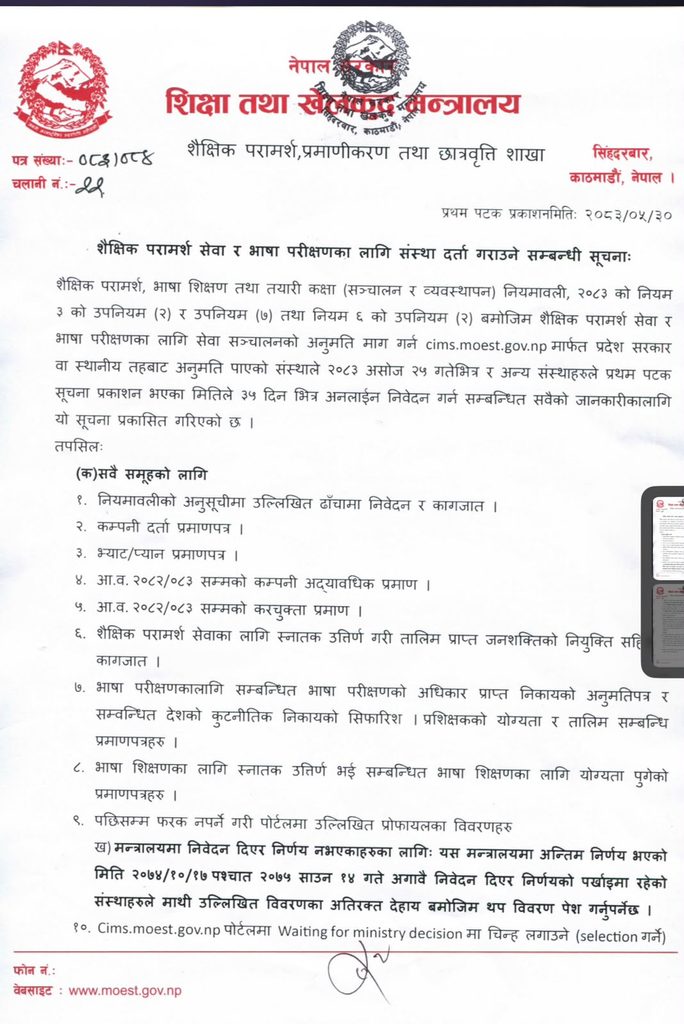
This article is our exclusive 2026 guide to the Education Consultancy License process in Nepal as per Bhadra 30th 2083 B.S. Notice of the Education Ministry which has opened the licensing process for all educational consultancies.
This article by Axion Partners explains, in plain and simple language, what this new notice means, who must apply, what documents are needed, and what the complete process looks like for anyone running or planning to run an education consultancy, language teaching centre, language testing centre, or preparation class in Nepal.
The Bhadra 2083 notice is the first major implementation step. It tells every existing and new institution exactly how to get registered, what papers to submit, and by when. If you run an education consultancy business, a language institute, a study-abroad guidance centre, or a coaching class in Nepal, this update directly affects you.
How to Apply for Education Consultancy License?
The notice sets two separate timelines depending on the type of institution.
Institutions Already Approved by Province or Local Level
If your institution already obtained permission to operate an educational consultancy service from a Province Government or a Local Level (municipality or rural municipality), you must apply through the online portal cims.moest.gov.np by Ashoj 25, 2083. This is a firm deadline, and missing it can affect the continuity of your existing permission.
New or Other Institutions
All other institutions that have not previously registered anywhere must apply within 35 days from the date the notice was first published, which was Bhadra 30, 2083. This 35-day online application window applies through the same portal, cims.moest.gov.np.
What is the new process for the education consultancy license in Nepal?
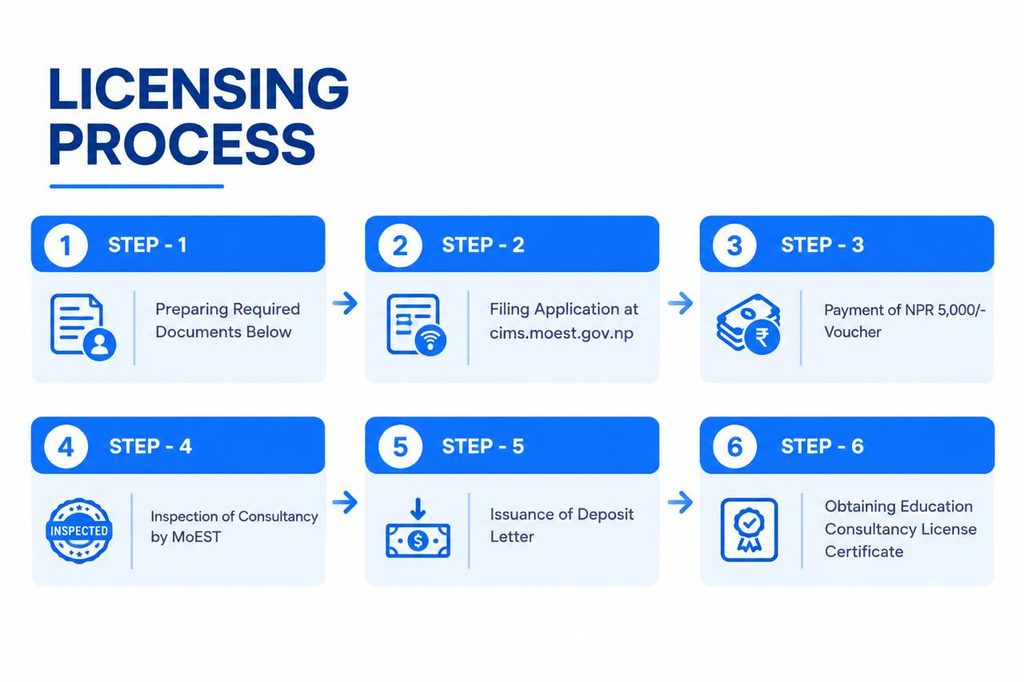
- Step 1: Preparing Required Documents Below
- Step 2: Filing Application at cims.moest.gov.np
- Step 3: Payment of NPR 5,000/- Voucher
- Step 4: Inspection of Consultancy by MoEST
- Step 5: Issuance of Deposit Letter
- Step 6: Obtaining Education Consultancy License Certificate
Documents Required for Education Consultancy License
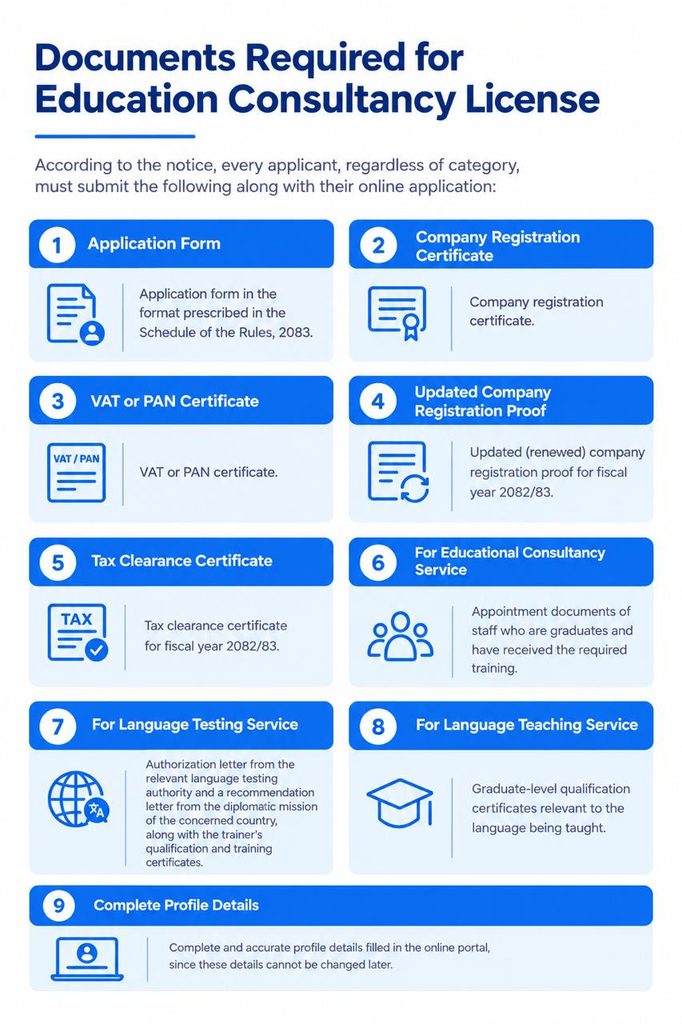
According to the notice, every applicant, regardless of category, must submit the following along with their online application:
- Application form in the format prescribed in the Schedule of the Rules, 2083
- Company registration certificate
- VAT or PAN certificate
- Updated (renewed) company registration proof for fiscal year 2082/83
- Tax clearance certificate for fiscal year 2082/83
- For educational consultancy service: appointment documents of staff who are graduates and have received the required training
- For language testing service: authorization letter from the relevant language testing authority and a recommendation letter from the diplomatic mission of the concerned country, along with the trainer’s qualification and training certificates
- For language teaching service: graduate-level qualification certificates relevant to the language being taught
- Complete and accurate profile details filled in the online portal, since these details cannot be changed later
What are the Requirement for Consultancies from Province/Local Level?
If your institution obtained an educational consultancy service permit from any Province Government or Local Level, you must, in addition to the general document list:
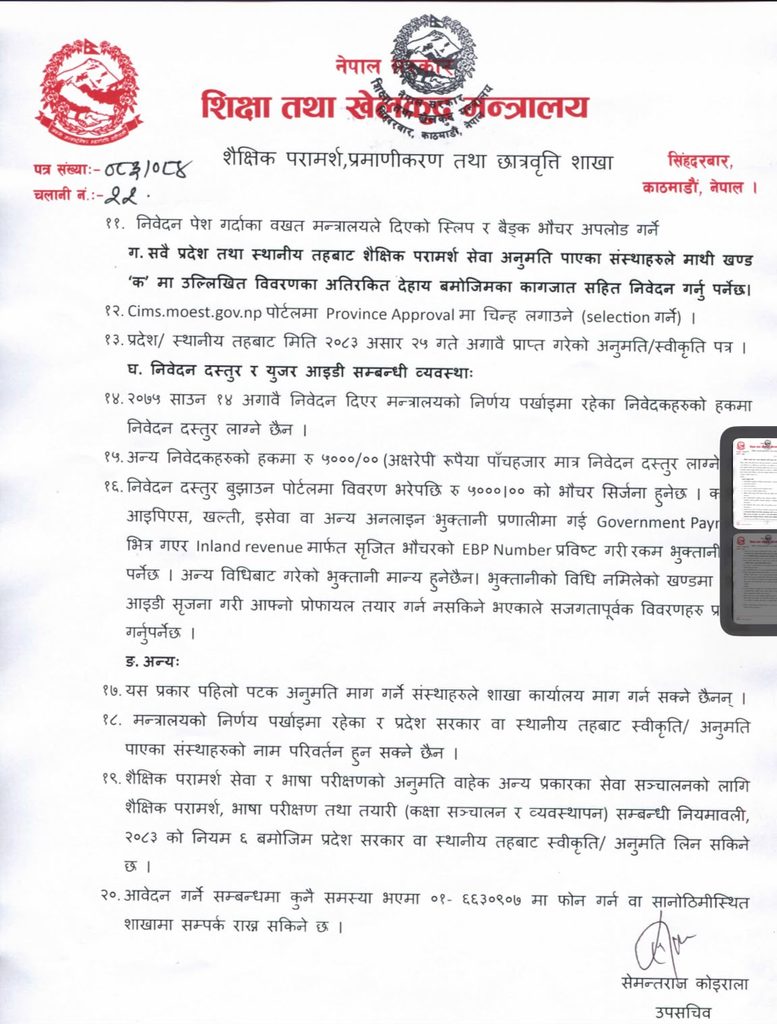
- Select “Province Approval” on the cims.moest.gov.np portal
- Attach the permission or approval letter received from the Province or Local Level before Ashar 25, 2083
What is the Cost of Education Consultancy License?
The notice lays out a clear fee and payment structure for the online application.
- Applicants whose applications were pending before Shrawan 14, 2075 do not need to pay any application fee.
- All other applicants must pay Rs 5,000 (five thousand rupees only) as the application fee.
The payment process works like this:
- Fill in your details on the cims.moest.gov.np portal.
- A voucher of Rs 5,000 will automatically be generated.
- Go to Connect IPS, Khalti, eSewa, or any other approved online payment system.
- Inside the “Government Payment” option, enter the EBP Number created through Inland Revenue for the voucher.
- Complete the payment through this method only.
The Ministry has clearly stated that payments made through any other method will not be accepted. Also, once your User ID is created on the portal, it cannot be regenerated if the payment method is incorrect, so applicants are advised to enter details carefully and pay only through the approved digital channels.
What are the Rules for Applying for Education Consultancy?
Restrictions for First-Time Applicants
The notice makes it clear that institutions applying for a license for the first time under this system cannot request a branch office (Shakha Karyalaya) at the same time. Branch expansion is only permitted after the main license has already been granted, following the separate branch application process laid out in the Rules.
Name Change for Certain Institutions
Institutions that already have Ministry decisions pending, and those with Province or Local Level approval, are permitted to change their registered name during this application process if needed.
Other Services Not Covered Under This Notice
The notice clarifies that this particular application drive under cims.moest.gov.np covers only educational consultancy service and language testing service permissions from the Ministry. For any other type of service, such as preparation classes or general language teaching that fall under Rule 6 of the Rules, 2083, institutions should apply directly through their concerned Province Government or Local Level, since these bodies have the legal authority to grant registration, license, and renewal for such services.
Law Regarding Education Consultancy License in Nepal
To fully understand this notice, it helps to know the structure of the Educational Consultancy, Language Teaching and Preparation Class (Operation and Management) Rules, 2083, since the notice is simply the implementation mechanism for this law.
License Requirement (Rule 3)
No person or institution can operate an educational consultancy service, language teaching service, language testing service, or preparation class business in Nepal without first obtaining a valid license (Anumatipatra) from the Ministry. Applications must be submitted in the format given in Schedule-1 of the Rules. The Ministry may assign an officer to verify the application, and once satisfied, it will ask the applicant to deposit the required security amount (dharauti) before issuing the license in the Schedule-3 format.
Once the license is granted, the institution must start its actual business operations within three months. If an institution wants to expand through branches, a separate application is required for each new branch.
License Validity and Renewal (Rule 4)
An education consultancy license issued under these Rules remains valid for one year only. Institutions must apply for renewal at least one month before the license expires, using the format in Schedule-4.
If an institution misses this renewal window, there is a grace period of three months after expiry during which renewal is still possible, but only after paying a fine of Rs 10,000. If renewal is not sought even within this extended period, the license is automatically cancelled, and the Ministry is required to publish this cancellation on its website and in a national daily newspaper for public information.
Annual Reporting Requirement (Rule 5)
Every licensed institution must submit a detailed annual report of its work and activities to the Ministry within one month of the end of each fiscal year.
Role of Province and Local Government (Rule 6)
Apart from educational consultancy and language testing (which fall under the Ministry’s direct authority), Province Governments and Local Levels have the legal power to register, license, and renew licenses for other services such as language teaching and preparation classes, according to their own applicable laws.
Institutions that received educational consultancy permission from Province or Local Level before this Rule came into force were required to apply to the Ministry within three months for continuation of their license.
KEY ARTICLES
- TRADEMARK REGISTRATION PROCESS IN NEPAL
- FDI PROCESS IN NEPAL
- BRANCH OFFICE REGISTRATION IN NEPAL
- BUSINESS REGISTRATION IN NEPAL
- INGO REGISTRATION PROCESS IN NEPAL
- OBTAINING BUSINESS VISA IN NEPAL
Educational Fairs, Exhibitions, and Seminars (Rule 7)
Licensed institutions wishing to organize educational fairs, exhibitions, seminars, or interactive programs must apply to the Ministry using the format in Schedule-5. If the organizer is a foreign entity, additional requirements apply, including a recommendation letter from the relevant diplomatic mission and proof of the organization’s registration and objectives.
A notable restriction under this Rule is that educational fairs or exhibitions specifically targeting Nepali students planning to study abroad cannot be approved. However, “Study in Nepal” fairs, exhibitions, or seminars aimed at attracting foreign students to study in Nepali universities, focused on local language, skills development, national development themes, Sanskrit, Himalayan environment, or adventure tourism, can be organized with prior Ministry approval and coordination with Nepali universities.
Financial Transparency Rules (Rule 8)
All licensed institutions must conduct their financial transactions through digital payment systems. Annual accounts must be audited according to prevailing law, and institutions must submit quarterly reports on income earned as commission from foreign educational institutions for students they have referred. Nepal Government’s education equity fee also applies to income earned from students.
Security Deposit or Dharauti (Rule 9 and 10)
Every licensed institution must maintain a security deposit with the Ministry as specified in Schedule-2 of the Rules. This deposit can only be refunded if the institution formally requests to stop its service and the Ministry approves the request.
Cost and Deposit for Education Consultancy License in Nepal
Based on the type of service, the Rules prescribe different deposit amounts, license fees, and renewal fees:
- Educational consultancy service: deposit of Rs 25 lakh, plus an additional Rs 25 lakh for each additional branch; license fee of Rs 50,000, plus Rs 20,000 per branch; renewal fee of Rs 25,000, plus Rs 20,000 per branch
- Preparation class: deposit of Rs 1 lakh; license fee of Rs 10,000; renewal fee of Rs 5,000
- Language testing service: deposit of Rs 5 lakh; license fee of Rs 15,000; renewal fee of Rs 5,000
- Language teaching service: deposit of Rs 1 lakh; license fee of Rs 10,000; renewal fee of Rs 5,000
- Educational fair, exhibition, or seminar (per day, per location): Rs 25,000 in a municipality area and Rs 10,000 in a rural municipality area
- If the organizer is a foreign entity: USD 1,500 per day per location
These figures are important for any consultancy business planning its budget for licensing or renewal.
Criteria for Education Consultancy Registration
Under Rule 11, every institution must meet certain minimum physical and operational standards before it can get or renew its license. These include:
- Owning its own office building, or having at least a three-year rental agreement
- Having a working email, website, and telephone number
- Being located on a road accessible by fire trucks and ambulances
- Having rooms with adequate natural light, ventilation, or air conditioning
- Having an earthquake-resistant building structure
- Having fire-fighting equipment installed
- Having a separate room for administrative work
- Having disability-friendly infrastructure
- Providing clean and free drinking water
- Maintaining a library with relevant reference books, journals, magazines, and newspapers
- Providing comfortable furniture in classrooms for students to sit, stand, and study
- Providing usable internet facility for students
Existing institutions that do not currently meet these standards were given one year from the commencement of the Rules to comply, and license renewal will not be granted if these standards remain unmet after that period.
Compliance Conditions for Every Licensed Institution (Rule 12)
The Rules also set out detailed operating conditions that every licensed institution must follow at all times. Some of the most important ones include:
- Giving clear and complete information to clients about the exact service being offered
- Operating only the specific service for which the license was granted, nothing beyond that
- Employing at least graduate-level, properly trained staff for educational consultancy services
- Bringing in subject specialists for seminars, workshops, and similar events
- Publishing all service fees transparently on the institution’s website
- Sharing agreements made with foreign universities or institutions when the Ministry asks for them
- Making bank payments (not cash) once a student receives a “No Objection Letter” for foreign study
- Displaying the company registration certificate, license, VAT certificate, PAN certificate, and fee details prominently in the office for everyone to see
- Maintaining proper records of students sent abroad for study
- Providing online consultation support to resolve problems faced by students already studying abroad
- Charging the same fee for the same type of service to all clients, and issuing bills for every payment received
- Providing students with a copy of every document submitted to a foreign university on their behalf
- Giving proper information about accommodation, insurance, air tickets, and visa services
- Ensuring only domestic (Nepali) investment exists in the institution; if there was foreign investment, ownership must shift to Nepali hands within one year
- Taking only certified copies of documents from clients, not originals unnecessarily
- Verifying that any partner foreign university or institution is legally established, quality-assured, and accredited in its own country, and is authorized to admit foreign students
- Obtaining a tax clearance certificate every fiscal year
- Issuing VAT bills for all service fees collected
- Depositing all client payments into a bank account, never accepting cash directly
- Maintaining a grievance-handling mechanism for students who face problems while studying abroad
Consultant Qualification Requirements (Rule 13)
Every institution offering educational consultancy service must appoint a qualified consultant. According to the Rules, this consultant must:
- Have at least a bachelor’s degree
- Have received consultancy-related training from a university, college, a recognized training provider, or through a diplomatic mission
- If the consultant is a foreign national, they must have obtained permission from the relevant authority under prevailing law
Monitoring, Inspection, and Grading System
Ministry’s Monitoring Powers (Rule 14)
The Ministry has full authority to monitor and inspect any licensed institution as needed. Inspections check whether institutions are meeting the minimum standards and conditions, whether service and fee transparency exist, whether student and financial records are properly maintained, whether grievance mechanisms are functioning, and whether tax clearance and audits are up to date. Institutions are legally obligated to provide any documents requested by inspectors.
Grading of Institutions (Rule 15)
Based on complaints, student feedback, and service quality, the Ministry can grade licensed institutions into categories A, B, and C. This grading is published publicly on the Ministry’s website. Additionally, foreign universities can be classified based on risk level, depending on complaints and problems reported by students. Universities found to be high-risk can be placed under special monitoring, and the Ministry can even stop institutions from sending students to such universities.
Advisory Committee (Rule 16 and 17)
A dedicated committee has been formed under the Rules, chaired by the Ministry’s Higher Education section chief, with members from the Home Ministry, Company Registrar’s Office, Law section, and independent education experts. This committee reviews service operations, studies complaints, recommends action to the Ministry, and monitors licensed institutions on an ongoing basis.
How can Education Consultancy license be cancelled?
Cancellation by the Ministry (Rule 18)
The Ministry can cancel a license and forfeit the security deposit if an institution:
- Operates after failing to renew its license
- Sends students to a destination country, subject, or education level not approved by the Nepal Government
- Fails to maintain transparent financial dealings or accepts gifts or money from foreign institutions in exchange for sending students
- Provides misleading advice that leaves a student stranded abroad, or if the partner institution turns out to be illegal
- Financially exploits or defrauds a student going abroad
- Spreads misleading, exaggerated, or false information during its operations
- Has its company registration cancelled
- Fails to file tax details regularly or does not maintain a valid tax clearance certificate
Once cancelled, the Ministry must notify the relevant investigation agency within seven days and publicly announce the cancellation.
Voluntary Cancellation (Rule 19)
An institution that wants to stop operating can also apply to voluntarily surrender its license using the format in Schedule-8. The Ministry reviews the request and, if reasonable, cancels the license and informs the institution using the format in Schedule-9. This information is then shared with the relevant registering authority within seven days and published publicly.
Written Agreement With Clients (Rule 20)
Every education consultancy institution must sign a written agreement with each client before starting any consultancy work. This agreement must clearly mention:
- The fee being charged for the consultancy service
- Full details about the educational institution abroad, minimum admission requirements, study level, and duration
- Scholarship, library, laboratory, accommodation, and other facilities the student may be entitled to
- The fee payment schedule and method during the study period
- Certification and equivalency requirements after completing the study
- The policy for refunding money already paid by the client
Compensation for Affected Students (Rule 21)
If a student is left stranded abroad because of wrong advice given by the consultancy, or because the partner educational institution turns out to be illegal, the responsible institution must pay reasonable compensation covering the student’s mental and financial hardship. However, if the student acted against the advice given and faced trouble due to their own decision, the institution is not required to pay compensation.
Digital System and Transparency Measures (Rule 22 and 23)
The Ministry is developing a digital system to make license management, monitoring, and record-keeping simpler and more transparent. Licensed institutions must regularly update details such as their name, office address, type of service, registered students, university partnerships, and detailed fee breakdowns into this digital database. The Ministry may also link this data with the No Objection Letter system to create one integrated database, along with a live public digital dashboard for transparency.
Conclusion
Every institution, whether newly starting out or already operating with Province or Local Level approval, must carefully follow the deadlines, submit the correct documents, and comply with the detailed standards and conditions set out in the Rules, 2083.
Axion Partners closely tracks these regulatory updates from the Ministry of Education and Sports and can assist education consultancy businesses, language institutes, and preparation class operators in understanding their legal obligations, preparing accurate documentation, and successfully completing the licensing or renewal process under the new Rules, 2083.
Can I run a consultancy or language institute without a license?
No. Rule 3(1) clearly states that no one may operate the service without obtaining a licence under this regulation.
What types of education consultancy licenses exist?
The Ministry licenses educational consultancy service (and, under the notice, language testing). Provinces and local levels may register, license, renew and manage services other than educational consultancy service under their own laws.
How long is the license valid, and what if I miss renewal?
One year. Apply at least one month before expiry. If missed, you may still renew within three months of expiry by paying a Rs 10,000 fine. Beyond that, the license is automatically cancelled and the cancellation is published on the Ministry website and in a national daily.
How much deposit does an educational consultancy need?
Rs 25 lakh, plus Rs 25 lakh for each additional branch. The license fee is Rs 50,000 (Rs 20,000 per branch on expansion) and renewal Rs 25,000 (Rs 20,000 per branch).
Can consultancies hold education fairs for students going abroad?
No. Rule 7(7) bars approval for fairs, exhibitions or seminars targeted at Nepali students going abroad. However, “Study in Nepal” events to attract foreign students may be organised after informing the Ministry
Can I apply for Branch of Education Consultancy?
Yes, I can apply for the Branch of an Education Consultancy.
What is the new process of education consultancy license?
Step 1: Preparing Required Documents
Step 2: Filing Application at cims.moest.gov.np
Step 3: Payment of NPR 5,000/- Voucher
Step 4: Inspection of Consultancy by MoEST
Step 5: Issuance of Deposit Letter
Step 6: Obtaining Education Consultancy License Certificate