Secure approval for DFTQC license in Nepal 2026. Ensure compliance with food quality standards for production, processing, and marketing under the Department of Food Technology and Quality Control (DFTQC), also known locally as Khadya Tatha Gun Niyantran.

How to Obtain a License from DFTQC in Nepal?
Obtaining a DFTQC license in Nepal remains a mandatory legal requirement for any business engaged in food production, processing, packaging, distribution, or import within the country. The Department of Food Technology and Quality Control (DFTQC), operating under the Ministry of Agriculture and Livestock Development, serves as the central food regulatory authority in Nepal responsible for enforcing food safety, hygiene, and quality control standards.
This article explains, in detail, how to obtain license from DFTQC in Nepal in 2026, covering legal requirements, documentation, procedural steps, fees, timelines, and post-registration compliance obligations.
What is a DFTQC license, and why does Nepal require it?
A DFTQC license is an official certification issued by the Department of Food Technology and Quality Control confirming that a food business complies with the Food Act 2023 (1966) and Food Rules 2027 (1970). This license verifies that food products manufactured, processed, or distributed by a business meet the safety and quality benchmarks set by the Government of Nepal. Businesses operating without this license face penalties, including fines and closure orders, since food safety compliance in Nepal is treated as a matter of public health protection rather than optional registration. Applicants can review current requirements directly through the official DFTQC portal at dftqc.gov.np.
What are the legal requirements for the DFTQC license application in 2026?
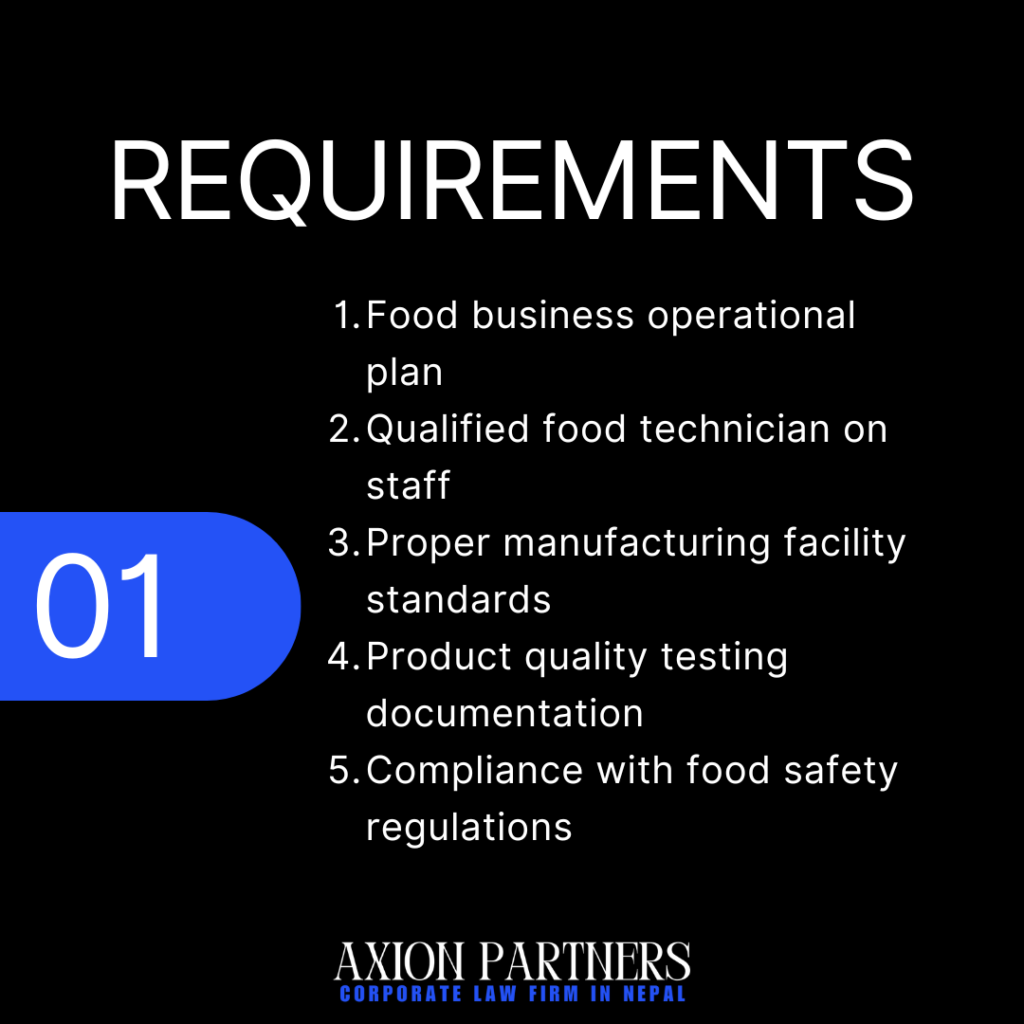
Businesses seeking a DFTQC license in Nepal in 2026 must satisfy several legal prerequisites established under Nepalese food regulation. These requirements are not optional and form the baseline eligibility criteria before any application proceeds to the documentation stage.
- Business Registration – A valid registration certificate from the Office of the Company Registrar (ocr.gov.np) or the relevant local ward office for smaller enterprises.
- PAN/VAT Registration – A tax registration certificate issued by the Inland Revenue Department (ird.gov.np).
- Industry Registration – Applicable for manufacturing units, obtained through the Department of Industry.
- Compliance with Food Standards – Products must conform to quality parameters defined by DFTQC and the Nepal Bureau of Standards and Metrology.
- Adequate Infrastructure – Business premises must have production, storage, and handling facilities that meet DFTQC-approved hygiene and safety benchmarks.
Meeting these legal requirements before submission reduces the likelihood of application rejection during the initial screening stage.
The Legal Framework: Food Hygiene and Quality Act, 2081
| Section | Subject | Key Requirements / Provisions |
|---|---|---|
| Section 8 | Pre-Establishment Recommendation (सिफारिस पत्र) | Food manufacturing, processing, packaging, and bulk storage facilities must obtain a recommendation from the DFTQC or designated office before registering the industry with the Department of Industry or Provincial Industry Office. |
| Section 9 | Mandatory Food Business License (अनुमतिपत्र) | Operating a food business without a valid license is prohibited. The licensing authority is determined by the nature and scale of operations. |
| Section 9(2)(a) | Local Level Jurisdiction | Retail, wholesale, street vending, hotels, restaurants, catering, homestays, food courts, and food outlets register with the concerned municipality or rural municipality. |
| Section 9(2)(b) | DFTQC Jurisdiction | Food production and processing industries, packaging facilities, and food import/export businesses must obtain a license from the Director General or Head of the DFTQC Office. |
| Section 10 | License Validity and Renewal | Licenses are valid for 2 years from the date of issuance. Renewal applications must be submitted at least 35 days before expiry. A 6-month grace period is available upon payment of double fees. |
| Section 13 | Import Approvals and Port Clearances | Importers must obtain advance clearance from DFTQC before shipment arrival, followed by an entry permit (प्रवेश अनुमति) at the border customs inspection point. |
| Section 19 | Mandatory Labeling Compliance | Packaged food must carry certified labels in Nepali or English, specifying the product name, ingredients, batch number, production and expiry dates, net weight, nutritional value, and manufacturer details. |
| Sections 20 and 27 | Quality Systems and Testing | Requires Good Manufacturing Practices (GMP), Good Hygiene Practices (GHP), HACCP principles, product traceability, and testing by accredited laboratories. |
| Sections 40 and 42 | Penalties for Non-Compliance | Operating without a license under Section 9 attracts fines of up to NPR 50,000. Selling contaminated or toxic food may attract imprisonment of up to 5 years and fines of up to NPR 500,000. |
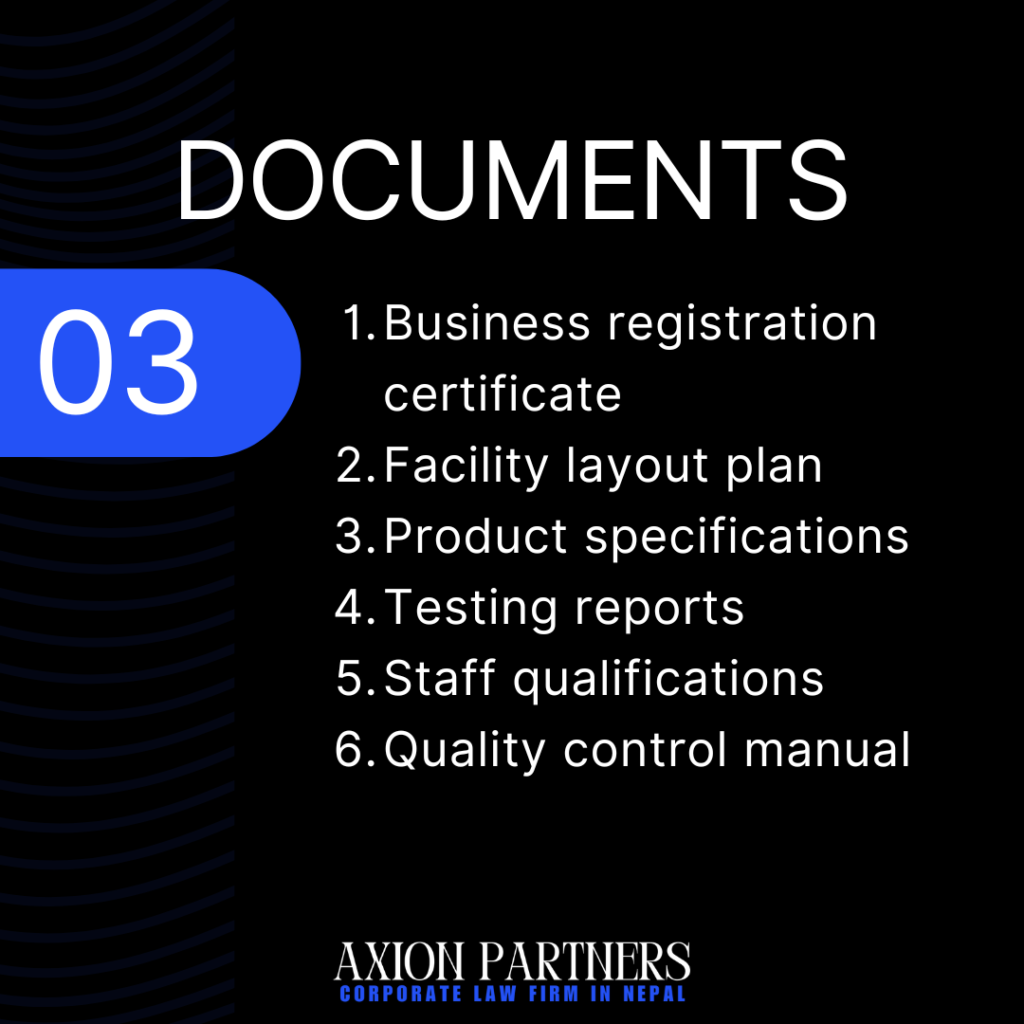
What Documents Are Required for a DFTQC License in Nepal?
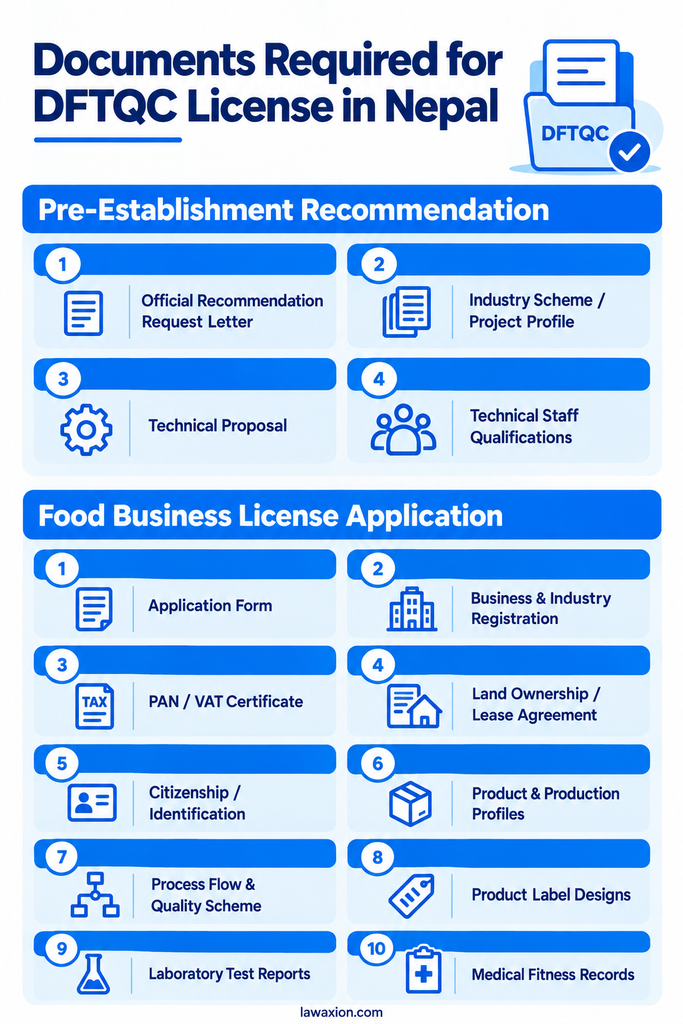
For Industry Pre-Establishment Recommendation (Under Section 8)
- Official recommendation request letter from the company/industry registration authority (e.g., Department of Industry / Office of Company Registrar).
- Industry scheme/project profile covering declared capital, scale, proposed production capacity, and machinery lists.
- Technical proposal detailing food safety, hygiene protocols, production line design, effluent/waste management, and quality control systems.
- Details and qualification certificates of technical human resources (food technologists, quality control officers, and lab technicians).
For Food Business License Application (Under Section 9)
- Application Form: Form prescribed under the Act/Rules, signed and stamped by the authorized signatory.
- Business & Industry Registration: Certificate of Incorporation (OCR), Department of Industry registration (for factories), or Ward/Municipality business registration.
- Tax Registration: Permanent Account Number (PAN) / VAT registration certificate.
- Premises Proof: Land ownership certificate (Lalpurja) or registered lease/rental agreement.
- Citizenship/Identification: Copy of citizenship certificate of the proprietor, partners, or board directors.
- Product & Production Profiles: List of food items, declared annual production/handling capacity, raw material sourcing, and detailed ingredient formulation.
- Process Flow & Quality Scheme: Comprehensive write-up on manufacturing techniques, Good Hygiene Practices (GHP), and Hazard Analysis Critical Control Points (HACCP) integration.
- Product Label Designs: Physical packaging samples or high-resolution graphic mockups satisfying Section 19 label rules.
- Laboratory Test Report: Baseline chemical, physical, and microbiological test report of finished products and source water from an accredited testing laboratory.
- Medical Fitness Records: Health check-up records of food handlers verifying absence of communicable diseases (as required by Section 20(e)).
What is the step-by-step process to obtain a DFTQC license?
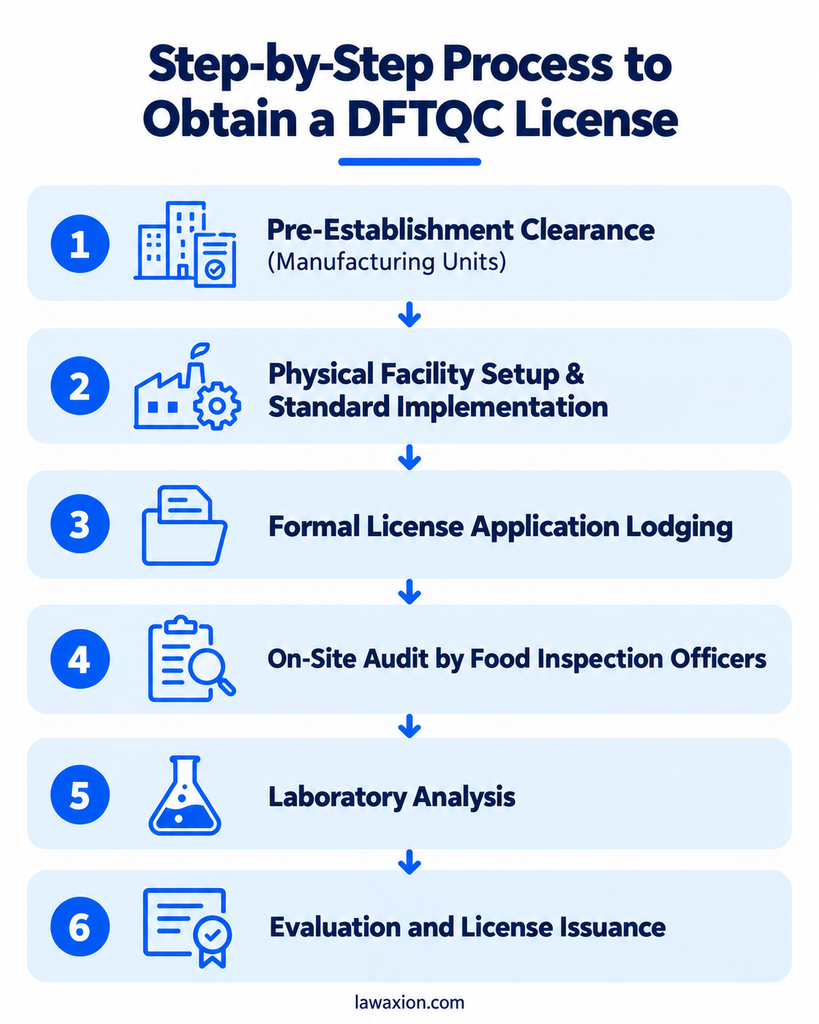
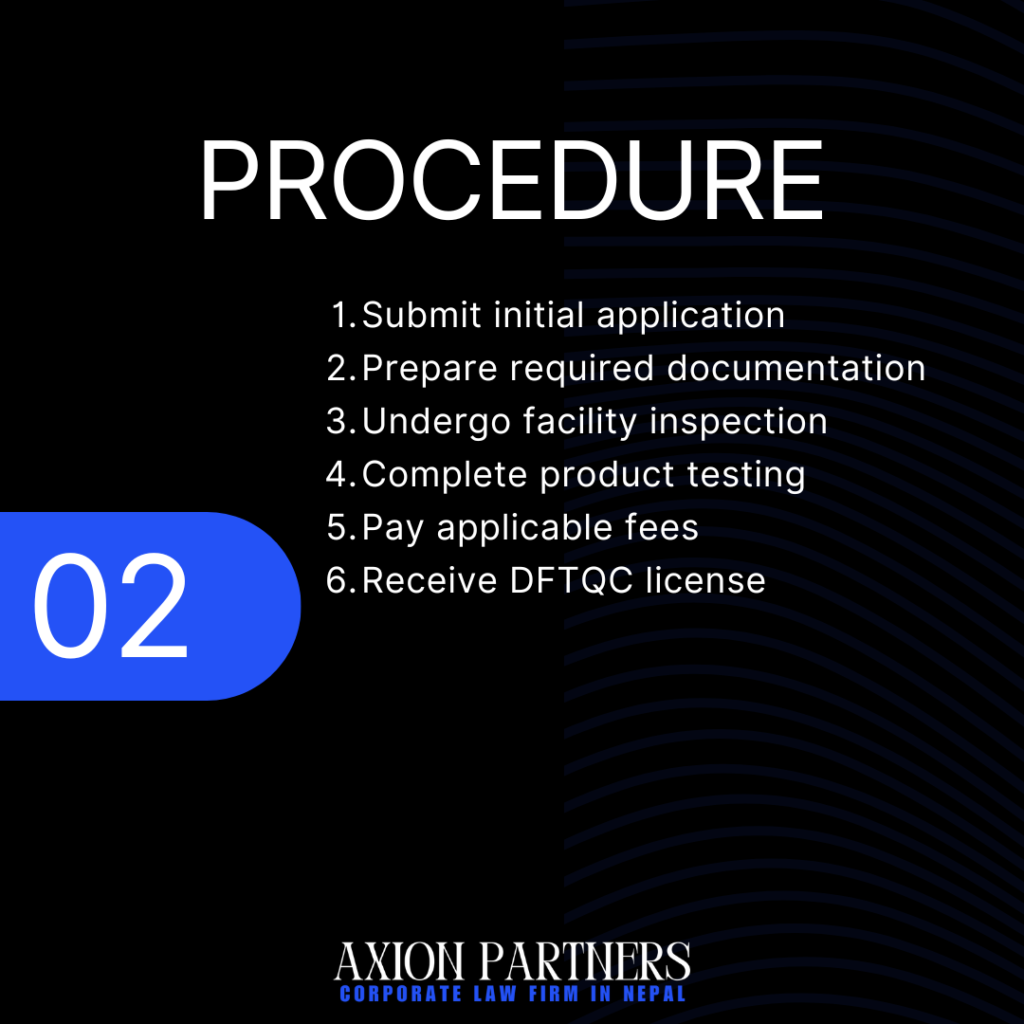
The DFTQC licensing procedure in Nepal follows a structured six-step process. Each stage must be completed sequentially, and delays at any step directly extend the overall licensing timeline.
- Pre-Establishment Clearance (Manufacturing Units)
- Physical Facility Setup & Standard Implementation
- Formal License Application Lodging
- On-Site Audit by Food Inspection Officers
- Laboratory Analysis
- Evaluation and License Issuance
Step 1: Pre-Establishment Clearance (Manufacturing Units)
Food processing and packaging enterprises submit their technical proposal and industry profile to the central DFTQC office in Babarmahal, Kathmandu, or the relevant Food Technology and Quality Control Division Office.
DFTQC verifies the site suitability and technical viability, issuing an official recommendation letter required by the Department of Industry to grant an industrial license.
Step 2: Physical Facility Setup & Standard Implementation
The enterprise develops the processing floor in accordance with standard sanitary layout requirements (pest-proof screening, washable surfaces, adequate drainage, segregated raw vs. finished goods storage, and clean water access).
Establish a documented traceability system (batch-tracking raw ingredients to final boxed shipments) as required under Section 20(h).
Step 3: Formal License Application Lodging
Submit the formal application under Section 9 to the appropriate authority:
Food industries, importers, and exporters lodge submissions directly at DFTQC Division Offices or through the online portal system.
Commercial foodservice establishments, retail stores, and local distributors apply at their municipal local ward/business administration division.
Pay the prescribed administrative screening fee through the designated government revenue portal (Rajaswa voucher).
Step 4: On-Site Audit by Food Inspection Officers
A designated Food Inspection Officer (खाद्य निरीक्षण अधिकारी) conducts a comprehensive physical inspection of the manufacturing and storage facility.
The officer audits:
- Personal hygiene of workers and PPE usage.
- Cross-contamination prevention between handling zones.
- Machinery food-grade compatibility and calibration logs.
- Potable water testing protocols and waste disposal arrangements.
The inspector draws representative finished product and processing water samples on-site, applies formal seals, and delivers them to the public food testing laboratory.
Step 5: Laboratory Analysis
The authorized public food laboratory tests the sample for conformity against mandatory parameters (microbiological counts, moisture limits, chemical additives, heavy metals, pesticide residues, and nutritional claims).
Testing takes 1 to 3 weeks depending on microbiological incubation and testing backlogs
Step 6: Evaluation, Fee Settlement, and Issuance
Upon receipt of a passing laboratory analysis report and a positive field audit report, DFTQC approves the dossier within 30 days.
The applicant deposits the final license issuance fee and receives the official Food Business License (खाद्य व्यवसाय अनुमतिपत्र), bearing the authorized scope of production, specific conditions, and a 2-year validity period.
What are the government fees for DFTQC license registration?
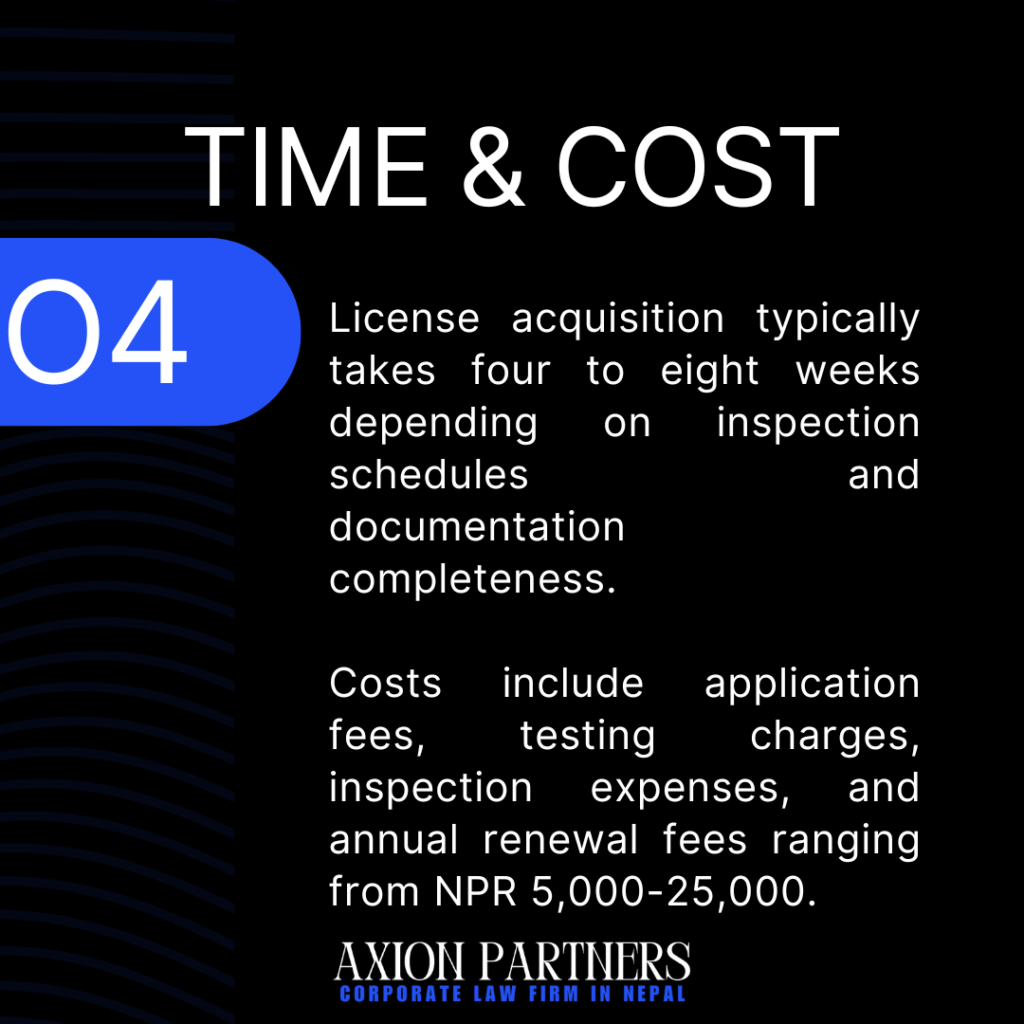
The government fee structure for obtaining a DFTQC license in Nepal in 2026 depends on the scale, category, and nature of the food business and includes separate charges for application processing, inspection, laboratory testing, and the license itself, typically ranging from a few thousand rupees for small-scale enterprises to significantly higher amounts for large manufacturing units, with renewal fees generally set lower than the initial licensing cost; applicants should confirm the exact current fee applicable to their business category by consulting the DFTQC office directly or checking the updated fee notice published on dftqc.gov.np, since fee revisions occur periodically under government notification.
What is the timeline for the DFTQC license process in 2026?
The complete DFTQC licensing timeline in Nepal depends on application completeness, inspection scheduling availability, and laboratory workload. The table below outlines the general processing duration for each stage of the DFTQC license application process in 2026.
| Process Stage | Estimated Duration |
|---|---|
| Application Submission and Initial Review | 1–2 weeks |
| Document Verification | 1–2 weeks |
| Inspection Scheduling and Execution | 2–3 weeks |
| Laboratory Testing (if required) | 1–2 weeks |
| Final Evaluation and Approval | 2–3 weeks |
| Total Estimated Timeline | 6–12 weeks |
Applicants planning business operations in 2026 should initiate the DFTQC application process well ahead of their intended launch date to accommodate potential delays in inspection scheduling or laboratory result turnaround.
What is the Regulatory Framework Governing DFTQC Compliance?
DFTQC compliance in Nepal operates under a layered regulatory framework combining domestic legislation and international reference standards.
| Regulatory Instrument | Function |
|---|---|
| Food Hygiene and Quality Act, 2081 (2024) | Replaced the outdated Food Act 2023 (1966). Acts as the primary law defining food hygiene and quality standards, mandating licensing, prohibiting adulteration, and setting penalties. |
| Food Rules 2027 (1970) | Provides step-by-step implementation guidelines for licensing, quality standards, and inspections. (Note: Transitioning to align with the new 2081 Act). |
| Food Regulation Directives | Issues category-specific processing, packaging, and labeling guidelines. |
| Nepal Standards (NS) | Product-specific quality parameters set by the Nepal Bureau of Standards and Metrology. |
| Codex Alimentarius | International reference standard considered by DFTQC for establishing domestic food safety benchmarks. |
This framework ensures that DFTQC licensing decisions in 2026 align with both domestic law and internationally recognized food safety practices.
What are the food safety requirements for DFTQC license approval?
Food safety compliance forms the core evaluation criterion during DFTQC inspections. Businesses must demonstrate the following measures before license approval:
- HACCP (Hazard Analysis and Critical Control Points) implementation for manufacturing processes
- Sanitation standards, including waste management and pest control systems
- Employee hygiene training and food handling protocols
- Temperature control systems for perishable product storage and transport
- Traceability systems tracking products from raw material sourcing to final distribution
DFTQC inspectors verify these measures on-site, and non-compliance at this stage typically results in a deferred license decision pending corrective action.
What Legal Compliance Obligations Apply After License Issuance?
DFTQC license holders in Nepal carry continuing legal obligations beyond initial approval. These obligations remain enforceable throughout the license validity period and beyond, into renewal cycles.
- Regular reporting on production volumes and quality control outcomes
- Detailed record keeping of manufacturing and traceability data
- Labeling compliance with current DFTQC formatting requirements
- Facility maintenance consistent with DFTQC-approved standards
- Ongoing staff training on food safety practices
- Prompt incident reporting for any food safety or quality issue
Non-compliance with these obligations can lead to fines, license suspension, or revocation following DFTQC inspection findings.
Which Government Bodies Are Authorized to Issue DFTQC Licenses?
Several government bodies participate in the DFTQC licensing framework in Nepal, though DFTQC itself remains the primary licensing authority.
- DFTQC Central Office, Kathmandu – primary licensing authority
- Regional DFTQC Offices – process regional applications and inspections
- Nepal Bureau of Standards and Metrology – collaborates on standard-setting
- Ministry of Agriculture and Livestock Development (moald.gov.np) – provides policy oversight
- Local Government Bodies – assist with initial verification and recommendations
Applicants may need to coordinate with multiple bodies depending on business location and product category.
What Post-Registration Compliance is Required for DFTQC License Holders?
After receiving a DFTQC license, businesses must maintain several ongoing compliance measures to retain their registration status in 2026 and beyond.
- Annual license renewal submissions with updated fees
- Periodic DFTQC inspections to verify continued compliance
- Regular product testing to confirm consistent quality
- Reporting of any significant changes in production processes or facilities
- Compliance with newly introduced food safety regulations issued by DFTQC
What Laboratory Testing Requirements Apply to DFTQC License Holders?
Laboratory testing remains a continuing requirement, not a one-time formality, for DFTQC license holders in Nepal.
- Initial product testing before license issuance
- Periodic quality checks throughout the license validity period
- Microbiological analysis for pathogen detection
- Chemical analysis for contaminants and nutritional composition
- Shelf-life studies for perishable product categories
DFTQC accepts results from its own laboratories along with select accredited private laboratories, and businesses should budget both time and cost for recurring testing cycles.
What is the product registration process under the DFTQC license?
Beyond the general business license, individual food products often require separate registration with DFTQC.
- Application submission for each individual product
- Detailed product information covering ingredients and manufacturing process
- Label submission for DFTQC review and approval
- Product sample submission for laboratory testing
- Payment of applicable product registration fees
Product registration certificates carry their own validity period and require periodic renewal, separate from the renewal cycle for the general business license.
What Annual Compliance Steps Must DFTQC License Holders Follow?
Annual compliance keeps a DFTQC license active and prevents lapses that could disrupt business operations.
- Timely license renewal application and fee payment before expiry
- Submission of annual production and quality control reports
- Participation in annual compliance audits conducted by DFTQC inspectors
- Submission of updated certificates, such as renewed business registration
- Maintenance of staff training records for food safety practices
Frequently Asked Questions
What products require a DFTQC license?
All food and beverage products manufactured, processed, packaged, or imported in Nepal require DFTQC registration, including packaged foods, dairy, meat products, beverages, and food additives. Even small-scale and home-based food producers need DFTQC approval before commercial sale.
How long is a DFTQC license valid?
A DFTQC license remains valid for one year from the date of issuance. License holders must apply for renewal annually, ideally starting the renewal process at least 35 days before expiry to avoid operational disruption.
What happens during DFTQC inspections?
DFTQC inspectors visit business premises to assess production facilities, storage conditions, hygiene practices, and documentation accuracy. Post-license, DFTQC may conduct surprise inspections to confirm continued compliance with food safety regulations.
Can a DFTQC license be transferred?
DFTQC licenses remain non-transferable since they are issued based on specific business operations and facilities. Ownership changes or major structural modifications typically require a fresh license application rather than a transfer of the existing one.
What does DFTQC license renewal require?
Renewal requires submitting a renewal application, paying the applicable fee, and providing updated documentation, including recent laboratory reports. DFTQC may conduct a renewal inspection before approving the license extension for continued validity.
Is laboratory testing mandatory for DFTQC licensing?
Yes, laboratory testing remains mandatory both at the initial application stage and periodically thereafter. Testing frequency depends on product risk category, covering microbiological safety, chemical composition, and nutritional accuracy verification.
What is the role of DFTQC in Nepal’s food sector?
DFTQC regulates food safety, hygiene, and quality standards across Nepal, issuing licenses, conducting inspections, and enforcing the Food Act to protect public health. It operates under the Ministry of Agriculture and Livestock Development.
Conclusion
Obtaining a DFTQC license in Nepal in 2026 requires businesses to follow a defined sequence of legal, documentary, and procedural steps established under the Food Act 2023 (1966) and Food Rules 2027 (1970). From initial document preparation through inspection, laboratory testing, and final approval, each stage carries specific requirements that determine whether a food business can legally operate within Nepal’s regulatory framework. Businesses that maintain accurate documentation, comply with food safety standards, and fulfill ongoing post-registration obligations position themselves for smoother license approval and renewal cycles. For updated fee schedules, application forms, and regulatory notices applicable in 2026, applicants should consult the official DFTQC portal at dftqc.gov.np or the Ministry of Agriculture and Livestock Development at moald.gov.np directly.