
Hospital registration in Nepal is very important part of this sector to establish a hospital including 25 bed Hospital in Nepal, requirements for 100 bed hospital and 50 bed hospital in Nepal. If you are thinking to establish a hospital with 25-100 beds, you must know the process of hospital registration process in Nepal including rules and regulations to be complied in Nepal. The registration is a way of saying, your hospital has the facilities, tools, manpower and patient practice in accordance with what the Ministry of Health and Population(MoHP) decides it should have.
The initiative is guided by the Nepal Health Sector Strategy 2015–2020 and The Public Health Service Act, 2075 (2018). The law has been designed to protect the Nepali public and medical facilities by offering them quality care; however, it works for both private hospital registration in Nepal as well as public health institutions.
This guide covers everything you need to know about the hospital registration process in Nepal, along with the medical company registration process in Kathmandu Nepal, guidelines for health institution establishment, operation, and upgrade, including polyclinic registration process in Nepal where applicable.

Legal Framework for 25-100 Bed Hospital Establishment
The legal foundation for establishing a hospital in Nepal covering 25 – 100 bed hospital requirements in Nepal is rooted in several key pieces of legislation:
- The Public Health Service Act, 2075 (2018)
- Nepal’s Health Professional Council Act, 2053 (1997)
- Nepal’s Medical Council Act, 2020 (1964)
- The Hospital Operation and Management Guidelines, 2069 (2013)
The laws together form the regulatory guidelines for operation of hospital in Nepal including private hospital registration in Kathmandu or any other provinces. Adherence to these legal articles are compulsory, and the hospital registration certificate in Nepal is granted based on these principles.
Legal Considerations
- Health Act-2075(2018) that, all health care institutions should be registered with MoHP as per the policy of hospital registration process in Kathmandu and throughout other parts in Nepal.
- The practice of medicine and the qualification of medical practitioners are regulated by the Nepal Medical Council Act.
- Hospital Operation Management Guidelines (HOMG) 29, The standards are specific requirements for different types of hospitals in terms of bed capacity and level of care..
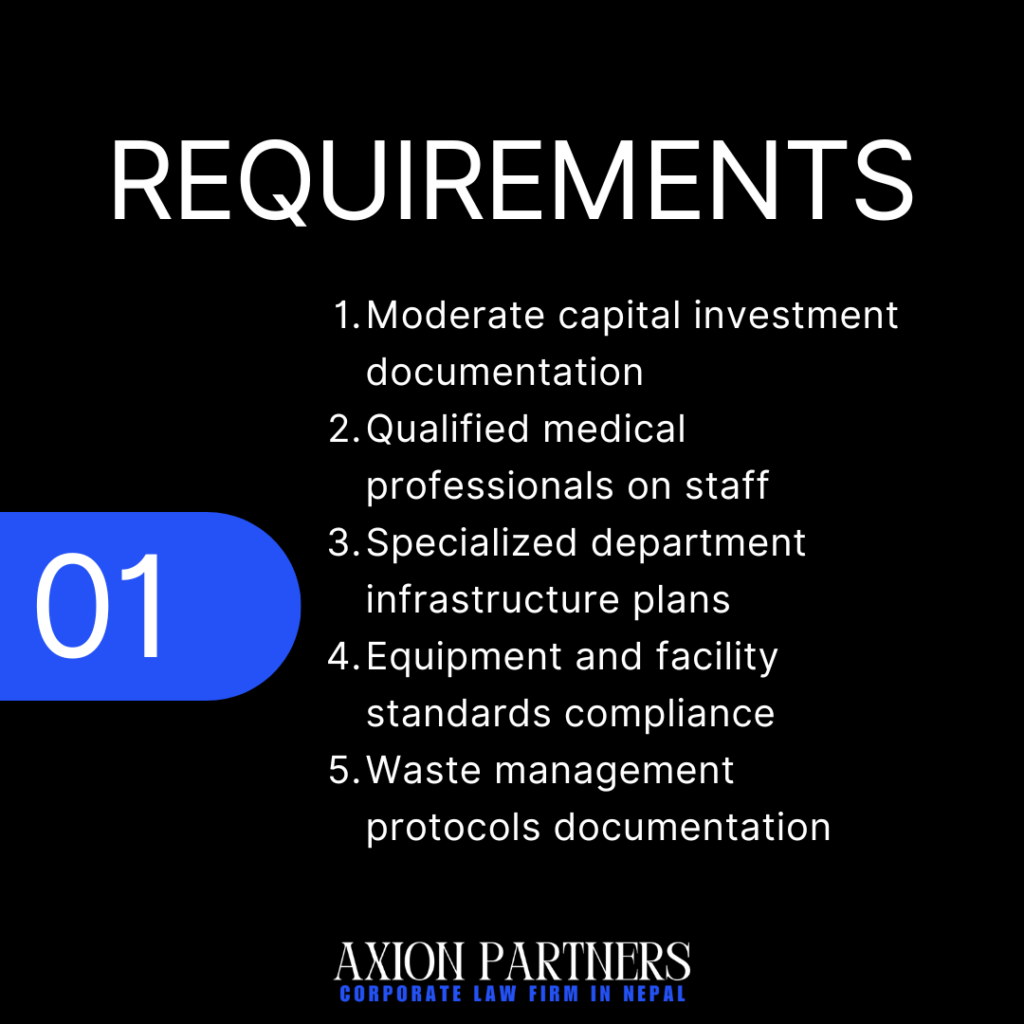
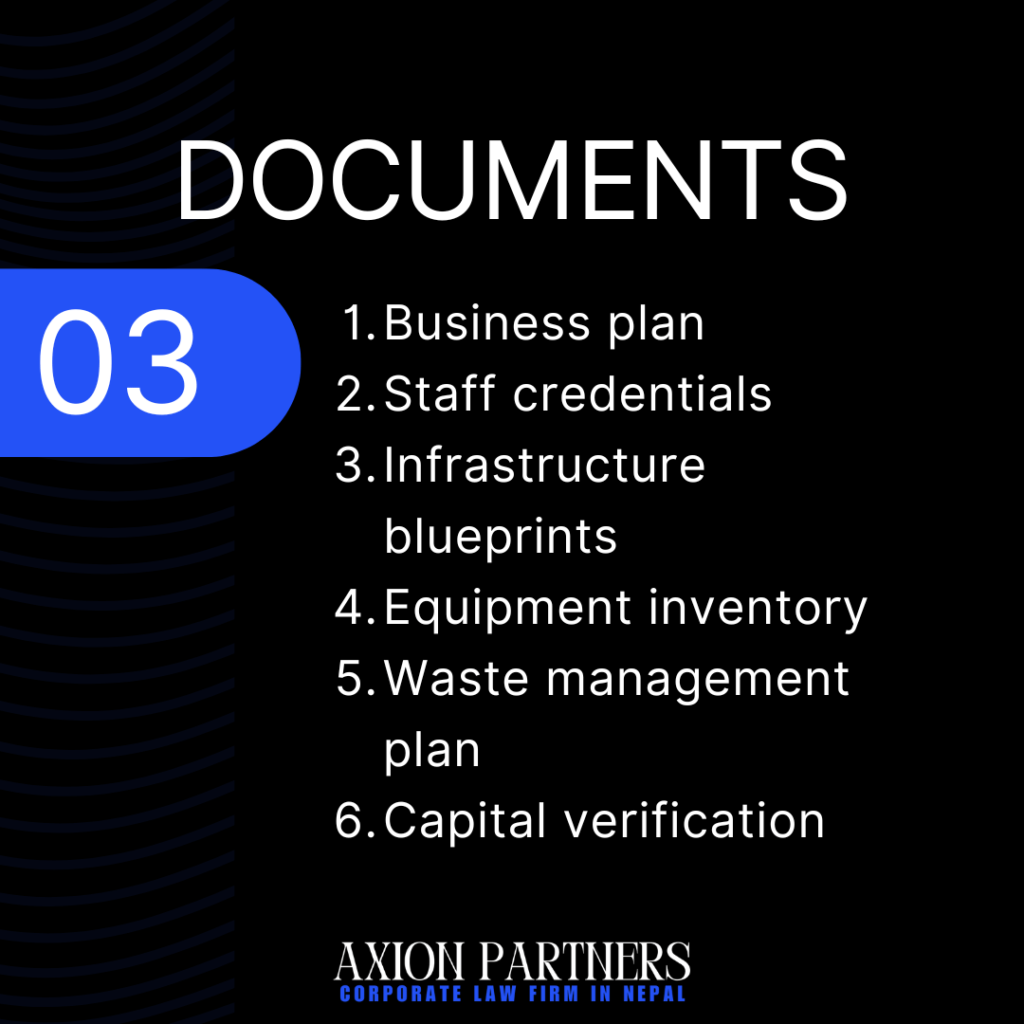
Documents Required for Hospital Registration Process in Nepal
- Completed application form prescribed by the MoHP
- Detailed project proposal including:
- Hospital vision and mission statement
- Organizational structure and management plan
- Services to be offered and bed distribution plan
- Human resource plan detailing staffing at all levels
- Architectural blueprints and building plans approved by local authorities
- Environmental Impact Assessment (EIA) report
- Fire safety clearance from the local fire department
- Proof of capital investment and financial viability
- List of medical equipment with specifications
- Curriculum vitae of key medical and administrative staff
- Copies of academic and professional certificates of medical personnel
- Memorandum and Articles of Association (for private limited companies)
Here, is the ensuring all documentation that is complete and accurate is vital to avoid delays in the private hospital registration in Nepal.
Large Hospital Registration Process with Health Ministry in Nepal
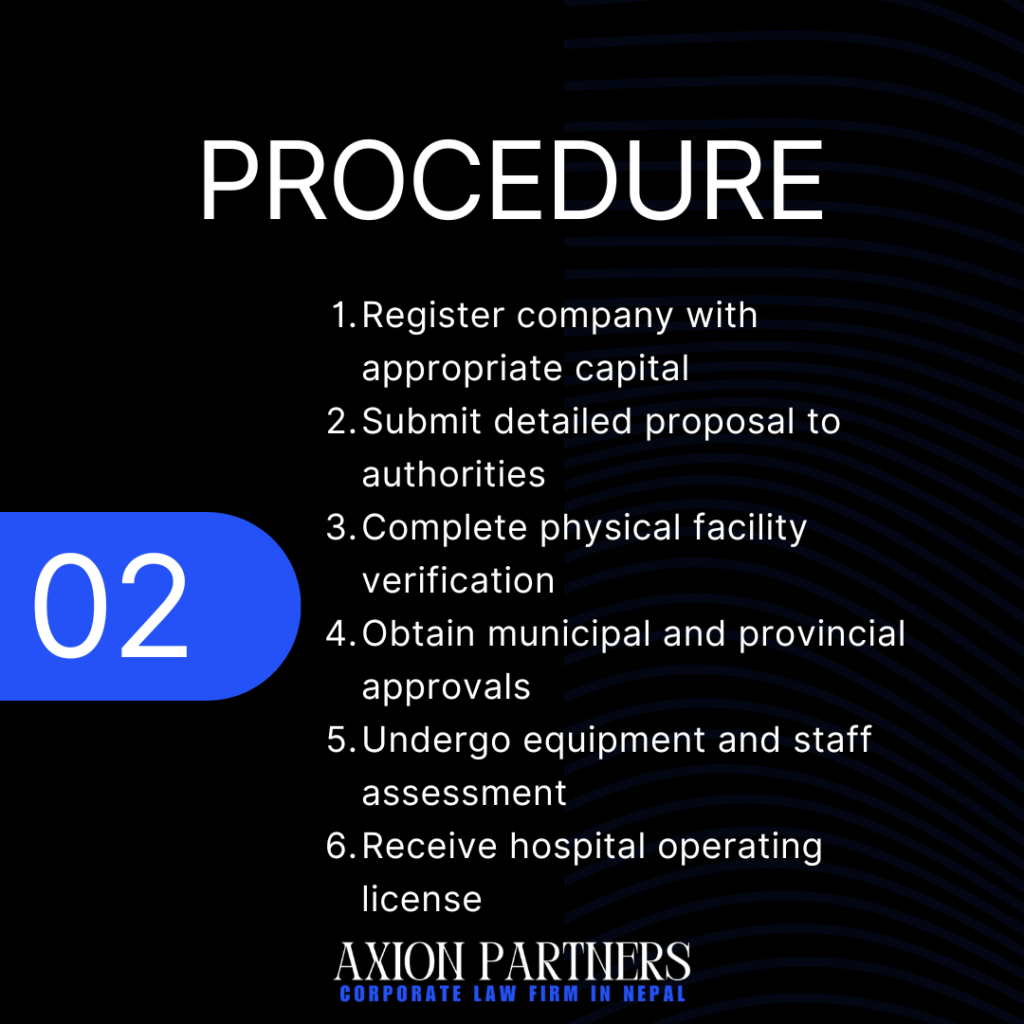
The registration process for a 25-100 bedded hospital requirements in Nepal follows a structured pathway:
- Pre-application consultation: Schedule a meeting with the MoHP to discuss the project and understand specific requirements.
- Document preparation: Compile all necessary documents as outlined in the previous section.
- Application submission: Submit the completed application form along with all required documents to the MoHP.
- Initial review: The MoHP conducts a preliminary review of the application to ensure completeness.
- Site inspection: A team from the MoHP visits the proposed hospital site to verify infrastructure and equipment.
- Technical committee evaluation: A specialized committee assesses the technical aspects of the proposal.
- Approval and registration: Upon satisfactory evaluation, the MoHP issues a registration certificate.
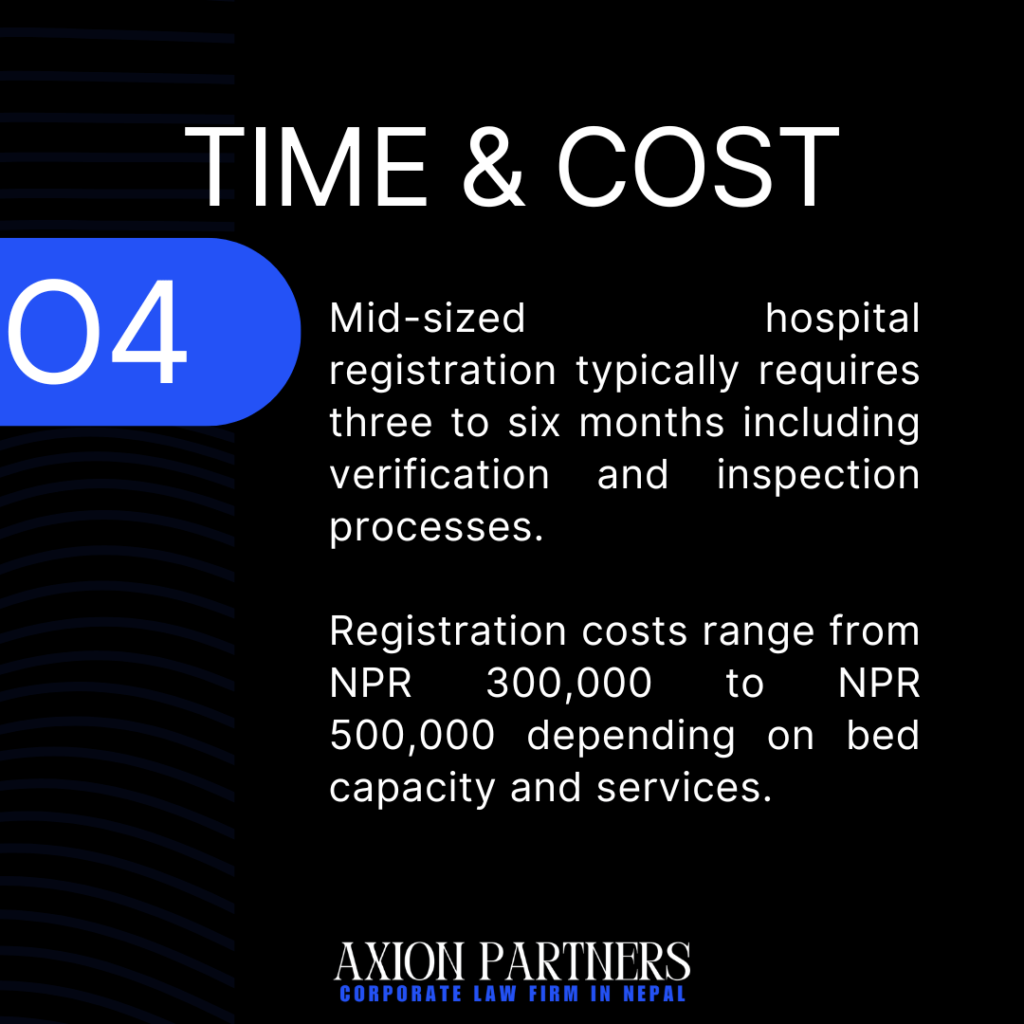
This process typically takes 3–6 months depending on the complexity of the hospital and whether the application relates to the hospital registration process in Kathmandu or other regions.
Infrastructure Requirements for Medical Facilities
The infrastructure requirements for a 25-100 bedded hospital requirements in Kathmandu Nepal are stringent and designed to ensure patient safety and quality care. The MoHP has set forth detailed specifications that must be met:
Building and Space Requirements
- Minimum land area of 1 ropani (5476 sq. ft.) per 25 beds
- Separate wards for male and female patients
- Isolation rooms for infectious disease cases
- Dedicated spaces for outpatient departments (OPD), emergency services, and diagnostic facilities
- Proper ventilation and natural lighting in all patient areas
- Accessibility features for differently-abled individuals
Utility and Support Services
- Reliable electricity supply with backup generators
- Clean water supply and proper sewage disposal systems
- Waste management facilities compliant with environmental regulations
- Fire safety equipment and emergency exits
Meeting these infrastructure requirements is essential for obtaining registration approval from the MoHP.
Requirements for Large Hospital Registration
The technical aspects of public or private hospital registration in Kathmandu, Nepal, involves ensuring that the facility is equipped to provides the level of care commensurate with its bed capacity. For a 25-100 bed hospital in Kathmandu Nepal, The following technical requirements must be met:
Medical Equipment Standards
- The Advanced life support equipment in emergency and intensive care units
- The Diagnostic imaging facilities including X-ray and ultrasound machines
- The Laboratory equipments for routine and specialized testing
- The Sterilization and disinfection equipment
Information Technology Infrastructure
- Hospital management information system (HMIS)
- Electronic medical records (EMR) system
- Telemedicine capabilities (recommended but not mandatory)
Quality Control Measures
- An Established protocols for infection control
- For Quality assurance mechanisms for all medical procedures
- Provide Regular equipment maintenance and calibration schedules
To complaince with these technical requirements is crucial during the registration inspection process.
Financial Requirements and Capital Structure Details
To establish a 25-100 bed hospital in Nepal then it requires significant financial investment. The MoHP sets a minimum capital requirements based on bed capacity, keeping in view the existing healthcare landscape and shows how many hospitals are there in Nepal, along with regulatory benchmarks such as the 15 bedded hospital requirements in Nepal.
- For 25-50 beds: NPR 50 million (approximately USD 420,000)
- For 51-100 beds: NPR 100 million (approximately USD 840,000)
Capital Structure Considerations
- Equity to debt ratio should be at least 30:70
- Proof of capital adequacy must be provided through bank statements or commitment letters
- A detailed financial projection for the first five years of operation is required
It’s important to note that these are minimum requirements and actual costs may be significantly higher depending on the scope and quality of services offered.
Online Company Registration in Nepal
Human Resource Requirements for Hospital Registration
Every staff at a 25-100 bed hospital in Nepal requires a diverse team of healthcare professionals. The MoHP mandates specific staffs ratios:
Medical Staff
- One doctor per 4 beds
- One nurse per 3 beds in general wards
- One nurse per bed in intensive care units
Specialist Requirements
- At least one specialist each in Medicine, Surgery, Gynecology/Obstetrics, and Pediatrics
- Anesthesiologist for hospitals offering surgical services
- Radiologist for hospitals with imaging facilities
Support Staff
- Pharmacists, laboratory technicians, and radiographers as per service offerings
- Administrative and maintenance personnel
Ensuring adequate staffing levels and qualifications is crucial for registration approval and ongoing compliance.
Equipment and Medical Facility Standards
The equipment standards either for 100 bed or 25 bedded hospital requirements in Nepal are designed to ensure comprehensive patient care:
Essential Equipment
- Emergency room equipment including defibrillators and ventilators
- Operating theater equipment for hospitals offering surgical services
- Intensive care unit equipment including monitors and life support systems
- Laboratory equipment for routine and specialized tests
- Imaging equipment such as X-ray and ultrasound machines
Facility Standards
- Dedicated areas for outpatient services, emergency care, and inpatient wards
- Properly equipped pharmacy and medical stores
- Central sterilization and supply department (CSSD)
- Kitchen facilities for patient meal preparation
Meeting these equipment and facility standards is essential for registration approval and ensuring quality patient care.
Environmental and Safety Compliance Measures
Environmental and safety compliance is a critical aspect of hospital registration in Nepal:
Environmental Considerations
- Proper medical waste management system
- Effluent treatment plant for hospitals with more than 50 beds
- Compliance with national environmental standards
Safety Measures
- Fire safety equipment including alarms, extinguishers, and sprinkler systems
- Emergency evacuation plans and regular drills
- Occupational health and safety protocols for staff
Demonstrating robust environmental and safety measures is crucial for obtaining and maintaining hospital registration.
Read More
Energy Generation License Process in Nepal
Quality Assurance and Medical Standards
Quality assurance in healthcare delivery is paramount for hospital registration and operation in Nepal:
Quality Management Systems
- Implementation of a comprehensive quality management system
- Regular internal audits and performance reviews
- Patient feedback mechanisms and complaint resolution processes
Medical Standards
- Adherence to national treatment guidelines
- Continuous medical education programs for staff
- Participation in national health programs and initiatives
Maintaining high quality and medical standards is essential for registration renewal and building trust with patients and regulatory bodies.
Registration Fees and Government Charges
The registration process for a 25 , 100, or also 50 bedded hospital requirements in Nepal involves various fees and charges:
- Initial registration fee: NPR 50,000 (approximately USD 420)
- Annual renewal fee: NPR 25,000 (approximately USD 210)
- Inspection fees: Variable, based on hospital size and location
Additional charges may apply for specific licenses and permits required for hospital operation. Hospitals must also ensure compliance with the 15 bed hospital guidelines where applicable to avoid regulatory issues and ensure smooth approval.
Timeline for Hospital Registration Completion
The timeline for completing the hospital registration process in Nepal can vary:
- Pre-application preparation: 2-3 months
- Application submission and initial review: 1 month
- Site inspection and technical evaluation: 1-2 months
- Final approval and registration issuance: 1 month
Total estimated timeline: 5-7 months
Factors affecting the timeline include the completeness of the application, responsiveness to MoHP queries, and the current workload of the regulatory bodies.
What to do after Hospital Registration in Nepal?
Hospital registration in Nepal is a mandatory legal process that ensures healthcare institutions operate under approved standards set by the government. From meeting infrastructure requirements to complying with regulatory guidelines, understanding the hospital registration process in Nepal is essential for establishing and running a hospital lawfully and efficiently.
- Annual renewal of registration certificate
- Regular reporting to the MoHP on key performance indicators
- Compliance with evolving healthcare regulations and standards
- Participation in national health programs and initiatives
Obtaining hospital registration is only the beginning of regulatory responsibility in Nepal. Maintaining post-registration compliance is crucial for uninterrupted hospital operations and avoiding penalties. Continuous adherence to licensing conditions, reporting obligations, and proper waste handling practices is essential in line with the national health care waste management guidelines nepal.
Renewal and Monitoring Procedures
The MoHP conducts regular monitoring of registered hospitals:
- Annual inspections to verify continued compliance with standards
- Review of patient care quality and safety measures
- Assessment of financial stability and operational efficiency
For renewal of registration is contingent upon satisfactory performance in these monitoring procedures.
What is the minimum capital requirement for 25-100 bed hospitals?
The minimum capital for hospital registration process in Nepal with 25-100 beds it invest a minimum of 50 million rupees for hospitals with a 25-50 bed capacity and a minimum of 100 million rupees for hospitals with 51-100 bed capacity.
How long does the Hospital registration process in Nepal take?
The hospital registration process in Nepal takes place once an applicant submits an application for registration and the registration process generally takes between five and seven months to be approved.
Can foreign investors own hospitals in Nepal?
Yes, Foreign investors may own and operates hospitals in Nepal if they comply with the Foreign Investment Regulations (FIR) of the Investment Board of Nepal.
How does hospital registration work in Nepal?
A Hospital registrations in Nepal is a legal process overseen by the Ministry of Health and Population (MoHP). It ensures that hospitals meet the required standards for infrastructure, staff, equipment, and patient care. The Process: Submission of Documents, Meeting Health Regulations, Passing Inspections, and Compliance with better Health Services in Nepal.
What are the requirements for opening a clinic in Nepal?
The Requirements for opening a clinics in Nepal are:
A proper location with adequate space.
Qualified medical staff (doctors, nurses, etc.).
Necessary medical equipment and facilities.
Registration with the Ministry of Health and Population.
Compliance with local health and safety regulations.
Submission of required documentation and payment of fees.
How do you become a hospital registration person?
To become a hospital registration person in Nepal, you typically need to work within the Ministry of Health and Population or a related health regulatory body.
What are the requirements for a 25-bedded hospital in Nepal?
In order to establish a 25 bedded Hospital in Nepal, the criteria include:
A facility that possesses appropriate infrastructure (ward rooms, emergency services, surgical theatre).
Qualified healthcare professionals (physicians, Nurses, ancillary staff) who may work.
Comply with national standards of care and regulations about patient treatment.
Maintain appropriate medical equipment/supplies.
Register with the Ministry of Health and Population.
Obtain all required legal documentation/ Licenses.
Nepal Hospital Registration By Axion Partners
This guide helps you understand the 25–100 bed hospital in Nepal setup, covering the essential legal, technical, and regulatory steps required for smooth approval under the hospital registration process in Nepal. With expert support from Axion Partners, proper planning and full compliance with government standards are ensured for successfully establishing a hospital in Nepal.
With clear guidance on 100 bed hospital requirements in Nepal and the overall hospital registration, this information supports healthcare investors and providers in meeting Ministry of Health and Population regulations while ensuring quality, compliant healthcare services across Nepal, hospital registration in Nepal.